



Virginia Rent-to-Own Agreement Overview
Virginia regulates rent-to-own transactions through a combination of the Virginia Residential Property Disclosure Act (Va. Code § 55.1-700 et seq.), the Virginia Residential Landlord and Tenant Act (VRLTA, Va. Code § 55.1-1200 et seq.), and general contract law. While Virginia does not have a single comprehensive rent-to-own statute like Texas, the overlapping disclosure and tenant protection requirements create a substantial regulatory framework.
The Northern Virginia housing market — Fairfax County, Arlington, Alexandria, and Prince William County — is one of the most expensive in the nation, making rent-to-own an attractive alternative for buyers priced out of traditional purchases. The Hampton Roads area, Richmond metro, and Charlottesville also have active rent-to-own markets. Virginia's requirement that real estate closings be supervised by a licensed attorney adds a layer of professional oversight to the final purchase.
Virginia is a judicial foreclosure state for most residential properties, which provides some protection for tenant-buyers if the seller's lender forecloses. However, some Virginia deeds of trust include power of sale clauses that allow non-judicial foreclosure. The tenant-buyer should verify the seller's mortgage status and type before entering into a rent-to-own agreement.
Partial
Specific RTO Statute
2-5%
Option Fee Range
Optional
Rent Credits
Recommended
Recording Option
Virginia Rent-to-Own Laws & Regulations
Virginia's regulatory framework combines property disclosure requirements, tenant protections, and recording rules.
- Property Disclosure Act (Va. Code § 55.1-700 et seq.): The seller must provide a residential property disclosure statement or disclaimer before the agreement is signed. The disclosure covers structural defects, environmental hazards, flood zone status, and material conditions. Virginia allows the seller to choose between a detailed disclosure or general disclaimer, but the disclaimer does not relieve liability for fraud.
- VRLTA (Va. Code § 55.1-1200 et seq.): Governs the lease portion. Limits security deposits to two months' rent, mandates return within 45 days, requires landlords to maintain habitable premises, and establishes eviction procedures including 5-day pay or quit for non-payment and 21-30 day notices for other violations.
- Recording Statutes (Va. Code § 55.1-600 et seq.): Virginia follows a race-notice recording system. Recording with the clerk of the circuit court provides constructive notice. The state imposes a deed recordation tax and a grantor tax at transfer.
- Attorney Requirement: Virginia requires a licensed attorney to supervise real estate settlements. When the tenant-buyer exercises the option, the closing must be conducted by or under the supervision of a Virginia-licensed attorney.
- HOA/Condo Disclosures (Va. Code § 55.1-1800 et seq.): If the property is in a common interest community, the seller must provide comprehensive HOA/condo disclosures including the declaration, bylaws, budget, reserve study, and pending assessments or litigation.
Virginia Attorney Requirement at Closing
Virginia law requires a licensed attorney to supervise real estate closings. When you exercise your purchase option, a Virginia attorney must review the title, prepare the deed, and oversee the settlement. Budget for attorney fees (typically $500-$1,500 for a residential closing) and select an attorney early in the process to avoid delays when the option period expires.
How Rent-to-Own Works in Virginia
Virginia rent-to-own transactions must navigate both the VRLTA (for the lease) and property disclosure requirements (for the purchase).
Obtain Property Disclosures
The seller provides the Virginia Residential Property Disclosure (or disclaimer), lead paint disclosure for pre-1978 homes, and any HOA/condo disclosures. The buyer should obtain an independent home inspection
Execute the Rent-to-Own Agreement
The written agreement must comply with Virginia's Statute of Frauds and VRLTA requirements for the lease component. Include the purchase price, option fee, rent credit terms, option period, and maintenance responsibilities
Record the Option with the Circuit Court Clerk
Record a memorandum of option with the clerk of the circuit court in the jurisdiction where the property is located. Virginia's recording tax may apply. Recording protects against subsequent purchasers and lienholders
VRLTA-Governed Lease Period
During the lease term, VRLTA protections apply. Security deposit is capped at two months' rent and must be held in a separate account. Rent credits accumulate per the agreement terms
Attorney-Supervised Closing
The buyer exercises the option, secures financing, and closes through a Virginia-licensed attorney. The attorney reviews title, prepares the deed, and oversees settlement. State deed recordation tax and grantor tax apply
Key Virginia Rent-to-Own Agreement Terms
Virginia law imposes specific requirements through the VRLTA and property disclosure statutes that must be reflected in the agreement.
| Term | Virginia Details |
|---|---|
| Option Fee | Typically 2-5%. Northern Virginia fees tend higher due to property values. Credited at closing |
| Purchase Price | Typically locked at signing. In hot NoVA markets, some agreements use an appraisal-based formula |
| Option Period | Usually 1-3 years. Include sufficient time for the attorney-supervised closing process |
| Rent Credits | Optional but common. Typically 10-25% of monthly rent. Clearly document accumulation and forfeiture terms |
| Security Deposit | Capped at 2 months' rent under VRLTA. Must be returned within 45 days. Separate from option fee |
| Maintenance | Landlord must maintain habitability per VRLTA. Additional duties can be allocated by agreement |
| Closing Costs | Budget for attorney fees ($500-$1,500), deed recordation tax ($0.25/$100), and grantor tax ($0.50/$100 for most localities) |
Virginia Consumer Protections for Tenant-Buyers
Virginia provides meaningful protections through the VRLTA and property disclosure requirements.
VRLTA Tenant Protections
The VRLTA provides comprehensive protections during the lease period: implied warranty of habitability, limitations on security deposits, required notice before entry, prohibition on retaliatory eviction, and tenant remedies for landlord violations including rent abatement and lease termination for material noncompliance.
Mandatory Property Disclosures
Virginia's Property Disclosure Act ensures the tenant-buyer receives information about the property's condition before committing. While the seller may choose a disclaimer instead of a full disclosure, the tenant-buyer can negotiate for a complete disclosure as a condition of the agreement.
Attorney-Supervised Closing
Virginia's requirement that a licensed attorney supervise real estate closings provides an additional layer of protection. The attorney reviews the title, identifies any encumbrances, ensures proper documentation, and protects the buyer's interests during the settlement process.
Virginia Consumer Protection Act
The Virginia Consumer Protection Act (Va. Code § 59.1-196 et seq.) prohibits deceptive and unconscionable practices in consumer transactions. Predatory rent-to-own schemes can be challenged under this Act. The Virginia Attorney General's office enforces consumer protection laws.
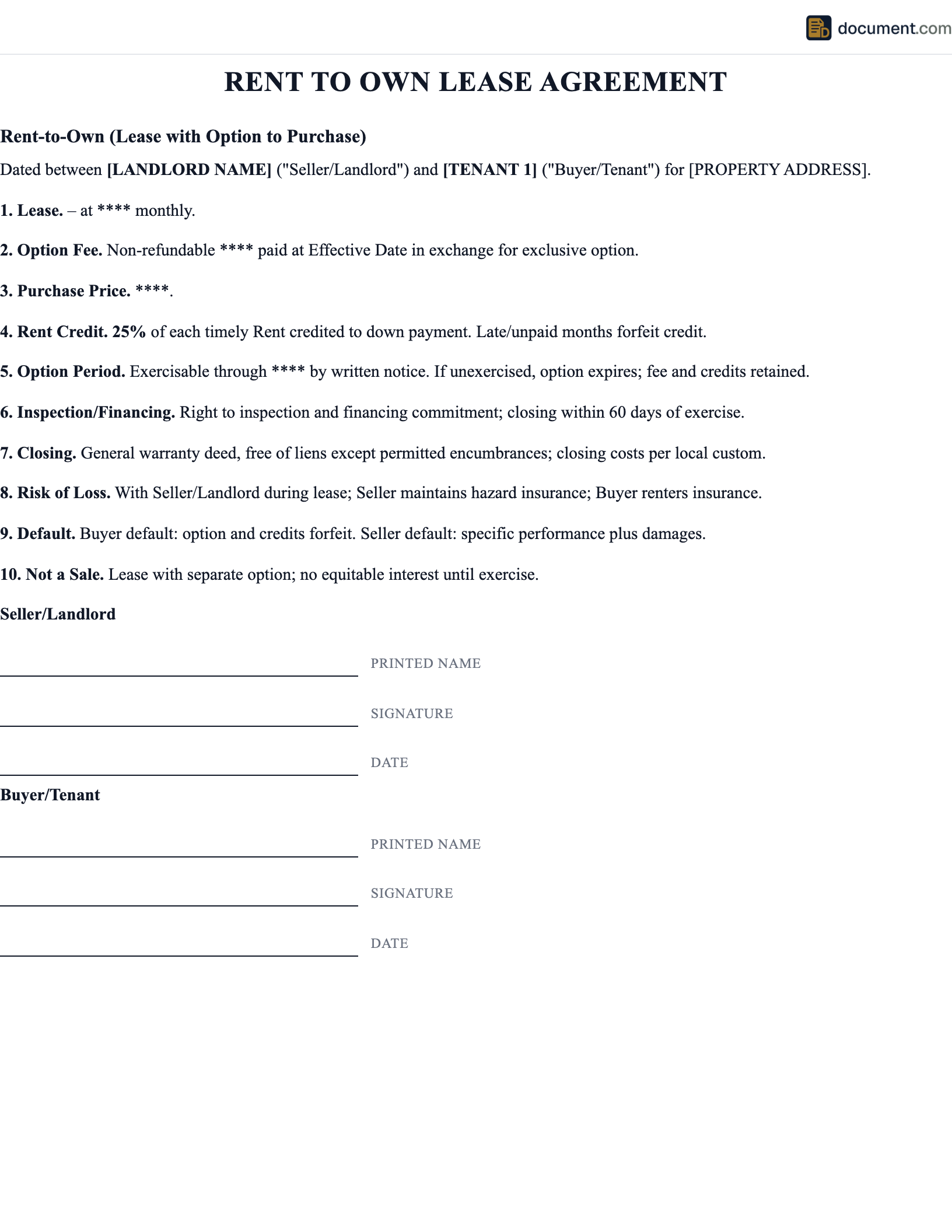
Sample Virginia Rent-to-Own Agreement
Below is a preview of our Virginia-compliant agreement.
COMMONWEALTH OF VIRGINIA
RESIDENTIAL LEASE WITH OPTION TO PURCHASE
VRLTA Compliant — Attorney-Supervised Closing Required
PROPERTY OWNER / OPTIONOR:
Name: [Owner Name]
Address: [Virginia Address]
TENANT-BUYER / OPTIONEE:
Name: [Tenant Name]
Address: [Current Address]
PROPERTY & TERMS
Property: [Virginia Property Address]
Option Fee: $[Amount] Purchase Price: $[Amount]
Monthly Rent: $[Amount] Rent Credit: [%]%
Virginia Rent-to-Own FAQ
Answers about Virginia's VRLTA protections, property disclosure requirements, attorney-supervised closings, and recording procedures.
Official Virginia Resources
Virginia government and legal resources for rent-to-own transactions.
Virginia Attorney General — Consumer Protection
File complaints and access consumer resources
Virginia Real Estate Board
State regulatory body for real estate transactions
Virginia Legal Aid
Free legal resources for Virginia residents
HUD — Virginia Housing Resources
Federal housing counseling and homebuyer education
Create your Virginia Rent To Own Lease Agreement in under 5 minutes.
Answer a few questions and download a Virginia-compliant document, ready for the state agency.