



North Carolina Commercial Sublease Agreement Overview
A commercial sublease in North Carolina arises when an existing tenant (the sublessor) rents all or part of its leased commercial space to a third party (the subtenant) for a period within the remaining prime lease term. The sublessor stays on the prime lease and remains fully responsible to the landlord, while the subtenant occupies the space and pays rent to the sublessor. North Carolina has no commercial subletting statute, so the entire arrangement is governed by the prime lease terms and the negotiated sublease agreement.
North Carolina's commercial sublease market is most active in Charlotte's office and industrial corridors, the Research Triangle's tech and life sciences campuses, and the Triad's industrial and logistics properties. Companies downsizing from larger footprints, relocating to different markets, or exiting the state often sublease their remaining lease obligations, creating opportunities for subtenants to access quality space at competitive economics.
The absence of privity between the subtenant and the landlord is the defining legal feature of any commercial sublease. The subtenant's right to occupy depends entirely on the sublessor's prime lease remaining in effect. If the sublessor defaults or the prime lease terminates for any reason, the subtenant faces displacement unless a separate non-disturbance agreement has been negotiated with the building landlord.
Per lease
Subletting default
Yes
Consent required
Yes
Tenant remains liable
2 months'
Deposit rules
North Carolina Commercial Sublease Requirements
North Carolina commercial subleases are governed entirely by the prime lease terms and the contract law principles that apply to commercial agreements. There are no statutory protections for commercial subtenants; everything depends on what is negotiated and documented in writing.
No Privity Between Subtenant and Landlord in North Carolina
In a North Carolina commercial sublease, the subtenant has no direct contractual relationship with the landlord. The sublessor remains liable on the prime lease, and the landlord's obligations run only to the sublessor. If the sublessor defaults and the prime lease is terminated, the subtenant has no right to remain in possession unless the landlord has separately agreed to a non-disturbance and attornment arrangement. This is the fundamental legal risk of any commercial subtenancy in North Carolina.
Sublessor Obligations
- Review Prime Lease: Confirm the prime lease permits subletting and identify any consent conditions, profit rent clauses, or recapture rights before marketing the space or negotiating with a subtenant
- Obtain Written Landlord Consent: Secure the landlord's formal written consent before the subtenant takes possession; subleasing without consent is typically a material default under North Carolina commercial prime leases
- Remain Liable on the Prime Lease: The sublessor owes every rent payment and obligation under the prime lease regardless of the subtenant's performance; this liability does not diminish during the sublease term
- Pass Through Use Restrictions: The sublease must impose on the subtenant all use restrictions, prohibited activities, and operating requirements from the prime lease to avoid inadvertently causing a prime lease default
Subtenant Key Considerations
- Review the Prime Lease: Request and read the full prime lease before signing; as subtenant you are bound by prime lease restrictions even if they are not explicitly restated in the sublease
- Assess Sublessor Financial Standing: A subtenant making significant improvements or a long-term commitment should understand the sublessor's financial stability, as a sublessor insolvency or default can end the subtenancy
- Negotiate Non-Disturbance with Landlord: Push for a non-disturbance and attornment agreement directly with the North Carolina building landlord so your right to occupy survives a prime lease default or termination
- Define All Cost Responsibilities: Confirm in writing who pays each operating expense, NNN pass-through, utility, and building service cost; North Carolina courts enforce commercial lease terms as written without implying cost-sharing obligations
How to Fill Out a North Carolina Commercial Sublease Agreement
Completing a North Carolina commercial sublease correctly requires reviewing the prime lease first, securing landlord consent, and documenting all economic and operational terms in the sublease agreement itself.
Review Prime Lease for Subletting Restrictions
Before engaging a subtenant, the sublessor's attorney should review the subletting clause in the prime lease, identify any conditions or approvals required, and determine whether profit rent participation, recapture rights, or other landlord conditions apply. In North Carolina, many institutional commercial landlords have the right to recapture the space rather than consent to a sublease, so understanding the landlord's options before marketing is essential.
Obtain Written Landlord Consent
Submit the proposed subtenant's information to the landlord for approval per the prime lease's consent process. Document the landlord's consent in writing and attach it to the sublease. Request a landlord estoppel confirming the prime lease is in full force and the sublessor is not in default. The subtenant should treat landlord consent and the estoppel as conditions to signing.
Define Economic Terms and Operating Responsibilities
Specify the sublease rent, term (must not exceed the prime lease expiration), permitted use, security deposit, and operating cost responsibilities. Confirm whether NNN pass-throughs from the prime lease will be billed to the subtenant directly or included in the sublease rent. Address utilities, HVAC, janitorial, parking, and any furniture or equipment included. North Carolina courts enforce written commercial agreements as written, so clarity at this stage prevents disputes.
Execute and Distribute Copies
Both parties sign the sublease and the sublessor provides copies to the landlord as required by the prime lease. Attach the landlord's consent, the prime lease as an exhibit or reference, and any work letter or furniture list. Set up payment processes and confirm the subtenant has obtained required insurance coverage with the sublessor named as additional insured before the commencement date.
Landlord Consent for Subletting in North Carolina
Understanding the landlord consent requirements in North Carolina is critical for a valid sublease.
| Topic | North Carolina Rules |
|---|---|
| Subletting Right | Governed entirely by the prime lease; North Carolina has no commercial subletting statute. Review the prime lease subletting clause before proceeding. |
| Landlord Consent | Required by virtually all North Carolina commercial leases; landlord's discretion to withhold consent is determined by the prime lease language, not by statute. |
| Original Tenant Liability | The sublessor remains fully liable to the landlord for all prime lease obligations throughout the sublease term; the landlord may pursue the sublessor directly for any subtenant default. |
| Privity Between Subtenant and Landlord | None by default. The subtenant has no direct legal relationship with the landlord unless a separate non-disturbance and attornment agreement is executed. |
| Non-Disturbance Protection | Not automatic; subtenants in North Carolina should negotiate a non-disturbance agreement with the landlord, especially for subleases with significant term remaining or major tenant improvement investment. |
Sample North Carolina Sublease Agreement
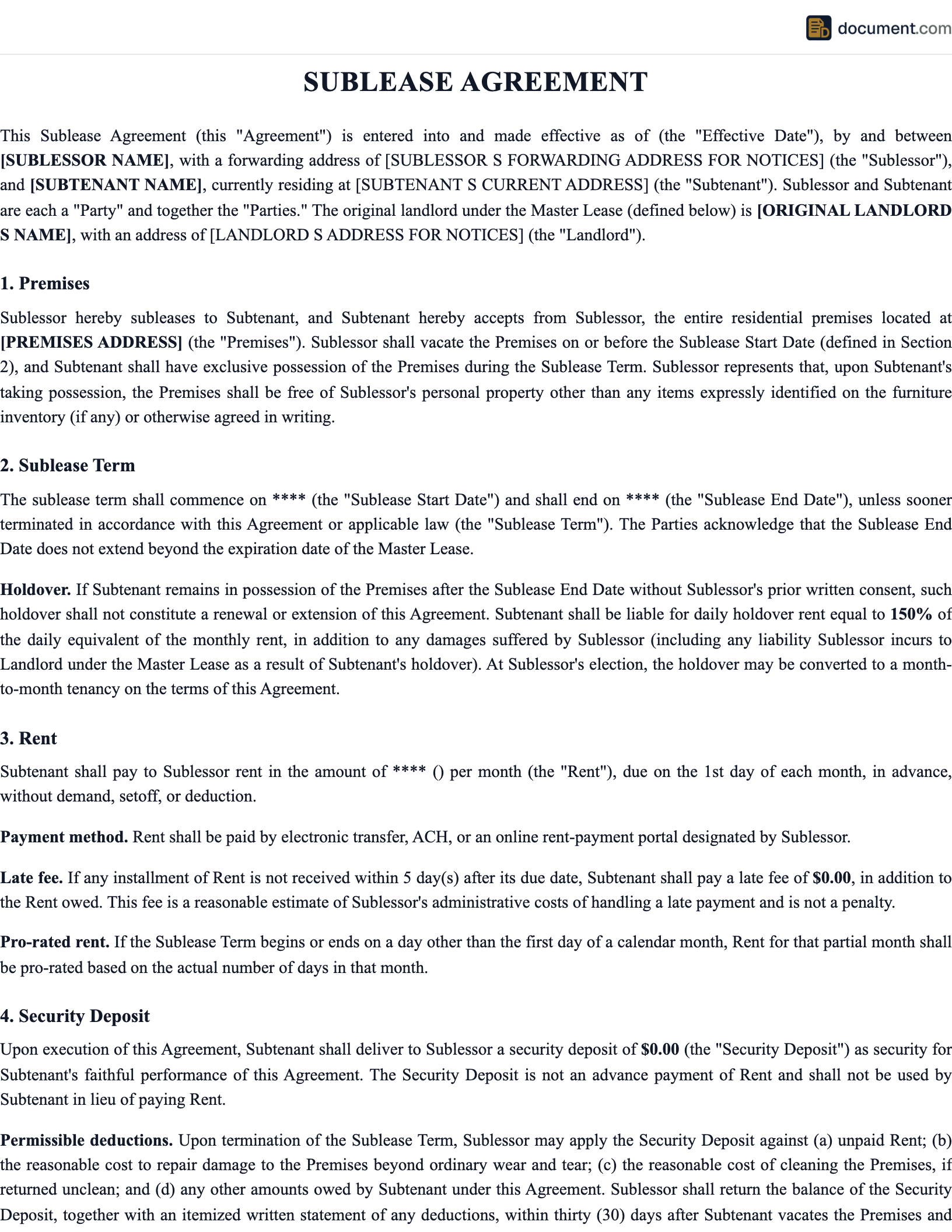
Below is a preview of our North Carolina-specific sublease agreement. Your customized document will include all provisions required under NC law.
STATE OF NORTH CAROLINA
SUBLEASE AGREEMENT
Residential Subletting Contract
SUBLESSOR (Original Tenant):
Name: [Sublessor Name]
Address: [North Carolina Address]
SUBLESSEE (New Occupant):
Name: [Sublessee Name]
Current Address: [Address]
SUBLEASE TERMS
Start Date: [Date]
End Date: [Date]
Monthly Rent: $[Amount]
Security Deposit: $[Amount]
North Carolina Sublease Agreement FAQ
Answers to common questions about sublease agreements in North Carolina.
Other North Carolina Lease Agreement Templates
Need a different type of lease agreement for North Carolina? We offer state-specific templates for every type of rental arrangement.
North Carolina Residential Lease
Standard rental agreements
North Carolina Month-to-Month Lease
Flexible short-term rentals
North Carolina Vacation Rental
Short-term vacation properties
North Carolina Commercial Lease
Business and retail spaces
North Carolina Roommate Agreement
Shared living arrangements
North Carolina Rent-to-Own
Lease with purchase option
North Carolina Equipment Lease
Equipment rental agreements
North Carolina Land Lease
Land rental agreements
North Carolina Room Rental
Individual room rentals
Create your North Carolina Sublease Lease Agreement in under 5 minutes.
Answer a few questions and download a North Carolina-compliant document, ready for the state agency.