



North Carolina Rent-to-Own Agreement Overview
North Carolina does not have a single comprehensive rent-to-own statute, but the state provides meaningful protections through the Residential Property Disclosure Act (N.C.G.S. Chapter 47E), the Residential Rental Agreements Act (N.C.G.S. Chapter 42), and equitable doctrines developed by NC courts. The NC approach balances freedom of contract with consumer protections for tenant-buyers.
North Carolina courts have recognized that tenant-buyers may acquire equitable interests in the property when they have made substantial payments and improvements. This equitable interest doctrine provides important protections against unjust forfeiture. The Charlotte, Raleigh-Durham Triangle, and Triad metro areas have active rent-to-own markets driven by rapid population growth and rising housing costs.
North Carolina allows both judicial foreclosure and power of sale foreclosure (N.C.G.S. 45-21.16), with a typical timeline of 60-90 days. Tenant-buyers should verify the seller's mortgage status and record the option agreement with the Register of Deeds to protect against foreclosure and third-party sales.
Partial
Specific RTO Statute
1-5%
Option Fee Range
Optional
Rent Credits
Recommended
Recording Option
North Carolina Rent-to-Own Laws & Regulations
North Carolina's legal framework for rent-to-own transactions draws from several sources of law.
- Residential Property Disclosure Act (N.C.G.S. Ch. 47E): Sellers must complete the state-mandated disclosure form covering structural, environmental, and material conditions. The buyer has the right to rescind if disclosures are materially inaccurate.
- Residential Rental Agreements Act (N.C.G.S. § 42-38 et seq.): Governs the lease portion. Landlords must maintain habitable premises, limit security deposits to 1.5-2 months' rent, hold deposits in trust accounts, and return deposits within 30 days.
- Recording Statutes (N.C.G.S. § 47-18): NC follows a race-notice recording system. Recording with the county Register of Deeds provides constructive notice. Unrecorded interests can be defeated by subsequent bona fide purchasers.
- Equitable Interest Doctrine: NC courts recognize that tenant-buyers who have paid substantial option fees, accumulated rent credits, or made property improvements may have equitable interests. Courts apply equity to prevent unjust enrichment.
- Unfair Trade Practices Act (N.C.G.S. § 75-1.1): Deceptive or unfair rent-to-own practices may violate this broad statute. Treble damages are available, making it a powerful tool for defrauded tenant-buyers.
NC Equitable Interest Protections
North Carolina courts have increasingly recognized equitable interests for tenant-buyers who have made substantial investments. Document all payments, improvements, and communications carefully. If you are a seller, be aware that attempting to forfeit a tenant-buyer's accumulated equity may be challenged under NC equitable doctrines and the Unfair Trade Practices Act.
How Rent-to-Own Works in North Carolina
Here is the typical process for an NC rent-to-own transaction.
Obtain Property Disclosures and Inspection
The seller completes the NC Residential Property Disclosure Statement. The buyer hires a licensed NC home inspector and reviews title and any HOA documents
Negotiate and Execute the Written Agreement
The agreement must comply with NC's Statute of Frauds and include the purchase price, option fee, rent credit terms, option period, and maintenance responsibilities
Record with the Register of Deeds
Record a memorandum of option with the county Register of Deeds. This provides constructive notice under NC's race-notice system and protects against third-party claims
Lease Period with Rent Credits
NC Residential Rental Agreements Act governs the landlord-tenant relationship. Security deposit is capped at 1.5-2 months' rent. Rent credits accumulate per the agreement terms
Exercise the Option and Close
The buyer provides written notice, secures financing, and closes. NC does not require attorney supervision of closings, but one is recommended. The NC excise tax ($1 per $500) applies at deed recording
Key NC Rent-to-Own Agreement Terms
Your NC rent-to-own agreement should clearly address each of these terms.
| Term | NC Details |
|---|---|
| Option Fee | Typically 1-5%. Common in Charlotte and Triangle markets. Credited at closing |
| Purchase Price | Locked at signing or determined by appraisal formula. NC does not regulate pricing |
| Option Period | Usually 1-3 years. Sufficient time to qualify for mortgage financing |
| Rent Credits | Optional. Typically 10-25% when included. Document accumulation and forfeiture clearly |
| Security Deposit | 1.5 months (terms > M2M) or 2 months (M2M). Trust account required. 30-day return |
| Maintenance | Landlord maintains habitability under NC law. Additional duties allocated by agreement |
| Default & Forfeiture | Specify consequences clearly. NC courts may apply equitable protections against forfeiture |
NC Consumer Protections for Tenant-Buyers
Key protections available in NC rent-to-own transactions.
Property Disclosure Protections
The NC Residential Property Disclosure Act requires sellers to disclose known material facts. If disclosures are materially inaccurate, the buyer has the right to rescind and recover damages.
Equitable Interest Recognition
NC courts recognize equitable interests for tenant-buyers who have made substantial investments. This protects against forfeiture of accumulated equity and provides standing to prevent third-party sales.
Treble Damages Under N.C.G.S. 75-1.1
NC's Unfair and Deceptive Trade Practices Act provides treble damages for violations. Predatory rent-to-own schemes involving misrepresentation or deceptive terms can be challenged under this powerful statute.
Residential Rental Agreements Act
During the lease period, NC's Act provides protections including implied warranty of habitability, security deposit limitations and trust account requirements, and proper eviction procedures.
Sample NC Rent-to-Own Agreement
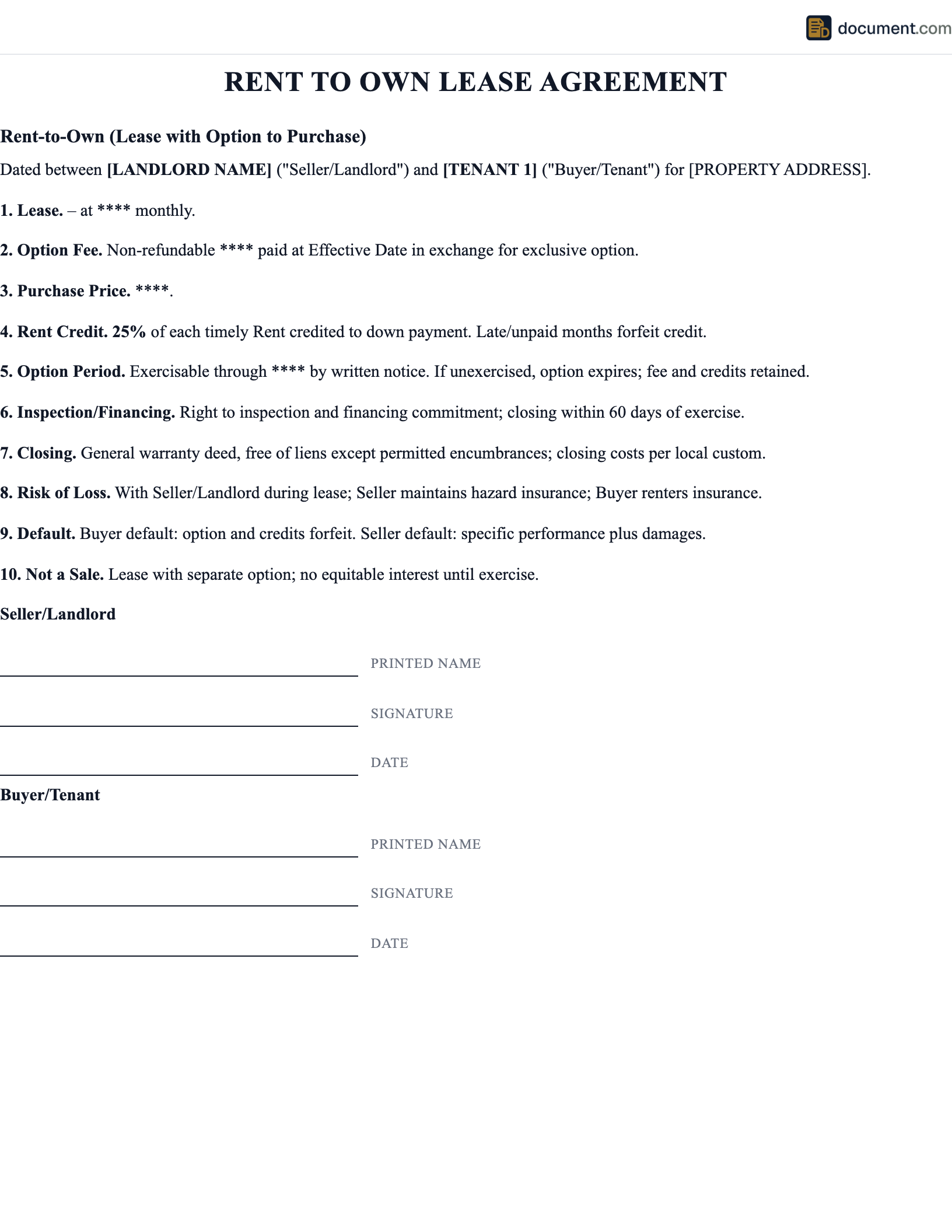
Below is a preview of our North Carolina-compliant agreement.
STATE OF NORTH CAROLINA
RESIDENTIAL LEASE WITH OPTION TO PURCHASE
NC Property Disclosure Act Compliant
PROPERTY OWNER / OPTIONOR:
Name: [Owner Name]
Address: [NC Address]
TENANT-BUYER / OPTIONEE:
Name: [Tenant Name]
Address: [Current Address]
PROPERTY & TERMS
Property: [NC Property Address]
Option Fee: $[Amount] Purchase Price: $[Amount]
Monthly Rent: $[Amount] Rent Credit: [%]%
North Carolina Rent-to-Own FAQ
Answers about NC property disclosures, equitable interest protections, recording, and the Unfair Trade Practices Act.
Official NC Resources
North Carolina government and legal resources.
Create your North Carolina Rent To Own Lease Agreement in under 5 minutes.
Answer a few questions and download a North Carolina-compliant document, ready for the state agency.