



Delaware Commercial Sublease Overview
A Delaware commercial sublease allows an existing tenant to sublet all or a portion of leased commercial space to a subtenant without surrendering the original tenant's rights under the prime lease. The original tenant becomes the sublessor and retains full liability to the landlord. The subtenant has rights only against the sublessor and no direct contractual relationship with the landlord unless a separate non-disturbance agreement is negotiated.
Delaware is an unusually corporate-sophisticated state for commercial leasing. The Court of Chancery, which handles significant commercial disputes including lease litigation, applies contract terms precisely as written and will not rewrite poorly drafted provisions to achieve a more equitable outcome. This means every provision in a Delaware commercial sublease, including the expense pass-throughs, liability allocation, non-disturbance rights, and termination procedures, should be drafted with precision rather than left to general language.
Delaware commercial subleases arise most commonly in Wilmington's office market when corporate tenants take more space than they currently need, and in New Castle County and Kent County retail and industrial markets when businesses shift operations or seek to monetize favorable below-market leases. Delaware has no sales tax, which simplifies the expense pass-through structure in commercial subleases compared to states where operating expense reimbursements may carry sales tax obligations.
Per lease
Subletting default
Yes
Consent required
Yes
Tenant remains liable
1 month's
Deposit rules
Delaware Commercial Sublease Requirements
Delaware commercial subleases are governed entirely by the prime lease and general contract law. There is no Delaware statute that specifically regulates commercial subletting or establishes any tenant protections for commercial sublessees. The rights of every party depend on what is written in the prime lease and the sublease document.
Check for Recapture Rights Before Requesting Consent
Many Delaware commercial prime leases contain recapture provisions that allow the landlord to terminate the prime lease and deal directly with the proposed subtenant when the tenant requests sublease consent. Requesting consent can trigger this right regardless of whether the landlord ultimately agrees to the sublease. Review the recapture clause with a Delaware attorney before notifying the landlord of any intent to sublease, particularly if the space is in a desirable Wilmington building where the landlord might prefer the subtenant's terms.
Sublessor (Original Tenant) Obligations
- Review the Prime Lease First: Identify the assignment and subletting clause, consent standard, recapture rights, and any profit-sharing provisions before engaging a subtenant
- Obtain Written Landlord Consent: Request consent in writing and document all conditions the landlord attaches to that consent before executing the sublease
- Remain Liable Under the Prime Lease: The sublessor owes the landlord all prime lease obligations regardless of what the subtenant does; there is no implied release under Delaware law
- Provide the Prime Lease to the Subtenant: Give the subtenant a complete copy of the prime lease so the subtenant understands all obligations that bind the subleased space
Subtenant Obligations and Protections
- Comply with the Prime Lease: The sublease should incorporate all applicable prime lease terms; subtenant violations can trigger defaults under the prime lease
- Seek a Non-Disturbance Agreement: Delaware subtenants taking significant space should negotiate directly with the landlord for a non-disturbance agreement protecting possession rights if the prime lease terminates
- Verify the Prime Lease Is in Good Standing: Before signing the sublease, confirm there are no existing defaults under the prime lease that could accelerate termination
- Confirm the Sublease Term Does Not Exceed the Prime Lease: A sublease cannot create a term extending beyond the prime lease expiration, or the excess period will be unenforceable against the landlord
How to Complete a Delaware Commercial Sublease
Delaware commercial sublease transactions require careful sequencing because the landlord consent process, recapture risk, and prime lease review all need to happen before the sublease is fully documented. Work through these steps in order.
Review the Prime Lease and Assess Recapture Risk
Read the assignment and subletting clause in the prime lease before doing anything else. Identify the consent standard, any recapture rights, profit-sharing provisions, and any conditions the landlord can attach to consent. If the lease includes a recapture clause, assess whether the proposed sublease rent and term are likely to trigger the landlord's exercise of that right before requesting consent. Work with a Delaware attorney if the recapture risk is significant.
Define the Subleased Premises and Financial Terms
Identify the subleased space by floor, suite number, exact square footage, and a floor plan exhibit if subleasing a portion of the overall leased space. Set the sublease base rent and payment schedule. If operating expenses or CAM charges flow through from the prime lease, specify how the subtenant's pro-rata share is calculated and billed. Address any profit-sharing obligations owed to the landlord if the sublease rent exceeds the prime lease rate.
Incorporate Prime Lease Terms and Obtain Landlord Consent
Attach a complete copy of the prime lease as an exhibit and incorporate its applicable terms by reference, subject to any modifications the parties negotiate in the sublease. Submit the sublease draft and the subtenant's financial and business information to the landlord with a formal written consent request. Document the landlord's response and any conditions the landlord attaches. Attach the consent letter to the fully executed sublease.
Execute and Retain Originals
Both sublessor and subtenant should sign the sublease with original signatures. Delaware commercial leases do not require notarization to be binding between the parties. Each party should retain a fully executed original of the sublease, the landlord consent letter, and the prime lease for the full sublease term plus three years. Deliver copies to the landlord as required by the prime lease.
Delaware Commercial Sublease Key Terms
The table below summarizes the structural features that define a Delaware commercial sublease and distinguish it from a residential sublease or a lease assignment.
| Topic | Delaware Commercial Sublease Rule |
|---|---|
| Subletting Default Rule | Governed entirely by the prime lease; most Delaware commercial leases require written landlord consent |
| Landlord Consent Standard | Depends on the prime lease; may be "not unreasonably withheld" or absolute landlord discretion; review the specific lease language |
| Original Tenant Liability | Sublessor remains fully liable to the landlord under the prime lease; no implied release under Delaware contract law |
| Subtenant-Landlord Relationship | No privity of contract; subtenant rights run only through the sublessor unless a separate non-disturbance agreement is negotiated with the landlord |
| Excess Rent Sharing | If the prime lease includes a profit-sharing clause, the sublessor must share above-market sublease income with the landlord after deducting documented subletting costs |
Sample Delaware Sublease Agreement
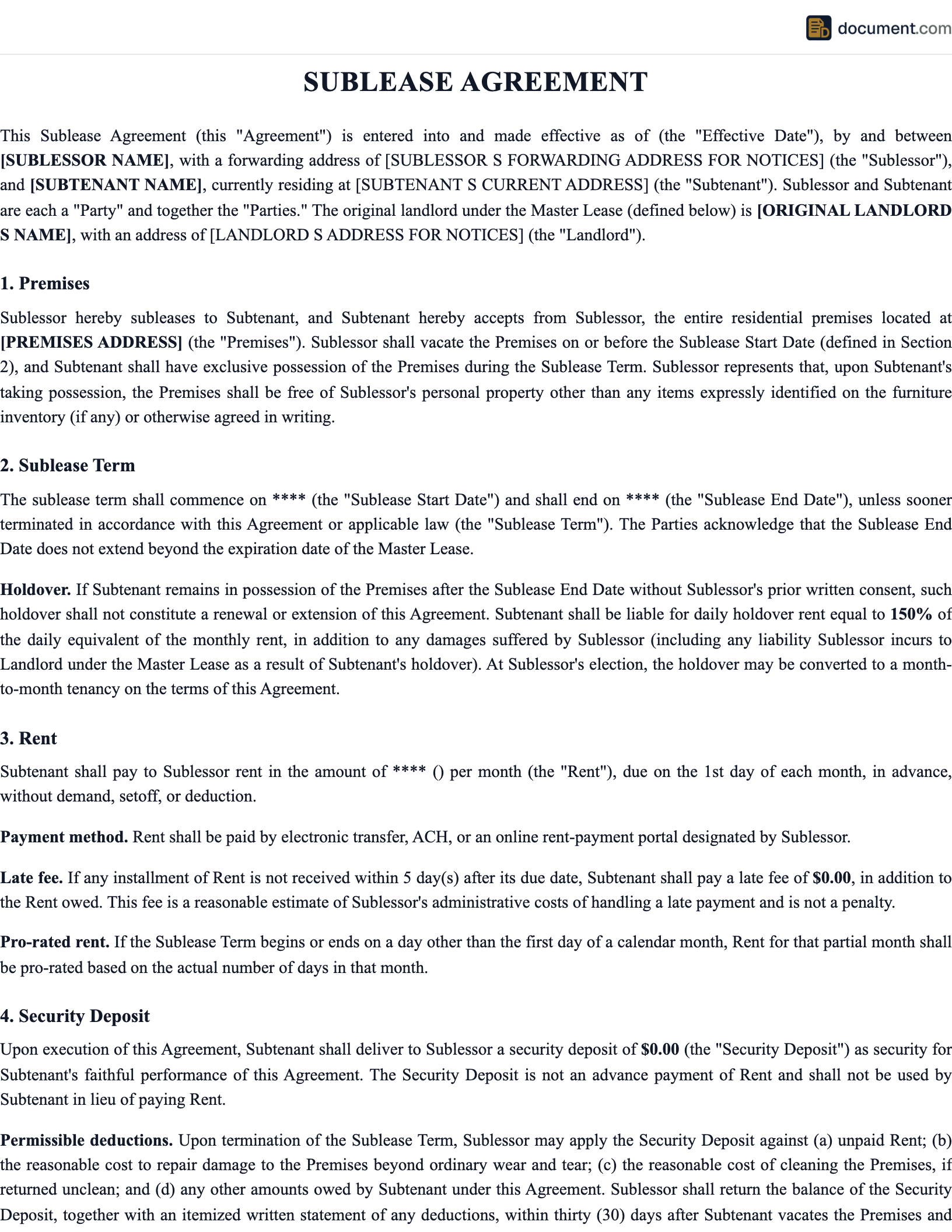
Below is a preview of our Delaware-specific sublease agreement. Your customized document will include all provisions required under DE law.
STATE OF DELAWARE
SUBLEASE AGREEMENT
Residential Subletting Contract
SUBLESSOR (Original Tenant):
Name: [Sublessor Name]
Address: [Delaware Address]
SUBLESSEE (New Occupant):
Name: [Sublessee Name]
Current Address: [Address]
SUBLEASE TERMS
Start Date: [Date]
End Date: [Date]
Monthly Rent: $[Amount]
Security Deposit: $[Amount]
Delaware Sublease Agreement FAQ
Answers to common questions about sublease agreements in Delaware.
Other Delaware Lease Agreement Templates
Need a different type of lease agreement for Delaware? We offer state-specific templates for every type of rental arrangement.
Delaware Residential Lease
Standard rental agreements
Delaware Month-to-Month Lease
Flexible short-term rentals
Delaware Vacation Rental
Short-term vacation properties
Delaware Commercial Lease
Business and retail spaces
Delaware Roommate Agreement
Shared living arrangements
Delaware Rent-to-Own
Lease with purchase option
Delaware Equipment Lease
Equipment rental agreements
Delaware Land Lease
Land rental agreements
Delaware Room Rental
Individual room rentals
Create your Delaware Sublease Lease Agreement in under 5 minutes.
Answer a few questions and download a Delaware-compliant document, ready for the state agency.