



Delaware Rent-to-Own Agreement Overview
Delaware does not have a dedicated rent-to-own statute for real property. These transactions are governed by the Delaware Residential Landlord-Tenant Code (Del. Code Ann. tit. 25, § 5101 et seq.) for the lease component, general contract law for the purchase option, and the Seller's Disclosure of Real Property Condition Act (Del. Code Ann. tit. 6, § 2571 et seq.) for property disclosures. Delaware's 4% realty transfer tax and judicial foreclosure system add important financial and procedural considerations.
Delaware is a small state with only three counties — New Castle, Kent, and Sussex — making the recording process straightforward compared to states with dozens of counties. The state's proximity to Philadelphia, Wilmington's business environment, and Sussex County's beach communities create diverse housing markets within a compact geography. Northern Delaware near Wilmington has a significantly different real estate landscape than Sussex County beach towns like Rehoboth Beach and Lewes.
Delaware is an equitable distribution state for marital property. The Delaware Fair Housing Act provides broader protections than federal law, including source of income, sexual orientation, and gender identity. These protections apply to both the rental and purchase components of a rent-to-own arrangement.
No
Specific RTO Statute
2-5%
Option Fee Range
4%
Transfer Tax
Race-Notice
Recording System
Delaware Rent-to-Own Laws & Regulations
Delaware regulates rent-to-own real estate transactions through its Landlord-Tenant Code, property disclosure requirements, and real property recording statutes.
- Residential Landlord-Tenant Code (Del. Code Ann. tit. 25, § 5101 et seq.): Governs the lease component. Limits security deposits to one month's rent. Deposits must be held in escrow at a federally insured Delaware institution. Return within 20 days. Establishes habitability standards, repair obligations, and eviction procedures.
- Seller's Disclosure Act (Del. Code Ann. tit. 6, § 2571 et seq.): Requires sellers to disclose known property conditions including structural, systems, environmental hazards, flooding, and HOA information. Must be provided before the buyer is contractually bound.
- Recording Statutes (Del. Code Ann. tit. 25, § 153): Delaware is a race-notice recording state. Record with the Recorder of Deeds in the appropriate county (New Castle, Kent, or Sussex). Recording fees are approximately $39.50 for the first page.
- Realty Transfer Tax (Del. Code Ann. tit. 30, § 5401 et seq.): Delaware imposes a 4% realty transfer tax on property conveyances (customarily split 2% buyer / 2% seller). This applies at closing when the deed transfers, not during the lease period. Additional local taxes may apply in Wilmington and other municipalities.
- Judicial Foreclosure (Del. Code Ann. tit. 10, § 5061 et seq.): Delaware requires judicial foreclosure through the Superior Court. The process typically takes 3-6 months and includes a sheriff's sale. Provides more time and notice than non-judicial foreclosure states.
Delaware's 4% Realty Transfer Tax
Delaware's 4% realty transfer tax is one of the highest in the nation and represents a significant closing cost. On a $300,000 home, the transfer tax alone is $12,000. By custom, this is split evenly between buyer and seller (2% each), but the allocation is negotiable. The rent-to-own agreement should clearly specify how the transfer tax will be split at closing. First-time homebuyers may qualify for a reduced rate under certain conditions — check with the Delaware Division of Revenue for current exemptions.
How Rent-to-Own Works in Delaware
Delaware rent-to-own transactions follow a structured process that accounts for the state's three-county recording system, property disclosure requirements, and significant realty transfer tax at closing.
Property Inspection and Disclosure Review
Hire a licensed Delaware home inspector. Review the Seller's Property Disclosure report. Check for lead paint (pre-1978), radon, and flood zone status. Obtain a title search through the county Recorder of Deeds
Negotiate and Execute the Agreement
Agree on purchase price, option fee, rent, rent credits, option period, maintenance, and transfer tax allocation at closing. The agreement must be in writing per Delaware's Statute of Frauds
Pay Option Fee and Record with Recorder of Deeds
Pay the option fee and record a memorandum of option with the Recorder of Deeds in the correct county (New Castle, Kent, or Sussex). Only three counties makes this straightforward in Delaware
Lease Period — Build Equity Through Rent Credits
During the 1-3 year lease, pay rent with credits toward the purchase price. Explore DSHA (Delaware State Housing Authority) first-time buyer programs and down payment assistance
Exercise the Option and Close
Notify the seller in writing, secure mortgage financing, and close through a Delaware settlement agent. Pay the 4% realty transfer tax (typically split 2%/2%). Option fee and rent credits are applied to the purchase price
Key Delaware Rent-to-Own Agreement Terms
Delaware's realty transfer tax makes the financial terms of the agreement particularly important. Both parties should plan for the significant closing costs unique to Delaware.
| Term | Delaware Details |
|---|---|
| Option Fee | Typically 2-5% of purchase price. Non-refundable but credited at closing. Separate from security deposit |
| Purchase Price | Set at signing or by appraisal at exercise. Factor in the 4% realty transfer tax when determining affordability |
| Option Period | Usually 1-3 years. Must include specific expiration date and exercise procedures |
| Monthly Rent | No rent control in Delaware. Lock rent for the option period in the agreement. Wilmington rents differ significantly from rural Sussex County |
| Rent Credits | Not required by Delaware law. When included, typically 10-25% of rent. Specify forfeiture conditions |
| Security Deposit | Capped at one month's rent. Must be held in escrow. Return within 20 days. Separate from option fee |
| Transfer Tax | 4% of purchase price at closing (typically 2% buyer / 2% seller). Additional local taxes may apply in Wilmington |
| Default & Forfeiture | Delaware requires judicial eviction through Justice of the Peace Court. Must specify consequences for option fee and rent credits |
Delaware Consumer Protections for Tenant-Buyers
Delaware provides meaningful consumer protections through its landlord-tenant code, property disclosure requirements, and broad fair housing law.
Seller's Property Disclosure Act (tit. 6, § 2571)
Delaware's comprehensive disclosure requirement covers structural conditions, systems, environmental hazards, flooding, and HOA information. The seller must disclose all known material defects. Failure to disclose can result in liability for damages and potential rescission of the agreement. Always insist on receiving the full disclosure before paying the option fee.
Delaware Consumer Fraud Act (Del. Code Ann. tit. 6, § 2511 et seq.)
The Consumer Fraud Act prohibits deception, fraud, false pretense, misrepresentation, and other unfair practices in the conduct of commerce. Predatory rent-to-own schemes may violate this Act. The Delaware Attorney General's Consumer Protection Unit investigates complaints. Consumers can also bring private actions for damages.
Delaware State Housing Authority (DSHA)
DSHA offers first-time homebuyer programs including the Homeownership Loan Program with below-market interest rates and the Preferred Plus down payment and closing cost assistance program. Tenant-buyers should explore DSHA programs during the lease period to prepare for exercising the purchase option.
Delaware Fair Housing Act (tit. 6, § 4601 et seq.)
Delaware's Fair Housing Act provides broader protections than federal law, adding marital status, sexual orientation, gender identity, and source of income as protected classes. Discriminatory practices in rent-to-own transactions — including discriminatory pricing, terms, or refusals — are illegal.
Sample Delaware Rent-to-Own Agreement
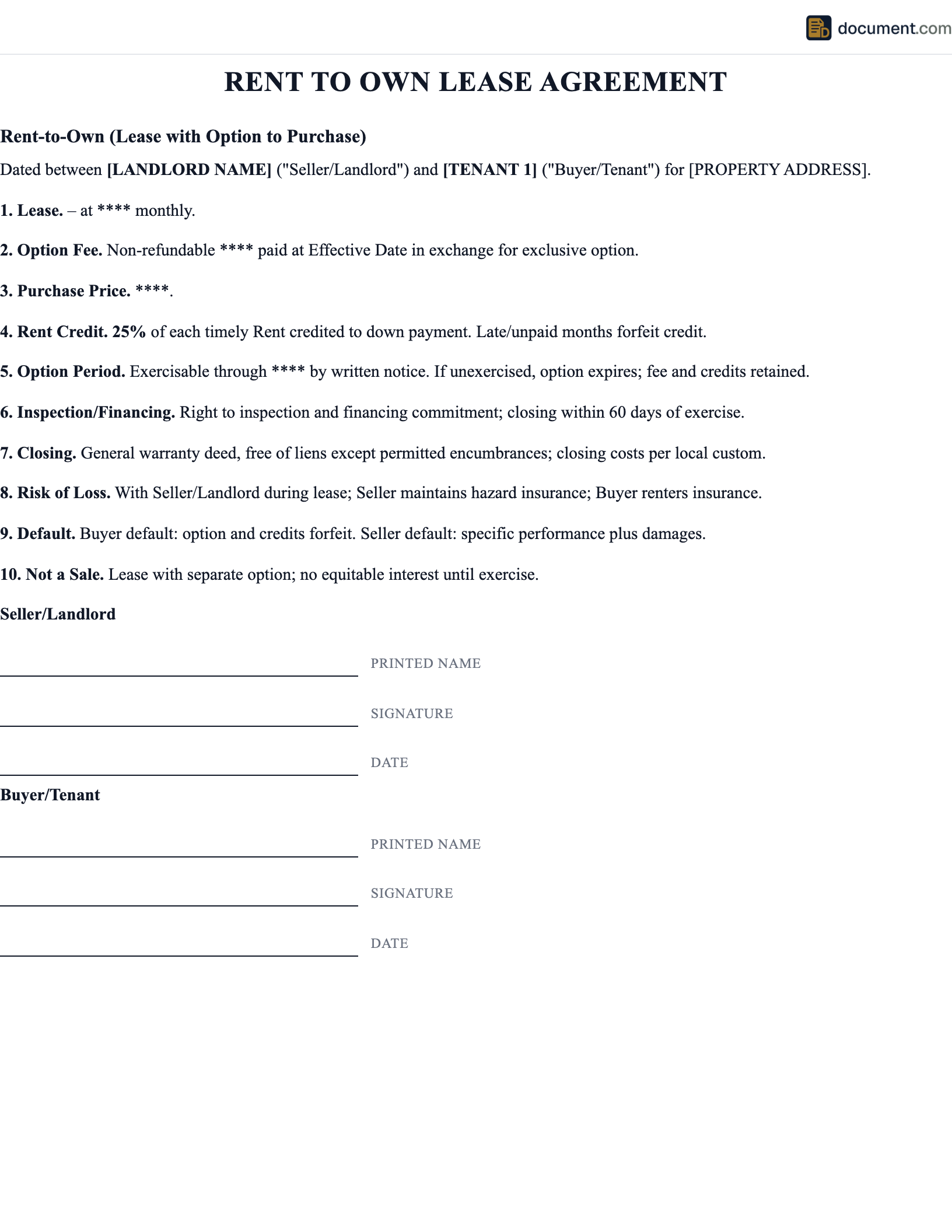
Below is a preview of our Delaware-specific rent-to-own agreement. The customized document addresses security deposit escrow, property disclosure, realty transfer tax allocation, and recording provisions.
STATE OF DELAWARE
RESIDENTIAL LEASE WITH OPTION TO PURCHASE
Governed by Del. Code Ann. tit. 25 & Delaware Contract Law
PROPERTY OWNER / OPTIONOR:
Name: [Owner Name]
Address: [Delaware Address]
TENANT-BUYER / OPTIONEE:
Name: [Tenant Name]
Address: [Current Address]
PROPERTY & TERMS
Property: [Delaware Property Address]
County: [New Castle/Kent/Sussex]
Option Fee: $[Amount] Purchase Price: $[Amount]
Monthly Rent: $[Amount] Rent Credit: [%]%
Delaware Rent-to-Own FAQ
Common questions about rent-to-own agreements in Delaware, including the 4% realty transfer tax, security deposit escrow, property disclosures, and judicial foreclosure.
Official Delaware Resources
Government and legal resources for Delaware rent-to-own transactions.
Delaware Attorney General — Consumer Protection
File complaints about deceptive rent-to-own practices
Delaware State Housing Authority (DSHA)
First-time homebuyer programs and down payment assistance
Delaware Real Estate Commission
Real estate licensing, regulation, and consumer resources
HUD — Delaware Housing Resources
Federal housing assistance, counseling, and complaint filing
Create your Delaware Rent To Own Lease Agreement in under 5 minutes.
Answer a few questions and download a Delaware-compliant document, ready for the state agency.