



What Is a Rent Increase Notice?
A rent increase notice is a formal written communication from a landlord to a tenant informing them that the monthly rent will be raised to a new amount, effective on a specific future date. This document is a legal requirement in every state — landlords cannot simply demand higher rent without providing proper written notice within the timeframe mandated by state law. The notice period typically ranges from 30 to 90 days depending on the jurisdiction and the amount of the increase, giving the tenant adequate time to accept the new terms, negotiate, or make plans to move.
Rent increases are one of the most sensitive aspects of the landlord-tenant relationship. For landlords, adjusting rent is necessary to keep pace with rising property taxes, insurance premiums, maintenance costs, and market conditions. For tenants, an unexpected or unreasonable increase can create financial hardship and housing instability. The legal framework surrounding rent increases attempts to balance these interests by requiring advance notice, prohibiting retaliatory or discriminatory increases, and in some jurisdictions, capping the allowable increase amount through rent control or rent stabilization laws.
The rules governing rent increases differ significantly between month-to-month tenancies and fixed-term leases. For month-to-month tenants, the landlord can typically raise rent with proper notice at any time. For tenants on a fixed-term lease, rent is locked in for the lease duration — the landlord can only increase rent when offering a renewal at the end of the term, unless the lease contains a specific escalation clause. Understanding this distinction is critical because attempting to raise rent during a fixed-term lease without a contractual basis is a breach of the lease agreement.
Rent control and rent stabilization laws add another layer of complexity. California's Tenant Protection Act (AB 1482) caps annual increases at 5% plus local CPI or 10%, whichever is less, for covered properties. Oregon limits increases to 7% plus CPI. New York City has one of the most comprehensive rent control systems in the country, with annual increases for stabilized units set by the Rent Guidelines Board. Understanding whether your property falls under rent control — and if so, what the maximum allowable increase is — is essential before sending any rent increase notice.
Market Rate
Increase rent to match current market rates based on comparable properties
Cost Recovery
Recover rising costs for property taxes, insurance, maintenance, and utilities
Rent Control
Limited increases per local rent board guidelines in controlled jurisdictions
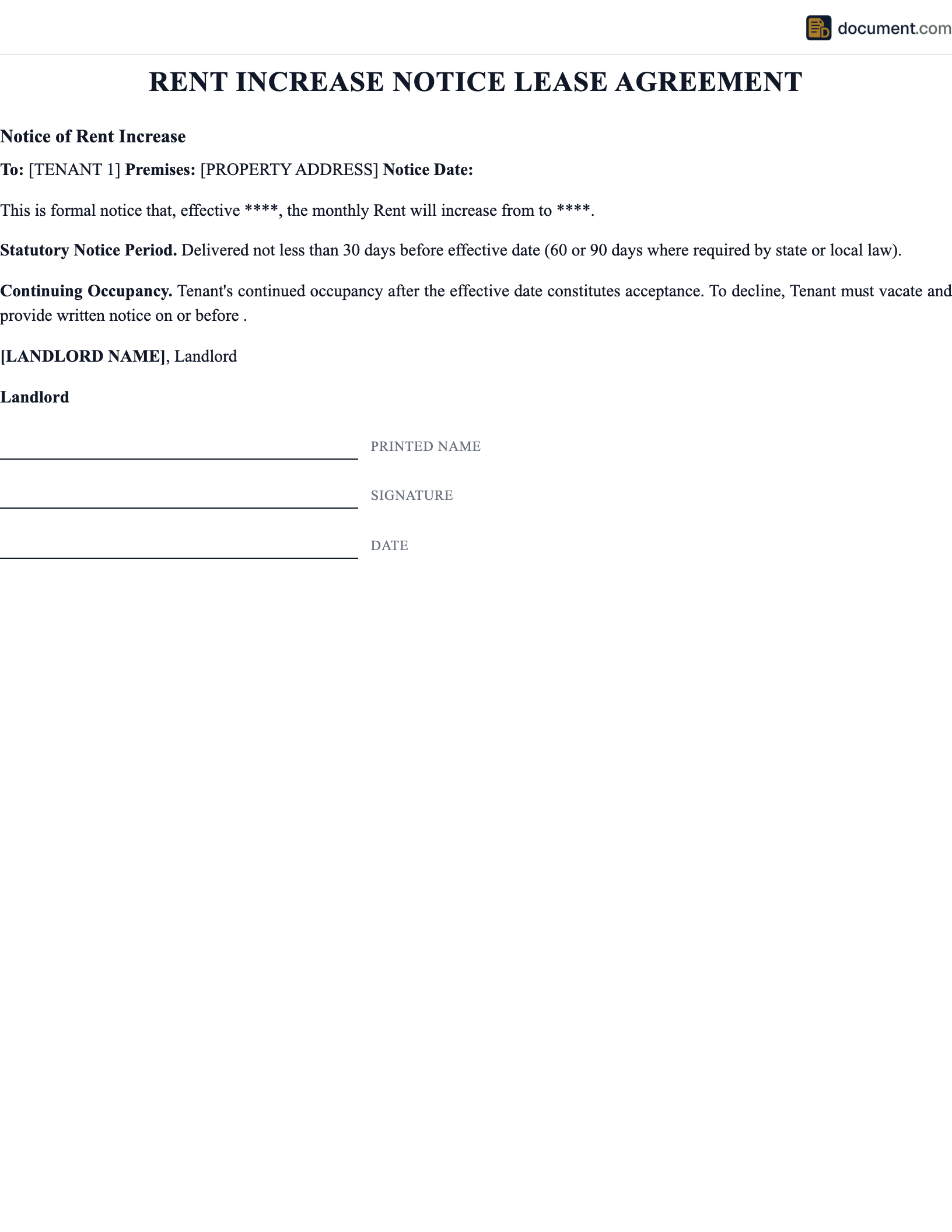
Rent Increase Notice Form Preview
Our template includes all required elements for a legally valid rent increase notice with state-specific compliance.
NOTICE OF RENT INCREASE
Written Notice to Tenant
TENANT & PROPERTY
Tenant: [Name(s)]
Property: [Address, Unit]
RENT INCREASE DETAILS
Current Rent: $[Amount]/month
New Rent: $[Amount]/month
Increase Amount: $[Amount] ([%]%)
Effective Date: [Date]
LANDLORD
Signature: [Signature]
Date: [Date]
How to Write a Rent Increase Notice
Follow these steps to create a legally compliant and professionally presented rent increase notice.
Research Market Rates and Legal Limits
Before setting the new rent amount, research comparable rents in your area and check whether your property is subject to rent control or rent cap laws. If rent control applies, verify the maximum allowable increase percentage from your local rent board. Even without rent control, understanding market rates helps set a competitive but fair increase that minimizes tenant turnover.
Verify the Required Notice Period
Look up your state's required advance notice period for rent increases. Most states require 30 days for month-to-month tenancies, but California requires 30 days for increases of 10% or less and 90 days for increases over 10%, Oregon requires 90 days, and some cities have additional requirements. Calculate backward from your desired effective date to determine when the notice must be delivered.
Draft a Clear, Professional Notice
State the current rent amount, the new rent amount, the dollar and percentage increase, and the effective date. Include the tenant's name and property address. Use a professional and respectful tone — this is a business communication, not a demand. If you choose to include a reason for the increase (rising property taxes, market adjustment, property improvements), it demonstrates transparency and goodwill.
Confirm the Effective Date Aligns with Law
Ensure the effective date of the increase falls on a rent due date (typically the first of the month) and allows for the full notice period required by law. In most states, the notice period begins when the tenant receives the notice, not when it is sent. Build in extra time for mail delivery if sending by mail. An increase that takes effect before the required notice period has expired is void and unenforceable.
Include Tenant Options
Inform the tenant of their options: accept the increase and continue the tenancy, negotiate a different amount or lease term, or provide notice of their intent to vacate before the increase takes effect. Including these options demonstrates professionalism and may open a productive dialogue. Many tenants accept reasonable increases when they feel treated with respect and given adequate time.
Deliver via Documented Method
Deliver the notice through a method that provides proof of delivery — certified mail with return receipt, personal delivery with signed acknowledgment, or another method recognized by your state. Keep a copy of the notice and all delivery documentation. If the tenant later disputes receiving the notice, this documentation is your evidence that proper notice was given.
Key Components of a Rent Increase Notice
An effective and legally compliant rent increase notice must include these elements.
| Component | Description |
|---|---|
| Date of Notice | The date the notice is prepared — establishes the start of the notice period |
| Tenant Name(s) | Full legal names of all tenants on the lease |
| Property Address | Full address of the rental property including unit number |
| Current Rent | The current monthly rent amount being paid |
| New Rent Amount | The new monthly rent that will be charged after the effective date |
| Dollar Increase | The difference between old and new rent stated as a dollar amount |
| Percentage Increase | The increase expressed as a percentage (important for rent control compliance) |
| Effective Date | The specific date when the new rent takes effect (must follow required notice period) |
| Reason (Optional) | Justification for the increase such as market adjustment, tax increase, or improvements |
| Tenant Options | Statement of tenant's options: accept, negotiate, or provide notice to vacate |
| Landlord Signature | Signature of landlord or authorized property manager |
| Contact Information | Phone, email, or address for tenant questions or negotiations |
Legal Requirements for Rent Increases
Rent increase regulations vary significantly by state and locality. Understanding these requirements is essential to avoid legal challenges.
Important: Retaliatory Increases Are Illegal
Most states prohibit retaliatory rent increases — raising rent in response to a tenant exercising legal rights such as reporting code violations, requesting repairs, filing complaints, or organizing with other tenants. If a rent increase occurs within 6-12 months of a tenant's protected activity, many states presume the increase is retaliatory, shifting the burden to the landlord to prove a legitimate, non-retaliatory reason.
State Notice Period Requirements
- 30-Day Notice: Most states require 30 days advance notice for month-to-month tenancies — this is the minimum in states without specific rent increase statutes
- 60-Day Notice: Some states require 60 days for larger increases or longer tenancies — California requires 90 days for increases over 10%
- 90-Day Notice: Oregon requires 90 days for all rent increases; some cities also require 90 days for certain increases
- Rent Control Caps: California (5% + CPI or 10% max), Oregon (7% + CPI), NYC (set by Rent Guidelines Board), San Francisco (60% of CPI increase)
Tenant Options After Receiving Notice
Upon receiving a rent increase notice, tenants have several options depending on their lease type. Month-to-month tenants can accept the increase, negotiate a smaller increase or longer lease term, or give notice to vacate before the effective date. Fixed-term tenants nearing lease expiration can accept the renewal terms, negotiate, or decline to renew and move out at lease end. In rent-controlled areas, tenants can challenge increases exceeding the legal limit through the local rent board or housing authority.
Sample Rent Increase Notice
Below is a sample rent increase notice. Your document will include state-specific notice periods and rent control compliance.
NOTICE OF RENT INCREASE
Date: [Date]
Dear [Tenant Name],
This letter serves as formal notice that the monthly rent for the property at [Property Address] will be increased as follows:
Current Monthly Rent: $[Current Amount]
New Monthly Rent: $[New Amount]
Increase: $[Difference] ([X]%)
Effective Date: [Effective Date]
This increase is provided with [30/60/90] days advance notice as required by [State] law. The new rent will be due on the first of the month beginning [Effective Date].
If you have questions or would like to discuss this change, please contact me at [Phone/Email]. I value your tenancy and hope to continue our rental relationship.
Sincerely,
Landlord Signature
Name: _______________ Phone: _______________
Frequently Asked Questions
Find answers about rent increases, notice periods, rent control, and tenant rights.
Official Resources
Use these trusted resources for rent increase regulations and tenant rights.
HUD Rental Information
Federal housing resources and rental assistance programs
CFPB Housing Resources
Consumer protection guidance for renters
Nolo — Rent Increase Guide
State-by-state rent increase laws and notice requirements
NYC Rent Guidelines Board
Annual rent increase percentages for NYC stabilized units
Related Landlord Documents
These documents are commonly used alongside rent increase notices.
Lease Renewal
Renew with updated rent at lease expiration
Lease Amendment
Document a mid-term rent change by mutual agreement
Late Rent Notice
Notify tenants of overdue rent payments
Lease Agreement
Comprehensive residential lease template
Lease Termination Letter
End a lease with proper notice
Eviction Notice
Formal notice to quit for lease violations
Create your Rent Increase Notice Lease Agreement in under 10 minutes.
Answer a few questions and download a compliant, attorney-drafted document ready for your state.