
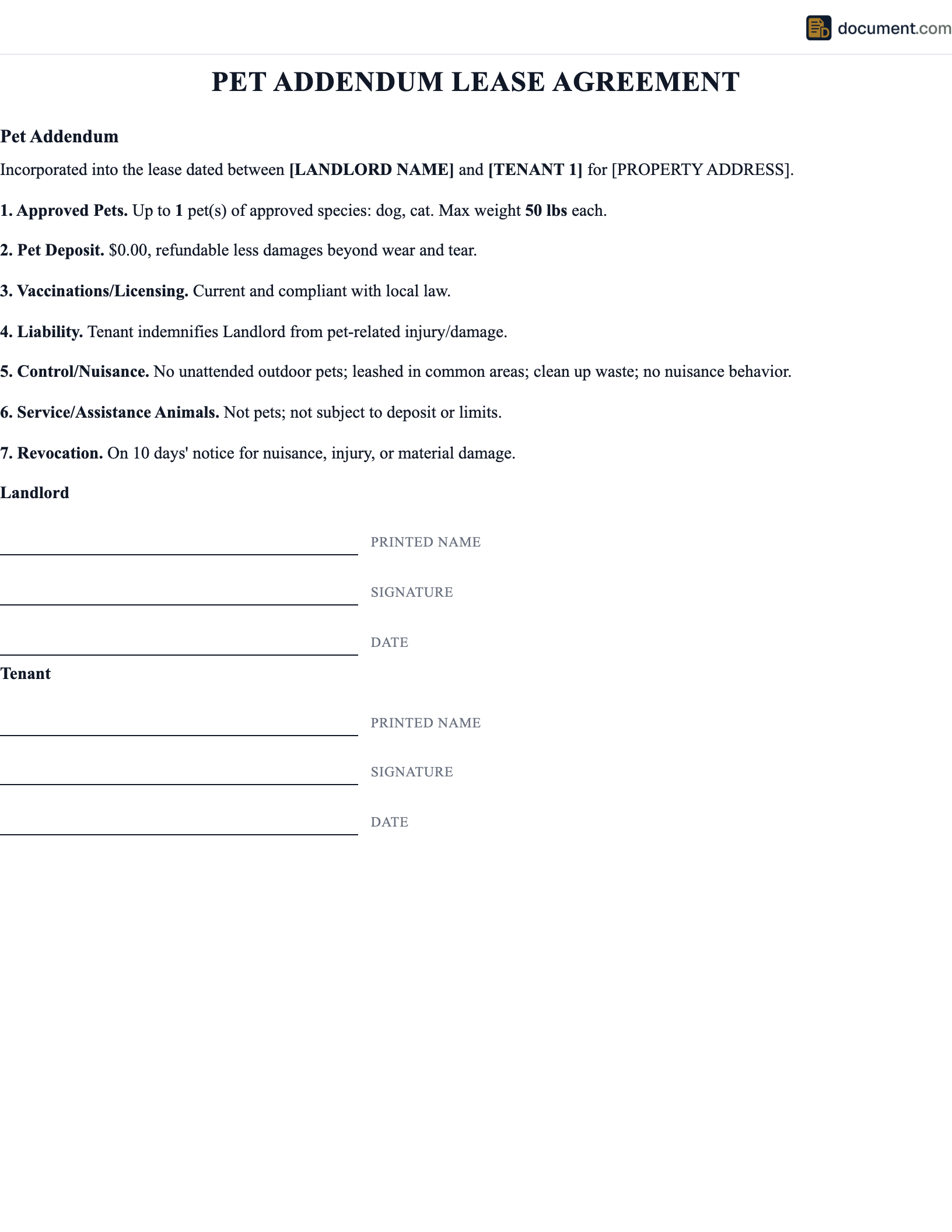



What Is a Pet Addendum?
A pet addendum is a written supplement to a residential lease that establishes the terms under which a tenant may keep pets on the property. It addresses the specific pets approved (breed, weight, age, vaccination status), the pet deposit and pet rent (with state-law deposit-cap compliance), behavioral and common-area rules, damage liability and chargeback procedure at move-out, the insurance requirement, and the Fair Housing Act exception that exempts service animals and assistance animals (ESAs) from every restriction. Approximately 70 percent of U.S. households include at least one pet (American Pet Products Association 2023 survey), so a generic no-pets policy excludes most prospective tenants and a generic pet-friendly policy without a written addendum exposes the landlord to disputes about deposit amounts, breed restrictions, damage allocation, and FHA compliance.
The addendum is a contract amendment under standard contract-law principles in every state. It must be in writing to modify the lease (Statute of Frauds for any term over one year, Civ. Code § 1624 in California and equivalents elsewhere), must be signed by both parties, and must clearly identify what is changed and what remains in effect from the original lease. Many landlords use a one-paragraph 'pets allowed' clause in the lease itself; that approach is inadequate because it does not document the specific approved animal, the deposit and rent amounts, the cleanup and noise rules, the insurance requirement, or the FHA carve-out. Disputes about pet damage and pet-rent late fees are among the highest-volume small-claims-court categories nationally.
The Fair Housing Act analysis is the part most landlords get wrong. Service animals (ADA-defined trained dogs and miniature horses) and emotional support animals (FHA-defined assistance animals of any species) are not 'pets' under federal law. The FHA, codified at 42 U.S.C. § 3604(f)(3)(B), requires reasonable accommodation for any tenant with a disability whose use of an assistance animal is necessary to enable equal use of the unit. 24 C.F.R. § 100.204(b) prohibits pet deposits, pet rent, pet fees, and breed or weight restrictions on assistance animals. HUD enforcement penalties under 42 U.S.C. § 3612(g)(3) currently $24,792 first violation, $61,981 second, $123,961 third or subsequent per the 2024 inflation adjustment. DOJ enforcement actions for pet-fee charges on assistance animals have produced published settlements ranging from $50,000 to $250,000 against major landlord operators.
Pet deposits and pet rent are subject to state security deposit law. California Civ. Code § 1950.5(c) caps total deposit including pet at one month's rent for unfurnished units (post-July 2024 amendment), two months for furnished units. New York Gen. Oblig. Law § 7-108 caps at one month total. Texas, Florida, Georgia, and Illinois have no statutory cap. Massachusetts, Vermont, Delaware, and Maine prohibit non-refundable pet deposits. Pet rent (typically $25 to $100 per pet per month) is generally not regulated under state security deposit statutes and can be charged separately. Insurance carrier breed exclusions remain a dominant constraint on what landlords can practically allow: most homeowner and landlord policies exclude bites by American Pit Bull Terriers, Rottweilers, Akitas, Dobermans, Chows, Wolf hybrids, and Presa Canarios.
Service animal vs. ESA distinction under FHA
Two federal statutes, two definitions. Service animals under the ADA (28 C.F.R. § 36.104) are dogs (and in narrow circumstances miniature horses) individually trained to perform specific tasks for a person with a disability. ADA coverage applies to public accommodations and most common areas of multifamily buildings, but the ADA does not regulate the rental units themselves. Emotional support animals (ESAs) are not 'service animals' under the ADA. Both service animals and ESAs are 'assistance animals' under the Fair Housing Act (42 U.S.C. § 3604(f)(3)(B)) when they perform a disability-related function or provide emotional support to a tenant with a disability. HUD's January 2020 Assistance Animals Notice (FHEO-2020-01) confirms that the FHA covers any species, trained or untrained. The practical implication: a landlord's pet policy can restrict regular pets to dogs and cats under 50 pounds, but must allow a tenant's emotional support cockatiel, support snake, or emotional support pot-bellied pig as a reasonable accommodation absent individualized direct-threat findings.
Pet deposit vs. pet rent and breed restrictions
Pet deposits are subject to general security deposit caps in most states; pet rent is generally not regulated. Pet deposit best practice is to charge an additional refundable deposit (within the state cap) of $200 to $500 per pet plus monthly pet rent of $25 to $100 per pet. Common breed restrictions on regular pets include American Pit Bull Terrier, Rottweiler, Doberman Pinscher, Akita, Chow Chow, Wolf hybrid, and several others driven by insurance carrier exclusions: most major carriers (State Farm, Allstate, Liberty Mutual, Travelers, Farmers) exclude bites by listed breeds and require the landlord to disclose any prohibited-breed dog on the property. Weight caps of 25 to 75 pounds are common but typically driven by HVAC, flooring, or noise considerations rather than insurance. For assistance animals under the FHA, breed and weight restrictions cannot apply; only the individualized direct-threat analysis under 24 C.F.R. § 100.202(d) can override the accommodation.
Disability accommodation procedure
Procedure under HUD's FHEO-2020-01 Notice. The tenant makes a written or verbal request for reasonable accommodation, identifying the disability and the animal as necessary accommodation. The landlord can request reliable supporting documentation only when the disability or the disability-related need for the animal is not readily apparent or already known. Acceptable documentation includes a letter from a healthcare provider with whom the tenant has an established treatment relationship; the documentation need only confirm that the person has a disability and that the animal performs disability-related work or provides emotional support. The landlord cannot demand specific HIPAA-protected medical records, cannot require documentation from a particular type of provider, and cannot impose response timelines that defeat the accommodation request. Online ESA letter mills lacking established treatment relationships may be insufficient documentation under the 'reliable' standard, but the landlord must engage an interactive dialogue rather than denying outright. Denial requires individualized direct-threat analysis under 24 C.F.R. § 100.202(d): the specific animal must pose a direct threat to health or safety that cannot be reduced or eliminated by reasonable accommodation.
Regular Pets
Dogs, cats, household pets subject to deposit, rent, breed, and weight restrictions under state law
Service Animals
ADA-defined trained dogs (28 C.F.R. § 36.104), no pet deposit, rent, or breed restrictions
Assistance Animals (ESAs)
FHA-protected under 42 U.S.C. § 3604(f)(3)(B), any species, no pet fees or restrictions
Pet Addendum Form Preview
Our pet addendum template includes FHA-compliant language for service animals and ESAs alongside standard pet provisions.
PET ADDENDUM
Addendum to Residential Lease Agreement
LEASE REFERENCE
Original Lease Date: [Date]
Property: [Address]
Tenant(s): [Names]
PET INFORMATION
Type: [Dog/Cat/Other] Breed: [Breed]
Name: [Name] Weight: [lbs] Color: [Color]
Vaccinations Current: [ ] Yes [ ] No Spayed/Neutered: [ ] Yes [ ] No
FINANCIAL TERMS
Pet Deposit: $[Amount] ([ ] Refundable [ ] Non-refundable)
Monthly Pet Rent: $[Amount]
SIGNATURES
Landlord: [Signature] Date: [Date]
Tenant: [Signature] Date: [Date]
How to Use a Pet Addendum
Six steps. Each documents a specific term that defeats a future dispute about deposit amount, breed restriction, damage allocation, or FHA compliance.
Establish Your Pet Policy
Define allowed species (dogs, cats, fish, small caged birds, small caged reptiles), allowed breeds (or excluded breeds: American Pit Bull Terrier, Rottweiler, Doberman, Akita, Chow Chow, Wolf hybrid, plus carrier-specific exclusions), maximum weight (typically 25 to 75 pounds), and maximum number of pets per unit (typically two). Check insurance carrier's prohibited-breed list before allowing any large dog. Address any state or local breed-specific legislation: Maryland Real Property § 8-208.4 prohibits insurance breed-based restrictions; New York City Housing Authority eliminated breed restrictions in 2023. State expressly that the policy does not apply to assistance animals under the Fair Housing Act.
Set Financial Terms
Pet deposit: $200 to $500 per pet, refundable, charged within state security deposit cap. California Civ. Code § 1950.5 caps total deposit at one month's rent for unfurnished units, two months for furnished. New York Gen. Oblig. Law § 7-108 caps at one month total. Massachusetts, Vermont, Delaware, Maine prohibit non-refundable pet deposits entirely. Pet rent: $25 to $100 per pet per month, generally not subject to security deposit caps. Specify charges apply only to regular pets, not assistance animals under 24 C.F.R. § 100.204(b). Pet-fee violations on assistance animals trigger HUD penalties of $24,792 first violation, $61,981 second under 42 U.S.C. § 3612(g)(3).
Document the Specific Pet
Record species, breed (with mix percentages for crossbreeds), name, color, weight, age, and spay/neuter status. Require proof of current vaccinations: rabies (required by every state), DHPP for dogs, FVRCP for cats, with veterinarian-signed records dated within the prior 12 months. Require local pet license number where required (most cities require dog license, fewer require cat license). Photograph the pet for the file. This documentation creates the baseline that prevents the addendum from being used to introduce a different animal later.
Include FHA Compliance Language
State expressly that the addendum does not apply to service animals under the ADA (28 C.F.R. § 36.104) or assistance animals under the Fair Housing Act (42 U.S.C. § 3604(f)(3)(B)). State that no pet deposit, pet rent, breed restriction, weight limit, or species restriction applies to assistance animals with proper documentation under HUD's FHEO-2020-01 guidance. State that the landlord retains the right to charge for actual damage caused by an assistance animal under standard security deposit rules. State the procedure for accommodation requests: written or verbal request, healthcare-provider documentation if disability not readily apparent, individualized direct-threat analysis only for denial.
Define Rules and Responsibilities
Leash requirement in all common areas (no off-leash even in dog runs without separate signed waiver). Immediate waste cleanup obligation with bag-disposal location. Noise restriction (no excessive barking, addressing neighbor complaints within 24 hours of notice). Damage liability (tenant pays all pet-related damage chargeable against deposit per state rules). Vaccination current at all times with annual proof of compliance. Prohibition on leaving pet alone for over 8 hours without arranged care. Prohibition on tying pet to fixtures. Prohibition in pool, gym, mailroom, and laundry except for assistance animals. Pet liability insurance minimum: $300,000 to $500,000 with landlord as additional insured.
Execute and Attach to Lease
Both landlord and tenant sign and date the addendum. State that the addendum is part of the original lease and that any conflict between the lease and the addendum is resolved by the addendum. Provide copies to all parties at signing. State the procedure for adding additional pets: separate addendum for each new pet, no automatic acquisition right under the existing addendum. State the consequences of unauthorized pet (one not approved on the addendum): cure-or-quit notice under state law, with eviction filing if not cured (typically 7 to 30 days depending on state).
Key Components of a Pet Addendum
A comprehensive pet addendum includes these essential elements.
| Component | Description |
|---|---|
| Lease Reference | Date and identification of the original lease this addendum supplements |
| Pet Description | Species, breed, name, color, weight, age, and spay/neuter status |
| Vaccination Records | Proof of current vaccinations including rabies and local license |
| Pet Deposit | One-time deposit amount and whether refundable or non-refundable |
| Monthly Pet Rent | Recurring monthly charge for pet privilege (not applicable to ESAs/service animals) |
| Breed/Weight Limits | Restrictions on allowed breeds and maximum weight (not applicable to ESAs/service animals) |
| Behavioral Rules | Leash requirements, noise limits, waste cleanup, and common area rules |
| Damage Liability | Tenant responsibility for all pet-related damage beyond normal wear and tear |
| Insurance Requirement | Pet liability insurance requirements and minimum coverage amounts |
| FHA Compliance | Statement exempting service animals and ESAs from pet restrictions and fees |
| Violation Consequences | Penalties for non-compliance including warnings, fines, and lease termination |
| Signatures | Dated signatures of landlord and all tenants |
Legal Requirements for Pet Addendums
Pet addendums must comply with federal fair housing laws, state security deposit regulations, and local animal ordinances.
Critical: Fair Housing Act, Service Animals and Assistance Animals
Under the Fair Housing Act (42 U.S.C. § 3604(f)(3)(B)) and 24 C.F.R. § 100.204(b), landlords cannot charge pet deposits, pet rent, or pet fees for service animals or assistance animals (ESAs); cannot impose breed, weight, or species restrictions on assistance animals; and cannot deny a request without individualized direct-threat analysis under 24 C.F.R. § 100.202(d). Civil penalties under 42 U.S.C. § 3612(g)(3): $24,792 first violation, $61,981 second violation, $123,961 third or subsequent per the 2024 inflation adjustment, plus actual damages, attorney fees, and HUD or DOJ enforcement costs. Published settlements have ranged from $50,000 to $250,000 against major landlord operators.
Deposit Regulations
- State Caps: Pet deposits subject to general security deposit caps. CA Civ. Code § 1950.5 caps at 1 month unfurnished after July 2024, 2 months furnished. NY Gen. Oblig. Law § 7-108 caps at 1 month total. MA G.L. c. 186 § 15B caps at 1 month. NJ caps at 1.5 months. TX, FL, GA, IL no statutory cap.
- Non-Refundable Fees: Massachusetts, Vermont, Delaware, Maine prohibit non-refundable pet deposits entirely. California permits non-refundable application fees but not non-refundable security deposits.
- Return Timeline: Pet deposits subject to standard return windows. 21 days CA (Civ. Code § 1950.5), 30 days FL (§ 83.49), 30 days TX (Property Code § 92.103), 30 days NY (Gen. Oblig. Law § 7-108), 60 days MD (Real Property § 8-203), 14 days VT.
- Service Animal Exception: No deposit, rent, or fee of any kind may be charged for a service animal or assistance animal under FHA. Standard security deposit applies; damage chargeable against it under state rules.
ESA Documentation Requirements
Per HUD's January 2020 Assistance Animals Notice (FHEO-2020-01), landlords may request reliable documentation that the tenant has a disability-related need for an assistance animal only when the disability or the disability-related need for the animal is not readily apparent or already known. Acceptable documentation includes a letter from a healthcare provider with whom the tenant has an established treatment relationship. Landlords cannot demand specific HIPAA-protected medical records, cannot require documentation from a particular type of provider, and cannot impose response timelines that defeat the accommodation request. Online ESA letter mills lacking established treatment relationships may be insufficient documentation under the 'reliable' standard, but the landlord must engage interactive dialogue rather than denying outright. Denial requires individualized direct-threat analysis under 24 C.F.R. § 100.202(d): the specific animal must pose a direct threat to health or safety that cannot be reduced or eliminated by reasonable accommodation.
Sample Pet Addendum
Below is a sample pet addendum. Your document will include state-specific deposit compliance and FHA language.
PET ADDENDUM TO LEASE AGREEMENT
This Pet Addendum is attached to and made part of the Lease Agreement dated [Date] between [Landlord] and [Tenant] for the property at [Address].
APPROVED PET:
Type: [Dog/Cat] | Breed: [Breed] | Name: [Name] | Weight: [lbs] | Color: [Color]
FINANCIAL TERMS:
Pet Deposit: $[Amount] (Refundable) | Monthly Pet Rent: $[Amount]
RULES:
1. Pet must be leashed in all common areas. 2. Owner must clean up after pet immediately. 3. Pet must not create unreasonable noise. 4. Tenant is liable for all pet-related damage.
FHA COMPLIANCE:
This addendum does not apply to service animals or emotional support animals as defined by the Fair Housing Act. No pet deposits, fees, or restrictions apply to assistance animals.
Landlord Signature
Date: _______________
Tenant Signature
Date: _______________
Frequently Asked Questions
Find answers about pet addendums, service animals, ESAs, pet deposits, and Fair Housing Act requirements.
Official Resources
Use these trusted resources for Fair Housing Act compliance, service animal regulations, and pet policy guidance.
HUD, Assistance Animals
Official HUD guidance on service animals and ESAs in housing
ADA.gov, Service Animals
ADA requirements for service animals in public accommodations
HUD Fair Housing Office
File complaints and learn about fair housing protections
Nolo, Pet Deposit Guide
State-by-state pet deposit and fee regulations
Related Rental Documents
These documents are commonly used alongside pet addendums.
Lease Agreement
Base residential lease to attach the pet addendum to
Lease Amendment
Modify lease terms including adding pet provisions
Lease Renewal
Renew lease with updated pet policy terms
Eviction Notice
For serious pet policy violations requiring cure or quit
Late Rent Notice
Notice for past due rent including pet rent
Lease Termination Letter
End a lease with proper notice and documentation
Create your Pet Addendum Lease Agreement in under 10 minutes.
Answer a few questions and download a compliant, attorney-drafted document ready for your state.