
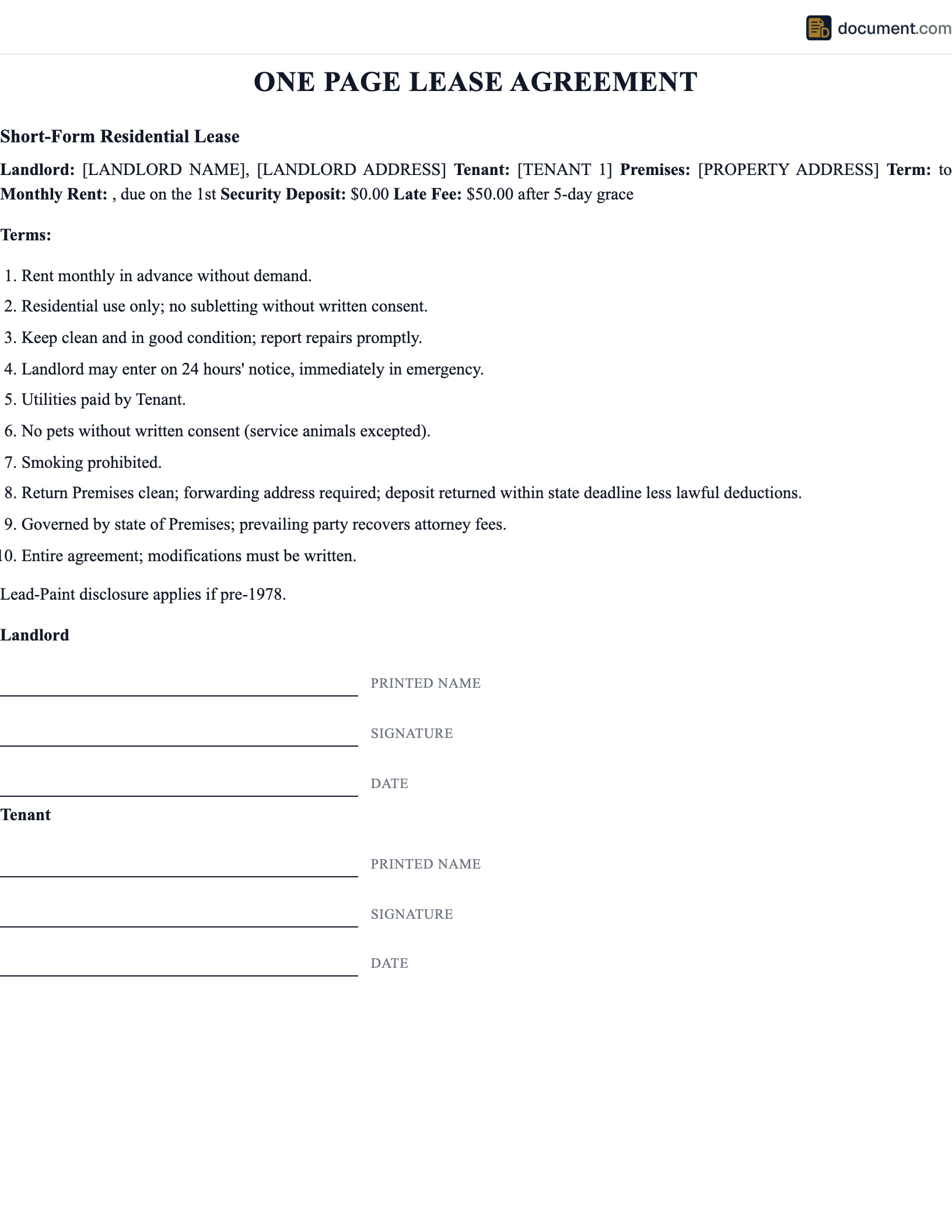



Louisiana One Page Lease Overview
A one-page lease in Louisiana operates under a fundamentally different legal framework than any other state. Louisiana is the only state whose legal system is based on the Napoleonic civil law tradition rather than English common law. Lease agreements in Louisiana are governed by Louisiana Civil Code Articles 2668-2729 (Lease or Hire), which define a lease as a synallagmatic (bilateral) contract. This means Louisiana lease law has different terminology, concepts, and rules than the other 49 states.
One of the most distinctive features of Louisiana lease law is the concept of tacit reconduction (La. C.C. Art. 2721). If a tenant continues to occupy the premises after a fixed-term lease expires without the landlord\'s objection, the lease is automatically renewed on a month-to-month basis under the same terms. This automatic renewal happens by operation of law and does not require any affirmative action by either party. A one-page lease should address what happens at expiration to avoid inadvertent renewals.
Louisiana has no statutory cap on security deposits, no mandatory grace period, and no rent control. The state is generally landlord-friendly in terms of regulatory burden. However, Louisiana\'s civil law framework provides tenants with the right of redhibition — essentially a warranty against hidden defects in the rental property that existed at the time of the lease. The Louisiana rental market centers on New Orleans, Baton Rouge, Shreveport, Lafayette, and Lake Charles, with a significant portion of rentals in flood-prone areas that require special lease considerations.
No statutory cap
Deposit Limit
30 days
Deposit Return
10 days (M-to-M)
Termination Notice
Louisiana Minimum Required Lease Terms
Under Louisiana Civil Code Article 2668, a lease is a synallagmatic contract by which one party binds himself to give the other enjoyment of a thing during a certain time. Louisiana\'s requirements for lease agreements derive from the Civil Code rather than a separate landlord-tenant act:
- Parties: Full legal names of lessor (landlord) and lessee (tenant); Louisiana uses civil law terminology
- Premises: Complete address including city, parish (not county), and zip code; specify if in a flood zone
- Rent: Monthly amount, due date, and payment methods; rent in Louisiana is called the \"price\" of the lease
- Term: Start and end dates for a fixed-term lease; if month-to-month, state expressly to avoid tacit reconduction issues
- Security deposit: Amount (no statutory cap) and return conditions; Louisiana requires return within 30 days
- Signatures: All parties must sign; no notarization required for standard residential leases
Louisiana Required Disclosures
Louisiana has relatively few mandatory disclosures, reflecting its civil law tradition.
- Lead-based paint (federal): Required for housing built before 1978 (42 U.S.C. § 4852d)
- Landlord identity: Name and address of the lessor and any authorized agent
- Flood zone status: If the property is in a designated flood zone, disclosure is strongly recommended given Louisiana\'s flood history
- Known defects: Under the redhibition doctrine, the lessor is liable for hidden defects — disclosing known issues protects against claims
Tacit Reconduction and Civil Law Concepts
Louisiana\'s civil law system creates unique lease dynamics. Under tacit reconduction (La. C.C. Art. 2721), a fixed-term lease automatically renews month-to-month if the tenant remains in possession without objection. The redhibition doctrine (La. C.C. Art. 2696) makes the landlord liable for hidden defects that existed at lease inception — even if the landlord was unaware of them. These civil law concepts have no equivalent in common law states and must be understood when using even a one-page lease in Louisiana.
Enforceability and Default Rules in Louisiana
Louisiana\'s implied warranty is framed as the lessor\'s obligation to deliver the premises in good condition and maintain them during the lease (La. C.C. Art. 2691-2695). The lessor must make necessary repairs during the lease unless the damage was caused by the lessee. If the premises become unfit for use, the lessee may demand repair, reduction of rent, or dissolution of the lease.
The redhibition doctrine (La. C.C. Art. 2696) provides that the lessor is bound to guarantee the lessee against all defects of the thing that prevent it from being used for its intended purpose. Unlike common law habitability claims, redhibition covers defects that existed at the time of the lease — even latent defects the landlord did not know about. This provides Louisiana tenants with broader protection against pre-existing property issues than most states.
Louisiana\'s eviction process begins with a 5-day notice to vacate for non-payment (La. C.C.P. Art. 4701). After the notice period, the landlord files a Rule to Show Cause in the appropriate court (City Court, Justice of the Peace, or District Court depending on the parish and rental amount). Month-to-month tenancies require 10 days\' notice for termination (La. C.C. Art. 2728). The notice period is measured in calendar days. Louisiana does not have just-cause eviction protections outside of New Orleans, which has enacted some tenant protection measures.
Key Financial and Legal Details
| Item | Louisiana Rule |
|---|---|
| Security Deposit Maximum | No statutory cap |
| Deposit Return Deadline | 30 days after lease termination (La. R.S. 9:3251) |
| Late Fee Cap | No statutory cap; must be reasonable |
| Grace Period | No statutory requirement |
| Termination Notice (M-to-M) | 10 calendar days (La. C.C. Art. 2728) |
| Non-Payment Notice | 5 days to vacate (La. C.C.P. Art. 4701) |
| Tacit Reconduction | Automatic month-to-month renewal if tenant stays (La. C.C. Art. 2721) |
| Rent Control | None statewide; limited protections in New Orleans |
Official Louisiana Resources
Other Louisiana Lease Agreement Types
Need a more comprehensive lease for Louisiana? Consider these full-length templates.
Louisiana One Page Lease FAQ
Common questions about simplified one-page lease agreements under Louisiana law.
Create your Louisiana One Page Lease Agreement in under 5 minutes.
Answer a few questions and download a Louisiana-compliant document, ready for the state agency.