
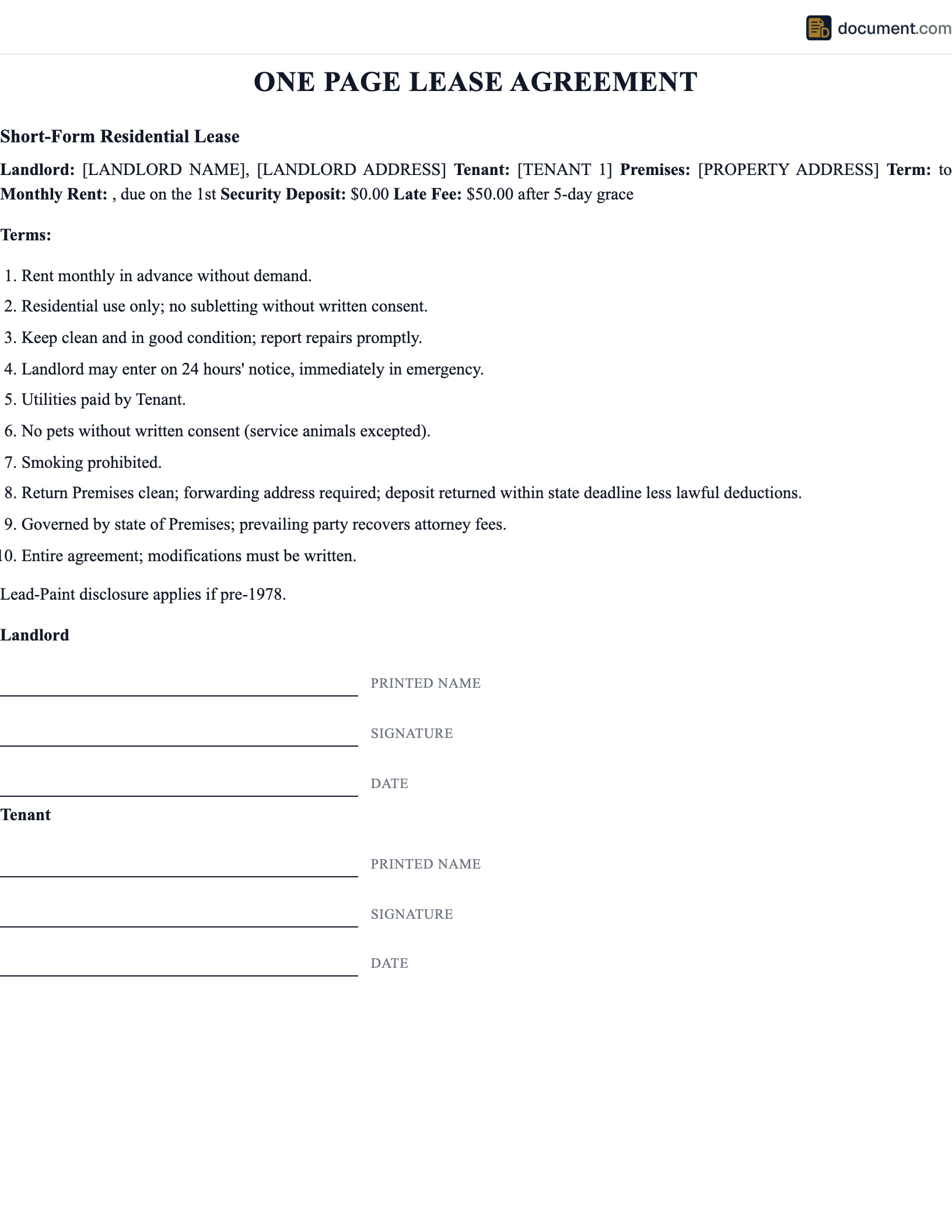



Kansas One Page Lease Overview
A one-page lease in Kansas is governed by the Kansas Residential Landlord and Tenant Act (KRLTA, K.S.A. § 58-2540 through § 58-2573). The Act applies statewide and provides a comprehensive framework for residential tenancies. Kansas is considered a balanced state — neither strongly landlord-friendly nor tenant-friendly — with specific requirements for security deposits, move-in inspections, and maintenance obligations.
Kansas caps security deposits at 1 month\'s rent for unfurnished units and 1.5 months\' rent for furnished units (K.S.A. § 58-2550). The landlord must return the deposit within 30 days after the tenant vacates. Kansas also requires a move-in and move-out inspection (K.S.A. § 58-2548) — both the landlord and tenant must have the opportunity to be present during these inspections. This inspection requirement is particularly important for deposit disputes.
The Kansas rental market centers on the Kansas City metro area (Overland Park, Olathe, Kansas City KS), Wichita, Topeka, Lawrence (University of Kansas), and Manhattan (Kansas State University). Military installations including Fort Riley (Junction City/Manhattan) and McConnell AFB (Wichita) significantly influence local rental markets. University towns and military communities are common settings for one-page leases due to high turnover and relatively straightforward rental arrangements.
1 month (unfurnished)
Deposit Limit
30 days
Deposit Return
Required
Move-In Inspection
Kansas Minimum Required Lease Terms
Under K.S.A. § 58-2543, a rental agreement establishes the tenancy terms. Kansas\'s Statute of Frauds requires leases exceeding one year to be in writing. A valid one-page lease should include:
- Parties: Full legal names of landlord and all adult tenants; include military service branch if applicable
- Premises: Complete address including city and county; specify included parking and storage
- Rent: Monthly amount, due date, and payment methods; if charging late fees, must disclose the amount
- Term: Start and end dates for fixed-term, or month-to-month designation
- Security deposit: Amount (max 1 month for unfurnished, 1.5 months for furnished under K.S.A. § 58-2550)
- Move-in inspection: Reference to the inspection conducted at move-in (K.S.A. § 58-2548)
- Signatures: All parties must sign; no notarization required
Kansas Required Disclosures
Kansas requires specific disclosures with residential leases. These can be attached as addenda.
- Lead-based paint (federal): Required for housing built before 1978 (42 U.S.C. § 4852d)
- Move-in inspection report: Both parties must have the opportunity to inspect at move-in and move-out (K.S.A. § 58-2548)
- Landlord/agent identity: Name and address of the landlord and authorized agent (K.S.A. § 58-2545)
- Late fee disclosure: If late fees are charged, the amount must be disclosed in the lease
Mandatory Move-In and Move-Out Inspections
Kansas law (K.S.A. § 58-2548) requires both a move-in and a move-out inspection of the rental unit. Both the landlord and tenant must have the opportunity to be present at each inspection. The results should be documented and signed by both parties. If the landlord fails to conduct these inspections, it weakens their ability to make security deposit deductions for damage. This requirement applies even with a one-page lease — the inspection report should be referenced in the lease and attached separately.
Enforceability and Default Rules in Kansas
Kansas\'s KRLTA provides an implied warranty of habitability (K.S.A. § 58-2553). The landlord must maintain the premises in a fit and habitable condition, comply with building and housing codes, maintain plumbing, heating, and electrical systems, and keep common areas clean and safe. This warranty applies automatically and cannot be waived in the lease.
If the landlord fails to maintain habitability, Kansas tenants may give 14 days\' written notice specifying the issue. If the landlord fails to repair within 14 days, the tenant may terminate the lease (K.S.A. § 58-2559). For emergency conditions affecting health and safety, the tenant may provide shorter notice. Kansas does not have a broad repair-and-deduct remedy by statute, but tenants can raise habitability defenses in eviction proceedings.
Kansas\'s non-payment eviction process begins with a 3-day notice to pay or vacate (10 days for a first-time non-payment in some circumstances, K.S.A. § 58-2564). If the tenant fails to pay, the landlord files a forcible detainer action in district court. Month-to-month tenancies require 30 days\' notice for termination by either party (K.S.A. § 58-2570). Kansas prohibits retaliatory eviction under K.S.A. § 58-2572. The landlord must give reasonable notice (at least 24 hours) before entering the unit (K.S.A. § 58-2557).
Key Financial and Legal Details
| Item | Kansas Rule |
|---|---|
| Security Deposit Maximum | 1 month (unfurnished) or 1.5 months (furnished) — K.S.A. § 58-2550 |
| Deposit Return Deadline | 30 days after tenant vacates (K.S.A. § 58-2550) |
| Late Fee Cap | No statutory cap; must be disclosed in lease |
| Grace Period | No statutory requirement |
| Termination Notice (M-to-M) | 30 days written notice (K.S.A. § 58-2570) |
| Non-Payment Notice | 3 days (or 10 days first offense) — K.S.A. § 58-2564 |
| Move-In/Out Inspection | Required (K.S.A. § 58-2548) |
| Landlord Entry Notice | Reasonable notice — at least 24 hours (§ 58-2557) |
Official Kansas Resources
Other Kansas Lease Agreement Types
Need a more comprehensive lease for Kansas? Consider these full-length templates.
Kansas One Page Lease FAQ
Common questions about simplified one-page lease agreements under Kansas law.
Create your Kansas One Page Lease Agreement in under 5 minutes.
Answer a few questions and download a Kansas-compliant document, ready for the state agency.