
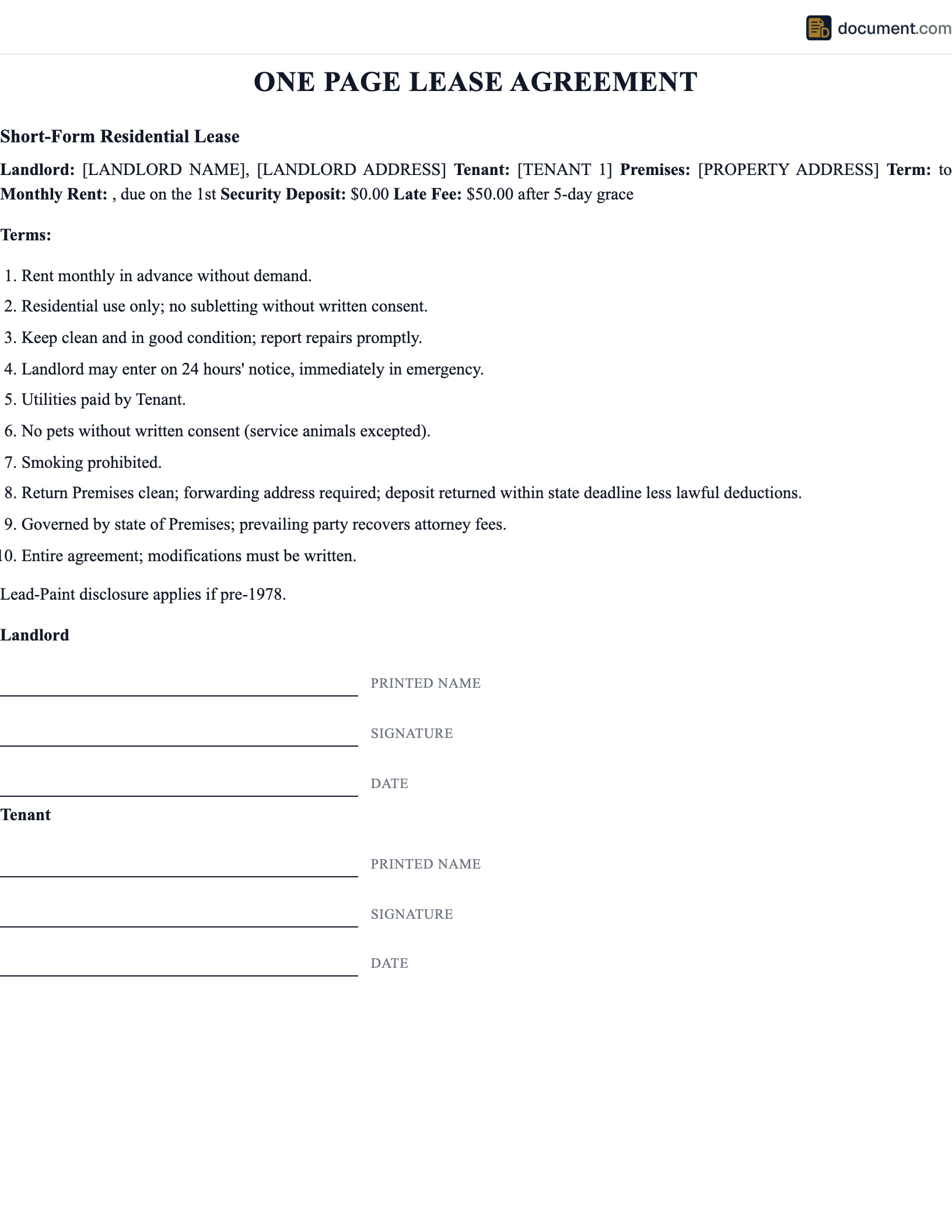



Illinois One Page Lease Overview
A one-page lease in Illinois presents unique challenges because the state does not have a single comprehensive landlord-tenant act that applies statewide. Instead, Illinois relies on a combination of the Security Deposit Return Act (765 ILCS 710), the Security Deposit Interest Act (765 ILCS 715), the Retaliatory Eviction Act (765 ILCS 720), and general landlord-tenant provisions in 735 ILCS 5/9. Chicago has its own comprehensive ordinance — the Chicago Residential Landlord and Tenant Ordinance (RLTO) — which imposes significantly more obligations on landlords than state law.
Outside of Chicago, Illinois landlord-tenant law is comparatively landlord-friendly. There is no statewide rent control, no mandatory grace period, and the security deposit limit depends on the municipality. Under state law, the landlord must return the security deposit within 30-45 days (depending on whether deductions are made) and must pay interest if holding the deposit for more than 6 months (in buildings with 25+ units). In Chicago, the RLTO imposes a detailed security deposit regime including required interest payments, receipts, and specific bank account requirements.
The Illinois rental market varies dramatically between the Chicago metro area and downstate regions. Chicago and its suburbs (Cook, DuPage, Lake, Will counties) have a highly regulated market with professional property management, while downstate markets (Springfield, Champaign-Urbana, Peoria, Rockford) have simpler rental arrangements where one-page leases are more common. University towns like Champaign-Urbana, Normal-Bloomington, and Carbondale have high turnover rental markets driven by student housing.
30-45 days
Deposit Return
5 days
Non-Payment Notice
30 days
Termination Notice
Illinois Minimum Required Lease Terms
Illinois\'s Statute of Frauds (740 ILCS 80/2) requires leases exceeding one year to be in writing. Given the patchwork of Illinois landlord-tenant laws, a one-page lease should include:
- Parties: Full legal names of landlord and all adult tenants; in Chicago, include the landlord\'s RLTO compliance agent if applicable
- Premises: Complete address including unit number, city, county, and zip code; note whether the property is within Chicago city limits (RLTO applies)
- Rent: Monthly amount, due date, and payment methods; late fees allowed but must be reasonable
- Term: Start and end dates for fixed-term, or month-to-month designation
- Security deposit: Amount and return timeline; state law requires return within 30 days (no deductions) or 45 days (with itemized deductions)
- Signatures: All parties must sign; no notarization required
Illinois Required Disclosures
Illinois disclosure requirements vary by location. These can be provided as addenda.
- Lead-based paint (federal): Required for housing built before 1978 (42 U.S.C. § 4852d)
- Radon disclosure: Illinois requires a radon hazard awareness pamphlet be provided (420 ILCS 46/25)
- Landlord identity: Name and address of the owner and authorized agent
- Concession disclosure: If the tenant received any rent concessions, these must be documented
- Carbon monoxide detector: Must disclose if the unit has a CO detector as required by Illinois law (430 ILCS 135)
Chicago RLTO vs. State Law
If the rental property is within Chicago city limits, the Chicago Residential Landlord and Tenant Ordinance (RLTO) imposes significantly more requirements than state law — including mandatory security deposit interest, specific receipt requirements, required lease addenda, and strict penalties for non-compliance. A one-page lease for a Chicago property is especially risky because the RLTO requires specific disclosures and terms that typically require several pages. For Chicago properties, a comprehensive lease is strongly recommended.
Enforceability and Default Rules in Illinois
Illinois recognizes an implied warranty of habitability through case law (Jack Spring Inc. v. Little, 1972). The landlord must maintain the premises in a condition fit for habitation, including structural integrity, plumbing, heating, and electrical systems. This warranty applies statewide regardless of what the lease says. If the landlord fails to maintain habitability, the tenant may raise this as a defense to eviction for non-payment or pursue affirmative claims for damages.
Illinois provides a repair-and-deduct remedy in some jurisdictions and through case law. If the landlord fails to make necessary repairs after notice, the tenant may in some circumstances make the repairs and deduct from rent, though this right is more clearly established in Chicago under the RLTO. Outside Chicago, the tenant\'s primary remedy is to withhold rent and raise habitability as a defense if the landlord files for eviction.
Illinois\'s non-payment eviction process begins with a 5-day notice to pay or vacate (735 ILCS 5/9-209). Month-to-month tenancies require 30 days\' notice for termination. The eviction (forcible entry and detainer) process is filed in circuit court. Illinois prohibits self-help evictions — the landlord must go through the court system. Cook County has additional protections including a right to legal counsel in eviction proceedings (as of recent ordinance changes).
Key Financial and Legal Details
| Item | Illinois Rule |
|---|---|
| Security Deposit Return | 30 days (no deductions) or 45 days (with itemized deductions) |
| Deposit Interest | Required for buildings with 25+ units if held 6+ months (765 ILCS 715) |
| Late Fee Cap | No statewide cap; must be reasonable |
| Grace Period | No statutory requirement (5-day grace in Chicago RLTO) |
| Termination Notice (M-to-M) | 30 days written notice |
| Non-Payment Notice | 5 days to pay or vacate (735 ILCS 5/9-209) |
| Radon Disclosure | Required statewide (420 ILCS 46/25) |
| Rent Control | None statewide; preempted (50 ILCS 825) |
Official Illinois Resources
Other Illinois Lease Agreement Types
Need a more comprehensive lease for Illinois? Consider these full-length templates.
Illinois One Page Lease FAQ
Common questions about simplified one-page lease agreements under Illinois law.
Create your Illinois One Page Lease Agreement in under 5 minutes.
Answer a few questions and download a Illinois-compliant document, ready for the state agency.