
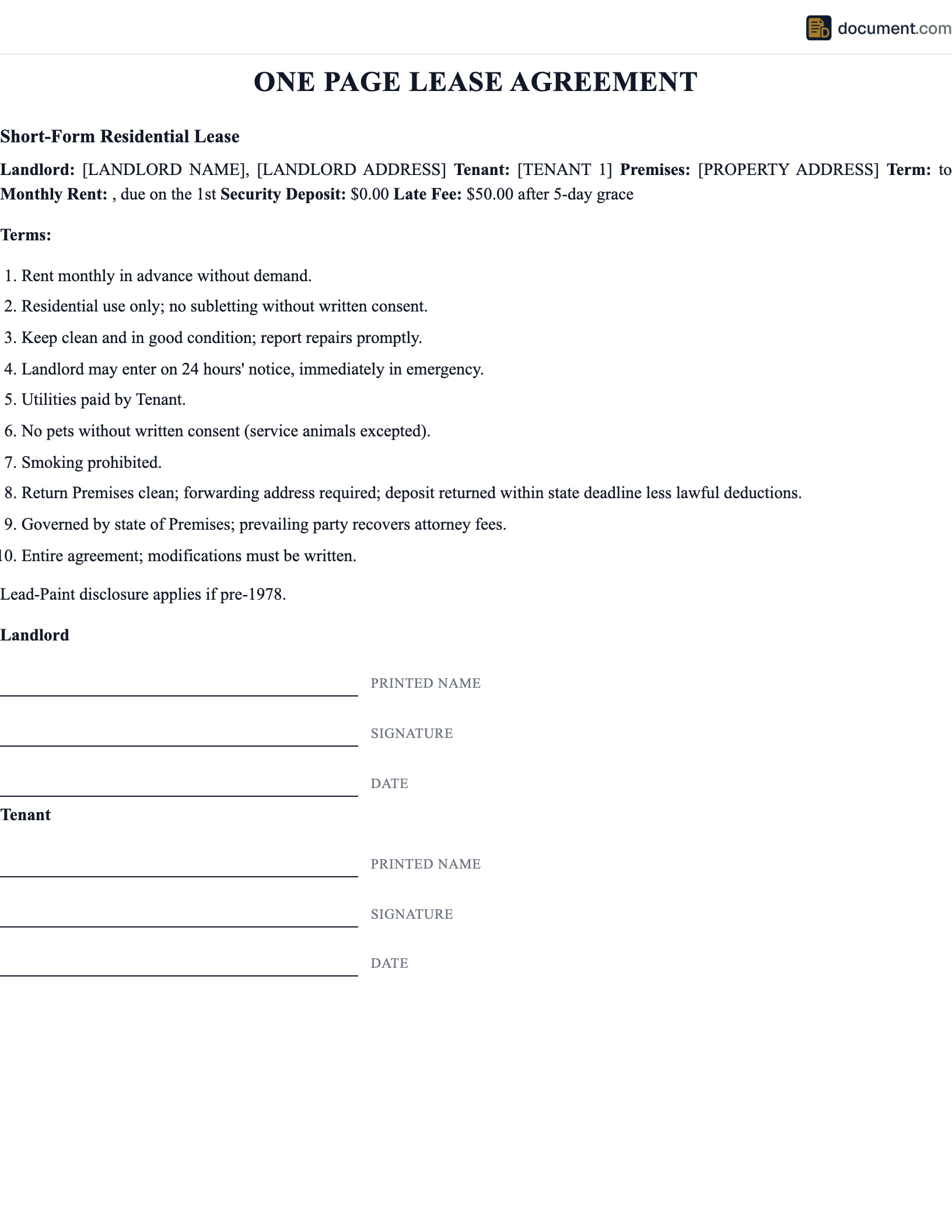



Florida One Page Lease Overview
A one-page lease in Florida is a concise rental agreement covering essential tenancy terms. Florida\'s landlord-tenant law is governed by the Florida Residential Landlord and Tenant Act (F.S. § 83.40-83.683), which applies statewide. Florida is widely considered one of the most landlord-friendly states, with no rent control (state law preempts local rent control under F.S. § 166.043), no mandatory grace period, and a fast eviction process that can be completed in as little as 2-3 weeks.
Florida\'s security deposit rules are among the most detailed in the country (F.S. § 83.49). While there is no cap on the deposit amount, the landlord must hold deposits either in a separate non-interest-bearing account, an interest-bearing account (with interest paid to the tenant), or post a surety bond. The landlord must notify the tenant in writing within 30 days of receiving the deposit, specifying the bank, the account type, and the interest rate if applicable. Failure to provide this notice waives the landlord\'s right to make a claim against the deposit.
Florida\'s rental market is massive and varied — from South Florida condos to Orlando-area houses near theme parks to Jacksonville\'s military-influenced market. Seasonal rentals are extremely common (the \"snowbird\" market), and one-page leases are frequently used for these short-term winter arrangements. For year-round tenancies, particularly in competitive markets like Miami-Dade, Broward, and Palm Beach counties, a comprehensive lease is recommended given the complex condominium association rules and flood zone considerations that may apply.
No statutory cap
Deposit Limit
15-30 days
Deposit Return
Within 30 days (req.)
Deposit Notice
Florida Minimum Required Lease Terms
Under F.S. § 83.43, a rental agreement includes any written or oral agreement for residential tenancy. Florida\'s Statute of Frauds requires leases exceeding one year to be in writing. A valid one-page lease should include:
- Parties: Full legal names of landlord (or management company) and all adult tenants
- Premises: Complete address including unit number, city, county, and zip code; note any condo/HOA association if applicable
- Rent: Monthly amount, due date, and payment methods; Florida has no mandatory grace period
- Term: Start and end dates for fixed-term, or month-to-month designation; seasonal leases should specify exact dates
- Security deposit: Amount collected and notice of which bank/account it will be held in (required within 30 days under F.S. § 83.49)
- Signatures: All parties must sign; no notarization or witnesses required
Florida Required Disclosures
Florida requires certain disclosures with any residential lease. These can be provided as addenda to a one-page lease.
- Lead-based paint (federal): Required for housing built before 1978 (42 U.S.C. § 4852d)
- Landlord identity: Name and address of the landlord and authorized agent for service of process (F.S. § 83.50)
- Security deposit notice: Written notice within 30 days of receipt specifying the bank, account type, and interest rate (F.S. § 83.49)
- Radon gas: Radon disclosure statement required in all Florida leases (F.S. § 404.056(5))
- Fire protection: Must notify if the building does not have fire protection (smoke detectors, fire extinguishers)
Mandatory Security Deposit Notice
Florida requires landlords to provide written notice of the security deposit terms within 30 days of receiving the deposit (F.S. § 83.49). The notice must state the bank name, whether the account is interest-bearing or non-interest-bearing, and the interest rate if applicable. If the landlord fails to provide this notice, they waive the right to make any claim against the deposit. This is one of the strictest deposit notice requirements in the country and applies even to one-page leases.
Enforceability and Default Rules in Florida
Florida recognizes an implied warranty of habitability through case law (Mansur v. Eubanks) and statutory requirements under F.S. § 83.51. The landlord must maintain the premises in compliance with building, housing, and health codes, and must maintain roofing, plumbing, electrical, heating, and structural systems. The landlord must also provide functioning locks, clean common areas, and extermination services. These obligations cannot be waived for single-family homes but can be partially shifted to the tenant for certain maintenance items in the lease.
Florida provides a robust repair-and-withhold remedy for tenants. If the landlord fails to maintain habitability, the tenant must give 7 days\' written notice specifying the issue (F.S. § 83.56(1)). If the landlord fails to fix the problem within 7 days, the tenant can withhold rent. For non-payment by the tenant, the landlord must provide a 3-day notice to pay or vacate (F.S. § 83.56(3)) — one of the shortest in the country — before filing for eviction.
Florida\'s eviction process is among the fastest in the nation. After the 3-day notice expires, the landlord can file an eviction complaint. If the tenant fails to respond within 5 business days, the landlord can obtain a default judgment. The entire process from notice to writ of possession can take as little as 2-3 weeks. Month-to-month tenancies require 15 days\' notice for termination (F.S. § 83.57). Florida does not have just-cause eviction protections — the landlord can terminate a month-to-month tenancy for any lawful reason with proper notice.
Key Financial and Legal Details
| Item | Florida Rule |
|---|---|
| Security Deposit Maximum | No statutory cap; must be held in approved account |
| Deposit Return Deadline | 15 days (no deductions) or 30 days (with deductions) — F.S. § 83.49 |
| Deposit Notice Requirement | Written notice within 30 days of receipt (F.S. § 83.49) |
| Late Fee Cap | No statutory cap; must be reasonable |
| Grace Period | No statutory requirement |
| Termination Notice (M-to-M) | 15 days written notice (F.S. § 83.57) |
| Non-Payment Notice | 3 days to pay or vacate (F.S. § 83.56) |
| Landlord Entry Notice | 12 hours reasonable notice (F.S. § 83.53) |
Official Florida Resources
Other Florida Lease Agreement Types
Need a more comprehensive lease for Florida? Consider these full-length templates.
Florida One Page Lease FAQ
Common questions about simplified one-page lease agreements under Florida law.
Create your Florida One Page Lease Agreement in under 5 minutes.
Answer a few questions and download a Florida-compliant document, ready for the state agency.