
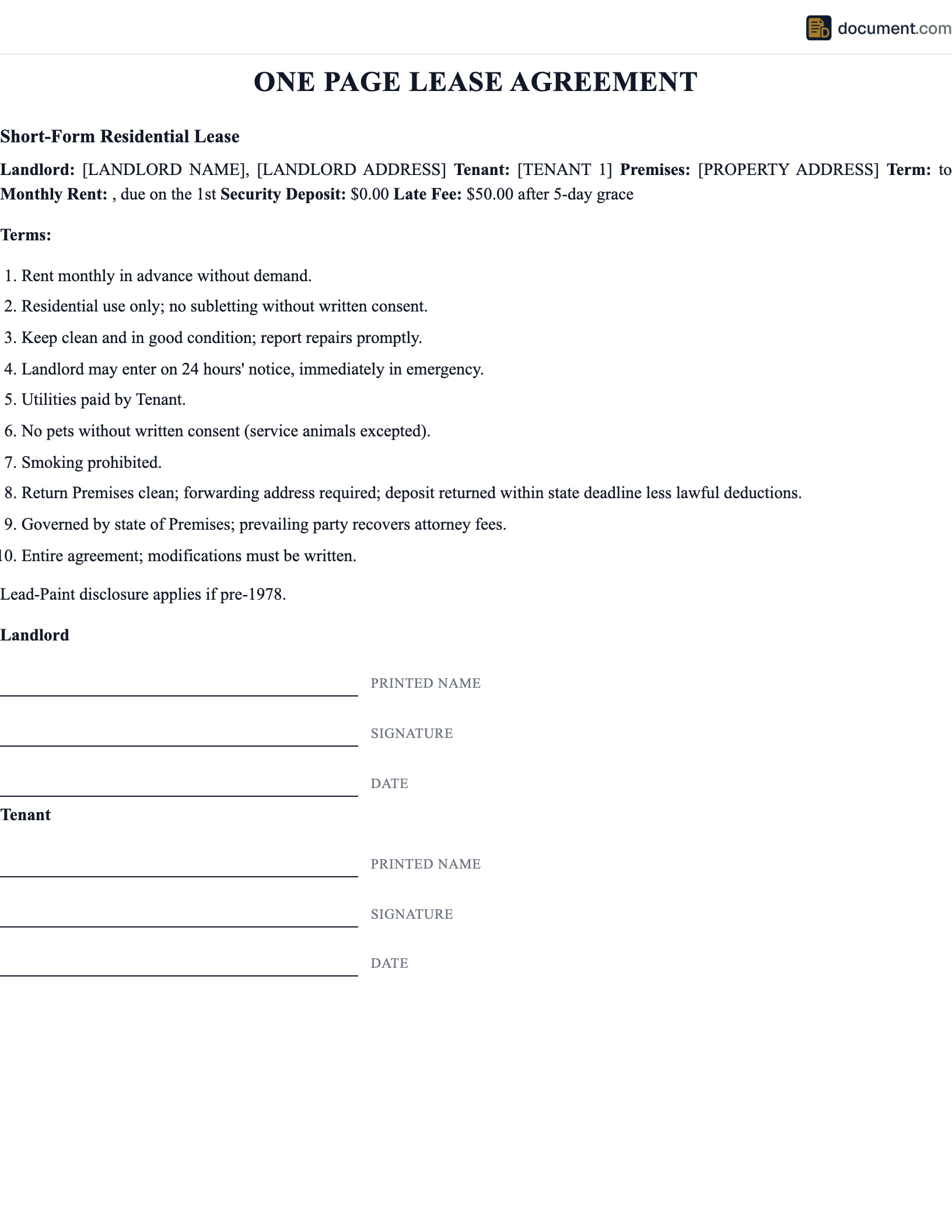



Connecticut One Page Lease Overview
A one-page lease in Connecticut is a concise rental agreement covering essential tenancy terms. Connecticut\'s landlord-tenant law is codified in the Connecticut General Statutes Title 47a (§ 47a-1 through § 47a-74), which provides comprehensive tenant protections that apply statewide. Connecticut is generally considered a tenant-friendly state with robust habitability requirements, strict security deposit rules, and a mandatory 9-day grace period for rent payments — one of the longest in the nation.
Connecticut\'s mandatory 9-day grace period (C.G.S. § 47a-15a) is a standout provision: landlords cannot impose a late fee or begin eviction proceedings until the rent is 9 full days past due. This grace period applies to all residential leases and cannot be waived. Additionally, Connecticut caps security deposits at 2 months\' rent (1 month for tenants 62 or older), and deposits must be held in an escrow account at a Connecticut bank. Interest must be paid annually to the tenant at a rate set by the Banking Commissioner.
The Connecticut rental market is concentrated along the I-95 corridor (Stamford, Norwalk, Bridgeport, New Haven, Hartford) and near Yale University and UConn. Several Connecticut municipalities have additional local housing regulations. A one-page lease works for simple month-to-month arrangements but must still comply with all mandatory disclosure and grace period requirements. For longer-term leases, especially in the competitive Fairfield County market, a comprehensive lease is recommended.
2 months\' rent
Deposit Limit
30 days
Deposit Return
9 days (mandatory)
Grace Period
Connecticut Minimum Required Lease Terms
Under C.G.S. § 47a-1, a rental agreement governs the tenancy. Connecticut\'s Statute of Frauds requires leases exceeding one year to be in writing. A valid one-page lease should include:
- Parties: Full legal names of landlord (or property management entity) and all adult tenants
- Premises: Complete street address including unit number, city, and zip code; specify included parking and storage
- Rent: Monthly amount, due date, and payment methods; note the mandatory 9-day grace period before late fees (C.G.S. § 47a-15a)
- Term: Start and end dates for fixed-term, or month-to-month designation
- Security deposit: Amount (max 2 months\' rent, or 1 month if tenant is 62+, under C.G.S. § 47a-21) and escrow account information
- Signatures: All parties must sign; no notarization required
Connecticut Required Disclosures
Connecticut requires specific disclosures that must accompany any residential lease, including a one-page format. These can be provided as separate addenda.
- Lead-based paint (federal): Required for housing built before 1978 (42 U.S.C. § 4852d)
- Common interest community: If the unit is in a common interest community, the landlord must disclose (C.G.S. § 47a-3e)
- Fire sprinkler system: Must disclose whether the building has a fire sprinkler system (C.G.S. § 47a-7e)
- Landlord/agent identity: Name and address of the owner and managing agent (C.G.S. § 47a-6)
- Bed bug history: Must disclose known bed bug infestations within the past year
Mandatory 9-Day Grace Period
Connecticut law mandates a 9-day grace period for rent payments (C.G.S. § 47a-15a). No late fee can be charged and no eviction action can be initiated until rent is at least 9 days past due. This grace period cannot be waived or shortened in the lease. Any one-page lease that attempts to impose a shorter grace period or charge immediate late fees is unenforceable on that point.
Enforceability and Default Rules in Connecticut
Connecticut provides strong tenant protections through the implied warranty of habitability (C.G.S. § 47a-7). Landlords must maintain premises in a fit and habitable condition, including adequate heat from October 1 to May 31 (minimum 65°F), working plumbing and electrical systems, and compliance with all housing and building codes. This warranty cannot be waived in the lease.
If the landlord fails to maintain habitability, Connecticut tenants have several remedies: they may withhold rent (after notice and opportunity to cure), pursue repair-and-deduct, or file a complaint with the local housing code enforcement office. The tenant may also petition the court for rent escrow under C.G.S. § 47a-14h, where rent is paid to the court until the landlord makes necessary repairs.
Connecticut does not have rent control statewide, though several municipalities have considered local ordinances. Month-to-month tenancies require 3 days\' written notice from the landlord (C.G.S. § 47a-23) before initiating eviction — but this is the notice to quit, not a lease termination notice. For lease termination, the terms of the lease control. If the lease is silent, one full rental period\'s notice is generally expected. The non-payment eviction process begins with a written demand and cannot proceed until after the 9-day grace period.
Key Financial and Legal Details
| Item | Connecticut Rule |
|---|---|
| Security Deposit Maximum | 2 months\' rent (1 month if tenant is 62+) — C.G.S. § 47a-21 |
| Deposit Return Deadline | 30 days after tenant vacates (or 15 days for elderly tenants) |
| Interest on Deposit | Required; rate set annually by Banking Commissioner |
| Late Fee Cap | No statutory cap; but cannot charge until 9 days past due |
| Grace Period | 9 days mandatory (C.G.S. § 47a-15a) |
| Termination Notice (M-to-M) | One rental period (typically 30 days) |
| Non-Payment Notice | 3-day notice to quit (after 9-day grace period) |
| Landlord Entry Notice | Reasonable notice required (24 hours recommended) |
Official Connecticut Resources
Other Connecticut Lease Agreement Types
Need a more comprehensive lease for Connecticut? Consider these full-length templates.
Connecticut One Page Lease FAQ
Common questions about simplified one-page lease agreements under Connecticut law.
Create your Connecticut One Page Lease Agreement in under 5 minutes.
Answer a few questions and download a Connecticut-compliant document, ready for the state agency.