
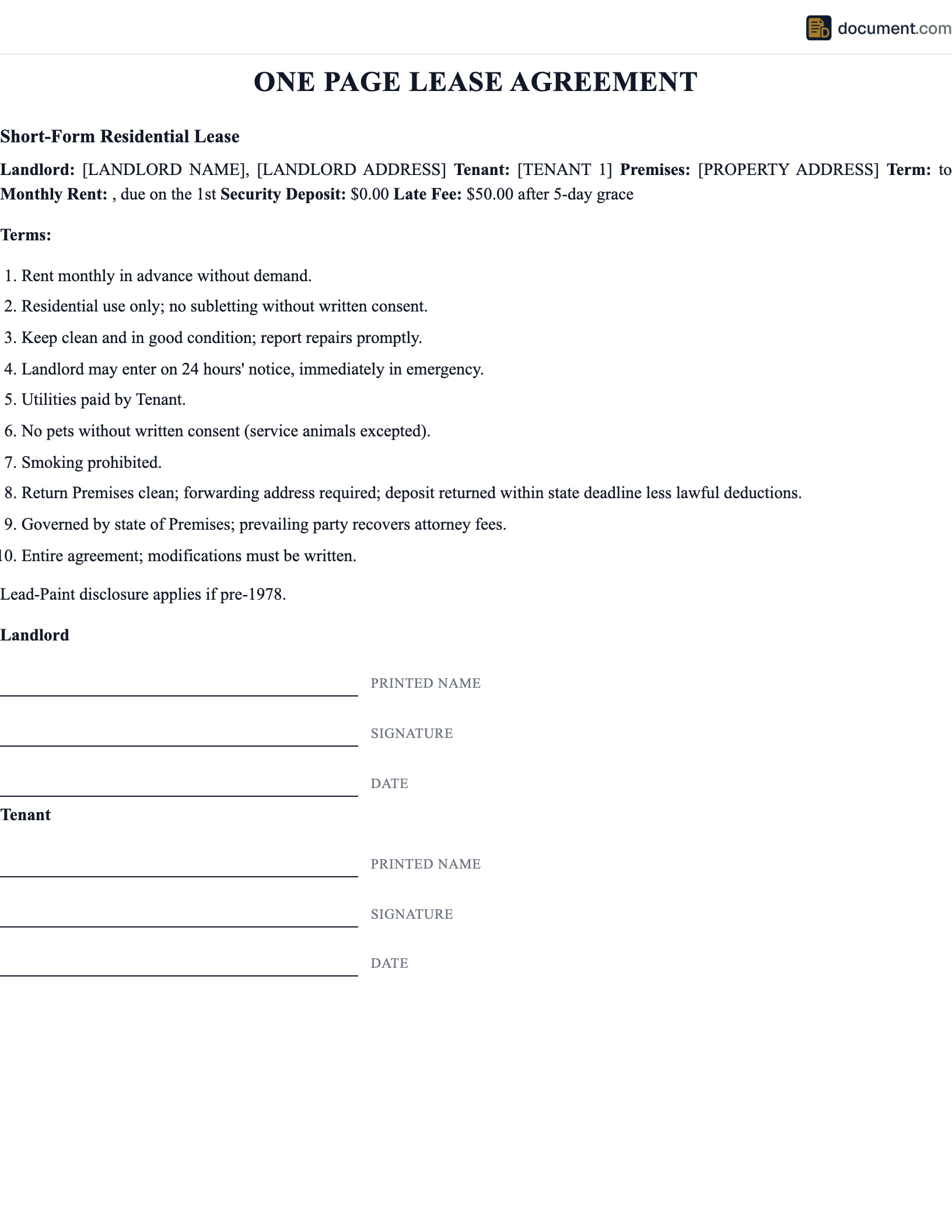



California One Page Lease Overview
A one-page lease in California is a streamlined rental agreement that covers core tenancy terms. California's landlord-tenant law is governed primarily by California Civil Code §§ 1940-1954.06 and the Tenant Protection Act of 2019 (AB 1482), which imposes statewide rent caps and just-cause eviction requirements on most residential properties. California is widely regarded as the most tenant-protective state in the nation, with dozens of mandatory disclosures, strict security deposit rules, and local rent control ordinances in many cities.
Using a one-page lease in California carries significant risk because the state imposes so many requirements on landlords. Missing even one mandatory disclosure can expose the landlord to penalties, and omitting required terms may not be saved by default rules in the tenant's favor. Cities like San Francisco, Los Angeles, Oakland, Berkeley, and Santa Monica have their own rent control ordinances that impose additional obligations beyond state law. A one-page lease may be appropriate for very short-term arrangements or situations where both parties are sophisticated, but for most California rentals a comprehensive lease is strongly recommended.
Effective July 1, 2024, California also enacted AB 12, which caps security deposits at 1 month's rent for all residential landlords regardless of whether the unit is furnished — replacing the prior limits of 2 months' (unfurnished) or 3 months' (furnished). This is one of the strictest deposit caps in the nation and a change that any one-page lease must reflect. Additionally, California requires landlords to accept at least one form of payment other than cash or electronic funds transfer, and prohibits requiring tenants to pay rent only through electronic means.
1 month's rent
Deposit Limit
21 days
Deposit Return
5% + CPI or 10%
Rent Cap (AB 1482)
California Minimum Required Lease Terms
California Civil Code § 1940 et seq. governs residential tenancies. The Statute of Frauds (Civil Code § 1624) requires leases exceeding one year to be in writing. Given California's extensive regulatory framework, a valid one-page lease should include at minimum:
- Parties: Full legal names of landlord (individual or entity) and all adult occupants who are tenants; California prohibits landlords from restricting occupancy to fewer persons than allowed by law
- Premises: Complete address including unit number; specify included parking, storage, and whether the unit is subject to local rent control
- Rent: Monthly amount, due date, and accepted payment methods; must accept at least one form other than cash or electronic transfer; must comply with AB 1482 rent caps (5% + CPI or 10%, whichever is less) if applicable
- Term: Start and end dates or month-to-month; month-to-month tenancies require 30 days' notice (under 1 year) or 60 days' notice (1 year or more) for termination
- Security deposit: Capped at 1 month's rent (Civil Code § 1950.5, as amended by AB 12 effective July 2024) — no distinction between furnished and unfurnished
- Signatures: All parties must sign; no notarization required
California Required Disclosures
Even with a one-page lease, California requires certain disclosures. These can be provided as separate addenda attached to the lease.
- Lead-based paint (federal): For housing built before 1978 (42 U.S.C. § 4852d)
- Mold disclosure: Known presence of mold or mold-producing conditions (Health & Safety Code § 26148)
- Bed bug disclosure: Known bed bug infestations (Civil Code § 1954.603)
- Flooding/flood zone: If the property is in a flood hazard zone (Gov. Code § 8589.45)
- Demolition plans: If the landlord has applied for a demolition permit (Civil Code § 1940.6)
- Sex offender database: Notice of Megan's Law database availability (Civil Code § 2079.10a)
- Pest control: Previous pest control treatments (Civil Code § 1940.8)
- Military ordnance: If the property is near a former military base with potential ordnance (Civil Code § 1940.7)
- Smoking policy: Building smoking policy disclosure (Civil Code § 1947.5)
- AB 1482 notice: Whether the property is subject to the Tenant Protection Act rent caps and just-cause eviction
Extensive Disclosure Requirements
California has the longest mandatory disclosure list of any state — over 20 separate disclosures depending on the property. The required addenda for a California lease will far exceed the one-page lease itself. Failing to provide mandatory disclosures can result in penalties, inability to enforce certain lease terms, and liability for the landlord. A one-page lease format is generally not recommended for California unless supplemented with comprehensive disclosure addenda.
Enforceability and Default Rules in California
California provides extremely strong default protections through statute. The implied warranty of habitability (Green v. Superior Court, 10 Cal.3d 616) requires landlords to maintain premises in a habitable condition regardless of lease terms. Tenants have repair-and-deduct remedies (Civil Code § 1942) and may withhold rent if conditions substantially impair habitability. The landlord must provide at least 24 hours' notice before entry (Civil Code § 1954), and entry is limited to specific purposes.
The Tenant Protection Act of 2019 (AB 1482) imposes statewide rent caps of 5% + local CPI (or 10%, whichever is less) and requires just-cause for eviction after 12 months of tenancy. These protections apply to most residential properties built before 2005 (rolling 15-year exemption). If a one-page lease fails to address AB 1482, the protections apply automatically — the landlord cannot evict without cause or raise rent beyond the cap, even if the lease is silent.
Security deposit rules in California are strictly enforced. The deposit must be returned within 21 days after the tenant vacates (Civil Code § 1950.5). Deductions are limited to unpaid rent, cleaning to the same level of cleanliness as move-in, and repair of damage beyond normal wear and tear. If the landlord fails to comply, the tenant may recover up to twice the deposit amount in court. The one-page lease should clearly state the deposit amount and return procedures.
Key Financial and Legal Details
| Item | California Rule |
|---|---|
| Security Deposit Maximum | 1 month's rent (Civil Code § 1950.5, AB 12) |
| Deposit Return Deadline | 21 days after tenant vacates (Civil Code § 1950.5) |
| Late Fee Cap | No statutory cap; must be reasonable estimate of damages |
| Grace Period | No statutory requirement |
| Rent Cap (if AB 1482 applies) | 5% + local CPI or 10%, whichever is less |
| Termination Notice (M-to-M) | 30 days (under 1 year) or 60 days (1+ year) |
| Non-Payment Notice | 3 days to pay or quit (CCP § 1161) |
| Landlord Entry Notice | 24 hours written notice (Civil Code § 1954) |
Official California Resources
Other California Lease Agreement Types
Need a more comprehensive lease for California? These full-length templates provide complete coverage.
California One Page Lease FAQ
Common questions about simplified one-page lease agreements under California law.
Create your California One Page Lease Agreement in under 5 minutes.
Answer a few questions and download a California-compliant document, ready for the state agency.