
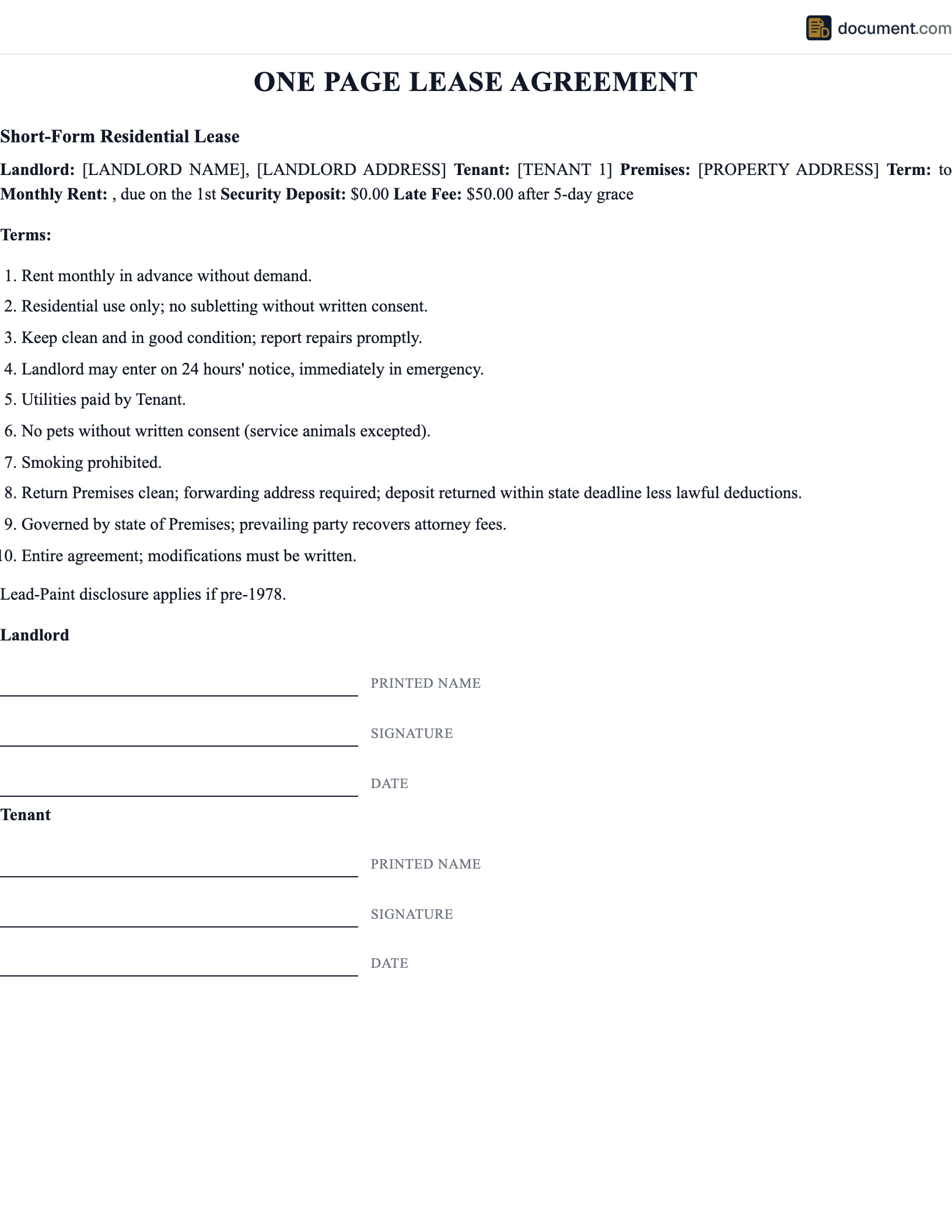



Alaska One Page Lease Overview
A one-page lease in Alaska is a concise rental agreement that covers the essential terms of a tenancy. Alaska's landlord-tenant relationship is governed by the Alaska Uniform Residential Landlord and Tenant Act (AS 34.03), which applies statewide to most residential rentals. Unlike states where tenant protection laws vary by jurisdiction, Alaska's statute provides a uniform baseline of rights and obligations that apply regardless of what the lease contains — making a short-form lease more practical here than in many other states.
Alaska's unique geographic and climatic conditions create special considerations for rental agreements. Extreme winter temperatures reaching -40°F in interior regions like Fairbanks, limited road access to many communities, and high cost of heating fuel mean that certain lease terms — particularly those addressing heating responsibility, utility costs, and winterization — are more critical here than in the Lower 48. A one-page lease that fails to address heating fuel responsibility can lead to serious disputes, especially when heating oil costs exceed $4 per gallon and a winter's supply can run $3,000 to $5,000.
The Alaska rental market is concentrated in a few urban areas — Anchorage (containing about 40% of the state's population), the Matanuska-Susitna Valley, Fairbanks, and Juneau. Each area has distinct conditions shaped by proximity to military bases (JBER in Anchorage, Eielson AFB near Fairbanks), seasonal employment in fishing and tourism, and housing supply constraints. One-page leases work best for straightforward month-to-month arrangements, seasonal rentals, and simple tenancies in urban areas where the statutory framework fills most gaps.
2 months' rent max
Security Deposit Limit
30 days
Termination Notice (M-to-M)
14 days
Deposit Return Deadline
Alaska Minimum Required Lease Terms
Under AS 34.03.010, a rental agreement governs the terms of the tenancy. Alaska's Statute of Frauds (AS 09.25.010) requires contracts that cannot be performed within one year to be in writing. For leases exceeding one year, a written agreement is mandatory. The following elements are essential for a valid Alaska one-page lease.
- Parties: Full legal names of landlord (or property management company) and all adult tenants; military tenants should include their duty station and branch
- Premises: Physical address including city and borough; many rural Alaska addresses lack standard street numbers and may use PO box or rural route designations
- Rent: Monthly amount, due date, and acceptable payment methods; account for rural mail delivery delays when setting payment deadlines
- Term: Start and end dates for fixed-term, or month-to-month designation; seasonal rentals should specify exact duration
- Security deposit: Amount (capped at 2 months' rent for units at $2,000/mo or less under AS 34.03.070) and return conditions
- Heating/utilities: Strongly recommended — specify who pays for heating fuel, electricity, water, and sewer; critical in Alaska's climate
- Signatures: All adult parties must sign; no notarization or witnesses required for enforceability
Alaska Required Disclosures
Alaska landlords must provide certain disclosures regardless of lease length. These can be provided as a separate addendum page attached to the one-page lease.
- Lead-based paint (federal): Required for housing built before 1978; landlord must provide the EPA pamphlet and disclose known lead hazards (42 U.S.C. § 4852d)
- Landlord/agent identity: Name and address of the person authorized to manage the premises and receive legal notices (AS 34.03.080)
- Fire extinguisher location: Alaska requires disclosure of fire safety equipment locations within the rental unit
- Municipal requirements: Anchorage, Fairbanks North Star Borough, and Juneau may have additional disclosure obligations — check local housing authorities
Climate-Related Disclosure Best Practices
While not legally mandated, Alaska landlords should strongly consider disclosing: heating system type (oil, natural gas, electric, wood), typical winter fuel costs, pipe freeze prevention procedures, and any known insulation deficiencies. Failure to disclose serious habitability issues related to winterization could expose landlords to liability under the implied warranty of habitability (AS 34.03.100). This is especially critical in remote areas with limited emergency repair services.
Enforceability and Default Rules in Alaska
Alaska's URLTA provides comprehensive default rules that apply when a lease is silent on an issue. This makes a one-page lease more viable in Alaska than in states with fewer statutory protections, because the Act automatically fills important gaps.
Implied warranty of habitability (AS 34.03.100): The landlord must maintain the premises in a fit and habitable condition regardless of what the lease says. This includes structural integrity, plumbing, electrical, and heating systems; weatherproofing; and compliance with building codes. In Alaska, adequate heating is considered essential to habitability. A landlord cannot waive this obligation through a lease provision — any waiver clause is void as a matter of public policy.
Tenant remedies (AS 34.03.180):If the landlord fails to maintain habitability, the tenant may give written notice and allow 10 days for repair. For essential services like heat, water, and electricity, the tenant may procure reasonable substitutes and deduct the cost from rent. In Alaska's climate, a failed heating system constitutes an emergency that requires immediate landlord response.
Entry notice (AS 34.03.140):Alaska requires at least 24 hours' notice before landlord entry, except in emergencies. Entry must be at a reasonable time and for specific purposes: inspections, repairs, showing the unit, or emergencies. This applies even if the lease does not mention entry rights.
Key Financial and Legal Details
| Item | Alaska Rule |
|---|---|
| Security Deposit Maximum | 2 months' rent (rent ≤ $2,000/mo); no cap if rent > $2,000/mo (AS 34.03.070) |
| Deposit Return Deadline | 14 days (with forwarding address); 30 days (without) |
| Late Fee Cap | No statutory cap; must be reasonable (not a penalty) |
| Grace Period | No statutory requirement |
| Termination Notice (M-to-M) | 30 days written notice (AS 34.03.290) |
| Non-Payment Notice | 7 days to pay or vacate (AS 34.03.220) |
| Landlord Entry Notice | 24 hours (AS 34.03.140) |
| Rent Control | None statewide |
Official Alaska Resources
Other Alaska Lease Agreement Types
Need a more detailed lease for Alaska? These templates address heating, winterization, and other Alaska-specific concerns comprehensively.
Alaska One Page Lease FAQ
Common questions about using a simplified one-page lease agreement under Alaska law.
Create your Alaska One Page Lease Agreement in under 5 minutes.
Answer a few questions and download a Alaska-compliant document, ready for the state agency.