
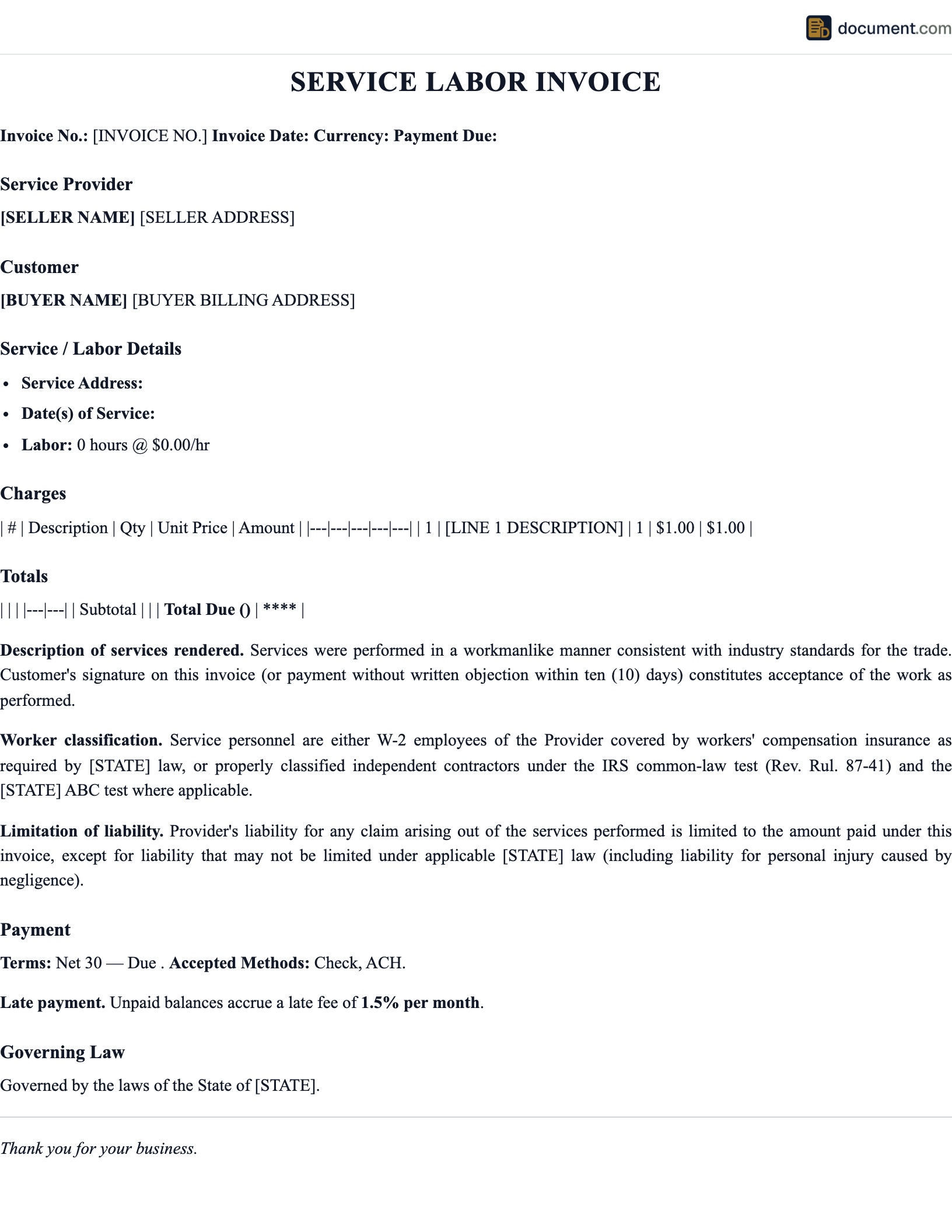



What Is a Service/Labor Invoice?
A service/labor invoice is the demand for payment a service provider issues to a client when the deliverable is labor, expertise, and time, with materials secondary or incidental. It is the most versatile invoice in the trades because it is profession-agnostic: handymen, appliance technicians, carpet cleaners, furniture assemblers, pressure washers, locksmiths, fence builders, junk-removal operators, computer repair technicians, and on-site equipment maintenance crews all use the same fundamental structure. The invoice records hours, rates, materials, travel, minimum charges, sales tax, and total. It is simultaneously the payment request, the warranty trigger, the tax document supporting the provider's Schedule C and the client's 1099-NEC obligation under IRC § 6041 (for $600 or more in trade-or-business payments), and, where state lien law applies to labor on real property, the predicate document for any subsequent mechanic's lien.
Service/labor invoicing differs from product invoicing because the deliverable is intangible: the client pays for the result but is being billed for the time and skill required to achieve it. This produces friction. The client wants to pay for the minimum time necessary; the provider needs compensation for expertise, travel, setup, cleanup, insurance, vehicle, and the carrying cost of running a service business. The well-structured invoice resolves this tension by showing exactly how time was spent, what materials were used, what travel was billed, and why the total reflects the reasonable value of the work. Vague invoices invite quantum-meruit disputes that the provider almost always loses; a magistrate court reduces the bill to what the homeowner's expert says the work should have cost.
Tax and licensing rules vary by state. Most states exempt labor from sales tax but tax materials sold to the client; Connecticut, Hawaii, New Mexico, South Dakota, and Texas tax most or all services. State licensing applies above per-project thresholds: California requires a CSLB license for any home-improvement project of $500 or more (Cal. Bus. & Prof. Code § 7028); Florida requires a registered or certified contractor for projects over $1,000 (Fla. Stat. § 489.103); Arizona at $1,000 (A.R.S. § 32-1121). Below the threshold, unlicensed handyman work is permitted in most states but the invoice should still display the provider's business name, contact information, EIN or SSN for 1099 purposes, and any insurance and bonding details. Properly structured invoices create the audit trail the provider needs for Schedule C reconciliation and the client needs for 1099-NEC issuance.
Worker classification under IRS, DOL, and state ABC tests
Service/labor providers operate as independent contractors in nearly every engagement. The IRS applies the common-law control test under Rev. Rul. 87-41 (behavioral control, financial control, type of relationship). The DOL applies the economic-realities test under the March 2024 final rule (29 C.F.R. Part 795) restoring the totality analysis. California, Massachusetts, New Jersey, and Connecticut apply the ABC test (Cal. Lab. Code § 2775 codifying Dynamex Operations W. v. Superior Ct., 4 Cal. 5th 903 (2018)): the worker is an employee unless the hiring entity proves freedom from control, work outside the usual course of business, and engagement in an independently established trade. A misclassified worker triggers back overtime under FLSA, unpaid FICA and FUTA contributions, state unemployment liability, and IRS § 3509 penalties up to 100 percent of unpaid taxes. The invoice from a properly classified independent contractor reads "Bill From: [Business Name], EIN: XX-XXXXXXX" rather than as a payroll-style timesheet.
1099-NEC reporting threshold
A client running a trade or business who pays a service provider $600 or more in a calendar year must collect Form W-9 before payment and issue Form 1099-NEC by January 31 of the following year (IRS Form 1099-NEC instructions, 2024 revision). Failure to file carries penalties under IRC § 6721 ranging from $60 to $310 per return depending on lateness, doubled for intentional disregard. The provider who refuses to provide a W-9 is subject to backup withholding of 24 percent under IRC § 3406. For purely personal-use payments (residential homeowner not running a rental or home office) the 1099-NEC obligation does not apply, but the invoice still generates self-employment income to the provider that must be reported on Schedule C and subject to self-employment tax of 15.3 percent under IRC § 1401 on net earnings up to the Social Security wage base ($168,600 for 2024).
Hourly Tracking
Documents start/end times, labor hours, and applicable rates for each service visit.
Travel Billing
Handles trip charges, mileage, and travel-zone pricing with full transparency.
Minimum Charges
Supports minimum service fees, flat dispatch rates, and blended billing models.
Service/Labor Invoice Form Preview
Service & Labor Invoice
Invoice #SVC-2024-0738
Service Provider:
Insured & Bonded
Client:
Service Address:
Services Rendered
Warranty: 30-day labor warranty on all work performed. Parts carry manufacturer warranty.
Key Components
Eight components convert a service receipt into an enforceable invoice that supports payment, lien rights, and tax reporting. Each addresses a question that would otherwise default to oral testimony or the client's adverse interpretation.
Insurance and bonding disclosure
General liability coverage of $1 million per occurrence and $2 million aggregate is the residential standard for service trades; commercial property managers and HOAs commonly require $2 million per occurrence. Workers' compensation is required by every state except Texas the moment the provider hires a single W-2 worker, with thresholds varying by state (one employee in California Lab. Code § 3700, three in Florida and South Carolina). Commercial auto insurance is required wherever the vehicle is used for business; personal auto policies exclude commercial use and the carrier denies the claim. Display carrier and policy number on the invoice and offer a Certificate of Insurance on request; commercial clients require the COI naming them as additional insured before authorizing work, often with 30-day cancellation notice riders.
Mechanic's lien predicate elements (where applicable)
When the work attaches to real property and qualifies for a mechanic's lien (improvements, repairs, installation work), the invoice should identify the property by legal description or street address, name the owner of record verified through county records, state the dates labor was furnished and materials delivered, itemize labor and materials separately, and show the unpaid balance. Maintain copies of the served Preliminary Notice (California within 20 days of first work under Cal. Civ. Code § 8204), Notice to Owner (Florida within 45 days under Fla. Stat. § 713.06), or monthly notice (Texas by the 15th day of the third month for residential under Tex. Prop. Code § 53.252). Pure personal-property service work (appliance repair, computer repair, fence on rental property) generally does not support a mechanic's lien but may be enforced through small-claims procedure or a UCC § 9 service-provider lien in some jurisdictions.
| Component | Purpose | Key Details |
|---|---|---|
| Provider Info | Identifies the service provider | Business name, phone, email, license (if applicable), insurance status |
| Service Description | Documents the work performed | Task description, location within property, start/end time, outcome |
| Labor Charges | Shows time-based billing | Hours worked, hourly rate, overtime rate, minimum charge, labor subtotal |
| Materials | Tracks supplies used | Item description, quantity, cost, markup, extended total, receipt references |
| Travel Charges | Compensates for dispatch | Trip charge, mileage, travel time rate, free-zone radius |
| Tax Calculation | Ensures compliance | Taxable materials separated from exempt labor, state/local rate applied |
| Warranty | Documents post-service coverage | Labor warranty period, parts warranty passthrough, exclusions, claim process |
| Payment Terms | Sets payment expectations | Due date, accepted methods, late fee, dispute procedure |
How to Create a Service/Labor Invoice
Six steps in this order. The pre-work documentation (signed estimate, change-order template, W-9 collection from commercial clients) controls what the post-work invoice can enforce.
Pre-work documentation
Before the first service step: signed written estimate stating scope and price (California Bus. & Prof. Code § 7159 for home-improvement contracts over $500 lists 16 mandatory items including the down-payment cap of the lesser of 10 percent or $1,000), W-9 collection from commercial clients that will issue a 1099-NEC, photographs of pre-existing conditions where damage claims are possible, and disclosure of the minimum service charge and travel-charge structure. The Federal Cooling-Off Rule (16 C.F.R. § 429.1) gives the homeowner three business days to cancel any home-solicitation sale of $25 or more; for in-home solicited work, deliver the cancellation notice in writing and wait out the rescission period before performing non-emergency work.
Change-order discipline
Any work exceeding the estimate by more than 10 to 15 percent requires written client authorization before resumption. Cal. Civ. Code § 1689.6 makes oral residential change orders unenforceable. The change order should state the new scope, the new dollar amount, and bear the homeowner's signature and date (signed text-message thread or signed email is sufficient under the federal ESIGN Act, 15 U.S.C. § 7001). Photograph any discovered condition that triggered the change order; the photo defeats later contests. Bill the additional work as its own labeled line on the invoice (Additional Work, Client Authorized [date]).
Document the Service Visit
Record the date, the client's name and service address, your arrival and departure times, and a summary of the work requested. If you provided an estimate before the visit, reference the estimate number so the client can compare the invoice to the original quote.
Describe Each Task Performed
Create a separate line item for each distinct task: ceiling fan installation, drywall patching, faucet repair, furniture assembly, etc. For each task, note the location within the property (e.g., 'master bedroom,' 'kitchen sink'), the work performed, and any relevant details the client should know about the completed work.
Calculate Labor Charges
Show the hours worked for each task (or the total hours if billing as a single block), the applicable hourly rate, and the labor subtotal. If a minimum service charge applies and the actual hours fall below the minimum, show the minimum charge instead of the hourly calculation. If overtime or after-hours rates apply to any portion of the work, break those out separately.
Itemize Materials and Travel
List every material or supply used with the description, quantity, cost, and any markup. Add the travel charge (flat trip fee or mileage calculation) as a separate line item. If materials were purchased specifically for this job, note that receipts are available upon request.
Apply Tax and Add Warranty Terms
Calculate sales tax on taxable items (materials in most states, services in Connecticut, Hawaii, New Mexico, South Dakota, Texas residential repair). Show the tax breakdown line by line. Add warranty terms (typical 30 to 90 days on labor with manufacturer pass-through on parts). Note warranty start and expiration dates and the claim procedure.
Present Payment Terms and Send
Specify payment terms (due on completion for residential, Net 15 or Net 30 for commercial), accepted methods (cash, check, ACH, card, Venmo, Zelle), and late-fee rate (1.5 percent per month is enforceable in most states; California limits to 10 percent annual under Civ. Code § 3289 absent agreement, Texas allows up to 18 percent under Fin. Code § 302.001). Send the invoice within 24 hours of completion; same-day invoicing dramatically improves collection rates.
Frequently Asked Questions
Official Resources
Business resources, government agencies, and industry organizations for service professionals.
SBA - Business Financial Management
Small Business Administration guide to invoicing, accounting, and financial planning for service businesses.
IRS Self-Employed Tax Center
Tax filing, quarterly estimated payments, business deductions, and 1099 requirements for independent service providers.
OSHA Small Business Resources
Safety standards, compliance assistance, and free consultation programs for small service businesses.
FTC Business Guidance
Federal Trade Commission resources on advertising, consumer protection, and business compliance for service providers.
SCORE - Free Business Mentoring
Free mentoring, workshops, and resources for small business owners including service contractors and freelancers.
DOL - Fair Labor Standards Act
Federal wage and hour standards relevant to service providers who hire employees or subcontractors.
Create Your Service/Labor Invoice
Document hourly rates, travel charges, materials, and warranty terms in a professional invoice your clients trust.
Create DocumentNo account required. Free to create and preview.