
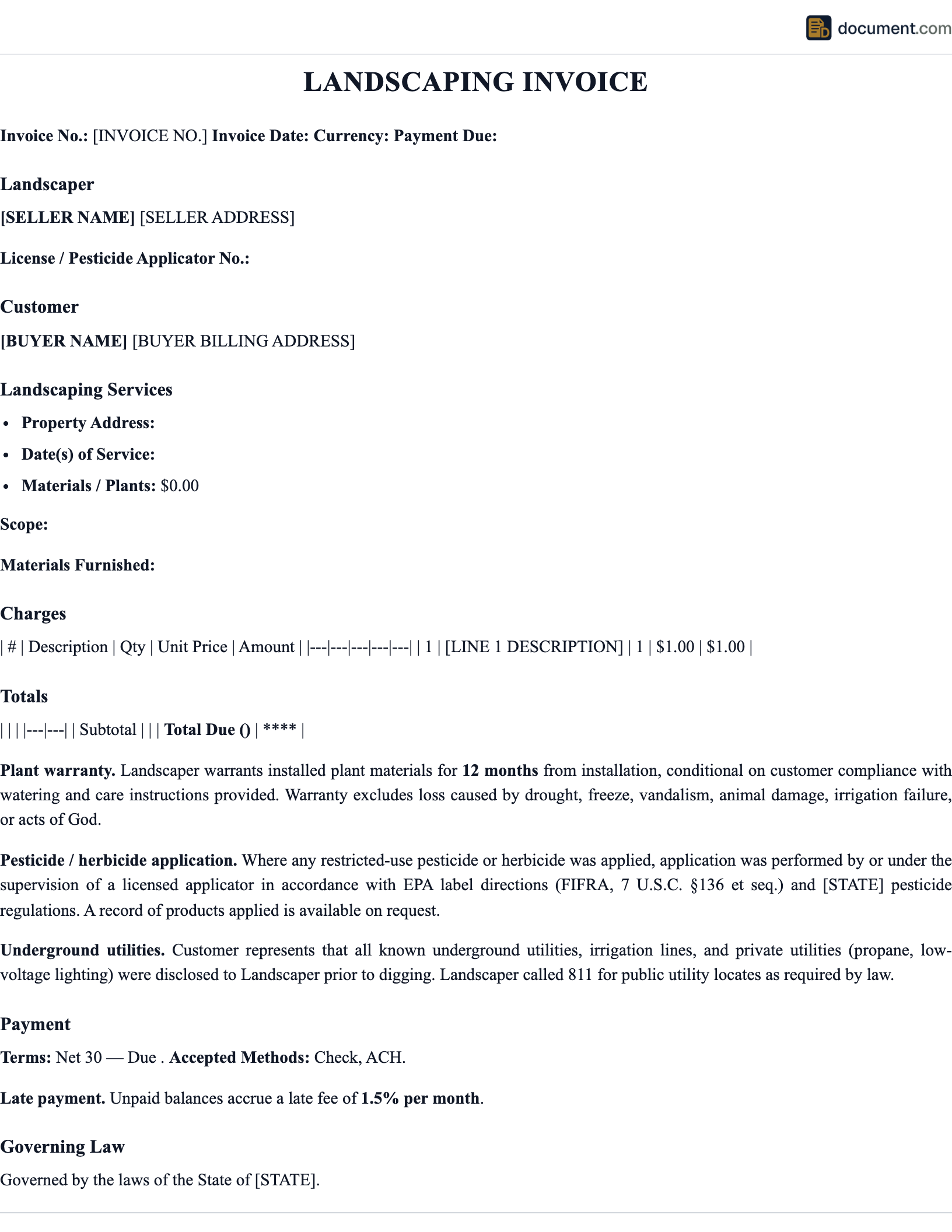



What Is a Landscaping Invoice?
A landscaping invoice is the demand for payment a lawn-care or landscape-installation business serves on a property owner, tenant, or property manager after performing mowing, planting, mulching, irrigation, or hardscape work. The invoice does triple duty: it perfects the contractor's right to compensation under the underlying service agreement, it supports a mechanic's lien claim against the property if the bill goes unpaid, and it documents sales-tax collection where state law treats landscaping labor as a taxable service. Texas taxes residential landscape maintenance at 8.25 percent under Tex. Tax Code § 151.0048; New York under Tax Law § 1105(c)(5); Connecticut under Conn. Gen. Stat. § 12-407 at 6.35 percent. The invoice that fails to itemize taxable from non-taxable items invites a state audit assessment.
Landscaping invoicing combines three pricing models on the same property within the same calendar year. Weekly mowing is per-visit. Monthly fertilization, aeration, and pre-emergent applications are seasonal. Installation projects (patios, retaining walls, planting beds) are deposit-plus-progress-plus-final. Materials are marked up over wholesale (15 to 25 percent on bulk, 30 to 50 percent on plants and trees, 20 to 35 percent on hardscape). The invoice must distinguish each pricing basis on its face, both because the client expects the breakdown and because state consumer-protection statutes (Cal. Civ. Code § 1770, N.Y. Gen. Bus. Law § 349) reach concealed pricing components.
Several landscaping operations require state-issued licenses that must appear on the invoice or in the supporting service agreement. Irrigation installation crosses the potable-water line and triggers the C-27 (California), TCEQ Irrigator (Texas), or specialty irrigation contractor license (Florida Stat. § 489.105(3)(p)). Pesticide application requires EPA-recognized state certification under the Federal Insecticide, Fungicide, and Rodenticide Act (7 U.S.C. § 136i) and 40 C.F.R. Part 171. Tree removal of certain species or above defined diameters requires arborist certification or municipal permits in most cities. Retaining-wall installation above 4 feet typically requires a structural engineer's stamp and a building permit. Disclose every applicable license number on the invoice; in California, omitting the CSLB license number on an invoice for work over $500 bars compensation under Bus. & Prof. Code § 7031.
License disclosure requirements
California Bus. & Prof. Code § 7030 requires any home-improvement contract or invoice over $500 to display the contractor's license number, the CSLB consumer-protection notice, and the contractor's expiration date. The unlicensed contractor recovers nothing under § 7031 and must disgorge sums already paid. Florida Stat. § 489.119 requires the license number on all advertising, contracts, and invoices for any work above the registration threshold. Maryland MHIC contractors must display the registration number under Md. Bus. Reg. § 8-308. Connecticut requires the Home Improvement Contractor registration number under Conn. Gen. Stat. § 20-429 along with the federal three-day cooling-off notice (16 C.F.R. § 429.1) for any in-home solicited residential work over $25.
Worker classification and 1099-NEC reporting
A landscaping business that uses subcontract crews (mowing teams, hardscape installers, tree-removal crews) must run the worker classification analysis. The IRS common-law test in Rev. Rul. 87-41 weights behavioral and financial control. The DOL economic-realities test (29 C.F.R. Part 795, March 2024 final rule) reaches misclassified crews for back overtime. California, Massachusetts, New Jersey apply the ABC test (Cal. Lab. Code § 2775); a mowing crew that uses the company's equipment, follows company-set routes, and works exclusively for one landscaper fails Prong B and Prong C and is an employee. Misclassification exposure includes back FICA, FUTA, state unemployment, and IRC § 3509 penalties of up to 100 percent of unpaid taxes. Properly classified subcontractors require Form W-9 collection and Form 1099-NEC issuance to any payee receiving $600 or more in a calendar year (IRS Form 1099-NEC instructions, 2024).
Seasonal Billing
Handles per-visit, monthly, and seasonal billing cycles for year-round service.
Materials Markup
Transparently tracks plant, mulch, and hardscape costs with industry-standard markup.
Irrigation Charges
Itemizes sprinkler installation, repairs, winterization, and spring startup.
Landscaping Invoice Form Preview
Landscaping Service Invoice
Invoice #LS-2024-0847
From:
License #: LND-XXXXX
Bill To:
Property:
Services Performed
Key Components
Eight components convert a service summary into an enforceable invoice. Each addresses a question that would otherwise default to oral testimony, the customer's recollection, or judicial improvisation.
Pesticide application disclosures
Federal law under FIFRA (7 U.S.C. § 136 et seq.) and 40 C.F.R. Part 171 requires state-certified applicators for restricted-use pesticides, and most states extend certification to general-use products applied commercially. The invoice for any application should list the EPA registration number of every product applied, the application rate, the area treated in square feet, the applicator's state certification number, and the date of application. California requires written notice to occupants under Title 3 Cal. Code Reg. § 6622 with 24 hours posted notice for many applications. New York requires neighbor notification for residential treatments under N.Y. Envt'l Conservation Law § 33-1004. Failure to deliver these notices is its own enforcement track separate from the underlying invoice.
Mechanic's lien predicate elements
For installation work that must support a lien, the invoice should identify the property by legal description or street address, name the owner of record (often different from the tenant or property manager who hired the work), state the dates labor was furnished and the dates materials were delivered (lien-statute filing windows run from these dates), itemize labor and materials separately, and show the unpaid balance. Maintain copies of the dated Preliminary Notice, Notice to Owner, or monthly notice with the project file; the lien claimant who cannot produce the served notice loses on the perfection element regardless of how complete the invoice is.
| Component | Purpose | Key Details |
|---|---|---|
| Business Identification | Establishes the invoicing entity | Company name, address, phone, email, contractor license number, pesticide applicator license |
| Property Address | Identifies the service location | Full property address (may differ from billing address for property managers or absentee owners) |
| Service Itemization | Details each task performed | Service description, date performed, area treated, unit price, extended amount |
| Materials Section | Tracks supplies and markup | Material type, quantity, unit cost, markup percentage, extended total |
| Equipment Charges | Covers specialty equipment use | Equipment type, rental or usage fee, hours used, delivery charges |
| Tax Calculation | Ensures state compliance | Separates taxable materials from non-taxable labor, applies correct state and local rates |
| Payment Terms | Sets payment expectations | Due date, accepted methods, late fee policy, early payment discount |
| Service Agreement Reference | Links invoice to contract | Agreement number, billing period, visit count in cycle, remaining balance |
How to Create a Landscaping Invoice
Six steps in this order. The discipline at step one (license disclosure, owner identification, signed scope) controls what step six (the demand for payment) can enforce.
Pre-installation documentation
For installation work over the residential threshold, deliver a written contract that complies with state home-improvement statute requirements. Cal. Bus. & Prof. Code § 7159 lists 16 mandatory items including a description of the project, the contract price, the down-payment cap (10 percent or $1,000, whichever is less), and a notice of the homeowner's three-day right to cancel. New York Gen. Bus. Law § 770 imposes similar requirements. Confirm property ownership through county assessor records before recording any lien. Photograph existing site conditions to defeat later pre-existing-damage claims.
Change-order discipline
Mid-project scope changes require written change orders signed by the homeowner before the work resumes. Cal. Civ. Code § 1689.6 makes oral change orders for residential home improvement unenforceable. The change order states the new scope, the new dollar amount, and bears the homeowner's signature and date. Discovered conditions (rock under planned planting beds, root intrusion in irrigation trench paths, drainage issues requiring grading beyond scope) all require the change-order procedure before the additional work proceeds.
Set Up Your Business Header
Include your company name, logo, full business address, phone number, email, website, and all relevant license numbers (contractor license, pesticide applicator license, irrigation license). If your state requires landscapers to display a license number on invoices, verify the current requirement with your state licensing board.
Identify the Client and Property
List the client's full name or company name, billing address, and the physical address of the property where services were performed. For property management clients, also include the property name or unit number and the property manager's contact information.
Itemize All Services Performed
List each service on its own line: mowing, edging, trimming, blowing, weeding, mulching, fertilizing, aeration, overseeding, pruning, and any other work performed. Include the date of each service visit, the area treated (in square feet for applications, per-visit for maintenance), the unit price, and the extended amount.
Break Out Materials and Markup
Create a separate materials section listing every item purchased for the project (mulch, plants, soil amendments, pavers, stone, irrigation parts) with quantities, your cost, the markup applied, and the total charged to the client. Show the markup as a separate line for institutional clients that require open-book billing; embed it in unit prices for residential work.
Calculate Taxes Correctly
Research your state's tax rules for landscaping services and materials. Separate taxable line items (usually materials) from non-taxable items (usually labor). Apply the correct combined state and local sales tax rate. Note the tax breakdown clearly on the invoice so the client can verify the calculation.
Set Payment Terms and Send
Specify the payment due date (Net 15 or Net 30 is standard), accepted payment methods (check, ACH, credit card, Venmo, Zelle), any early payment discount, and the late payment penalty (typically 1.5% per month). Include your payment portal link if you offer online payments. Email the invoice within 24-48 hours of completing the work while the services are fresh in the client's mind.
Frequently Asked Questions
Official Resources
Industry associations, government agencies, and professional organizations supporting landscaping business operations.
National Association of Landscape Professionals
Industry trade association offering business resources, certifications, and best practices for landscape professionals.
SBA - Manage Your Business Finances
Small Business Administration guide to invoicing, accounting, and financial management for small businesses.
IRS - Self-Employed Tax Center
Tax filing requirements, quarterly estimated payments, and deduction guidance for self-employed landscapers.
OSHA - Landscaping and Horticultural Services
Workplace safety standards, heat illness prevention, and equipment safety for landscaping operations.
EPA - Pesticide Worker Safety
Federal pesticide application regulations, worker protection standards, and applicator certification requirements.
Irrigation Association
Professional standards for irrigation system design, installation, and maintenance with certification programs.
Create Your Landscaping Invoice
Itemize mowing, planting, irrigation, and materials costs in a professional invoice your clients can pay promptly.
Create DocumentNo account required. Free to create and preview.