



What Is a Painting Invoice?
A painting invoice is the demand for payment a licensed painting contractor issues to a property owner, tenant, or general contractor after completing interior or exterior painting work. It itemizes surface preparation, priming, paint application, cleanup, and materials so the client can verify the scope, the products, and the dollar total. The invoice does triple duty: it triggers any contractual touch-up warranty (the warranty clock typically starts on the invoice date), it supports a mechanic's lien claim if the client fails to pay (under state lien statutes from Cal. Civ. Code § 8400 to Fla. Stat. § 713 to N.Y. Lien Law § 3), and it records EPA Lead-Safe compliance for any work covered by the federal Renovation, Repair, and Painting Rule (40 C.F.R. § 745.81 et seq.) on pre-1978 buildings.
Painting work is uniquely visible. The client sees and judges the result the moment the painters drive away. A vague invoice that reads "painting services, $4,500" invites arguments over which paint brand was used, how many coats were applied, whether closet interiors and ceiling cut-ins were in scope, and whether the trim line items were included or extra. A detailed invoice that names the manufacturer, color, and finish on every surface, breaks out coat counts, separates prep labor from application labor, and itemizes every room ends those arguments before they start. Detail is also evidence: the invoice that fails to specify products is no answer to the warranty claim that arrives 6 months later when the homeowner alleges the wrong paint was applied.
Painting contractors face state licensing thresholds and federal lead-paint requirements that most other trades do not. California requires a C-33 Painting and Decorating license for projects over $500 (Cal. Bus. & Prof. Code § 7058.5); the unlicensed painter recovers nothing under § 7031 and must disgorge sums already paid. Florida requires registered or certified painting contractor status under Fla. Stat. § 489.117. Louisiana requires a state painting contractor license under La. R.S. § 37:2150 et seq. The EPA RRP Rule (40 C.F.R. § 745) requires Lead-Safe firm certification for any work disturbing more than 6 square feet of interior or 20 square feet of exterior painted surface in pre-1978 housing, with civil penalties up to $46,989 per violation under TSCA § 16 (15 U.S.C. § 2615). Disclose every applicable license and EPA certification number on the invoice.
EPA Lead-Safe certification on RRP-covered work
The EPA Renovation, Repair, and Painting Rule applies to any compensated work that disturbs more than 6 square feet of interior or 20 square feet of exterior painted surface in housing built before 1978, in child-occupied facilities, and in zero-bedroom dwellings (40 C.F.R. § 745.83). Compliance requires firm certification (renewed every 5 years), certified renovator on every job, lead-paint testing or assumption that lead is present, containment using plastic sheeting and HEPA vacuum cleanup, and delivery of the EPA "Renovate Right" pamphlet to the homeowner at least 60 days before work begins or before contract signing. The invoice should reference the firm certification number, the certified renovator's name, the date the Renovate Right pamphlet was delivered, and the disposition of any lead-paint waste. Civil penalties run up to $46,989 per violation per day under 15 U.S.C. § 2615; criminal penalties for knowing violations reach $50,000 per violation per day.
State licensing disclosure
California Bus. & Prof. Code § 7030 requires the CSLB license number on every contract and invoice over $500 plus the standard CSLB consumer-protection notice. Florida Stat. § 489.119 requires the license number on advertising, contracts, and invoices. Maryland Bus. Reg. § 8-308 requires the MHIC registration number. The license-number disclosure is not just regulatory; in California, omitting the number on an invoice for work over $500 bars compensation under § 7031 and gives the homeowner a private right of action to disgorge sums already paid.
Room-by-Room Detail
Breaks down pricing by room, surface type, and area for full transparency.
Paint Specification
Documents brand, color code, finish, and coat count for each surface.
Warranty Terms
Includes touch-up warranty duration and covered conditions.
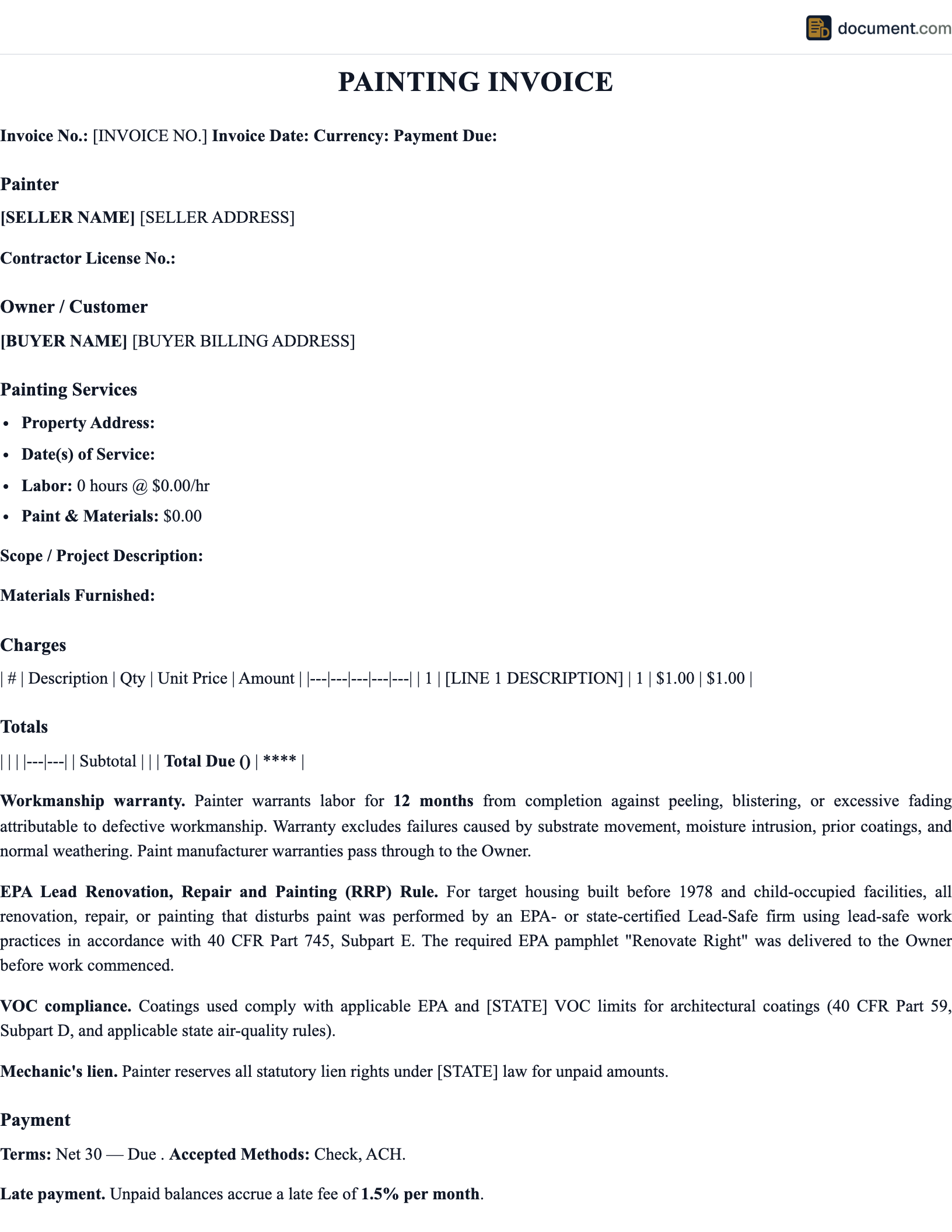
Painting Invoice Form Preview
Painting Service Invoice
Invoice #PT-2024-0631
Contractor:
License #: PTR-XXXXX
Client:
Property:
Work Performed
Warranty: 30-day touch-up warranty from invoice date. Covers nail pops, settling cracks, and missed spots.
Key Components
Eight components convert a paint receipt into an enforceable invoice that supports payment, lien rights, and EPA compliance. Each addresses a question that would otherwise default to oral testimony or the client's adverse interpretation.
VOC limits and finish-grade documentation
EPA architectural-coatings VOC limits under 40 C.F.R. Part 59 cap volatile organic compound content (250 grams per liter for flat coatings, 380 grams per liter for non-flat). California, Massachusetts, New York, and several Northeast Ozone Transport Region states impose stricter limits under SCAQMD Rule 1113 and OTC Phase II rules (50 grams per liter flat, 100 grams per liter non-flat). The invoice should specify the product's VOC content for any work in low-VOC jurisdictions; non-compliant product application is the contractor's exposure under state air-quality law. LEED projects and many institutional clients require documentation of VOC compliance for credit submission; bake the data into the invoice line item.
Mechanic's lien predicate elements
For payment-default exposure, the invoice should identify the property by legal description or street address, name the owner of record verified through county records, state the dates labor was furnished and materials delivered, itemize labor and materials separately, and show the unpaid balance. Maintain copies of the served Preliminary Notice (California within 20 days of first work under Cal. Civ. Code § 8204), Notice to Owner (Florida within 45 days under Fla. Stat. § 713.06), or monthly notice (Texas by the 15th day of the third month for residential under Tex. Prop. Code § 53.252).
| Component | Purpose | Key Details |
|---|---|---|
| Contractor Info | Identifies the painting business | Business name, license number, EPA certification (if applicable), insurance, contact details |
| Room/Area Breakdown | Details work by location | Room name, surfaces painted (walls, ceiling, trim), square footage, per-unit price |
| Paint Specifications | Documents products used | Brand, product line, color name, color code, finish type, number of coats, gallons used |
| Prep Work | Justifies labor costs | Sanding, scraping, patching, caulking, priming, taping, protection, fixture removal |
| Labor vs Materials | Separates charges for tax compliance | Labor hours/rate, materials cost with markup, separate tax calculation |
| Equipment Charges | Covers specialty equipment | Scaffolding rental, spray equipment, lift rental, power washer |
| Warranty Terms | Documents post-completion coverage | Touch-up period, covered defects, exclusions, warranty claim process |
| Payment Terms | Establishes payment expectations | Due date, accepted methods, deposit credited, remaining balance, late fee policy |
How to Create a Painting Invoice
Six steps in this order. Front-end paperwork (signed contract complying with state home-improvement statutes, EPA pamphlet delivery for pre-1978 work, lead-paint testing or assumption) controls what can be invoiced at the back end.
Pre-work documentation
Before the first prep cut: signed home-improvement contract complying with state statute (Cal. Bus. & Prof. Code § 7159 lists 16 mandatory items including the down-payment cap of the lesser of 10 percent or $1,000), confirmed property ownership through county records, photographs of existing surface conditions (defends against pre-existing damage claims), EPA Renovate Right pamphlet delivered to the homeowner for pre-1978 work, lead-paint testing results or written assumption that lead is present, and signed change-order template ready for mid-project scope expansions.
Walkthrough sign-off
Before invoicing, walk every painted surface with the homeowner under the same lighting conditions the work will be viewed in. Note any punch-list items in writing and obtain the homeowner's signature on a completion acknowledgment. The walkthrough sign-off is the contractor's defense against retroactive complaints about cut lines, holiday spots, or sheen variations; courts treat the signed acknowledgment as an admission against interest under Federal Rule of Evidence 801(d)(2). Address punch-list items before delivering the final invoice; partial completion claims are the leading source of withheld final payments in painting work.
Document the Project Scope
Before starting the invoice, confirm the final scope against the original estimate. Walk through every room and surface with the client to verify what was painted, what prep work was performed, and whether any change orders were approved during the project. Note any areas where the actual work deviated from the estimate.
List Each Room and Surface
Create a line item for each room or exterior section. For each, specify the surfaces painted (walls, ceiling, trim, doors, closets), the measured area in square feet or linear feet, the paint product used (brand, color, finish), the number of coats applied, and the price for that area.
Itemize Prep Work Separately
Break out all preparation tasks: sanding, scraping, patching (with number of patches), caulking, taping, plastic sheeting, fixture removal and reinstallation, and priming. Show the labor hours and rate for each prep category. Clients who see the prep work itemized understand why it represents a significant portion of the total cost.
Separate Materials from Labor
List all paint and supplies purchased: product name, quantity (gallons), your cost, the markup percentage, and the total charged. Separately list labor charges with the hours worked and the hourly rate (or the flat-rate labor fee). This separation is essential for correct sales tax calculation in most jurisdictions.
Apply Correct Sales Tax
Calculate sales tax on the materials portion only (in most states, painting labor is not taxable). Use the combined state and local tax rate for the property's jurisdiction. If your state taxes the entire project as a service, apply the rate to the full invoice amount. Double-check the current rate with your state's department of revenue.
Include Warranty and Payment Terms
Add the touch-up warranty terms (duration, covered items, exclusions), note the warranty start date, and specify the payment terms: amount due, due date, accepted payment methods, and late payment penalties. If a deposit was collected, show it as a credit against the total. Send the invoice within 48 hours of completing the walkthrough.
Frequently Asked Questions
Official Resources
Industry organizations, government agencies, and safety resources for painting contractors.
Painting Contractors Association (PCA)
Industry trade association offering business resources, estimating tools, and safety training for painting professionals.
EPA RRP Program
Lead-safe work practice requirements and firm certification for renovation, repair, and painting in pre-1978 buildings.
OSHA - Painting Safety
Worker safety standards for painting operations including fall protection, respiratory protection, and hazard communication.
SBA - Business Financial Management
Small Business Administration resources on invoicing, cash flow management, and accounting for contractors.
IRS Self-Employed Tax Center
Tax filing requirements, estimated payments, and deduction guidance for independent painting contractors.
Benjamin Moore Contractor Resources
Product specifications, color tools, and technical data sheets for accurate invoice paint documentation.
Create Your Painting Invoice
Itemize rooms, surfaces, prep work, and paint products in a professional invoice with warranty terms included.
Create DocumentNo account required. Free to create and preview.