



What Is a Roofing Invoice?
A roofing invoice is the demand for payment a licensed roofing contractor serves on a property owner, property manager, or general contractor after performing tear-off, replacement, overlay, repair, or maintenance work. The invoice does four jobs at once. It perfects the contractor's right to compensation under the underlying agreement. It documents the material assembly that the manufacturer's enhanced warranty (GAF Golden Pledge, Owens Corning Platinum) requires for registration. It supports a mechanic's lien claim against the property under state lien statutes. And in insurance-funded work, it is the proof-of-completion document the homeowner submits to release the recoverable-depreciation holdback. A typical residential re-roof runs $8,000 to $25,000; commercial projects routinely clear six figures. Defective invoicing at these dollar values produces claims that consume project margin within a single dispute cycle.
Roofing contractors require state licensing in nearly every jurisdiction, and the license number must appear on every invoice. California requires a C-39 Roofing Contractor license (Cal. Bus. & Prof. Code § 7058.5) and CSLB license-number disclosure on invoices over $500 (§ 7030.5); the unlicensed roofer recovers nothing under § 7031 and must disgorge sums already paid. Florida requires a state Certified Roofing Contractor (CCC) under Fla. Stat. § 489.105(3)(e) or a county-registered roofing contractor license. Texas requires Roofing Contractor Association of Texas certification for certain work and Texas Department of Insurance windstorm certification (WPI-8) in coastal Tier 1 and Tier 2 counties under Tex. Ins. Code Ch. 2210. The license number on the invoice is non-negotiable; omitting it reads as practicing without a license.
In insurance work, the invoice is the document that triggers payment of the recoverable-depreciation holdback. Carriers pay claims in two installments under the standard ACV/RCV structure: Actual Cash Value (depreciated value of the loss) at claim approval, and the Recoverable Depreciation (RCV minus ACV) only on proof that repairs were actually completed. The contractor's invoice, mirroring the Xactimate scope of loss code-for-code, is what proves completion. Invoices that overstate scope above the approved estimate without filing an approved supplement implicate state unfair claims-practice statutes (Texas Ins. Code Ch. 542A, Florida Stat. § 489.147 prohibiting deductible rebating). File supplements through the adjuster before invoicing any overage to the homeowner.
State licensing disclosure on every invoice
California Bus. & Prof. Code § 7030 requires the contractor's CSLB license number on every contract and invoice for home-improvement work over $500, plus the consumer notice that the homeowner may file complaints with the board. Florida Stat. § 489.119 requires the license number on advertising, contracts, and invoices. Maryland Bus. Reg. § 8-308 requires the MHIC registration number. North Carolina Gen. Stat. § 87-13 requires the license number for any project of $30,000 or more. The license-number disclosure runs to the contractor's right to compensation, not just regulatory compliance; in California, the contractor who omits the number on an invoice for work over $500 cannot collect, and the homeowner may sue to disgorge sums already paid.
Insurance claim alignment with Xactimate
Every major insurance carrier underwrites residential property losses on Xactimate, the Verisk-owned estimating platform that uses standard line-item codes (RFG 240 for 30-year architectural shingles, RFG ICE for ice-and-water shield, RFG SYNUL for synthetic underlayment, RFG DRIP for drip edge, RFG VENT for ridge vent). The contractor's invoice should mirror these codes line-for-line. Mismatch between the invoice and the carrier's approved scope is the single most common reason RCV holdbacks are delayed. For damage discovered during tear-off (rotted decking, damaged framing, dry-in failures) file a written supplement with the adjuster and obtain approval before invoicing the homeowner for the overage. Texas Tex. Ins. Code § 542A.003 and Florida Stat. § 489.147 prohibit deductible rebating that conceals the true loss from the carrier.
Progress Payments
Milestone-based billing with deposit, progress, and final payment tracking.
Material Specs
Documents every component by manufacturer, product, and quantity for warranty.
Warranty Tiers
Distinguishes manufacturer, system, and workmanship warranty levels.
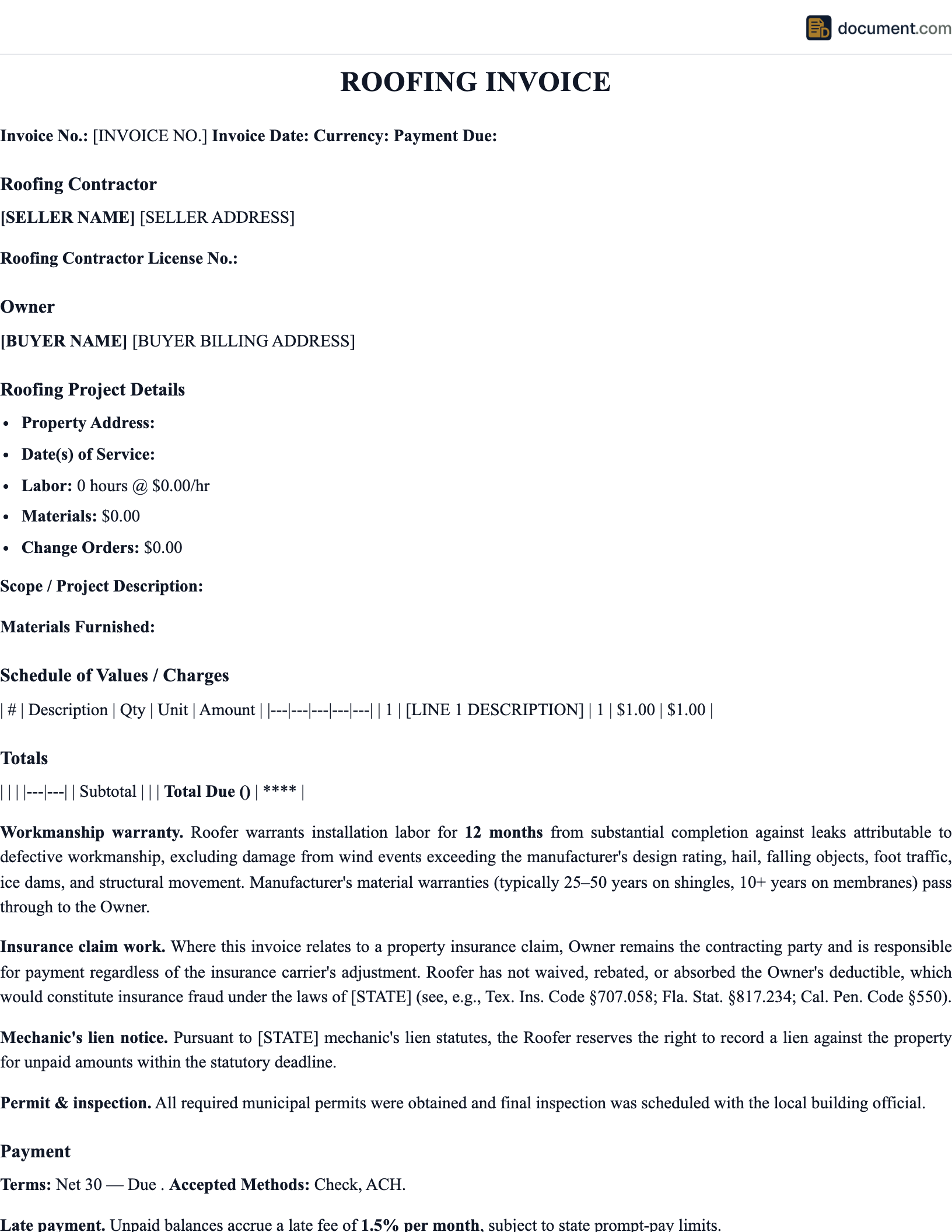
Roofing Invoice Form Preview
Roofing Contractor Invoice
Invoice #RF-2024-0372 | Permit #BLD-2024-9043
Contractor:
License #: RFG-XXXXX
Property Owner:
Claim #:
Scope of Work: Full Roof Replacement (28 squares)
Key Components
Eight components convert a roof-repair receipt into an enforceable invoice that supports warranty registration, mechanic's lien filing, and insurance recovery. Each addresses a question that would otherwise default to the homeowner's recollection or the manufacturer's adverse interpretation.
Wind, fire, and code-compliance documentation
Florida Building Code §§ R4406, R4407 require enhanced fastening schedules and a separate dry-in inspection in High Velocity Hurricane Zone counties (Miami-Dade, Broward); the contractor captures the underlayment photo set before installing shingles. Texas Tex. Ins. Code Ch. 2210 and TWIA windstorm certification require a WPI-8 certificate from a licensed Texas Department of Insurance windstorm engineer for coastal Tier 1 and Tier 2 counties. California Title 24 cool-roof requirements (CEC-400-2022-010) apply to low-slope replacements in climate zones 2, 3, 4, 13, 14, 15. Document the wind-uplift rating (typically 110 to 130 mph for Class H architectural shingles), the Class A fire rating under UL 790, and the cool-roof Solar Reflectance Index where applicable. Code violations void the manufacturer warranty and trigger municipal stop-work orders.
Mechanic's lien predicate elements
The roofing invoice that may support a lien must identify the property by legal description or street address, name the owner of record verified from county assessor data (the owner is often someone other than the tenant who hired the work), state the dates labor was furnished and materials delivered, itemize labor and materials separately, and show the unpaid balance. Maintain copies of the served Preliminary Notice (California, within 20 days of first work), Notice to Owner (Florida, within 45 days), or monthly notice (Texas, by the 15th day of the third month for residential). The lien claimant who cannot produce the served notice loses on perfection regardless of how complete the invoice looks.
| Component | Purpose | Key Details |
|---|---|---|
| Contractor Credentials | Proves licensing and insurance | License number, bond, GL insurance, workers' comp, manufacturer certifications |
| Tear-Off & Disposal | Documents removal scope | Layers removed, area, disposal method, dumpster fee, decking condition |
| Material Specifications | Supports warranty registration | Manufacturer, product line, color, quantity per component, system certification |
| Labor Breakdown | Separates labor from materials | Tear-off labor, installation labor, repair labor, crew size, days worked |
| Permit & Inspection | Confirms code compliance | Permit number, fee, inspection dates, pass/fail status, corrections |
| Warranty Documentation | Records all warranty tiers | Manufacturer warranty type, registration #, workmanship warranty duration, terms |
| Insurance Claim Info | Aligns with carrier scope | Claim number, date of loss, ACV paid, depreciation holdback, supplement status |
| Payment Schedule | Tracks milestone payments | Deposit, progress payments, final balance, payments received, amount due |
How to Create a Roofing Invoice
Six steps in this order. The pre-installation paperwork (signed contract, change-order template, owner verification, insurance scope) controls what the post-installation invoice can enforce.
Pre-installation documentation
Before the first nail: signed home-improvement contract complying with the state statute (California Bus. & Prof. Code § 7159 lists 16 mandatory items including the down-payment cap of the lesser of 10 percent or $1,000), confirmed property ownership through county records, photographs of existing roof condition (defends against pre-existing damage claims), insurance scope of loss with claim number and adjuster contact for insurance-funded jobs, building permit issued in the homeowner's name, and W-9 collected from any commercial property-owner client that will issue a 1099.
Change-order discipline for tear-off discoveries
Tear-off routinely uncovers rotted decking, damaged framing, or compromised flashing that was invisible from the surface. Cal. Civ. Code § 1689.6 makes oral residential change orders unenforceable; obtain a signed amendment, signed text-message thread, or signed email from the homeowner authorizing each additional scope item before installing the replacement material. The change order should state the new line item, the unit price (pre-priced in the original contract for common items like decking sheets at $65 to $100 installed), the total quantity, and the resulting new contract sum. Photograph every replaced board with a date stamp; the photo defeats any later contest.
Compile Project Documentation
Gather the signed contract, every change order, the permit, inspection reports, dated before-and-after photos, and the insurance scope of loss for funded jobs. The invoice must reconcile with each of these documents. Any discrepancy between the contract scope and the invoiced work creates a dispute the contractor will lose under the parol-evidence rule (Cal. Civ. Code § 1856, parallel state codifications).
Itemize Tear-Off and Disposal
Document the number of layers removed, the total area in roofing squares, the dumpster size and rental cost, the disposal fee, and any additional charges for unexpected conditions discovered during tear-off (rotted decking, damaged rafters, mold remediation). Reference any change orders approved for additional work.
Specify Every Material Component
List each material with the manufacturer, product name, color, and quantity: shingles (in squares), underlayment (in squares or rolls), ice-and-water shield (linear feet and number of rolls), ridge vent (linear feet), drip edge (linear feet and type), step flashing, valley flashing, pipe boots, starter strip, and ridge cap. This detail is required for manufacturer warranty registration.
Break Out Labor Charges
Separate tear-off labor from installation labor. For time-and-materials projects, show the crew size, hours worked, and hourly rate. For fixed-price contracts, show the labor component as a line item even if it is part of a lump-sum price. This separation supports sales-tax calculation in states that tax labor differently from materials and supports insurance-claim Xactimate matching.
Add Permits, Tax, and Warranty
Include the permit fee, apply sales tax to materials (labor is generally exempt), document all warranty tiers with their respective coverage periods and registration numbers, and note the inspection status. If the manufacturer's warranty requires registration, note whether it has been submitted or will be submitted upon final payment.
Apply Payment Credits and Send
Show the total project cost, subtract the deposit and any progress payments already received, and present the remaining balance due. Specify the payment due date, accepted methods, financing options, and late payment penalties. For insurance claims, reference the claim number and note which payment installment (ACV or depreciation holdback) this invoice supports.
Frequently Asked Questions
Official Resources
Industry associations, manufacturer resources, and regulatory agencies for roofing professionals.
National Roofing Contractors Association (NRCA)
Industry trade association offering technical standards, training, and business resources for roofing professionals.
GAF Professional Resources
Manufacturer certification programs, warranty registration, technical documentation, and contractor tools.
OSHA - Roofing Safety
Fall protection standards, safety training requirements, and compliance guidance for roofing operations.
SBA - Business Financial Management
Small Business Administration resources on contractor invoicing, cash flow management, and financial planning.
International Code Council - Building Codes
International Building Code (IBC) and International Residential Code (IRC) standards governing roofing installations.
IRS Self-Employed Tax Center
Tax obligations, quarterly estimated payments, and deductions for roofing contractors and subcontractors.
Create Your Roofing Invoice
Document materials, progress payments, warranty tiers, and insurance claim details in a professional invoice.
Create DocumentNo account required. Free to create and preview.