



What Is a Plumbing Invoice?
A plumbing invoice is the demand for payment a licensed plumbing contractor serves on a property owner, tenant, property manager, or general contractor after performing plumbing repair, installation, or maintenance work. It is simultaneously a legal record of work performed, parts installed, warranty provided, and the contractor's license credentials. Plumbing is licensed in every state at the master and journeyman level (no state allows unlicensed plumbing work above minor self-help), and the master plumber license number must appear on every invoice. California requires the C-36 Plumbing Contractor license number on invoices over $500 (Cal. Bus. & Prof. Code § 7030.5). Texas requires the Responsible Master Plumber name and license number on every invoice (22 Tex. Admin. Code § 365.14). New York requires the master plumber license on all advertising and contracts (N.Y. Gen. Bus. Law § 392-c).
The trade operates under two pricing models. Flat-rate quotes a fixed price from a standardized price book (Profit Rhino, Coogan's) before work begins, giving the client cost certainty and the plumber margin protection on difficult jobs. Time-and-materials shows actual hours at the hourly rate (typical $85 to $175 standard, $150 to $300 emergency), each part with cost and markup, plus service-call and permit fees. Both models are legitimate; each requires a different invoice structure to be transparent. Flat-rate invoices show the job description and the flat amount; T&M invoices itemize labor, parts, and add-ons line by line. Mixing models on one invoice (flat-rate for the toilet swap, T&M for the unforeseen valve replacement) is permissible if the model is labeled per line.
Plumbing is among the most regulated trades in the United States. Most jurisdictions require permits for any work altering, extending, or replacing the system: water-heater installation, repiping, sewer-line replacement, new fixtures, gas-line work, backflow preventers. Specialty endorsements apply to gas (state-issued gas-fitter license in many jurisdictions), backflow prevention (state-recognized BAT certification under EPA Safe Drinking Water Act 40 C.F.R. Part 141), medical gas (NFPA 99 certification), and cross-connection control. Each applicable license number should appear on the invoice. Proper invoicing protects the plumber's lien rights under state lien statutes, supports warranty claims by establishing a paper record of what was installed, and demonstrates regulatory compliance to building inspectors and insurance adjusters who will scrutinize work performed without proper permitting.
Master plumber license disclosure on every invoice
Every state requires plumbing licensing at the master, journeyman, or apprentice level. Texas Occupations Code § 1301.351 makes operating without a master plumber unlawful and unenforceable; the unlicensed plumber recovers nothing. California Bus. & Prof. Code §§ 7028, 7031 bar compensation for any project above $500 performed without the appropriate CSLB license (C-36 Plumbing). Florida Stat. § 489.105(3)(m) requires state-certified Plumbing Contractor or registered Plumbing Contractor status. New York requires master plumber licensure under N.Y. Gen. Bus. Law § 392-c with municipal-level licensing in New York City and several counties. Display the master plumber license number on every invoice, every contract, and every advertisement. The license-number disclosure runs to the right of recovery, not just regulatory compliance.
Backflow prevention and cross-connection compliance
Federal Safe Drinking Water Act regulations under 40 C.F.R. Part 141 require water purveyors to administer cross-connection control programs. State implementation typically requires Backflow Assembly Tester (BAT) certification for any plumber installing or testing reduced-pressure-zone (RPZ), double-check (DC), or pressure-vacuum-breaker (PVB) assemblies. Annual testing is required by most water utilities; the test certificate runs in the property owner's name and is filed with the utility. The invoice for backflow installation or testing should include the BAT certification number, the assembly type and serial number, the test results (pass or fail with corrective action), and the date the certification was filed with the water utility. Failure to comply triggers utility disconnection and potential EPA enforcement under the SDWA.
Flat-Rate & T&M
Supports both flat-rate job pricing and detailed time-and-materials breakdowns.
Emergency Billing
Documents after-hours surcharges, emergency dispatch fees, and minimum charges.
Warranty Tracking
Records separate labor and parts warranty terms with start and expiration dates.
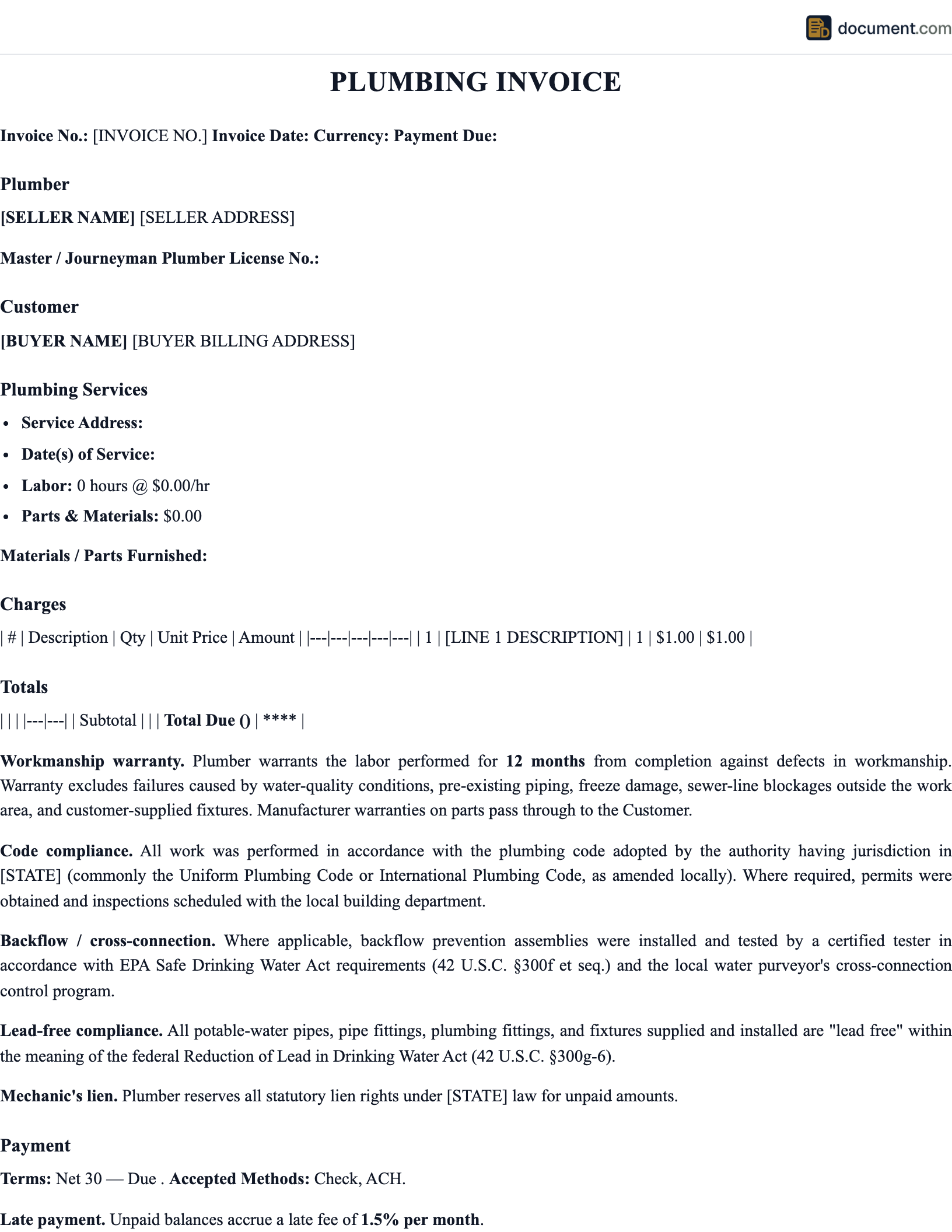
Plumbing Invoice Form Preview
Plumbing Service Invoice
Invoice #PLB-2024-0519
Contractor:
License #: PLB-XXXXX
Client:
Service Address:
Work Performed
Labor Warranty: 1 year from installation date
Manufacturer Warranty: 12-year heat exchanger, 5-year parts (see Rinnai documentation)
Key Components
Eight components convert a service receipt into an enforceable plumbing invoice that supports payment, lien rights, warranty claims, and code-compliance defense. Each addresses a question that would otherwise default to oral testimony or the customer's adverse interpretation.
Gas-line and specialty endorsements
Gas piping work requires a state-issued gas-fitter license or an LPG certification in most jurisdictions. Texas requires a Plumbing Inspector or Gas Pipe Installer endorsement for residential gas (22 Tex. Admin. Code Ch. 365). California requires the C-36 Plumbing license to install gas piping below 5 psi (Cal. Bus. & Prof. Code § 7058.5). NFPA 58 governs LPG storage and handling; NFPA 54 governs natural gas piping. The invoice for gas work should reference the applicable code edition (typically the locally adopted IRC G2401 or IFGC), the test pressure used, the duration of the pressure test (typical 10 to 15 minutes at 1.5x working pressure), and the inspector's sign-off. Improperly installed gas piping triggers homeowner-insurance coverage denials and code-board discipline.
Mechanic's lien predicate elements
For payment-default exposure, the invoice should identify the property by legal description or street address, name the owner of record verified through county assessor data, state the dates labor was furnished and materials delivered, itemize labor and parts separately, and show the unpaid balance. Maintain copies of the served Preliminary Notice (California within 20 days of first work under Cal. Civ. Code § 8204), Notice to Owner (Florida within 45 days under Fla. Stat. § 713.06), or monthly notice (Texas by the 15th day of the third month for residential under Tex. Prop. Code § 53.252). Lien rights without timely notice are extinguished regardless of the invoice quality.
| Component | Purpose | Key Details |
|---|---|---|
| License & Insurance | Proves contractor credentials | Plumbing license number, bond number, insurance carrier, gas endorsement (if applicable) |
| Service Details | Documents the work performed | Problem diagnosed, solution implemented, service date, arrival and departure time |
| Labor Charges | Shows time or flat-rate pricing | Hours worked, hourly rate, or flat-rate job price, overtime/emergency rate if applicable |
| Parts Itemization | Lists all materials used | Part description, manufacturer, model/spec, quantity, cost, markup, extended total |
| Permit Information | Confirms regulatory compliance | Permit number, issuing authority, permit fee, inspection status and date |
| Warranty Terms | Documents post-repair coverage | Labor warranty duration, parts manufacturer warranty, exclusions, claim process |
| Diagnostic Charges | Covers inspection and testing | Camera inspection fee, pressure test, leak detection, smoke test, diagnostic credit |
| Payment & Lien Notice | Establishes payment obligations | Due date, methods, late fees, preliminary lien notice reference (if filed) |
How to Create a Plumbing Invoice
Six steps in this order. The pre-work paperwork (signed authorization, permit pulled in the homeowner's name, photos of pre-existing conditions) controls what the post-work invoice can enforce.
Pre-work documentation
Before opening the wall: confirm the master plumber license is current and in the responsible plumber's name on the invoice (Texas requires the RMP's personal license, not just the business's; 22 Tex. Admin. Code § 365.14), pull the building permit in the homeowner's name when the scope requires one, photograph existing conditions including water-meter reading and main-shutoff position, deliver any required disclosure (California Cal. Bus. & Prof. Code § 7159 for residential home-improvement contracts over $500), and obtain a signed authorization for diagnostic work before performing it.
Change-order discipline for tear-out discoveries
Plumbing exposes hidden conditions: galvanized steel that crumbles when touched, polybutylene tubing subject to class-action settlement (Cox v. Shell Oil), corroded shut-off valves that fail open, lead solder requiring abatement, asbestos pipe insulation requiring licensed remediation. Cal. Civ. Code § 1689.6 makes oral residential change orders unenforceable; obtain written homeowner authorization (signed amendment, signed text-message thread, or signed email) before installing the additional work. Photograph each discovered condition with a date stamp; the photograph is the evidence in any later dispute.
Record Service Call Details
Document the service date, the time you arrived and departed, the client's name and service address, and how the call was initiated (scheduled, emergency, referral). If the call was an emergency or after-hours service, note the time the call was received to support the emergency surcharge.
Describe the Problem and Solution
Write a clear description of the problem diagnosed (e.g., 'Slab leak on hot water supply line under master bathroom, detected via electronic leak detection') and the repair performed (e.g., 'Rerouted hot water supply line through attic using 3/4-inch PEX, bypassing slab leak'). This detail protects you in disputes and supports warranty claims.
Itemize Labor and Parts
For T&M jobs, list the labor hours at the applicable rate (standard, overtime, or emergency) and every part used with its description, specification, quantity, cost, and markup. For flat-rate jobs, show the job description and the flat price. Include any service call or dispatch fee as a separate line item.
Add Permits and Equipment Charges
If the work required a permit, list the permit number, the fee, and the inspection status. If specialty equipment was used (camera inspection, hydro-jetting, pipe bursting), show the equipment charge and the findings. Equipment charges are often separate from the repair price and should be listed as distinct line items.
Document Warranty Terms
Specify the labor warranty duration (typically 30 days to 2 years depending on the work), the manufacturer's warranty on parts installed (reference the manufacturer's documentation), what is covered and excluded, and how the client should initiate a warranty claim. Note the warranty start date, which is typically the invoice date.
Calculate Tax and Present Payment Terms
Apply sales tax to parts and materials (plumbing labor is exempt from sales tax in most states). Show the subtotal, tax calculation, and total due. Specify the payment due date, accepted methods, and late payment penalty. If you filed a preliminary lien notice (required in many states to preserve lien rights), reference it on the invoice.
Frequently Asked Questions
Official Resources
Industry organizations, licensing bodies, and safety resources for plumbing professionals.
Plumbing-Heating-Cooling Contractors Association
National trade association offering business resources, advocacy, and education for plumbing and HVAC contractors.
International Association of Plumbing and Mechanical Officials
Develops and publishes the Uniform Plumbing Code (UPC) adopted in many western and southern states.
OSHA - Plumbing Safety
Worker safety standards for plumbing operations including trenching, confined spaces, and lead exposure.
SBA - Business Financial Management
Small Business Administration resources on invoicing, accounting, and financial management for contractors.
IRS Self-Employed Tax Center
Tax filing requirements, estimated payments, and deductions for self-employed plumbing contractors.
EPA Drinking Water Standards
Federal drinking water regulations relevant to plumbing installations involving potable water systems.
Create Your Plumbing Invoice
Itemize labor, parts, permits, and warranty terms in a professional invoice that protects your lien rights.
Create DocumentNo account required. Free to create and preview.