



What Is a Photography Invoice?
A photography invoice is a billing document issued by a photographer or studio to a client for creative services, image licensing, and physical or digital products. It serves a dual purpose: it is a payment request and a licensing document defining how the client may use the delivered images. Without clear licensing terms, photographers risk losing control of their copyright, and clients risk infringement claims for unauthorized uses.
Photography invoicing is layered because a single session generates multiple revenue streams taxed differently. The session fee is a service. Digital image files are digital goods, taxable in some states (Texas, New York, Washington) and exempt in others. Prints, albums, and canvases are tangible personal property taxable nearly everywhere. Usage licensing fees are a separate category that some states treat as an intangible right. Each line must be itemized with the correct tax treatment, and the photographer must understand sales-tax rules in the state where the photography was performed (post-Wayfair v. South Dakota, 2018, the destination state controls).
Photographers operate as Schedule C sole proprietors, single-member LLCs, or S-corps. Self-employment tax under IRC Section 1401 applies at 15.3 percent. Quarterly estimated payments under IRC Section 6654 are required. Clients paying $600 or more in a calendar year (corporations, agencies, magazines) must issue Form 1099-NEC by January 31 (IRC Section 6041); the photographer should furnish a Form W-9 before the first invoice. Wedding clients are individuals and generally do not issue 1099s, but the photographer remains responsible for reporting all income.
Deposits versus retainers and refund implications
The terms 'deposit' and 'retainer' are often used interchangeably but have different legal consequences. A deposit is a refundable down payment held in trust against future delivery; on cancellation, the deposit returns to the client minus actual damages. A retainer (or non-refundable booking fee) compensates the photographer for taking the date off the calendar and is forfeited on cancellation. Industry-standard practice for weddings: 25 to 50 percent non-refundable retainer at booking, balance due 2 to 4 weeks before the event. Non-refundability is enforceable as liquidated damages under UCC Section 2-718 and the Restatement (Second) of Contracts Section 356 when the amount is a reasonable forecast of damage, not a penalty. California Civ. Code Section 1671 imposes a reasonableness test on liquidated damages in consumer contracts; the further out the cancellation, the harder it is to keep the full retainer because the photographer has time to rebook. The invoice should label the line item correctly so the cancellation refund analysis is unambiguous.
Copyright assignment versus license fees under 17 U.S.C. Section 204(a)
Under U.S. copyright law (17 U.S.C. Section 201(a)), the photographer owns the copyright to every image at the moment of capture. The client buys a license to use the images per the terms in the contract and invoice. Transfer of copyright ownership to the client requires a written assignment signed by the photographer (17 U.S.C. Section 204(a)); without that writing, the client gets a license, not ownership. Standard licensing variables: scope (personal, editorial, commercial advertising), territory (local, national, worldwide), duration (one-time use, one year, three years, perpetual), and medium (web only, print only, all media). Each licensing tier should be a separate line item with its own fee. A corporate headshot session might include a personal-use license at no extra charge but charge $500 to $2,000 for a one-year commercial advertising license. Full copyright assignment commands a premium of 5 to 10 times the standard license fee. The invoice should reference the license clause in the contract and note that copyright remains with the photographer absent a separate written assignment.
Sales tax on digital files, prints, and services
Sales-tax treatment varies by category and state. Tangible personal property (prints, albums, canvases, USB drives with images) is taxable in 45 states. Digital files are taxable in roughly 30 states post-Streamlined Sales and Use Tax Agreement adoption (including Texas, New York, Washington, Wisconsin, Colorado) and exempt in others (California, Florida, Massachusetts). Photography services themselves (the act of taking photos) are taxable in Hawaii, New Mexico, South Dakota, and West Virginia, exempt in most others. Licensing fees are typically untaxed when separately stated and the underlying right is intangible; bundled with tangible delivery, they may be subject to the state's bundled-transaction rule. Wayfair v. South Dakota (2018) established that economic nexus (typically $100,000 in sales or 200 transactions per state) triggers sales-tax collection obligations even for out-of-state sellers. Destination wedding photographers shooting in multiple states should verify nexus and registration in each.
Session Billing
Tracks session fees, coverage hours, second shooters, and overtime charges.
Usage Licensing
Defines usage rights by scope, territory, duration, and medium on each invoice.
Product Sales
Itemizes prints, albums, canvases, and digital files with correct tax treatment.
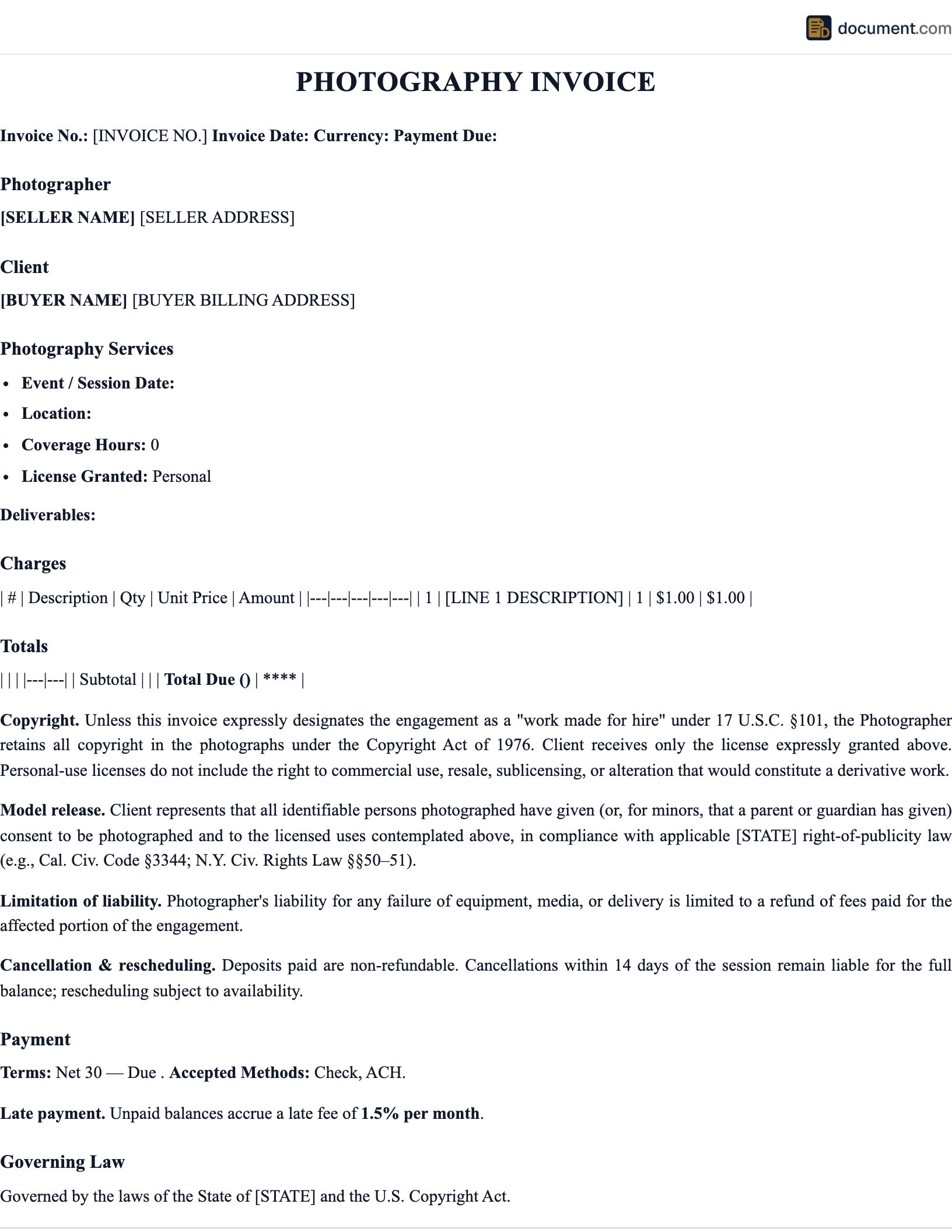
Photography Invoice Form Preview
Photography Invoice
Invoice #PH-2024-0294 | Contract #WED-2024-0087
Photographer:
EIN: XX-XXXXXXX
Client:
Event: Wedding | June 15, 2024
Services & Products
License: Personal use only. Commercial licensing available upon request.
Key Components
A professional photography invoice should include these elements to protect the photographer's intellectual property and produce prompt payment:
| Component | Purpose | Key Details |
|---|---|---|
| Session Details | Documents the shoot scope | Session type, date, location, duration, number of looks or setups |
| Service Fees | Covers the photographer's time | Session rate, overtime hours, second shooter, assistant, retouching |
| Usage License | Defines image usage rights | License type, permitted use, territory, duration, medium, exclusivity |
| Product Orders | Itemizes physical and digital products | Prints, albums, canvases, digital files, USB drives, specifications, quantities |
| Travel Expenses | Covers location travel costs | Mileage, airfare, lodging, meals, car rental, travel time fee |
| Tax Calculation | Ensures state compliance | Separates taxable products from services, applies correct state/local rate |
| Payment Credits | Tracks deposits and payments | Retainer paid, progress payments, remaining balance due |
| Delivery Terms | Sets expectations for delivery | Gallery delivery timeline, product production time, payment-before-release policy |
How to Create a Photography Invoice
Reference the Contract
Pull the session type, coverage hours, package inclusions, pricing, and licensing terms from the signed contract. The invoice should match the contract exactly. Any additions (overtime, extra images, upgraded products) should reference a written change order or email approval from the client.
Itemize Session and Service Fees
List the base session or day rate, any overtime hours at the agreed rate, second-shooter or assistant fees, advanced retouching charges (with the number of images and per-image rate), rush editing surcharges, and any other service fees. Each should be a separate line item with clear descriptions.
Specify the Usage License
Define the image usage rights being granted: personal use, commercial editorial, commercial advertising, social media, web, print, or all media. State the territory (local, national, worldwide), duration (one-time, one year, perpetual), and whether the license is exclusive or non-exclusive. If different images carry different licenses, create separate license line items.
Add Product and Print Orders
List every physical and digital product: print size, paper type, quantity, albums with page count and cover material, canvas wraps with dimensions, and digital file deliverables. Include the unit price and extended total for each. Products ordered after the session should be invoiced separately from the session invoice.
Calculate Travel and Expenses
Itemize mileage at the IRS rate, airfare, lodging, meals, parking, tolls, and any equipment rental needed for the specific shoot. If a flat travel fee was agreed upon in the contract, list it as a single line item with a reference to the contract term.
Apply Tax and Credit Deposits
Calculate sales tax on taxable items (products in most states, services in some states, digital goods in select states). Show the tax breakdown clearly. Credit any retainer or deposit already paid. Show the final balance due, the payment due date, accepted payment methods, and the gallery or product release policy tied to payment.
Frequently Asked Questions
Official Resources
Professional organizations, copyright resources, and business tools for photographers.
Professional Photographers of America (PPA)
Industry association offering business education, insurance, copyright protection, and print competition for professional photographers.
U.S. Copyright Office - Registration
Federal copyright registration for photographers to protect their images and strengthen enforcement rights.
American Society of Media Photographers
Business resources, licensing guides, and legal information for commercial and editorial photographers.
SBA - Business Financial Management
Small Business Administration resources on invoicing, accounting, and financial planning for creative businesses.
IRS Self-Employed Tax Center
Tax obligations, quarterly estimated payments, and deduction guidance for self-employed photographers.
National Press Photographers Association
Ethics standards, legal resources, and advocacy for photojournalists and visual journalists.
Create Your Photography Invoice
Bill session fees, license usage rights, and itemize products in a professional invoice that protects your work.
Create DocumentNo account required. Free to create and preview.