



What Is a Legal Invoice?
A legal invoice is the billing statement a law firm, solo attorney, or legal consultant issues to a client for professional services rendered during a specified billing period. Unlike invoices in most industries, legal invoices are governed by professional conduct rules that mandate transparency, reasonableness, and specific disclosures about how fees were calculated. Every state bar regulates legal billing through its version of ABA Model Rule 1.5 (reasonableness of fees), Rule 1.5(b) (writing requirement for fee agreements with new clients), and Rule 1.15 (safekeeping of property, the source of trust-accounting obligations). Violations, even unintentional overbilling, expose attorneys to disciplinary proceedings, fee forfeiture, and malpractice liability.
The complexity of legal invoicing stems from the billing models used in practice. Hourly billing tracks time in tenths of an hour with different rates for partners, associates, paralegals, and law clerks. Flat-fee arrangements require clear deliverable milestones and may trigger partial refunds if the engagement terminates early. Contingency-fee matters (governed by Model Rule 1.5(c) and state-specific caps such as the medical-malpractice contingency caps in California Bus. and Prof. Code Section 6146) generate invoices only for advanced costs during litigation. Hybrid arrangements combine reduced hourly rates with success bonuses. Each model demands its own invoice structure.
Corporate clients and insurance carriers add LEDES (Legal Electronic Data Exchange Standard) format and UTBMS task codes as table stakes. E-billing systems automatically flag or reject entries that violate billing guidelines: block-billed entries, excessive research time, unauthorized timekeepers, rates above the agreed cap. For institutional client work, the invoice is not just a payment request. It is a compliance document that must satisfy both ethical rules and client-specific billing protocols to avoid write-downs.
IOLTA trust accounting and Model Rule 1.15 compliance
Trust account compliance is the highest-discipline area in legal billing. ABA Model Rule 1.15 (and every state's analog: California Rule of Professional Conduct 1.15, New York Rule 1.15, Texas Disciplinary Rule 1.14) requires attorneys to hold client funds separately from operating funds in an Interest on Lawyers Trust Account (IOLTA), to maintain detailed individual ledgers per client, to provide the client with an accounting of all funds received and disbursed, and to draw fees from trust only after they have been earned and the client has been billed. Drawing trust funds before issuing the invoice violates the advance-billing prohibition. Commingling client funds with the firm's operating account is the most common discipline trigger nationally; ABA data shows trust-account violations account for roughly 13 percent of all attorney disciplinary actions. The invoice must show the trust balance before the draw, the amount withdrawn, and the closing balance. Many states (California Bus. and Prof. Code Section 6148, New York Judiciary Law Section 53) require these disclosures on every invoice or in a periodic accounting statement.
Client fee disclosure and engagement letter requirements
Model Rule 1.5(b) requires the scope of representation, the basis or rate of the fee, and any expenses to be communicated in writing before or within a reasonable time after commencing representation, except where the lawyer charges a regularly represented client on the same basis. Many states impose stricter rules. California Bus. and Prof. Code Section 6148 requires written fee agreements for any matter expected to exceed $1,000 in fees, with specific contents (hourly rate, services to be rendered, costs and expenses), or the agreement is voidable by the client. Section 6147 imposes parallel requirements on contingency-fee agreements. Rule 4-1.5 of the Florida Rules of Professional Conduct caps contingency fees at 33.3 percent before filing suit, 40 percent thereafter, and tighter on medical malpractice. The engagement letter sets the structure; every invoice issued must conform to it.
Retainer billing and replenishment mechanics
A traditional retainer (security retainer) is a deposit held in trust against future fees. The funds remain the client's property until earned and billed. A 'true' or 'classic' retainer (fee paid solely to secure availability) is the lawyer's property on receipt and rare in modern practice; many states (California, New York) have effectively abolished it for general practice. An 'evergreen' retainer maintains a minimum trust balance, refilled by the client whenever it drops below the threshold. The engagement letter sets the initial retainer ($5,000 to $50,000 typical for litigation), the replenishment threshold ($1,000 to $5,000 typical), and the consequences of failure to replenish (suspension of work, withdrawal subject to court approval where the matter is pending). Each invoice should track the retainer balance and trigger a replenishment notice when the threshold is hit.
Billable Hours
Tracks time by timekeeper with task-level descriptions and UTBMS codes.
LEDES Compliant
Formats invoices for corporate e-billing systems with standard task codes.
Trust Accounting
Handles IOLTA draws with balance tracking and replenishment notices.
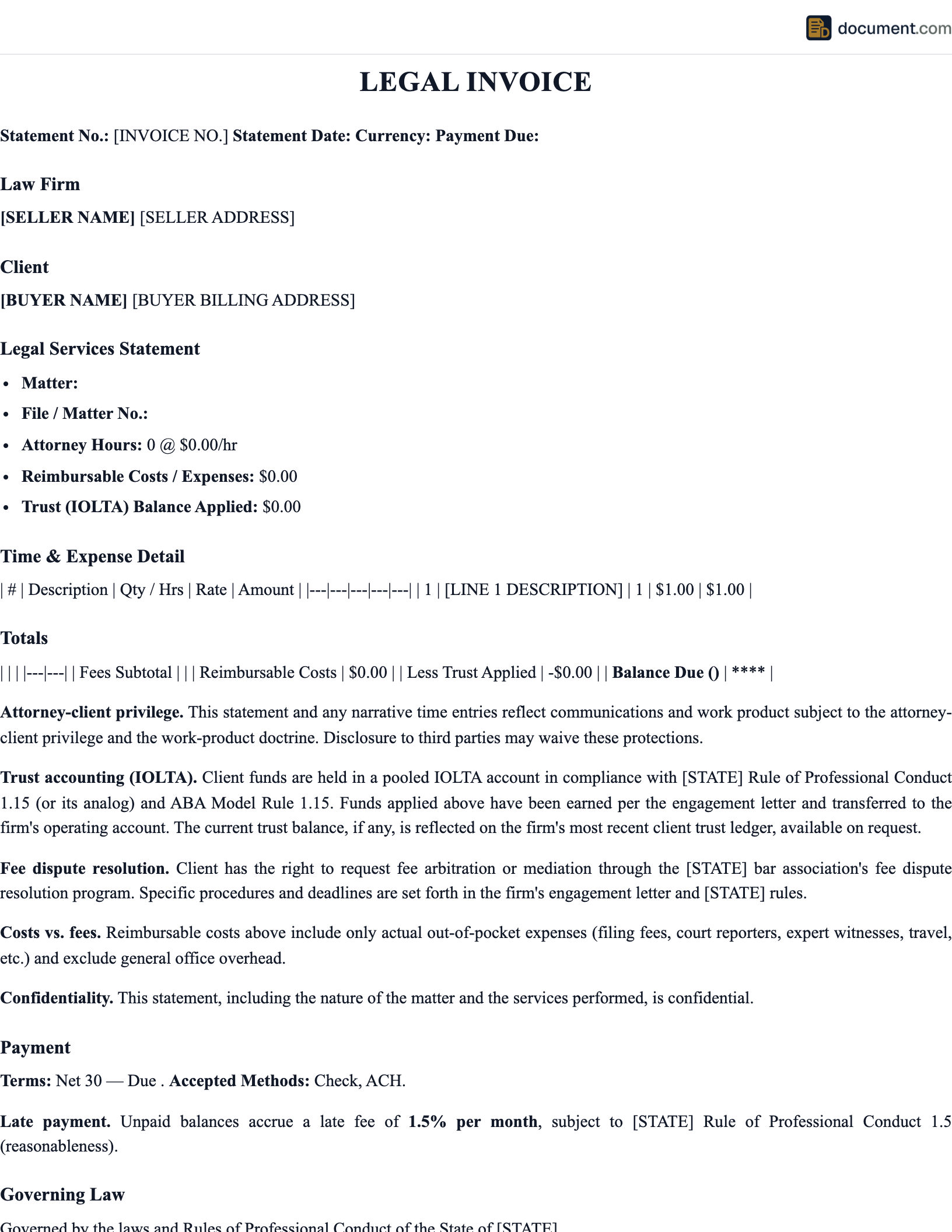
Legal Invoice Form Preview
Legal Services Invoice
Invoice #LGL-2024-1193 | Matter #: 2024-CV-0472
From:
Bar #: XXXXX
Bill To:
Billing Period: March 1-31, 2024
Professional Fees
Disbursements
Key Components
A legally compliant legal invoice must include these elements to satisfy bar rules, client expectations, and e-billing system requirements:
| Component | Purpose | Key Details |
|---|---|---|
| Matter Identification | Links invoice to the correct engagement | Matter number, matter name, billing period, invoice number, engagement letter date |
| Timekeeper Schedule | Discloses who worked and at what rate | Timekeeper name, role, bar number, hourly rate, total hours billed |
| Time Entries | Documents specific work performed | Date, timekeeper, task description, UTBMS code, hours, rate, line amount |
| Expense Itemization | Details reimbursable costs advanced | Date, description, vendor, amount, receipt reference |
| Trust Account Summary | Tracks IOLTA draws and balances | Opening balance, amount drawn, closing balance, replenishment threshold |
| Fee Summary | Provides billing-period totals | Total fees, total expenses, credits, payments received, balance forward, total due |
| Payment Instructions | Facilitates prompt payment | Payment methods, wire instructions, online portal link, remittance address |
| Billing Guidelines Reference | Confirms compliance with client rules | Reference to applicable billing guidelines, rate agreement date, approved rate schedule |
How to Create a Legal Invoice
Verify the Engagement Terms
Before generating the invoice, confirm the fee arrangement (hourly, flat, contingency, hybrid), the agreed billing rates for each timekeeper, any rate caps or billing guidelines imposed by the client, the trust account balance and replenishment threshold, and the billing frequency. These terms should all be documented in the signed engagement letter.
Review and Edit Time Entries
Pull all time entries for the billing period from your practice management system. Review each entry for clarity and specificity. Replace vague descriptions like 'research' with specific descriptions like 'Research applicable case law regarding statute of limitations defense under [State] Code Section [X].' Eliminate block billing by splitting multi-task entries into individual line items. Verify that billing increments are consistent (0.1-hour minimum is standard).
Compile and Categorize Expenses
Gather all disbursements for the billing period: filing fees, transcript costs, expert fees, travel, copying, postage, and research charges. Verify that each expense complies with the engagement letter's expense policy (no first-class flights, copying at agreed rate, etc.). Attach receipts for expenses above the agreed threshold.
Apply UTBMS Codes (If Required)
If the client requires LEDES-format invoices, assign the appropriate UTBMS task code (L-codes for litigation, C-codes for counseling, P-codes for project) and expense code (E-codes) to every line item. The UTBMS code set is maintained by the ABA and LEDES Oversight Committee. Common codes include L110 (Fact Investigation), L120 (Analysis/Strategy), L210 (Pleadings), and L310 (Written Discovery).
Calculate Trust Account Draws
If the matter is funded by a retainer held in trust, calculate the total invoice amount, compare it to the current trust balance, and apply the draw. Show the opening balance, the draw amount, and the closing balance clearly on the invoice. If the closing balance falls below the agreed replenishment threshold, include a replenishment request or issue a separate replenishment invoice.
Review for Ethical Compliance
Before sending, verify that all fees are reasonable under Model Rule 1.5, that no entries are block-billed, that timekeeper rates match the engagement agreement, that no administrative overhead is improperly billed, and that the invoice format matches the client's billing guidelines. Many firms have a billing partner or billing coordinator perform this review for quality control.
Frequently Asked Questions
Official Resources
Professional standards, ethics opinions, and industry resources for legal billing compliance.
ABA Model Rule 1.5 - Fees
The foundational ethical rule governing fee reasonableness, fee agreements, and billing practices.
LEDES Oversight Committee
Official standards body for Legal Electronic Data Exchange Standard billing formats and UTBMS codes.
ABA Law Practice Division - Financial Management
Billing best practices, trust accounting guidance, and financial management resources for law firms.
LSC Accounting Guide
Legal Services Corporation guide to accounting standards relevant to legal organizations receiving federal funds.
IRS Self-Employed Tax Center
Tax obligations for solo practitioners including quarterly estimated payments and business deductions.
Association of Corporate Counsel - Resource Library
Corporate legal department billing guidelines, outside counsel management, and e-billing best practices.
Create Your Legal Invoice
Track billable hours, manage trust account draws, and generate LEDES-compliant invoices for your legal practice.
Create DocumentNo account required. Free to create and preview.