



What Is a Handyman Invoice?
A handyman invoice is the demand for payment that a home-repair tradesperson serves on a homeowner, tenant, or property manager after completing work. It functions simultaneously as a contract performance record, a tax document under IRC § 162 (deductible business expense for the homeowner if the property is income-producing, capitalized to basis if not), the predicate for any mechanic's lien claim under state lien statutes, and, where the work clears the residential home-improvement licensing threshold, evidence of compliance with state contractor-license disclosure requirements. The invoice does the legal work even when the underlying engagement was a verbal handshake on the front porch.
Handyman invoicing is structurally distinct from single-trade invoicing because one visit typically combines unrelated tasks across plumbing, electrical, carpentry, drywall, and finish trades. Each task may carry a different pricing basis (flat-rate from the price book versus time-and-materials), different material requirements, and a different licensing analysis. California Bus. & Prof. Code § 7048 sets the unlicensed minor-work threshold at $500 per project including labor and materials; Florida Stat. § 489.103(7) sets it at $1,000; Arizona Rev. Stat. § 32-1121(A)(14) at $1,000. Aggregate the day's tasks, not the line items, when running the threshold analysis. A handyman who invoices four $200 tasks on one visit has performed an $800 project and triggers California licensing.
Handymen are independent contractors in nearly every engagement, which means the homeowner who pays $600 or more in a calendar year must issue Form 1099-NEC by January 31 of the following year (IRS Instructions for Form 1099-NEC, 2024 revision). The handyman receives no W-2, no withholding, and no employer-paid FICA share; quarterly estimated tax under IRC § 6654 is required, and self-employment tax of 15.3 percent under IRC § 1401 applies to net earnings up to the Social Security wage base ($168,600 for 2024). The invoice creates the paper trail that supports the 1099 and that the handyman's Schedule C reconciles against. Cash-only handyman work without invoices is a tax-evasion vector that the IRS pursues through 1099-K reporting and bank-deposit analysis.
Invoice as predicate for mechanic's lien
A defective invoice extinguishes lien rights in every state. The invoice must identify the property by street address or legal description, name the owner of record (not the tenant who hired the handyman), state the dates labor was furnished and materials delivered, and itemize labor and materials separately. California requires the contractor's license number on every invoice over $500 (Cal. Bus. & Prof. Code § 7030.5) and a Preliminary Notice within 20 days of first furnishing labor or materials (Cal. Civ. Code § 8204). Florida requires a Notice to Owner within 45 days of first work (Fla. Stat. § 713.06). Texas requires monthly notice to the owner and original contractor by the 15th day of the third month following the month in which labor was performed for residential work (Tex. Prop. Code § 53.252). New York requires the lien be filed within 8 months of last work for commercial property and 4 months for single-family residential (N.Y. Lien Law § 10).
Tax classification and 1099-NEC reporting
A homeowner running a rental property or home office who pays a handyman $600 or more in a tax year must collect Form W-9 before payment and issue Form 1099-NEC by January 31 (IRS Form 1099-NEC instructions). Failure to file carries penalties under IRC § 6721 ranging from $60 to $310 per return depending on lateness, doubled for intentional disregard. The handyman who refuses to provide a W-9 is subject to backup withholding of 24 percent under IRC § 3406. For purely personal-residence work the 1099-NEC obligation does not apply, but the work still generates self-employment income to the handyman that must be reported on Schedule C and subject to self-employment tax under IRC § 1401.
Labor & Materials
Separate labor charges from material costs with clear documentation and receipts.
Flexible Pricing
Support flat-rate, hourly, and time-and-materials billing on the same invoice.
Warranty & Insurance
Document workmanship warranties and insurance coverage for client confidence.
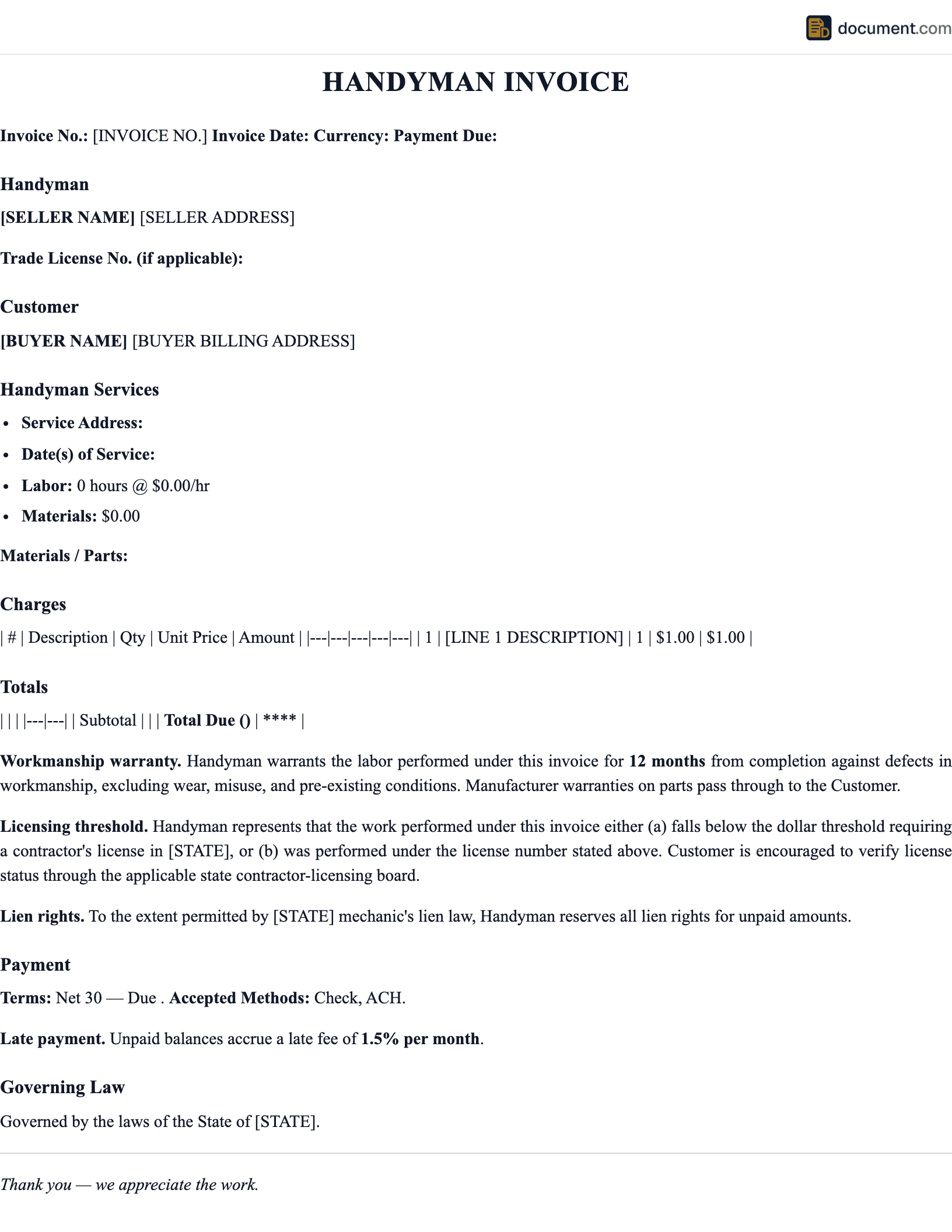
Handyman Invoice Form Preview
Handyman Service Invoice
Home Repair & Maintenance Services
From:
Handyman Name / Business
Bill To:
Homeowner / Property Manager
Service Date
Property Address
Invoice #
Work Performed
Materials
HANDYMAN
CLIENT
Key Components
Eight components convert a receipt into an enforceable invoice. Each one resolves a question that would otherwise default to oral testimony, the homeowner's recollection, or judicial guesswork.
Statutory disclosures by state
California Bus. & Prof. Code § 7030 requires home-improvement contracts and invoices to display the contractor's license number and the CSLB statement that complaints may be filed with the board. Maryland Bus. Reg. § 8-308 requires the Maryland Home Improvement Commission license number. Massachusetts G.L. c. 142A § 2 requires the Home Improvement Contractor registration number. Connecticut Gen. Stat. § 20-429 requires the registration number plus a notice of the homeowner's right to cancel within 3 business days under the federal Cooling-Off Rule (16 C.F.R. § 429.1). Omitting the disclosure does not just embarrass the handyman; in California it bars compensation under § 7031 and in Connecticut it voids the contract.
Sales-tax treatment of labor versus materials
Roughly 20 states tax repair labor outright (Connecticut at 6.35 percent, Hawaii at 4 percent under the GET, New Mexico at 5.125 percent gross-receipts tax, South Dakota, Texas at 8.25 percent for residential repair labor under Tex. Tax Code § 151.0101). Most states tax materials but exempt labor; the invoice must split the two on its face for the audit trail. Several states (Iowa, Pennsylvania) use a primary-purpose test for repair-versus-installation that determines whether the entire transaction is taxable. The handyman who collects sales tax must register for a sales-tax permit with the state department of revenue and remit on the schedule the state assigns (monthly, quarterly, or annual based on volume).
| Component | Purpose | Key Details |
|---|---|---|
| Property Information | Identifies the service location | Property address, unit number, access instructions, property manager contact |
| Task Description | Details each repair or task | Location in home, problem description, work performed, pricing model (flat/hourly) |
| Labor Charges | Documents time and rates | Hourly rate, hours per task, flat-rate amounts, service call minimum, overtime if applicable |
| Materials | Itemizes parts and supplies | Item description, brand/model, quantity, unit cost, markup percentage, receipt references |
| Warranty Terms | Documents workmanship guarantee | Labor warranty period, material warranty (manufacturer), exclusions, callback procedure |
| Before/After Notes | Documents the work visually | Photo references, condition notes, client sign-off on completed work |
| Insurance Reference | Confirms liability coverage | General liability policy reference, COI availability note, workers comp status |
| Payment Terms | Sets payment expectations | Due date (typically on completion), accepted methods, late fee policy |
How to Create a Handyman Invoice
Six steps in this order. The sequence matters because the documentation built at the start of the engagement (W-9, signed work authorization, change-order template) controls what can be invoiced at the end. Skip the front-end paperwork and the back-end invoice has nothing to enforce.
Pre-work documentation
Before the first wrench turns: collect a signed work authorization (in California a residential home-improvement contract is mandatory at $500 and must include the items listed in Bus. & Prof. Code § 7159(c)), confirm property ownership through county assessor records (lien rights run against the owner of record, not the tenant who hired the handyman), photograph existing conditions (defends against pre-existing damage claims later), and obtain a W-9 from any commercial client that will issue a 1099-NEC. The Federal Cooling-Off Rule (16 C.F.R. § 429.1) gives the homeowner three business days to cancel any home-solicitation sale of $25 or more; for in-home solicited work, deliver the cancellation notice in writing and wait out the rescission period before performing non-emergency work.
Change-order discipline
Mid-job scope changes require written change orders signed by the homeowner before resumption. Cal. Civ. Code § 1689.6 makes oral change orders unenforceable for residential home-improvement work. The change order should state the new scope, the new dollar amount (flat or T&M cap), and bear the homeowner's signature and date. Photograph the discovered condition that triggered the change order; that photograph is the evidence in any later dispute. Attach the signed change order to the final invoice as a labeled exhibit.
Document the Property and Client
Record the client's name, phone, email, and billing address. Note the service property address (which may differ from billing), the unit number for multi-unit properties, access instructions, and whether the client is the homeowner, tenant, or property manager. For property management clients, note the property owner and the PM company's billing requirements.
List Each Task with Pricing
Describe each task performed with its location in the home, the problem addressed, and the work completed. Apply the appropriate pricing model: flat rate for standard tasks from your price list, or hourly rate with time logged for custom work. If you have a service call minimum, show it as the first line item with a note that it includes the first hour of labor.
Itemize All Materials
List every material used with the item description, brand/model number (for verifiable purchases), quantity, and unit cost. Note your markup percentage if applicable. Attach or reference receipts for material purchases over $25. For truck stock items (screws, tape, caulk, wire nuts), a single line item with the total is acceptable.
Document Additional or Discovered Work
If you encountered unexpected conditions during the visit (mold behind drywall, corroded pipes, faulty wiring), document the discovery and the client's written authorization for the additional scope. Add the additional work as a separate section on the invoice marked 'Additional Work, Client Authorized [date].' Cal. Civ. Code § 1689.6 voids unsigned residential change orders.
Add Warranty and Insurance Information
Include your workmanship warranty period (30-90 days), note manufacturer warranties on installed materials, and reference your general liability insurance. For property management clients, note that a COI is available upon request. This documentation protects you and reassures the client.
Calculate Total and Request Payment
Subtotal labor and materials separately so the client can see the breakdown. Apply applicable sales tax (Connecticut taxes repair labor at 6.35 percent; Texas taxes residential repair labor at 8.25 percent under Tex. Tax Code § 151.0101; most other states tax materials only). State payment terms (due on completion for residential, Net 15 or Net 30 for property managers) and accepted methods. Add a 1.5 percent monthly late fee where state usury caps allow it.
Mechanic's Lien Rights and Notice Deadlines
A mechanic's lien is the only collection remedy that attaches to the homeowner's real estate. Without it, an unpaid handyman holds an unsecured contract claim that survives bankruptcy at twenty cents on the dollar. With it, the handyman holds a perfected security interest that can force a sheriff's sale. Every state confers lien rights on contractors, but the procedural traps differ enough that the handyman who follows California rules in Texas loses the lien.
Pre-lien notice deadlines
California requires a Preliminary Notice within 20 days of first furnishing labor or materials, served on the owner, the lender, and the original contractor (Cal. Civ. Code § 8200, § 8204). Florida requires a Notice to Owner within 45 days of first work (Fla. Stat. § 713.06). Texas residential work requires monthly notice to the owner and original contractor by the 15th day of the third month after the month labor was performed (Tex. Prop. Code § 53.252). Arizona requires the Preliminary 20-Day Notice (A.R.S. § 33-992.01). Failure to serve the pre-lien notice on time is fatal in California, Florida, Arizona, Nevada, Utah, and Washington; the lien cannot be perfected later.
Lien recording deadlines
After completion or abandonment, the lien must be recorded with the county recorder within the statutory window: California 90 days from completion of the work as a whole or 60 days after a Notice of Completion is recorded (Cal. Civ. Code § 8412); Florida 90 days from final furnishing (Fla. Stat. § 713.08); Texas 4 months from last work for residential homestead, 4 months for non-residential (Tex. Prop. Code § 53.052); New York 8 months for commercial, 4 months for single-family residential (N.Y. Lien Law § 10). After recording, suit to foreclose the lien must be filed within 90 days in California (Cal. Civ. Code § 8460), one year in Florida (Fla. Stat. § 713.22), and similar windows elsewhere. Miss the foreclosure deadline and the lien expires automatically.
Frequently Asked Questions
Official Resources
Licensing authorities, industry organizations, and business resources for handyman professionals.
IRS - Self-Employed Tax Center
Federal tax guidance for independent handymen, including vehicle deductions, tool depreciation, and estimated tax payments.
SBA - Licenses & Permits
State and local licensing requirements for handyman businesses, including contractor license thresholds.
OSHA - Construction Safety Standards
Workplace safety standards applicable to home repair work, including ladder safety, electrical, and fall protection.
National Association of Home Builders
Industry resources on residential construction and remodeling standards, codes, and best practices.
SCORE - Home Services Resources
Free mentoring and business planning resources for handyman startups and home service entrepreneurs.
BLS - Maintenance & Repair Workers
Bureau of Labor Statistics data on handyman wages, job outlook, and employment trends.
Create your Handyman Invoice Template in under 10 minutes.
Answer a few questions and download a compliant, attorney-drafted document ready for your state.