



What Is a Cleaning Invoice?
A cleaning invoice is the billing record that professional cleaners and janitorial companies use to document completed services and request payment. The industry ranges from a solo house cleaner working a three-bedroom home every other week to a janitorial company maintaining a 50,000-square-foot office building nightly. The invoice answers four questions: what was cleaned, when, how the price was calculated, and when payment is due.
Cleaning has invoicing challenges other service industries avoid. Pricing varies with property condition: a routine biweekly clean takes 2 to 3 hours, but the same home after a party or extended vacancy can need 6 to 8 hours. Recurring clients expect consistent pricing, but actual labor fluctuates with seasonal work (spring cleaning, holiday preparation), occupant behavior, and pet ownership. The invoice must separate the base service from add-ons, time overages, and supply charges so clients see exactly what they paid for.
Cleaning income is taxable as self-employment income on Schedule C with 15.3 percent self-employment tax under IRC Section 1401. Quarterly estimated payments are required under IRC Section 6654 for any year the cleaner expects to owe more than $1,000. Proper invoicing supports tax compliance, documents deductible expenses (mileage at the IRS standard rate of $0.67/mile in 2024, supplies, equipment depreciation, professional liability insurance), and creates the recurring-revenue documentation banks require for business loans and lines of credit. Cleaning businesses sell on the strength of their recurring contract base; an invoice history is the proof of that base.
1099-MISC versus 1099-NEC and residential clients
Reporting obligations depend on whether the client uses the cleaner for personal or business purposes. Business clients (offices, rental property landlords, commercial property managers) who pay $600 or more in a calendar year must issue Form 1099-NEC by January 31 (IRC Section 6041 and the 2020 reinstatement of the NEC form). Residential clients using the cleaner for personal household purposes are not required to issue 1099s under IRC Section 6041 because they are not engaged in a trade or business. However, residential clients who employ a cleaner directly (rather than contracting with an independent cleaning business) may face household-employer obligations under IRS Schedule H if cash wages exceed $2,700 in 2024 ($1,000 in any quarter for FUTA). The cleaner should furnish a Form W-9 to commercial clients at engagement and maintain an invoice register reconciling to 1099-NEC totals each January. For mixed practices, segregate residential and commercial revenue in the books.
Supply pass-through markups and disclosure
Cleaning businesses handle supplies one of three ways: bundled into the base rate (preferred by residential clients who want consistent product quality), flat monthly supply fee ($15 to $30 typical for residential), or itemized line items at cost plus markup (standard for commercial janitorial contracts). For commercial contracts, paper goods (toilet paper, paper towels, can liners), cleaning chemicals, and consumables are tracked and invoiced at cost plus a 15 to 25 percent markup that covers procurement, storage, and delivery. The markup must be disclosed in the service agreement; undisclosed markups violate the implied covenant of good faith and fair dealing in most jurisdictions and can trigger consumer-protection claims. Sales tax applies to supply line items separately stated in nearly every state because supplies are tangible personal property; cleaning services themselves are taxed in some states (Texas, Connecticut, Hawaii) and exempt in most others.
Day-of-Service surcharges and cancellation policies
Cancellations and no-shows are the highest-volume billing dispute in residential cleaning. The service agreement should establish: a free cancellation window (24 to 48 hours notice typical), a 50 percent late-cancellation charge for less than 24 hours notice (compensating for the lost scheduling slot), a full-charge no-show fee if the cleaner arrives and cannot access the property, and a $25 to $50 lockout fee for access failures (wrong code, broken lockbox, no one home). These charges are enforceable as liquidated damages under UCC Section 2-718 and the Restatement (Second) of Contracts Section 356 when reasonable in light of actual loss. For commercial clients, day-of-service surcharges (rush requests, after-hours work, holiday service) typically run 1.5x to 2x the standard rate and should be priced in the master service agreement, not negotiated visit-by-visit. Cleaners working in a tip-eligible context (residential, hospitality) should report cash tips on Form 4137 and through Schedule C; tips bundled into the base fee are taxable as ordinary income.
Residential Cleaning
House cleaning with flat or hourly rates, recurring schedules, and add-on services.
Commercial Janitorial
Office and facility cleaning with square-footage pricing and supply tracking.
Recurring Billing
Weekly, biweekly, and monthly billing cycles with automatic discounts and scheduling.
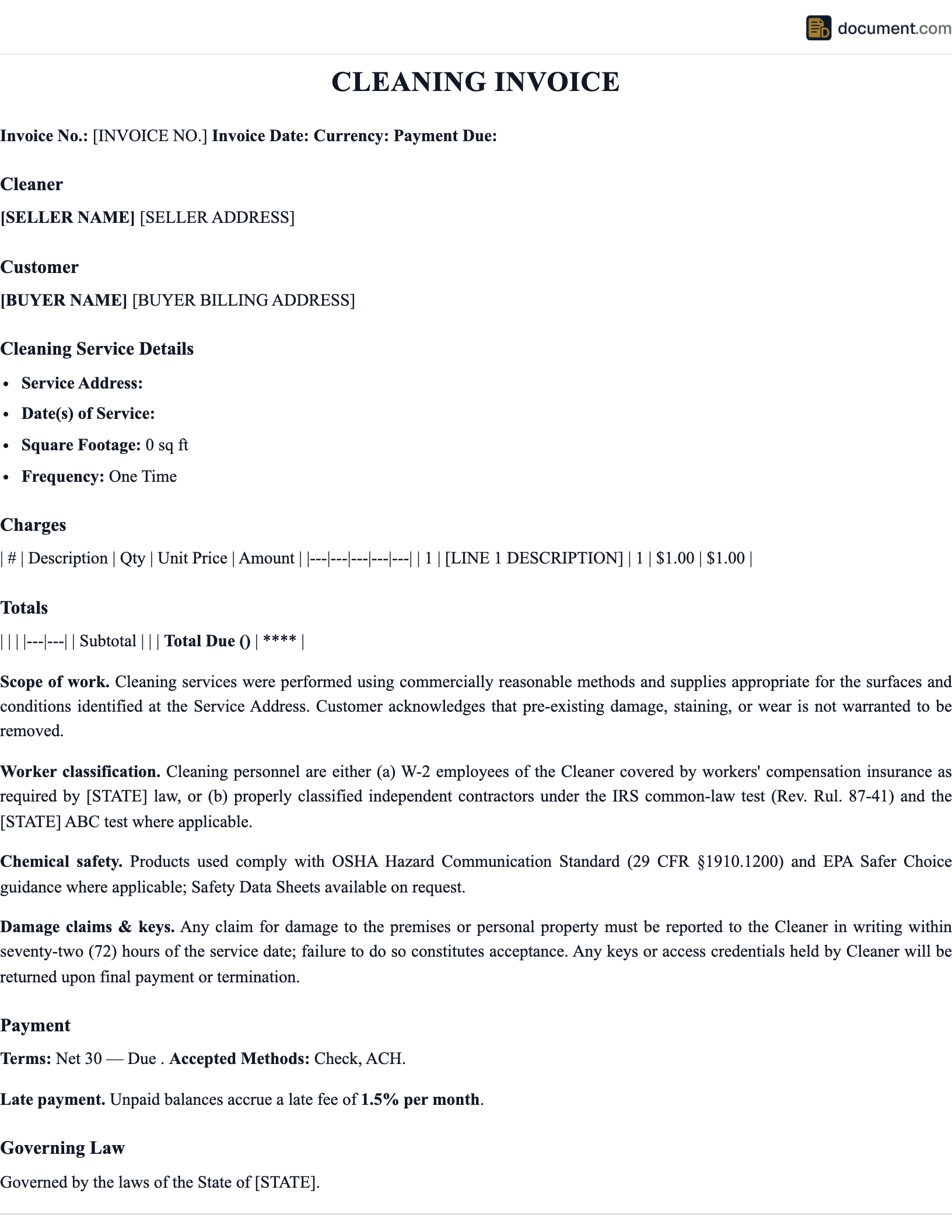
Cleaning Invoice Form Preview
Cleaning Service Invoice
Residential & Commercial Cleaning
From:
Cleaning Business Name
Bill To:
Client Name / Property Address
Service Date(s)
Property Type
Invoice #
Services Rendered
SERVICE PROVIDER
CLIENT
Key Components
A professional cleaning invoice should include these elements for clear communication and prompt payment:
| Component | Purpose | Key Details |
|---|---|---|
| Property Information | Identifies the service location | Address, property type, square footage, number of bedrooms/bathrooms, access instructions |
| Service Description | Details what was cleaned | Cleaning type (standard, deep, move-out), rooms covered, specific tasks completed |
| Pricing Model | Shows how charges were calculated | Hourly rate with hours worked, flat fee per visit, or per-square-foot rate |
| Add-On Services | Itemizes extras beyond base clean | Window cleaning, oven/fridge deep clean, carpet shampooing, laundry, organizing |
| Supply Charges | Tracks product and material costs | Cleaning products, paper goods, trash bags, specialty chemicals, equipment wear |
| Recurring Schedule | Documents the billing cycle | Frequency (weekly, biweekly, monthly), next service date, discount applied |
| Discounts | Shows savings for loyal clients | Recurring client discount, referral credit, package prepay discount |
| Payment Terms | Sets expectations for payment | Due date, accepted methods (Venmo, Zelle, check, card), late fee policy |
How to Create a Cleaning Invoice
Document the Property and Client Details
Record the client's name, billing address (which may differ from the cleaning address), phone, and email. Note the property address, type (house, apartment, condo, office), approximate square footage, and any access instructions (lockbox code, alarm code, parking). This information carries forward on all future invoices for the client.
Select the Pricing Model
Choose between hourly billing (best for first-time or unpredictable cleanings), flat-rate per visit (best for recurring residential), or per-square-foot (best for commercial). Document the rate clearly and note the basis: for example, '$175 flat for standard 3BR/2BA clean' or '$35/hour with 3-hour minimum.' If using a hybrid model (flat rate with hourly overages), state both rates.
Itemize Base Services and Add-Ons
List the base cleaning scope (kitchen, bathrooms, bedrooms, living areas, vacuuming, mopping, dusting) and then separately itemize any add-on services performed (window interiors, oven cleaning, refrigerator, baseboards, laundry). Each add-on should show its own price so the client understands the breakdown.
Add Supply and Material Charges
If you charge separately for supplies, list the products or a flat supply fee. For commercial accounts, itemize consumable supplies (paper products, trash bags, cleaning chemicals) with quantities and unit costs. Note if the client provides their own supplies and whether this reduces the service rate.
Apply Discounts and Calculate Totals
Apply any recurring client discounts, referral credits, or prepaid package savings as visible line items. Calculate the subtotal, apply sales tax if required in your state for cleaning services, and show the total due. For recurring billing, include the service period covered and the next scheduled service date.
Set Payment Terms and Send
Specify the due date (due on receipt for residential, net-15 or net-30 for commercial), accepted payment methods, and any late fee policy (typically $10-25 or 1.5% per month after 15 days). Send via email or text with a link to your payment platform. For recurring clients, consider automated invoicing through a platform like Square, Jobber, or Housecall Pro.
Frequently Asked Questions
Official Resources
Industry organizations, regulatory agencies, and business resources for cleaning professionals.
ISSA - The Worldwide Cleaning Industry Association
Global cleaning industry standards, certifications (CIMS), and best practices for janitorial companies.
IRS - Self-Employed Tax Center
Tax filing guidance for independent cleaners, including estimated tax payments and deductible business expenses.
OSHA - Cleaning Industry Safety
Workplace safety standards for cleaning professionals, including chemical handling and ergonomic guidelines.
SBA - Choose Your Business Structure
Guidance on structuring a cleaning business as a sole proprietorship, LLC, or corporation.
EPA - Safer Choice Program
EPA-certified cleaning products and green cleaning standards for environmentally conscious cleaning businesses.
BLS - Building & Grounds Cleaning Occupations
Labor statistics on cleaning industry wages, job outlook, and employment trends.
Create Your Cleaning Invoice
Build a professional cleaning invoice with detailed service breakdowns, supply tracking, and recurring billing support.
Create DocumentNo account required. Free to create and preview.