
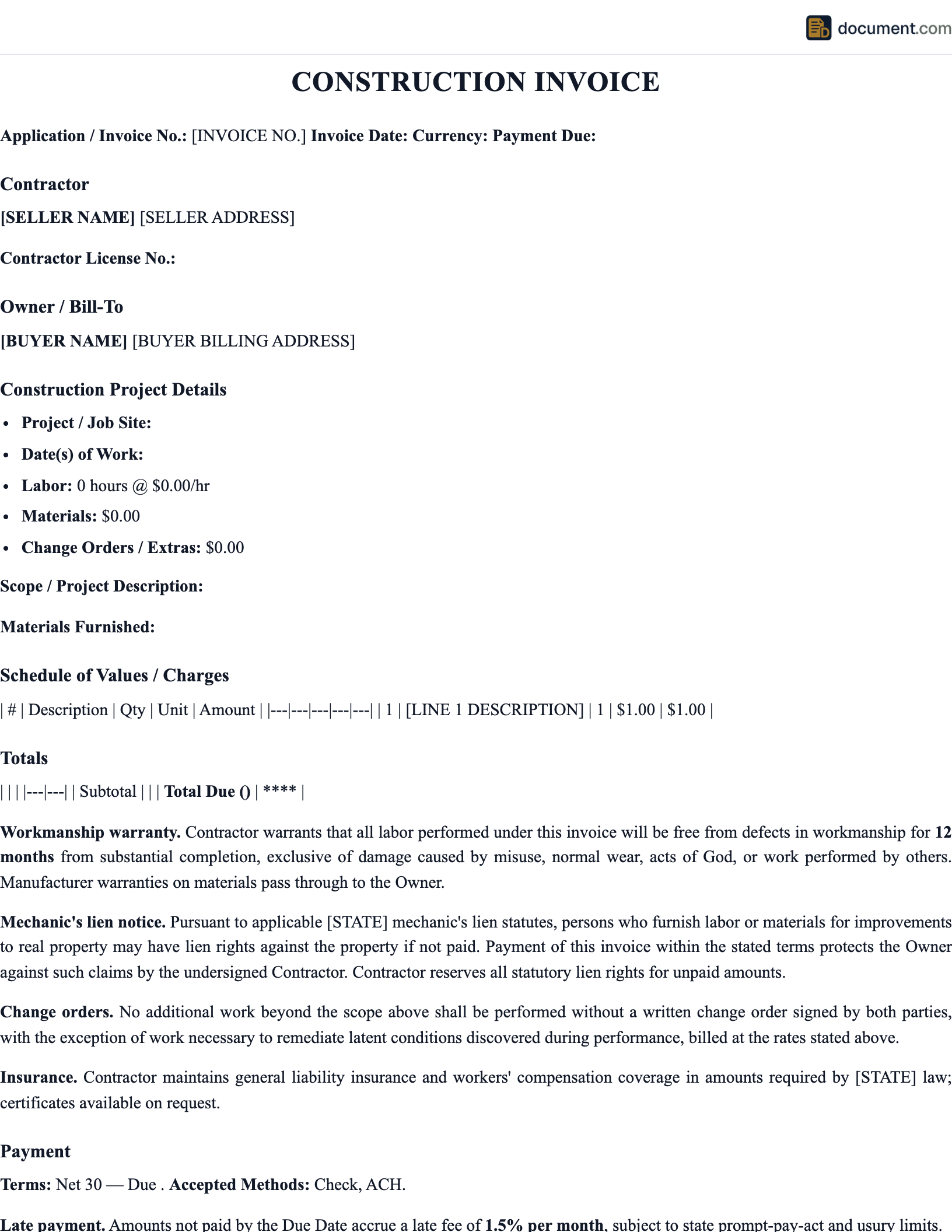



What Is a Construction Invoice?
A construction invoice (the trade calls it a pay application or progress billing) is the periodic demand for payment a contractor or subcontractor submits against a fixed schedule of values during the life of a construction project. It is fundamentally different from a service invoice. The contractor bills progressively, not on completion: each month the SOV is updated with the percentage of completion per line item, the architect certifies the application under AIA Document G702, the owner pays within the contract or statutory window, and the contractor pays its subs and suppliers within the state prompt-payment window (7 days in California under Cal. Bus. & Prof. Code § 7108.5, 7 days in New York under Gen. Bus. Law § 756-a, 7 days in Texas under Prop. Code § 28.002).
The pay application sits at the intersection of contract law, mechanic's lien law, surety law, and project finance. Each application triggers a chain of legal rights: the contractor's certification of work performed, the architect's certification under AIA A201 § 9.4, the owner's payment obligation, the GC's downstream payment to subs, the lien-waiver exchange that conditions payment, and the lender's draw approval that funds the owner's account. Break any link and the invoice becomes the evidentiary foundation for the mechanic's lien claim under state lien statutes (Cal. Civ. Code § 8400 et seq., Fla. Stat. § 713, Tex. Prop. Code § 53), the bond claim against a Miller Act or Little Miller Act surety (40 U.S.C. § 3133), and the breach-of-contract claim for unpaid sums.
Project complexity drives invoice complexity. A single mid-size commercial build involves 20 to 50 subcontractors, hundreds of material suppliers, dozens of change orders, stored-materials line items requiring bills of sale and certificates of insurance, retention accumulating across the project duration (often $200,000 or more on a $5 million project at 5 percent), and backcharges for defective work. The pay application must account for each in a format the owner, architect, lender, and surety can verify line by line. Format errors cost real money: a misallocated SOV gets the application rejected and pushes payment back another 30-day cycle.
Public-work bonding under Miller Act and Little Miller Acts
The federal Miller Act (40 U.S.C. § 3131) requires payment and performance bonds on every federal construction contract above $150,000. Subcontractors and suppliers without direct contractual privity to the federal owner have no lien rights against federal property; their remedy is a Miller Act payment-bond claim served on the prime contractor's surety within 90 days of last work and filed in federal district court within one year. State Little Miller Acts (Cal. Civ. Code § 9550, Fla. Stat. § 255.05, Tex. Gov't Code § 2253.021) impose parallel bond requirements on state and municipal public construction. Properly format every public-work pay application to support the eventual bond claim: identify the bonded principal, the bond number, and the contracting public entity on each invoice.
Prompt-payment statutes and pay-when-paid clauses
California Bus. & Prof. Code § 7108.5 requires GCs to pay subs within 7 days of receiving owner payment, with 2 percent monthly penalty interest plus attorney fees on wrongful withholding. New York Gen. Bus. Law § 756-a (the Prompt Payment Act) imposes a 30-day owner-payment window with 1 percent monthly interest. Texas Prop. Code § 28.002 imposes 1.5 percent monthly interest. The federal Prompt Payment Act (31 U.S.C. § 3902) gives federal owners 14 days to pay properly submitted invoices. Pay-when-paid clauses purporting to make sub payment conditional on owner payment are unenforceable as risk-shifting in California (Wm. R. Clarke Corp. v. Safeco Ins., 15 Cal. 4th 882 (1997)), New York (West-Fair Elec. Contractors v. Aetna, 87 N.Y.2d 148 (1995)), and several other states. They are enforceable only as timing provisions providing a reasonable cushion for owner payment.
Progress Billing
Track percentage of completion across every scope of work in the schedule of values.
Retention Tracking
Calculate and track 5-10% retention holdback with statutory release timelines.
Lien Rights Protection
Coordinate lien waivers with each pay application to preserve mechanic's lien rights.
Construction Invoice Form Preview
Application for Payment
AIA G702 Format, Progress Billing
Contractor:
Owner:
Project Name
Application #
Period To
Schedule of Values Summary
CONTRACTOR
ARCHITECT
OWNER
Key Components
Eight components make a pay application enforceable. Each addresses a question that would otherwise default to oral testimony, the architect's discretion, or the owner's adverse interpretation.
Schedule of values discipline
AIA A201 § 9.2 requires the SOV to allocate the contract sum "as may be necessary for its proper accuracy." Front-loading (over-allocating value to early line items like Mobilization or General Conditions to accelerate cash flow) is grounds for the architect to refuse certification. Build the SOV by CSI MasterFormat division (Division 03 Concrete, Division 09 Finishes, Division 23 HVAC) so each line ties to discrete inspectable scope. Update the SOV when change orders are approved by adding a new line for each CO rather than diluting existing lines. Lender construction inspectors verify the SOV against monthly site progress; mismatches delay the draw and back up the entire payment chain.
Lien-waiver exchange protocol
California Civ. Code §§ 8132 to 8138 prescribe four mandatory waiver forms verbatim: Conditional Waiver and Release on Progress Payment (§ 8132), Unconditional Waiver and Release on Progress Payment (§ 8134), Conditional Waiver and Release on Final Payment (§ 8136), Unconditional Waiver and Release on Final Payment (§ 8138). Deviation from the statutory text invalidates the waiver. Texas Prop. Code §§ 53.281 to 53.287 prescribe parallel forms. The pay application package transmits the conditional progress waiver for the current pay period (effective on payment) and the unconditional progress waiver for the prior pay period (proving prior payment was received). Collect lower-tier waivers from every sub and supplier before the GC's submission; the bundle is what gives the owner clean title.
| Component | Purpose | Key Details |
|---|---|---|
| Cover Sheet (G702) | Summarizes the billing and approvals | Project name, application number, period, contract sum, change orders, total completed, retainage, prior payments, current due |
| Schedule of Values (G703) | Details line-item progress | Item number, description, scheduled value, previous completion, current work, materials stored, total completed, percentage, balance to finish |
| Change Order Log | Tracks contract modifications | CO number, date, description, amount (addition/deduction), approval status, cumulative impact |
| Retention Summary | Calculates withheld amounts | Retention percentage, current period retention, cumulative retention, release conditions |
| Stored Materials | Bills for purchased but uninstalled materials | Item description, storage location, value, insurance documentation, transfer of title |
| Lien Waivers | Accompanies payment requests | Conditional/unconditional, progress/final, amount covered, sub and supplier waivers |
| Certification | Provides sworn accuracy statement | Contractor certification, architect approval, notarization (if required by state or contract) |
| Backup Documentation | Supports the billing amounts | Daily logs, progress photos, delivery tickets, sub invoices, time sheets, equipment logs |
How to Create a Construction Invoice
Six steps in this order. The discipline at step one (the SOV) controls everything downstream; a sloppy SOV makes every subsequent application a renegotiation.
Pre-application coordination
Before Application No. 1: confirm the bond requirements (Miller Act for federal projects above $150,000, state Little Miller Act for public work), obtain certificates of insurance with the owner named as additional insured, deliver the W-9 if requested by a commercial owner, file the Preliminary Notice within state statutory windows (California within 20 days under Cal. Civ. Code § 8204, Florida within 45 days under Fla. Stat. § 713.06), and serve any state-required notice on the lender. Late notices forfeit lien rights regardless of how clean the pay applications are.
Pencil-copy review with the architect
AIA practice is to circulate a pencil-copy pay application 5 to 7 days before formal submission. The architect walks the site, reviews percentage-of-completion claims line by line, negotiates differences in the field rather than after submission, and approves the percentages that will appear on the formal G702/G703. The pencil-copy practice cuts certification time in half and prevents the architect from rejecting the formal application after submission, which restarts the 30-day owner-payment clock.
Establish the Schedule of Values
Before the first billing, break the contract sum into line items keyed to CSI MasterFormat divisions (Division 03 Concrete, Division 09 Finishes, Division 23 HVAC) or project phases. Each line should represent a measurable, verifiable portion of work. Obtain owner and architect approval within 30 days of contract execution. Front-loading (over-allocating to Mobilization or General Conditions) gets the application rejected under AIA A201 § 9.2 and damages the architect relationship for the project duration.
Update Percentage of Completion
At the end of each billing period, walk the project with the superintendent and update the percentage complete for each SOV line. Base percentages on measurable progress: cubic yards of concrete placed, linear feet of pipe installed, square footage of drywall hung. Document progress with dated photographs keyed to SOV line items. The lender's construction inspector will verify the percentages against site progress; mismatches delay the draw.
Incorporate Change Orders and Stored Materials
Add approved change orders as new SOV line items with their own completion percentages. For stored materials, document the purchase (supplier invoice), location, insurance coverage, and bill of sale. Calculate the stored materials value for each applicable line item. Do not include pending or disputed change orders in the billing amount.
Calculate Retention and Net Payment
Apply the contractual retention percentage to the total completed and stored to date. Subtract all prior certified payments. The result is the current payment due. Check the contract for retention-reduction provisions; many private contracts reduce retention from 10 percent to 5 percent after 50 percent completion. California Pub. Cont. Code § 7201 caps public-work retention at 5 percent. Texas Gov't Code § 2252.032 caps state-agency retention at 5 percent.
Assemble Lien Waivers and Supporting Documents
Collect conditional lien waivers from all subcontractors and material suppliers for the current billing period, plus unconditional waivers covering the prior period's payment. Attach progress photographs, daily logs, and any required certifications. Use your state's statutory lien waiver form if applicable.
Submit for Certification and Track Payment
Submit the complete pay application package to the architect by the contractual due date. Follow up on certification within the review period (typically 7-10 days). Track the owner's payment obligation date per the contract and state prompt-payment statute. Document all submissions and communications in your project correspondence log.
Frequently Asked Questions
Official Resources
Industry standards, legal resources, and regulatory agencies for construction billing and payment.
AIA - G702/G703 Contract Documents
Official AIA pay application forms and guidance for the industry-standard billing format.
Associated General Contractors of America
Industry association resources on construction best practices, contract forms, and payment advocacy.
Levelset - Mechanics Lien Resources
State-by-state mechanics lien law guides, notice requirements, and lien waiver forms.
SBA - Construction Business Finances
Small Business Administration resources on cash flow management and financial record-keeping for contractors.
OSHA - Construction Industry Standards
Occupational safety standards for construction sites, including compliance documentation requirements.
IRS - Construction Industry Tax Guide
IRS guidance on construction accounting methods, long-term contract taxation, and record-keeping requirements.
Create Your Construction Invoice
Build a professional pay application with progress billing, retention tracking, and lien waiver coordination.
Create DocumentNo account required. Free to create and preview.