



What Is a Freelance Invoice?
A freelance invoice is the financial bridge between creative work delivered and payment received. For the 64 million Americans who freelanced in 2023 (Upwork Freelance Forward survey), the invoice is the single most important business document. It triggers payment, creates the tax record, documents the scope of work delivered, and establishes the professional credibility that distinguishes a Schedule C business from a hobby in IRS Section 183 ('hobby loss') analysis. Unlike employees who receive automatic paychecks, freelancers must request payment for every project, which makes invoicing discipline a direct determinant of cash flow.
Freelance invoicing carries unique challenges salaried professionals never face. Payment timing is unpredictable: Net 30 terms mean the freelancer funds 30 days of living expenses between delivery and payment, and chronic late payers stretch that to 60 or 90 days. Project scope is fluid; clients request 'small changes' that accumulate into substantial unbilled work unless tracked. Multiple revenue streams with different billing models (per-word, per-project, hourly, retainer) must consolidate into one coherent financial picture. The freelancer bears full tax responsibility under IRC Section 1401: 15.3 percent self-employment tax (12.4 percent Social Security plus 2.9 percent Medicare), quarterly estimated payments under IRC Section 6654, and no employer withholding or FICA match.
A well-designed freelance invoice does more than request payment. It documents exactly what was delivered for dispute-resolution purposes, conditions intellectual property transfer on payment receipt under 17 U.S.C. Section 204(a), and builds the financial documentation that lenders and landlords require. For freelancers planning to scale (subcontracting, agency formation, securing credit), a history of professional invoicing is foundational evidence of business legitimacy.
Form W-9 collection and 1099-NEC reporting under IRC Section 6041
Any client who pays a freelancer $600 or more in a calendar year must issue Form 1099-NEC by January 31 of the following year (IRC Section 6041 and the 2020 reinstatement of the NEC form). To meet that obligation, the client needs the freelancer's TIN, legal name, and address from a completed Form W-9 (Request for Taxpayer Identification Number and Certification). Best practice: send a W-9 with the first invoice or attach it to the engagement letter. Failing to provide a TIN exposes the freelancer to 24 percent backup withholding under IRC Section 3406. Failing to file 1099-NEC exposes the client to penalties of $60 to $310 per missed form (IRC Section 6721, 2024 inflation adjustment), capped at $3.78 million per year for large filers. The freelancer's invoice register (invoice number, client, date issued, amount, date paid) reconciles to the 1099-NEC each January.
Prompt-payment laws and late-fee enforcement
Several states have enacted prompt-payment laws that override 'Net 60' or 'Net 90' terms commonly imposed by large clients. New York's Freelance Isn't Free Act (NY Labor Law Section 191-d, expanded statewide in August 2024) requires written contracts for any freelance work over $800, payment within 30 days of completion (or per contract), and creates statutory damages of double the unpaid amount plus attorney fees for violations. Illinois passed a similar Freelance Worker Protection Act effective July 2024. Los Angeles, Minneapolis, Seattle, and Columbus have their own freelance protection ordinances. For construction-adjacent freelance work (architectural, engineering, design build), state prompt-payment statutes apply: California Bus. and Prof. Code Section 7108.5 (10 days for prime contractors to pay subs), Florida Section 715.12 (25 days), New York Prompt Payment Act Section 756 (30 days). Late-fee maximums follow state usury caps: California Civ. Code Section 1916-1 caps interest at 10 percent annually for personal/family loans, but commercial transactions are governed by negotiated terms. Most freelancers charge 1.5 percent monthly (18 percent APR) which is enforceable in most jurisdictions if disclosed in the contract.
Kill fees and project cancellation rights
A kill fee compensates the freelancer for time invested and opportunity cost when a client cancels mid-project. Standard practice: 25 to 50 percent of the project fee for cancellation after contract signing but before substantial work; 50 to 100 percent after major deliverables ship. Kill fees are enforceable in most states as liquidated damages under UCC Section 2-718 and the Restatement (Second) of Contracts Section 356, provided the amount is a reasonable forecast of actual loss and not a penalty. The contract should specify the kill-fee schedule by project phase. The cancellation invoice references the contract clause, identifies the cancellation date and phase, lists deliverables produced through cancellation, and applies the kill-fee percentage. Without a written kill-fee clause, the freelancer is left arguing quantum meruit recovery, which is unpredictable and rarely covers the freelancer's full loss.
Milestone Billing
Project-phase payments tied to deliverable completion and client acceptance.
Revision Tracking
Document included revision rounds and bill additional changes at defined rates.
1099 Compliance
Maintain the invoice records that support accurate annual tax reporting.
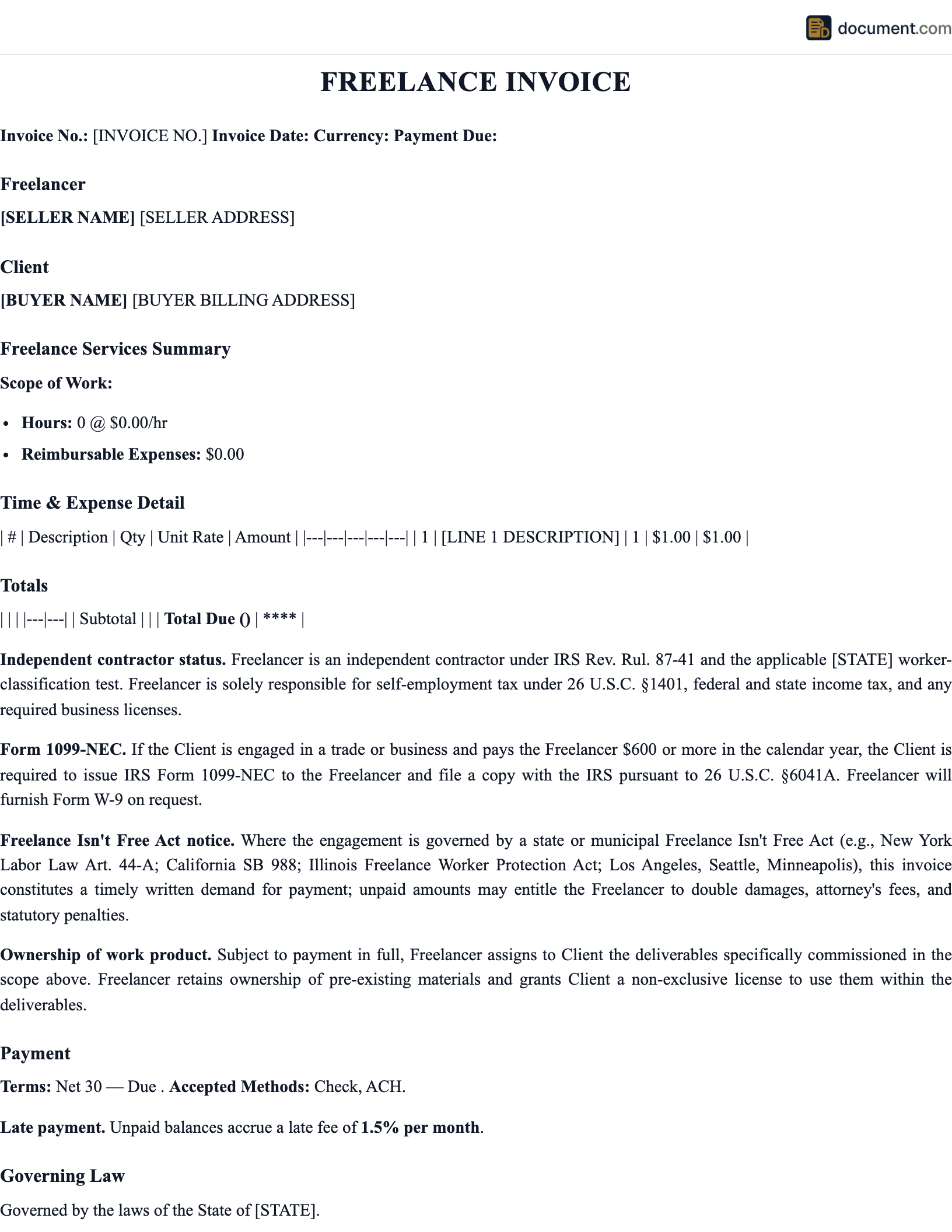
Freelance Invoice Form Preview
Freelance Invoice
Creative & Professional Services
From:
Freelancer Name / Business
Bill To:
Client / Company
Invoice Date
Project Ref
Due Date
Project Deliverables
FREELANCER
CLIENT
Key Components
A professional freelance invoice should include these elements for clear billing and payment protection:
| Component | Purpose | Key Details |
|---|---|---|
| Project Reference | Links invoice to governing agreement | Contract or SOW number, project name, client PO number, billing period |
| Deliverable Detail | Documents what was delivered | Deliverable description, milestone reference, quantity, unit price, acceptance date |
| Revision Tracking | Bills changes beyond scope | Included rounds used, additional round count, hourly or per-round fee, change log reference |
| Expense Pass-Throughs | Reimburses project costs | Stock assets, software licenses, printing, shipping, subcontractor fees, receipt documentation |
| Payment Terms | Sets expectations and penalties | Net terms, due date, early discount, late fee rate, accepted payment methods |
| IP Transfer Clause | Conditions rights transfer on payment | Rights transfer upon payment receipt, license scope, contract clause reference |
| Kill Fee / Cancellation | Bills for canceled projects | Kill fee percentage, project phase at cancellation, deliverables transferred, contract reference |
| Tax Information | Supports 1099 compliance | Freelancer TIN (on W-9, not invoice), running year-to-date total, sales tax if applicable |
How to Create a Freelance Invoice
Reference the Project Agreement
Start with the contract or SOW that governs the engagement. Pull the agreed pricing model (project fee, hourly rate, per-unit rate), included revision rounds, expense reimbursement terms, payment terms, and IP transfer provisions. Include the project reference and any client PO number on the invoice header for routing through accounts payable.
Itemize Deliverables and Milestones
List each deliverable with a clear description, the associated milestone (if project-based), the agreed price, and the delivery/acceptance date. For hourly work, include a time log with dates, activity descriptions, hours, and the hourly rate. For per-unit pricing (articles, illustrations, photos), show quantity and unit rate.
Document Revisions and Scope Changes
Separate included revisions from additional billable revisions. For each additional revision round, note the client's change request date, the nature of the changes, and the time or fee charged. Reference the revision clause in the contract to support the charges.
Add Expense Pass-Throughs
Itemize any reimbursable expenses: stock photography/illustration licenses, fonts, software subscriptions, printing costs, shipping, subcontractor fees. Include the vendor, date, and amount for each expense. Attach receipts or a receipt summary if required by the contract.
Apply Late Fees and Calculate Totals
If prior invoices are past due, add late fees as separate line items with a clear calculation referencing the original invoice number and the contractual late fee terms. Subtotal deliverables and expenses separately, apply any applicable taxes, and calculate the total due.
Set Terms, Add IP Notice, and Send
State the payment due date and accepted methods (ACH, PayPal, Wise, check). Include the IP transfer notice: 'Intellectual property rights transfer to Client upon receipt of full payment per [contract clause].' Send via email with the invoice number in the subject line and retain a copy in your records for 1099 reconciliation.
Frequently Asked Questions
Official Resources
Tax guidance, industry organizations, and business resources for freelance professionals.
IRS - Self-Employed Tax Center
Federal tax guidance for freelancers, including quarterly estimated payments, deductions, and 1099 reporting.
Freelancers Union
Advocacy organization offering resources on freelance contracts, benefits, tax guidance, and client payment issues.
SBA - Business Structure Guide
Guidance on structuring a freelance business as a sole proprietorship, LLC, or S-Corp.
U.S. Copyright Office
Official resources on copyright registration, work-for-hire doctrine, and intellectual property protection for creators.
SCORE - Freelance Resources
Free mentoring and workshops for freelancers on business planning, pricing, and client management.
BLS - Self-Employment Data
Bureau of Labor Statistics data on self-employment trends, earnings, and industry projections.
Create your Freelance Invoice Template in under 10 minutes.
Answer a few questions and download a compliant, attorney-drafted document ready for your state.