
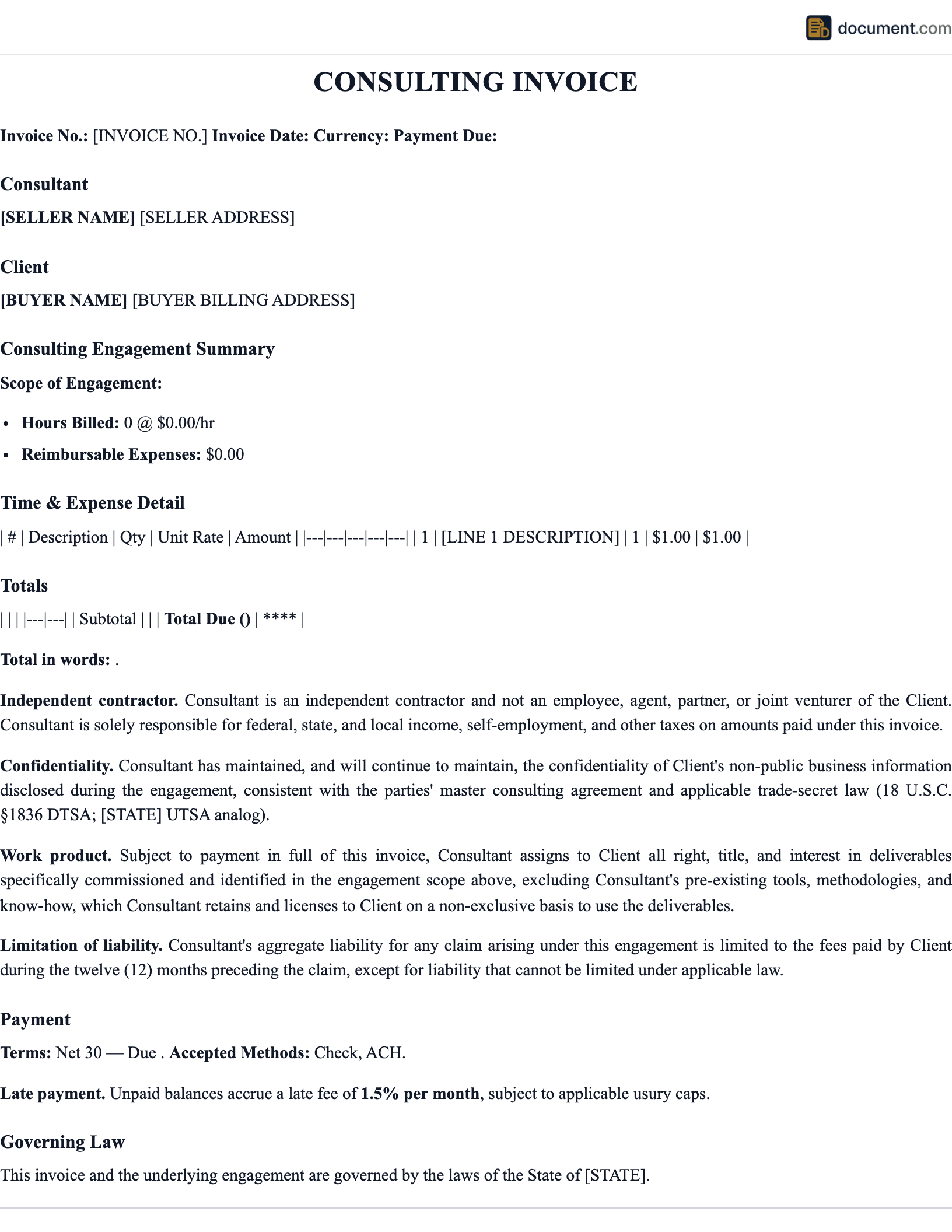



What Is a Consulting Invoice?
A consulting invoice converts professional advisory work into a payment request. Consulting is expertise-for-hire: clients pay for a consultant's knowledge, analytical capability, industry relationships, and strategic judgment rather than a tangible product. The invoice has to demonstrate value in a form that justifies fees ranging from $100 per hour for independent specialists to $500 or more per hour for senior partners at global firms. Corporate clients route consulting invoices through procurement, legal, and finance before payment is authorized, so every invoice must be self-explanatory to readers who were not involved in the engagement.
Three billing models dominate the industry. Hourly billing requires detailed time logs showing what work was performed, by whom, for how long, and at what rate. Project-based billing ties payments to deliverable acceptance, requiring the invoice to reference specific outputs. Retainer billing secures ongoing access through either a fixed monthly fee or drawdown against a prepaid balance. Many engagements combine models: project-based billing for core deliverables with hourly for ad-hoc requests outside the original scope. Without crisp scope boundaries and change-order discipline, consulting invoices become contested.
As an independent contractor, the consultant is responsible for their own tax obligations under IRC Section 1401: 15.3 percent self-employment tax (12.4 percent Social Security up to the wage base of $168,600 in 2024, plus 2.9 percent Medicare on all earnings) and quarterly estimated payments under IRC Section 6654. Clients paying the consultant $600 or more in a calendar year must issue Form 1099-NEC by January 31 (IRC Section 6041). The consultant should furnish a completed Form W-9 at engagement to ensure correct TIN reporting.
Scope of work, change orders, and out-of-scope billing
Scope creep is the most common consulting invoice dispute. The engagement letter should define included activities, excluded activities, assumptions about client cooperation, and the procedure for adding work. Industry best practice: any activity outside the defined scope requires a written change order signed by the client before work begins. The change order specifies the additional scope, the incremental fee or hourly rate, the timeline impact, and any change to deliverable acceptance criteria. On the invoice, in-scope and out-of-scope work appear as separate line items, with the out-of-scope line referencing the change order number and date. Many consultants build a 10 to 15 percent contingency into project estimates and notify the client when the contingency is consumed. Without change-order discipline, the consultant carries the risk of unbilled work.
Retainer mechanics: fixed-fee versus evergreen
A fixed-fee retainer charges a set monthly amount for a defined scope of availability or deliverables. Unused hours do not roll over or generate refunds; the consultant carries the variability. The invoice shows the monthly fee as a single line item with the service period covered. An evergreen retainer requires the client to maintain a minimum balance in a retainer account that the consultant draws against based on actual hours worked. The invoice shows the opening balance, individual time entries drawn against the balance, the closing balance, and any replenishment amount due. Evergreen retainers are common in legal-adjacent consulting (regulatory, compliance, M&A advisory) where time is unpredictable. Both types should reference the retainer agreement, the notice period for modification or termination (typically 30 to 90 days), and the rollover or refund treatment of unused balance.
Kill fees and termination compensation
When a client terminates a consulting engagement before completion, a kill-fee or termination-compensation clause governs the consultant's recovery. Standard structures: 25 to 50 percent of the remaining project fee for cancellation after contract signing but before substantial work; 50 to 100 percent after major deliverables ship. Kill fees are enforceable in most states as liquidated damages under UCC Section 2-718 and the Restatement (Second) of Contracts Section 356, provided the amount is a reasonable forecast of actual loss and not a penalty. For retainer engagements, termination notice (typically 30 to 90 days) keeps the retainer in force during the notice period, and the consultant invoices for that period at the standard rate. Without a kill-fee clause, the consultant is left arguing quantum meruit recovery for the value of work performed, which is unpredictable and rarely covers the full opportunity cost.
Milestone billing and prompt-payment expectations
Project-based engagements typically use milestone billing: 30 percent at signing, 30 percent at mid-project deliverable acceptance, 40 percent at final delivery and client sign-off. Each milestone invoice should reference the engagement letter, identify the milestone being billed, describe the deliverable produced, note the client's acceptance date, and show the cumulative payment status. Net 30 is the standard payment term; corporate clients often impose Net 45 or Net 60. New York's Freelance Isn't Free Act (NY Labor Law Section 191-d, expanded statewide August 2024) and Illinois's parallel Freelance Worker Protection Act (effective July 2024) require written contracts for freelance work over $800 and payment within 30 days of completion or per contract, with statutory damages of double the unpaid amount plus attorney fees for violations. Late fees of 1.5 percent monthly (18 percent APR) are enforceable in most jurisdictions if disclosed in the engagement letter and within state usury caps for commercial transactions.
Hourly Billing
Detailed time tracking with consultant-level rates and activity descriptions.
Project Milestones
Deliverable-based payments tied to specific project outputs and acceptance criteria.
Retainer Management
Fixed monthly fees or drawdown tracking with balance reporting and replenishment.
Consulting Invoice Form Preview
Consulting Services Invoice
Professional Advisory Services
From:
Consultant / Firm Name
Bill To:
Client / Company Name
Invoice Date
Project Ref
Payment Terms
Professional Services
Reimbursable Expenses
CONSULTANT
CLIENT APPROVAL
Key Components
A professional consulting invoice should include these elements that produce clarity, accelerate approval, and accelerate payment:
| Component | Purpose | Key Details |
|---|---|---|
| Engagement Reference | Links invoice to the governing agreement | SOW or engagement letter number, project name, client PO number, billing period |
| Time Detail | Justifies hourly charges | Date, consultant name, activity description, hours, rate, amount per entry |
| Rate Schedule | Documents applicable billing rates | Rate by personnel level (partner, senior, associate), overtime/weekend premium, blended rate |
| Deliverable Status | Connects charges to project progress | Milestone name, completion status, acceptance date, associated payment amount |
| Expenses | Itemizes reimbursable costs | Travel, lodging, meals, materials, software, subconsultant fees, receipt references |
| Retainer Balance | Tracks prepaid account status | Opening balance, charges applied, closing balance, replenishment amount due |
| Payment Terms | Specifies payment expectations | Net terms (15/30/45/60), early payment discount, late fee rate, payment methods, banking details |
| Work Summary | Provides context for decision-makers | Key activities, deliverables completed, decisions supported, next-period plan |
How to Create a Consulting Invoice
Reference the Engagement Agreement
Start by pulling the key commercial terms from your engagement letter or SOW: billing model (hourly, project, retainer), approved rates, expense reimbursement policy, payment terms, and any not-to-exceed caps. Include the project reference number and client PO number on the invoice header for easy routing through the client's accounts payable system.
Compile and Categorize Time Entries
Export your time tracking data for the billing period and organize entries by date and consultant. Each entry should describe the work performed in enough detail for the client to evaluate value (2-3 sentences, not just 'research' or 'analysis'). Subtotal by consultant to show the blended rate, and flag any entries that exceed the scope of the original agreement.
Document Deliverables and Milestones
For project-based billing, list each deliverable with its agreed payment amount and completion status. For milestone-based payments, note the acceptance criteria and whether the deliverable has been formally accepted. Attach deliverable acceptance sign-offs when available.
Itemize Reimbursable Expenses
List each expense with the date, description, vendor, amount, and receipt reference number. Organize by category (travel, lodging, meals, materials, subscriptions). Verify that each expense falls within the reimbursement policy: check per-diem caps, pre-approval requirements, and markup allowances. Attach receipts or a receipt summary.
Calculate Totals and Apply Terms
Subtotal professional fees and expenses separately. Apply any retainer credits, prior deposits, or early payment discounts. Calculate the total due and note the payment due date based on the agreed net terms. Include banking details for ACH or wire payment and specify any credit card surcharge if applicable.
Add a Work Summary and Send
Include a brief cover summary (3-5 bullet points) connecting the charges to project value: what was accomplished, what decisions were supported, and what the next period's focus will be. Send the invoice via email to the client's designated billing contact with the engagement reference in the subject line. Set a calendar reminder for follow-up if payment is not received by the due date.
Frequently Asked Questions
Official Resources
Professional associations, tax guidance, and business resources for consulting professionals.
IRS - Self-Employed Tax Center
Federal tax guidance for independent consultants, including quarterly estimated payments and deductible business expenses.
SBA - Manage Your Business Finances
Resources on invoicing, cash flow management, and financial record-keeping for small consulting firms.
Consulting Success
Industry resources on consulting pricing models, proposal writing, and client engagement best practices.
SCORE - Free Business Mentoring
Free mentoring and workshops for independent consultants on business planning, pricing, and growth.
FTC - Business Guidance
Federal Trade Commission guidance on advertising, contracts, and business compliance for service providers.
BLS - Management Analysts
Bureau of Labor Statistics data on consulting industry wages, employment trends, and growth projections.
Create Your Consulting Invoice
Build a professional consulting invoice with detailed time tracking, expense documentation, and flexible billing models.
Create DocumentNo account required. Free to create and preview.