



What Is a DJ Invoice?
A DJ invoice is the billing document that entertainment professionals use to request payment for event performance services. The industry operates differently from most service businesses because revenue concentrates on weekends and event dates, making each booking a high-value transaction. A four-hour wedding reception performance represents 15 to 20 total hours of work after client consultations, music curation, transportation, setup, sound check, and teardown. The invoice captures the full scope in a format that justifies the fee.
Modern DJ businesses package multiple services. A wedding DJ might provide ceremony sound (separate system), cocktail hour music, reception entertainment with MC duties, uplighting design, photo booth operation, and late-night dance floor management. Each component prices separately. Corporate event DJs bill flat-rate packages for parties and itemized service breakdowns for multi-day conferences. The invoice must accommodate these structures while preserving the deposit-balance payment model the events industry uses to protect the booking date.
DJ income is taxable as self-employment income on Schedule C, with 15.3 percent self-employment tax under IRC Section 1401 and quarterly estimated payments under IRC Section 6654. Clients who pay a DJ $600 or more in a calendar year (corporate events, venues, agencies) must issue Form 1099-NEC by January 31 (IRC Section 6041). Wedding clients are individuals and generally do not issue 1099s, but the DJ remains responsible for reporting all income.
Non-refundable retainer deposits and date-protection
The DJ industry universally operates on a non-refundable retainer model. The retainer (25 to 50 percent of the total fee) is due at contract signing to take the date off the calendar. It is enforceable as liquidated damages under UCC Section 2-718 and the Restatement (Second) of Contracts Section 356 when the amount is a reasonable forecast of damages, not a penalty. A DJ booked 12 to 18 months out for a Saturday in June has real opportunity-cost damages from cancellation: the calendar slot is gone, and rebooking that close to the event is rare. California Civ. Code Section 1671 requires liquidated damages in consumer contracts to be reasonable in light of circumstances at signing or breach; courts in Texas, Florida, and New York apply similar reasonableness tests. Industry-standard cancellation tiers: 100 percent retainer forfeit at any time, plus 50 percent of remaining balance for cancellations 90 to 180 days out, plus 100 percent of remaining balance for cancellations within 90 days. Force majeure clauses (pandemic, natural disaster, venue closure) typically allow refund of all amounts except the retainer.
BMI, ASCAP, and SESAC public-performance licensing
Playing copyrighted music at a public event is a 'public performance' under 17 U.S.C. Section 106(4) and requires licensing through the performing rights organizations (PROs): BMI, ASCAP, and SESAC. The venue (not the DJ) typically holds the public-performance license under blanket licenses that cover all music in the PRO's catalog. Wedding receptions in private homes are exempt under 17 U.S.C. Section 110(4) because the audience is limited to family and social acquaintances. Receptions at commercial venues (hotels, banquet halls, country clubs) require the venue's blanket licenses, which most established venues maintain. DJs operating their own events (open-to-public dance nights, commercial parties they promote) need their own PRO licenses, typically $300 to $1,500 annually per PRO depending on venue capacity and frequency. A DJ-charged surcharge for licensing pass-through (typical: $25 to $75) should be itemized when the DJ is the licensed party. The invoice should not include a 'BMI/ASCAP fee' for a venue event the DJ does not license.
Equipment-damage clauses and event insurance
DJ equipment (speakers, mixers, lighting trusses, computers) runs $5,000 to $50,000 for a working setup. The performance contract should allocate damage risk: most DJs carry their own equipment-only insurance for in-transit and setup damage and require the venue or client to maintain general liability covering guest-caused damage at the event. Many DJ contracts include a damage waiver clause limiting the DJ's liability for guest spills, intoxicated guests, dance-floor accidents, and weather-driven outdoor damage. An equipment-damage line on the invoice (when triggered) should reference the contract clause, document the specific damage with photos and timestamps, and apply the contracted repair or replacement cost. For destination events and large weddings, a one-day event-insurance policy ($150 to $500) covering up to $1 million in liability and equipment damage is increasingly standard and can be billed as a pass-through line item.
Performance Fees
Flat-rate event fees with defined performance windows and overtime provisions.
Equipment Rental
Sound systems, lighting, effects, photo booths, and specialty equipment add-ons.
Travel & Logistics
Mileage, hotel, meals, and destination event travel expense tracking.
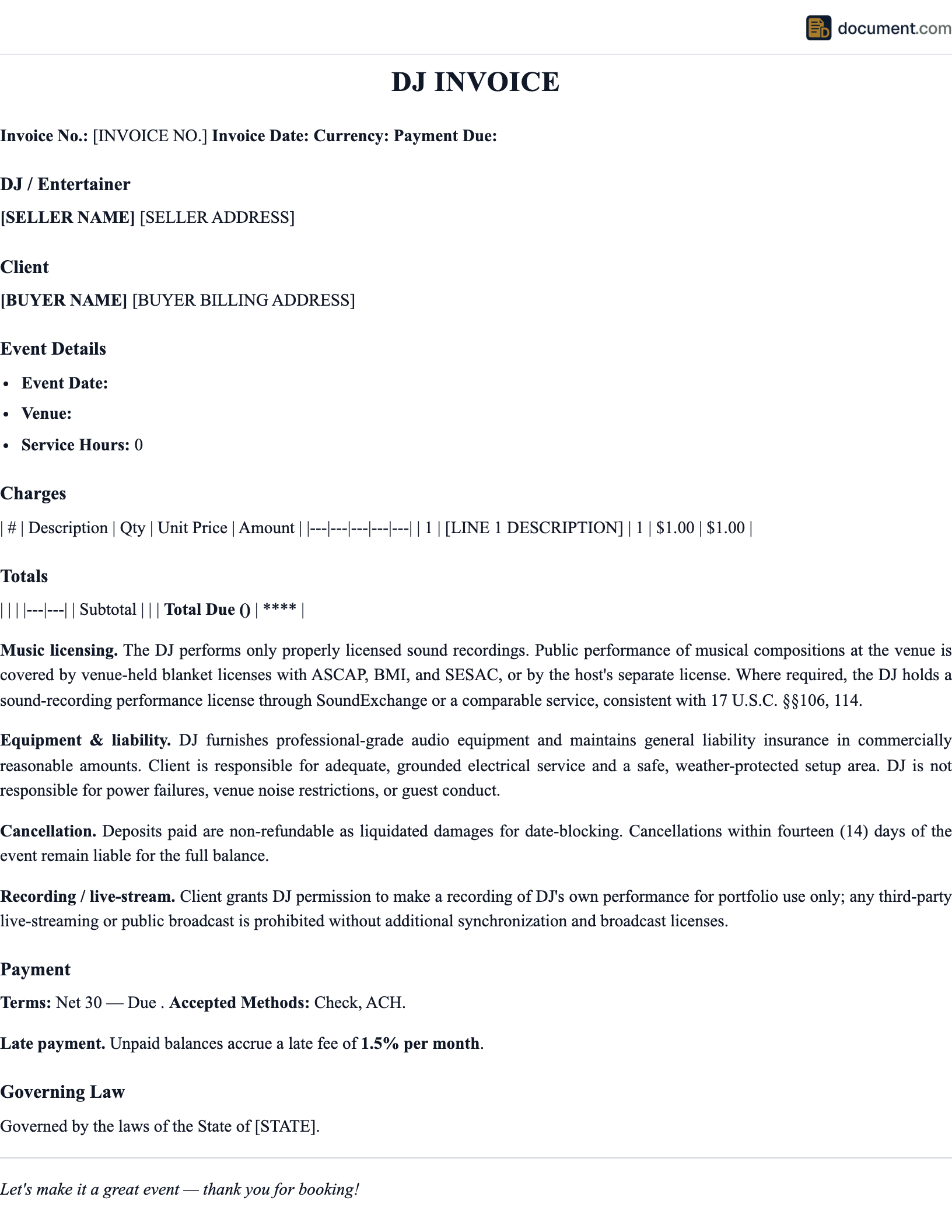
DJ Invoice Form Preview
DJ Entertainment Invoice
Event Performance & Equipment Services
DJ / Company:
Client:
Event Date
Venue
Event Type
Services & Equipment
DJ / PROVIDER
CLIENT
Key Components
A professional DJ invoice should include these elements to produce accurate billing and prevent event-day disputes:
| Component | Purpose | Key Details |
|---|---|---|
| Event Information | Identifies the specific booking | Event date, venue name and address, event type, contracted hours, setup/soundcheck time |
| Performance Fee | Documents the base entertainment charge | Flat event rate, performance window, included services (MC duties, music curation, timeline coordination) |
| Equipment Rental | Itemizes gear beyond base package | Sound system upgrades, lighting, uplighting, photo booth, fog machine, wireless mics, monogram projection |
| Overtime | Bills for time beyond the contract | Overtime rate per hour, increments, authorization requirements, contracted vs actual end time |
| Travel Expenses | Covers out-of-area logistics | Mileage, hotel, meals, tolls, parking, airfare for destination events |
| Deposit & Payments | Tracks the payment schedule | Retainer deposit amount and date, interim payments, balance due date, accepted payment methods |
| Cancellation Terms | References the booking agreement | Non-refundable deposit clause, cancellation tier schedule, rescheduling policy, force majeure |
| Insurance & Liability | Documents coverage status | General liability policy reference, equipment insurance, venue certificate of insurance requirements |
How to Create a DJ Invoice
Document the Event and Client Details
Record the client's full name, phone, email, and billing address. Note the event date, venue name and address, event type (wedding, corporate, birthday, club), contracted performance hours (start and end time), and the setup/soundcheck window. Reference the entertainment contract or booking agreement number.
Itemize the Performance Package
List the base performance fee with the included services: DJ performance, MC duties if applicable, music curation, timeline coordination. If you offer tiered packages (silver, gold, platinum), note which package the client booked. Separate the ceremony sound system from the reception package if they are priced independently.
Add Equipment and Enhancement Charges
List each equipment add-on with quantity and per-unit pricing: uplighting fixtures, photo booth rental, fog/haze effects, upgraded speaker system, wireless microphones, monogram projector. Note any equipment that requires venue approval (fog machines, confetti cannons) and confirm authorization was obtained.
Calculate Overtime and Travel
If the event ran past the contracted end time, document the overtime with the authorization details, number of additional hours/increments, and the overtime rate. Calculate travel charges based on your rate schedule: mileage beyond the free radius, hotel if overnight, and any incidental travel costs.
Apply Deposits and Calculate Balance
Show the total package price, subtract the retainer deposit (with date received), subtract any interim payments, and calculate the remaining balance. Note the balance due date and accepted payment methods. If the event has already occurred, the balance is typically due immediately or within 7 days.
Add Tax, Terms, and Send
Apply sales tax if required in your state for entertainment services. Include your business contact information, payment instructions (Venmo, Zelle, check payable to), and a thank-you note for the booking. Send via email with the entertainment contract attached for reference. For balance-due invoices sent before the event, set a calendar reminder for the due date.
Frequently Asked Questions
Official Resources
Industry associations, licensing organizations, and business resources for DJ professionals.
American DJ - Professional Equipment
Industry-leading DJ equipment manufacturer with product guides and technical resources.
IRS - Self-Employed Tax Center
Federal tax guidance for DJ businesses, including equipment depreciation and business expense deductions.
SBA - Business Structure Guide
Guidance on structuring a DJ business as a sole proprietorship, LLC, or S-Corp for liability protection.
BMI - Music Licensing
Music performance licensing requirements for DJs playing copyrighted music at public events.
ASCAP - Music User Licensing
ASCAP licensing information for DJs and entertainment companies performing copyrighted works.
SCORE - Entertainment Business Resources
Free mentoring and business planning resources for entertainment entrepreneurs and event service providers.
Create Your DJ Invoice
Build a professional DJ invoice with event fees, equipment charges, and deposit-balance payment tracking.
Create DocumentNo account required. Free to create and preview.