



What Is a Catering Invoice?
A catering invoice is the financial reconciliation document that bridges a catering proposal or contract and the final payment for event food and beverage services. Unlike a restaurant check, a catering invoice captures a multi-phase service engagement that spans tasting, menu design, preparation, delivery, setup, live service, and teardown. The invoice must reconcile variable pricing elements that shift between the proposal stage and the event itself: final guest counts that differ from estimates, menu substitutions driven by ingredient availability, last-minute add-ons from the host, and overtime when events run long.
Catering operates on thin margins. Food costs typically run 28 to 35 percent of revenue and labor consumes another 25 to 30 percent, so accurate invoicing is the difference between a profitable event and a loss. The invoice is also a regulated tax document. Most states tax prepared food and beverages served at events at the combined state-and-local sales-tax rate (Texas at 8.25 percent, California at 7.25 to 10.75 percent, New York City at 8.875 percent). Many jurisdictions tax mandatory service charges (Maryland Code Tax-Gen Section 11-101 includes them in the taxable base) but exempt voluntary tips from the same tax (Treas. Reg. Section 31.3402(k)-1 governs the federal tip-credit treatment for wage purposes). The invoice has to draw the line clearly so neither side underpays the state.
For corporate clients, nonprofit organizations, and event planners, the invoice doubles as a bookkeeping and audit document. Corporate clients paying $600 or more in a calendar year to an unincorporated caterer must file Form 1099-NEC under IRC Section 6041 by January 31 of the following year. Caterers should furnish a completed Form W-9 at booking so the client has the correct TIN on file. Nonprofits using grant funds need invoices that itemize allowable versus unallowable costs under OMB Circular A-122. A caterer who hands over a single-line "catering services" invoice loses business with these clients because the document fails downstream compliance review.
Deposit forfeiture and cancellation rules
Most catering contracts collect a 25 to 50 percent non-refundable deposit at booking to reserve the date. Whether that deposit can be retained on cancellation depends on the contract language and state law. Liquidated-damages clauses are enforceable in most states (UCC Section 2-718, Restatement (Second) of Contracts Section 356) when the amount is a reasonable forecast of actual damages, not a penalty. A caterer who books a Saturday in June six months out and turns away other inquiries has real opportunity-cost damages. A caterer cancelled with 18 months notice has time to rebook and likely cannot keep the full deposit. The invoice should reference the contract clause governing forfeiture and apply credits or refunds per its terms. Some states (California Civ. Code Section 1671) require liquidated damages in consumer contracts to be reasonable in light of the circumstances at signing or at breach.
Service charge versus gratuity tax treatment
Mandatory service charges (typically 18 to 22 percent) and voluntary tips are treated differently for sales-tax and payroll-tax purposes. Mandatory service charges are taxable as part of the receipts in most states (DC, Maryland, New York, Pennsylvania, Texas all include them in the sales-tax base). For payroll-tax purposes, mandatory service charges are wages under IRS Rev. Rul. 2012-18, subject to FICA, FUTA, and federal income-tax withholding when distributed to staff. Voluntary tips left at the staff's discretion remain tip income reported on Form 4070 and W-2 box 7. The invoice should label the line item correctly ("service charge" if mandatory and retained or distributed by the caterer; "suggested gratuity" if voluntary and going directly to staff) so the right tax treatment follows downstream.
Food-safety license markups and pass-throughs
Off-premises catering at venues without a commercial kitchen often requires a temporary food permit ($25 to $250 per event) issued by the local health department under FDA Food Code Section 8-302. Liquor service requires a one-day or off-premises liquor license ($75 to $1,500 per event) from the state ABC commission, with TIPS or ServSafe-Alcohol-certified bartenders required by most state ABC rules. These pass-through costs should be itemized on the invoice, not buried in the per-head price. Caterers who mark up third-party rentals (tables, chairs, linens, china) typically add 10 to 20 percent as a coordination fee. The contract should disclose markups; the invoice should reflect them transparently.
Per-Head Pricing
Itemized food and beverage costs broken down by guest count and menu tier.
Rental & Logistics
Equipment rentals, delivery fees, setup/teardown charges, and venue coordination.
Staffing & Gratuity
Server hours, bartender fees, chef surcharges, and automatic service charges.
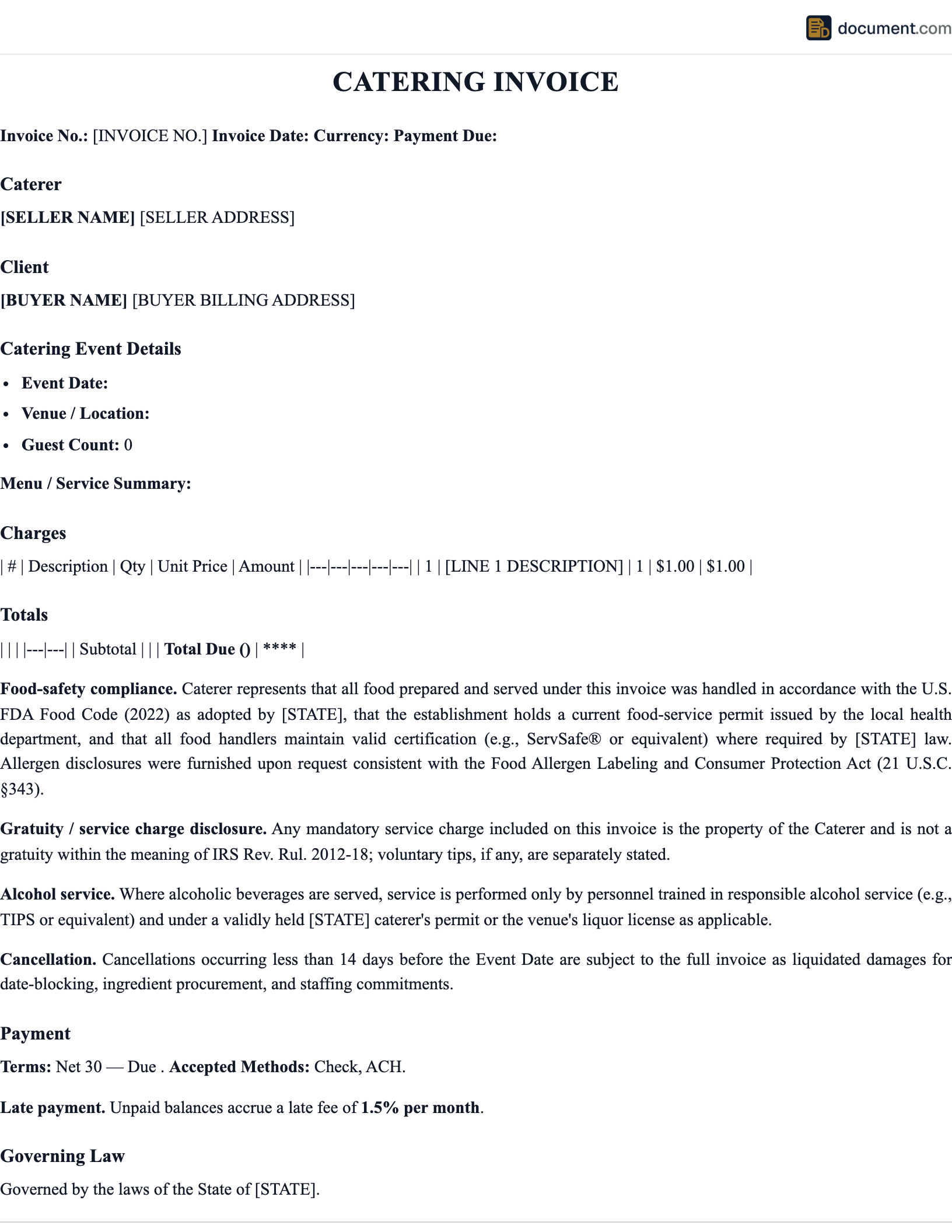
Catering Invoice Form Preview
Catering Invoice
Event Food & Beverage Services
From:
Catering Company Name
Bill To:
Client / Event Host
Event Date
Guest Count
Invoice #
Line Items
CATERER SIGNATURE
CLIENT SIGNATURE
Key Components
A complete catering invoice covers these billing elements to keep transparency tight and prevent disputes:
| Component | Purpose | Key Details |
|---|---|---|
| Event Details | Identifies the specific event being billed | Date, venue, event type, start/end times, final guest count, contract reference number |
| Food & Beverage | Documents per-head pricing and menu selections | Menu tier, per-head rate, guest count, dietary accommodations, bar package level, consumption-based charges |
| Staffing | Breaks down labor charges | Server count, hours worked, hourly rate, bartender fees, chef surcharge, event coordinator |
| Equipment Rentals | Itemizes tables, chairs, and specialty items | Item type, quantity, per-unit rate, delivery/pickup fee, damage waiver |
| Delivery & Setup | Covers logistics costs | Delivery mileage, setup hours, teardown time, venue access fees |
| Service Charge & Gratuity | Calculates mandatory and voluntary tips | Service charge percentage, base for calculation, voluntary tip line, staff distribution |
| Tax & Totals | Provides the final accounting | Taxable subtotal, exempt items, tax rate, deposits credited, balance due, payment terms |
| Payment History | Tracks deposits and prior payments | Booking deposit date/amount, progress payments, tasting credit, remaining balance |
How to Create a Catering Invoice
Confirm Event Details and Final Guest Count
Verify the event date, venue name and address, start and end times, event type (wedding, corporate, birthday), and the final confirmed guest count from the client. Cross-reference against the original contract to identify any changes that affect pricing.
Itemize Food and Beverage Charges
List each menu component with per-head pricing: appetizers, entrees, desserts, late-night snacks, and beverage packages. Note any dietary accommodations (vegan, gluten-free, kosher) that carry upcharges. For consumption-based bar service, calculate totals from the bartender's final count.
Calculate Staffing Costs
Document each staff role (servers, bartenders, kitchen crew, event coordinator), the number of personnel, hours worked, and hourly rate. Add overtime charges for any hours beyond the contracted event window. Include chef appearance fees if applicable.
Add Equipment Rentals and Logistics
List all rental items (tables, chairs, linens, china, glassware, serving equipment, tenting) with quantities and per-unit rates. Include delivery and pickup fees, setup and teardown labor, and any damage deposits or waiver fees.
Apply Service Charge, Tax, and Credits
Calculate the mandatory service charge (typically 18-22%) on the food and beverage subtotal. Apply the correct sales tax rate for the event venue's jurisdiction. Credit all prior payments (booking deposit, progress payments, tasting fees) against the total to determine the final balance due.
Set Payment Terms and Send
Specify the payment due date (typically 7-14 days after the event), accepted payment methods, and late payment penalties. Include your business banking details for wire or ACH payments. Send the invoice via email with the original contract attached for reference, and retain a signed copy.
Frequently Asked Questions
Official Resources
Industry associations, food safety authorities, and tax resources for catering professionals.
IRS - Self-Employed Tax Center
Federal tax guidance for catering businesses, including quarterly estimated payments and deductible expenses.
SBA - Manage Your Business Finances
Small Business Administration resources on invoicing, cash flow management, and financial record-keeping.
FDA - FSMA Preventive Controls
Food safety regulations and preventive controls applicable to commercial food preparation and catering operations.
National Restaurant Association Educational Foundation
Industry certifications, food safety training (ServSafe), and best practices for food service professionals.
SCORE - Food Industry Resources
Free mentoring and business planning resources for catering startups and food service entrepreneurs.
BLS - Food Service Occupational Outlook
Bureau of Labor Statistics data on food service wages, employment trends, and industry projections.
Create Your Catering Invoice
Build a detailed catering invoice with per-head pricing, rental itemization, staffing breakdown, and multi-stage payment tracking.
Create DocumentNo account required. Free to create and preview.