



What Is a Dental Invoice?
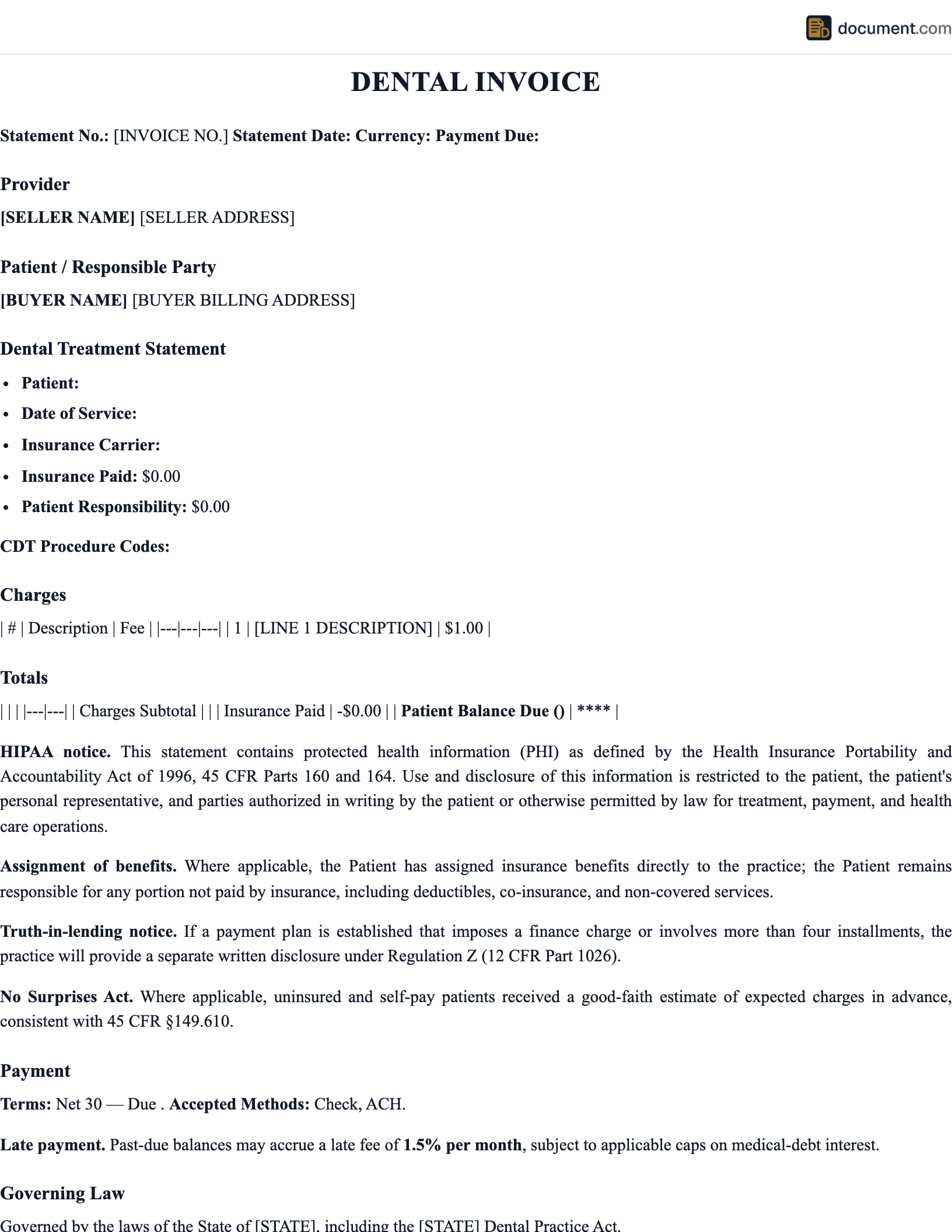
A dental invoice (also called a patient ledger or walkout statement) is the billing document that translates clinical dental services into financial terms. Dental billing operates on a three-party system: the dental provider, the insurance carrier, and the patient. The final amount the patient owes depends on procedure codes, insurance benefit structure, in-network versus out-of-network fee schedules, deductible status, annual maximum remaining, and coverage tier. Most dental plans cover preventive at 100 percent, basic at 80 percent, and major at 50 percent, with a $1,000 to $2,000 annual maximum that has not meaningfully changed in 30 years. The invoice sits at the end of this chain, presenting the patient with responsibility after insurance adjudication via Explanation of Benefits (EOB).
Every procedure maps to a specific Current Dental Terminology (CDT) code maintained by the American Dental Association under license to CMS for HIPAA standardized transactions (45 C.F.R. Part 162). A routine visit might generate D0120 (periodic oral evaluation), D1110 (adult prophylaxis), and D0274 (bitewing X-rays, four images). Each code has its own allowed amount, coverage percentage, and frequency limitation under the patient's plan. The dental invoice must reconcile all of these into a patient-friendly statement that shows what was done, the office fee, the insurance allowed amount, the insurance payment, any in-network write-off, and the patient balance.
Invoicing accuracy directly affects revenue cycle health. The average dental practice collects 91 to 95 cents of every dollar billed; the gap is insurance adjustments, write-offs, uncollected patient balances, and claim denials (ADA Health Policy Institute data). A clear invoice accelerates patient payment, reduces billing-line phone calls, and protects the practice's financial stability.
HIPAA and patient billing privacy under 45 C.F.R. Section 164.508
Dental invoices contain protected health information (PHI): patient name, account number, treatment dates, CDT codes, and (often) tooth numbers. The HIPAA Privacy Rule (45 C.F.R. Section 164.502) permits use of PHI for treatment, payment, and healthcare operations without separate authorization, which covers routine billing. Disclosing invoices to a third party (collection agency, family member who is not the responsible party, employer) requires either an authorization meeting the six elements of 45 C.F.R. Section 164.508(c) or a specific permitted disclosure. Email transmission requires encryption per the HIPAA Security Rule (45 C.F.R. Section 164.312(e)). Invoices left visible at the front desk or mailed in window envelopes that expose CDT codes can constitute incidental disclosures. OCR civil penalties run from $137 (unknown violation, 2024 inflation adjustment) to $68,928 per violation, capped at $2.067 million per identical violation per year.
Assignment of benefits and insurance billing
An assignment of benefits (AOB) is the patient's written authorization directing the insurance carrier to pay the dental office directly rather than reimbursing the patient. The standard ADA Dental Claim Form includes an AOB box that the patient signs at the visit. With AOB, the office submits the claim, the carrier sends payment to the office, and the patient receives only an EOB and the residual balance invoice. Without AOB, the carrier sends payment to the patient, who must remit it to the office (a major collection risk for non-network providers). AOB is recognized in every state for in-network providers; for out-of-network providers, eight states have anti-AOB statutes that limit assignment for indemnity plans (notably California, Texas, Georgia). The invoice should reference the AOB on file and the EOB used to compute the patient balance.
Predeterminations and treatment plan estimates
A predetermination of benefits (also called a pre-authorization or pre-treatment estimate) is a non-binding estimate the insurance carrier issues for proposed treatment, typically required for procedures over $300 to $500. The office submits the proposed CDT codes; the carrier responds with the allowed amounts, coverage percentages, deductible status, and any frequency or waiting-period issues. Predeterminations are not guarantees of payment; the carrier can deny the claim post-treatment if eligibility lapses or facts change. State 'no surprise billing' rules and the federal No Surprises Act (effective January 2022, applies to emergency and out-of-network bills at in-network facilities) require good-faith estimates for self-pay patients. The treatment plan invoice should clearly mark estimated insurance coverage as non-binding and disclose the patient's responsibility for any difference.
CDT Coded Procedures
Standardized ADA procedure codes for accurate insurance processing and patient clarity.
Insurance Coordination
Claim tracking, EOB reconciliation, and patient responsibility calculations.
Treatment Planning
Phased cost estimates with insurance pre-authorization and financing options.
Dental Invoice Form Preview
Dental Patient Statement
Itemized Procedure & Insurance Summary
Practice:
Provider Name, DDS/DMD
Patient:
Patient Name / Account #
Date of Service
Insurance
Statement #
Procedures
PROVIDER
PATIENT
Key Components
A complete dental invoice includes these elements for accurate billing and patient understanding:
| Component | Purpose | Key Details |
|---|---|---|
| Patient Demographics | Identifies the patient and account | Patient name, DOB, account number, insurance ID, group number, subscriber information |
| Procedure Detail | Lists services with standardized codes | CDT code, procedure description, tooth number/surface, provider, date of service, fee |
| Insurance Summary | Shows claim status and payments | Claim number, allowed amount, coverage percentage, insurance payment, adjustment, denial notes |
| Patient Responsibility | Calculates what the patient owes | Deductible applied, copay/coinsurance, non-covered services, balance after insurance |
| Lab Fees | Documents laboratory charges | Lab name, item fabricated, material type, lab cost, markup (if billed separately) |
| Treatment Plan | Estimates future procedure costs | Recommended procedures, estimated fees, insurance estimate, patient estimate, phasing |
| Account History | Shows running balance | Previous balance, charges, payments received, insurance payments, credits, current balance |
| Payment Options | Presents financing alternatives | Due date, accepted methods, CareCredit availability, in-office payment plan terms, prepay discount |
How to Create a Dental Invoice
Verify Patient and Insurance Information
Confirm the patient's demographics, insurance carrier, plan type (PPO, HMO, fee-for-service, Medicaid), group and subscriber ID, and remaining annual benefits. Verify eligibility and confirm that the patient's deductible status and annual maximum are current. This prevents claim denials and produces accurate patient estimates.
Code Procedures with Correct CDT Codes
Assign the appropriate CDT code to each procedure performed, noting the tooth number and surface(s) for restorative work. Coding accuracy matters: using the wrong code (e.g., D1110 prophylaxis vs D4341 scaling and root planing) can result in claim denial or underpayment. Document the clinical rationale for any procedures that may require narrative justification.
Submit Insurance Claim and Track Adjudication
Submit the ADA Dental Claim Form electronically with all required attachments (X-rays, periodontal charts, narratives). Track the claim through adjudication, noting the allowed amount, insurance payment, and any adjustments. If the claim is partially denied, determine whether to appeal before billing the patient.
Calculate Patient Responsibility
After receiving the insurance EOB, calculate the patient's responsibility: total office fee minus insurance adjustment (for in-network providers) minus insurance payment equals patient balance. Factor in deductible amounts applied, coinsurance percentages, and any non-covered services. Show each component clearly on the invoice.
Add Lab Fees and Treatment Plan Estimates
If lab fees are billed separately, add them as individual line items with the lab name and material type. For patients with recommended future treatment, include a treatment plan section showing estimated costs, insurance coverage, and patient responsibility for upcoming procedures.
Present Payment Options and Send
Note the payment due date, accepted payment methods, and available financing (CareCredit, in-office plans, prepay discounts). Send the statement via the patient's preferred method (mail, email, patient portal) in compliance with HIPAA requirements. Set up automatic reminder sequences for balances over 30 days.
Frequently Asked Questions
Official Resources
Professional associations, coding resources, and regulatory guidance for dental billing.
ADA - Dental Insurance Resources
American Dental Association guidance on dental insurance billing, CDT codes, and claim submission best practices.
CMS - Coding & Billing Resources
Centers for Medicare & Medicaid Services coding resources and billing compliance guidelines.
HHS - HIPAA for Professionals
HIPAA compliance requirements for patient billing, electronic claims, and protected health information.
National Association of Dental Plans
Industry data on dental insurance enrollment, benefit trends, and plan design standards.
Dental Economics
Practice management resources including billing efficiency, revenue cycle optimization, and fee schedule analysis.
IRS Publication 502 - Medical Expenses
IRS guidance on deductible medical and dental expenses for patients claiming itemized deductions.
Create your Dental Invoice Template in under 10 minutes.
Answer a few questions and download a compliant, attorney-drafted document ready for your state.