



What Is an End-of-Life Plan?
An end-of-life plan is a comprehensive personal document that captures your preferences for medical care at the end of life, your funeral and memorial wishes, an inventory of your financial and digital assets, and personal messages you want to leave behind. It is a practical companion to your legal estate plan — the document that helps your family actually carry out your wishes when the time comes. Where a will distributes assets and an advance directive records medical preferences, an end-of-life plan organizes everything your loved ones will need in one clear, accessible place.
A thoughtful plan answers the questions families most often struggle with in the days and weeks after a death: Where is the will? Who is the executor? What funeral home should we call? Was there a prepaid burial plan? Did they want to be cremated? What accounts exist, and where are the passwords? Who should be notified? By answering these questions in advance, you spare your family the emotional burden of guessing during a time of grief.
End-of-life planning is ultimately an act of love. It gives you the chance to reflect on what matters most, communicate your values, and ensure the people closest to you are protected and supported. Our templates walk you through each section step by step so you can build a complete plan without missing anything important.
Medical Wishes
Document your preferences for treatment, hospice, and comfort care
Asset Inventory
List accounts, policies, and important documents in one place
Digital Legacy
Instructions for email, social media, and online accounts
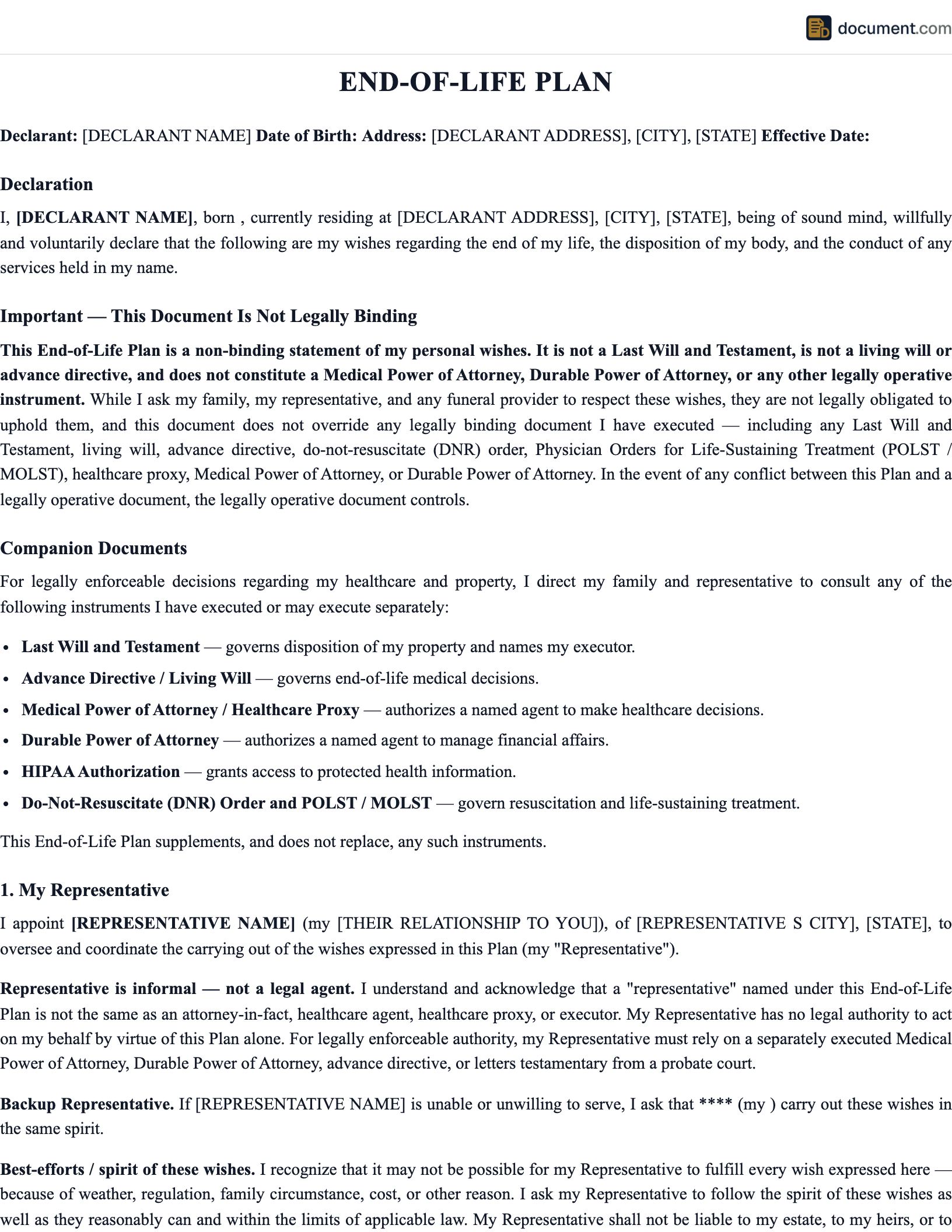
End-of-Life Plan Form Preview
A visual preview of the main sections included in our end-of-life plan workbook.
End-of-Life Plan
A Guide for My Family and Care Team
Section 1: Personal Information & Key Contacts
Section 2: Medical Preferences
Section 3: Funeral & Memorial Wishes
Section 4: Financial & Legal Documents
Section 5: Digital Legacy
Section 6: Messages to Loved Ones
Types of End-of-Life Plans
Some people want a single comprehensive workbook; others prefer focused documents that address specific areas. Choose the format that fits your needs.
How to Create an End-of-Life Plan
Break the process into manageable steps. Most people complete a full plan over the course of a few weekends rather than in a single sitting.
- 1
Gather your legal documents
Locate your will, advance directive, POA, and any trust paperwork before you begin so you can reference them in the plan.
- 2
Inventory your accounts and policies
List every bank, investment, retirement, and insurance account along with the institution and contact information.
- 3
Document your medical preferences
Capture your wishes for treatment, hospice, pain management, DNR status, and organ donation.
- 4
Record funeral and memorial wishes
Decide between burial, cremation, or alternatives, and describe the service you would like.
- 5
Plan your digital legacy
Configure legacy contacts on major platforms and store passwords in a reputable password manager.
- 6
Write personal messages
Consider letters, stories, or an ethical will that capture values and memories you want to leave behind.
- 7
Share the plan with key people
Give copies to your spouse, executor, and healthcare agent, and tell them where the original lives.
Key Components of an End-of-Life Plan
A strong plan covers personal identification, medical care, funeral arrangements, assets and debts, digital accounts, beneficiaries, and personal legacy.
Sample End-of-Life Plan
A condensed excerpt from our standard workbook template.
END-OF-LIFE PLAN
Prepared by [Name] on [Date]
INTRODUCTION
I, [Full Name], have prepared this plan to help my family and medical team honor my wishes and manage my affairs at the end of my life. It is not a substitute for my will or advance directive, but it provides context and details that those documents do not cover.
1. MEDICAL PREFERENCES
My advance directive is on file with [Provider]. If I am terminally ill with no reasonable chance of recovery, I want to be enrolled in hospice and to receive comfort-focused care at home whenever possible. I have registered as an organ and tissue donor.
2. FUNERAL & MEMORIAL WISHES
I would like to be cremated. My preferred funeral home is [Name], where I have a prepaid arrangement (see file marked "Funeral" in the home safe). Please hold a simple memorial service at [Location].
3. LEGAL & FINANCIAL DOCUMENTS
My will is stored [Location]. My executor is [Name]. A complete account inventory and beneficiary list appears in Appendix A.
4. DIGITAL LEGACY
Passwords are stored in [Password Manager]. The recovery key is with [Trusted Person]. Instructions for memorializing social media accounts appear in Appendix B.
5. MESSAGES TO LOVED ONES
Sealed letters to each of my immediate family members are stored with this plan. Please deliver them before the memorial service.
Frequently Asked Questions
Common questions about end-of-life planning, legal authority, and how to get started.
Official Resources
Trusted organizations for end-of-life and advance care planning.
NIA - Advance Care Planning
National Institute on Aging guide to planning for end-of-life care
NHPCO - Hospice & Palliative Care
National Hospice and Palliative Care Organization resources
Five Wishes
Widely used advance care planning document recognized in most states
AARP - End-of-Life Planning
Guides on wills, funerals, digital legacy, and conversations
Caring Info
State-by-state advance directive forms and end-of-life resources
Organ Donor
Federal organ and tissue donor registration portal
The Conversation Project
Free tools for discussing end-of-life wishes with loved ones
FTC - Funeral Rule
Consumer rights when arranging funerals and cremations
Create your End of Life Plan in under 10 minutes.
Answer a few questions and download a compliant, attorney-drafted document ready for your state.