
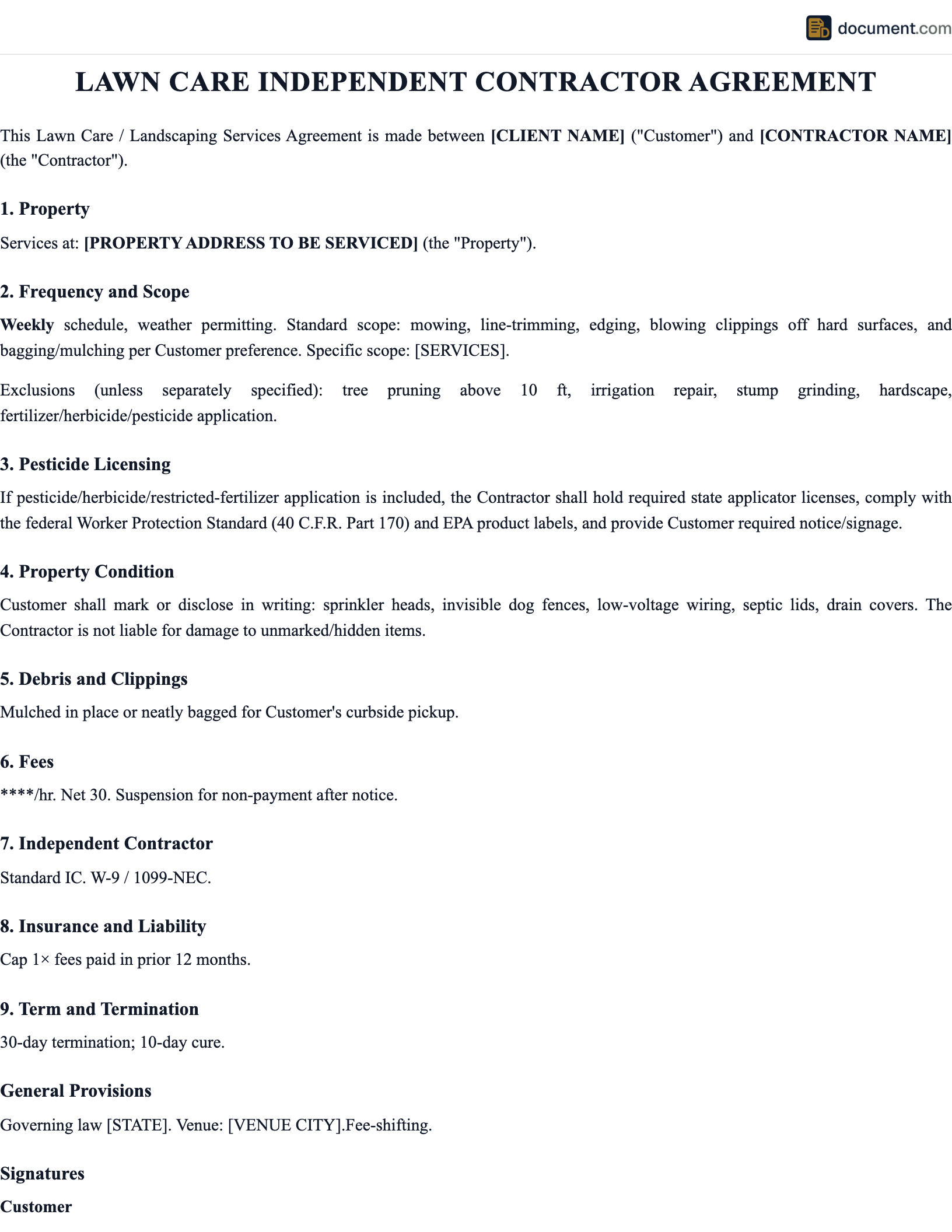



What Is a Lawn Care Contract?
A lawn care contract is a written independent-contractor agreement between a property owner or property manager and a lawn care professional that defines the scope, schedule, pricing, and liability terms for recurring grounds maintenance. Unlike a one-time landscaping project, the lawn care contract governs an ongoing relationship with regular service visits: typically weekly mowing during the growing season (March 15 to November 15 in most of the South, April 1 to October 31 in the Midwest and Northeast) plus supplemental services such as fertilization, pre-emergent and post-emergent weed control, aeration, overseeding, and seasonal cleanup. The contract is also the operational artifact through which independent-contractor classification is established under the IRS common-law test (Rev. Rul. 87-41), the DOL economic-realities test (29 C.F.R. Part 795), and the California ABC test (Cal. Lab. Code § 2775); a properly classified arrangement avoids the homeowner's exposure to back FICA, FUTA, state unemployment, and IRS § 3509 misclassification penalties.
For the property owner, the contract locks in service schedule and pricing, defines quality standards, requires the contractor to carry GL insurance and (where applicable) workers comp and pesticide-applicator certification, and provides recourse if services are not performed as agreed. For the lawn care provider, the contract secures a committed revenue stream for the season, protects against scope creep (clients adding services without additional payment), defines payment terms and late-fee rate (typically 1.5 percent per month, enforceable up to state usury caps), limits liability for pre-existing property conditions and undisclosed hazards, and establishes a clear cancellation process with reasonable notice. The contract should also document worker classification (independent contractor with own equipment, own schedule, multiple clients) to defeat IRS or DOL reclassification challenges.
The lawn care industry generates over $130 billion annually in the United States, with the majority of residential maintenance still operating on informal handshake arrangements. The exposure to both parties is real: disputes over service scope, payment delays without enforceable late fees, property damage claims without insurance verification, and IRS misclassification when the homeowner directs the work too closely. A written contract eliminates these issues and is standard for any professional operation. For commercial property managers and HOAs, the contract is non-negotiable; the property-management company requires a Certificate of Insurance naming the property as additional insured before authorizing any work.
Independent contractor classification under DOL Part 795 and Dynamex ABC test
Lawn care workers are independent contractors in nearly every properly structured engagement, but the classification analysis is fact-specific and the cost of misclassification is high. The IRS common-law control test under Rev. Rul. 87-41 weights behavioral control (does the homeowner direct how the work is performed), financial control (does the worker have a meaningful opportunity for profit or loss), and type of relationship (is the engagement one of many similar relationships the worker maintains). The DOL economic-realities test under 29 C.F.R. Part 795, restored to multi-factor totality analysis by the March 2024 final rule, examines six factors: opportunity for profit or loss based on managerial skill, investments by the worker and the potential employer, degree of permanence, nature and degree of control, whether the work is integral to the employer's business, and skill and initiative. California Lab. Code § 2775 codifies the Dynamex ABC test: the worker is an employee unless the hiring entity proves (A) freedom from control and direction in performing the work, (B) work outside the usual course of the hiring entity's business, and (C) engagement in an independently established trade. Massachusetts and New Jersey apply similar ABC tests. Misclassification exposure includes back overtime under FLSA, unpaid FICA and FUTA, state unemployment liability, and IRS § 3509 penalties up to 100 percent of unpaid taxes.
Equipment and premises-liability allocation
The contract should clearly allocate equipment ownership and premises-liability risk. Lawn care contractors supply their own commercial mowers (zero-turn riders running $8,000 to $15,000 new, walk-behind self-propelled at $1,500 to $3,000), string trimmers, edgers, blowers, and trucks or trailers. The contractor's use of its own equipment is one of the strongest indicators of independent-contractor status under all three classification tests. Premises liability for client-disclosed hazards (the homeowner who fails to identify a buried sprinkler line, a hidden cinder block, an invisible-fence wire, or a child's buried toy) shifts to the homeowner under most state premises-liability frameworks; the contractor remains liable for ordinary negligence in operation of equipment. Cal. Civ. Code § 1668 voids contractual exculpation for fraud, willful injury, or violation of law; courts split on enforceability of ordinary-negligence waivers between landowner and contractor. Define the claims process: written notice within 7 days, photographs, contractor inspection within 14 days, repair or denial within 30 days.
Seasonal Scheduling
Predefined visit frequency by season with weather-adjusted flexibility.
Insurance Required
Contractor must carry GL, auto, and workers' comp coverage.
Flexible Pricing
Per-visit, monthly flat rate, or seasonal prepayment with add-on services.
Lawn Care Contract Form Preview
Lawn Care Service Agreement
Residential / Commercial Maintenance
Section 1: Parties & Property
Section 2: Services
Section 3: Pricing
Monthly flat rate of $______ covering all scheduled visits. Additional services billed at agreed per-service rates.
Key Components
Eight components convert an oral handshake into an enforceable lawn care contract that establishes independent-contractor classification, protects against premises liability, and supports the contractor's right to payment.
Pesticide-applicator licensing and notice requirements
Federal law under FIFRA (7 U.S.C. § 136 et seq.) and 40 C.F.R. Part 171 requires state-certified applicators for restricted-use pesticides; states extend certification to general-use commercial application. Categories typically include Turf and Ornamental, Right-of-Way, and Aquatic. The state department of agriculture or environmental agency administers certification with testing on product identification, application techniques, IPM principles, environmental safety, and recordkeeping. Federal recordkeeping requires retention for 2 years; many states require longer (Texas requires 2 years per Tex. Agric. Code § 76.115; California requires 2 years per Title 3 Cal. Code Reg. § 6624). Notification statutes apply to commercial applications: California Title 3 Cal. Code Reg. § 6622 requires 24-hour posted notice for many residential applications; New York N.Y. Envt'l Conservation Law § 33-1004 requires neighbor notification for residential treatments; Massachusetts G.L. c. 132B requires written notification to abutters within defined distances. The contract should reference applicator certification number, products by EPA registration number, and applicable notice procedures.
1099-NEC reporting threshold
A homeowner running a rental property or home office who pays a lawn care contractor $600 or more in a calendar year must collect Form W-9 before payment and issue Form 1099-NEC by January 31 (IRS Form 1099-NEC instructions). Failure carries IRC § 6721 penalties of $60 to $310 per return depending on lateness, doubled for intentional disregard. The contractor who refuses to provide a W-9 is subject to backup withholding of 24 percent under IRC § 3406. Purely personal-residence work does not trigger 1099-NEC obligation (no trade or business of the homeowner) but still generates self-employment income to the contractor that must be reported on Schedule C and subject to self-employment tax of 15.3 percent under IRC § 1401 on net earnings up to the Social Security wage base ($168,600 for 2024). For contractors structured as single-member LLCs the LLC is disregarded for federal tax purposes and the income flows to Schedule C; multi-member LLCs file Form 1065 partnership returns; corporations and S corps file the appropriate corporate return.
| Component | Description |
|---|---|
| Parties & Property | Legal names, property address, lot dimensions, and service area boundaries |
| Service Scope | Itemized list of included and excluded services with definitions |
| Schedule & Frequency | Visit frequency by season, preferred day of week, and weather postponement policy |
| Pricing & Payment | Rate structure, billing cycle, payment due date, late fees, and accepted payment methods |
| Term & Renewal | Contract duration, auto-renewal provisions, and rate increase notice requirements |
| Insurance & Licensing | Required coverage minimums, certificate of insurance, and applicable licenses |
| Chemical Applications | Products used, applicator licensing, notification requirements, and safety wait times |
| Property Damage | Contractor liability for damage, claims process, and pre-existing condition documentation |
| Cancellation | Notice period, early termination fee, and post-cancellation obligations |
| Indemnification | Hold harmless provisions for property damage, injuries, and environmental compliance |
How to Create a Lawn Care Contract
Six steps in this order. The pre-engagement classification analysis controls everything downstream; a contract that fails the IRS, DOL, or California ABC test reclassifies the lawn care worker as an employee with retroactive payroll-tax exposure for the homeowner.
Pre-engagement classification analysis
Before drafting: run the classification analysis under the IRS common-law test (Rev. Rul. 87-41), the DOL economic-realities test (29 C.F.R. Part 795), and (in California, Massachusetts, New Jersey, Connecticut) the ABC test (Cal. Lab. Code § 2775). Structure the engagement to pass: contractor uses own equipment, sets own schedule, serves multiple clients, maintains separate business identity (registered LLC or sole proprietorship with EIN, business bank account, separate insurance), and is paid net of withholding by 1099-NEC. The arrangement must avoid factors that suggest employment: homeowner-dictated work hours, homeowner-supplied equipment, exclusive engagement with single client, uniform requirement, prohibition on working for others. Document the contractor's business identity in the contract recital and require the contractor to warrant its independent-contractor status with specific representations on each ABC prong.
Identify the parties and property
Legal name of the lawn care business, property owner's name, property address with lot dimensions, and a description of the service area (front, back, side yards, common areas).
Define the service scope
List every service included (mowing, edging, trimming, blowing, fertilization, weed control, aeration, overseeding) and explicitly exclude services not covered (tree trimming, irrigation repair, hardscaping).
Set the schedule and frequency
Specify visit frequency by season (weekly spring-fall, bi-weekly winter in warm climates), preferred day of week, and weather postponement/makeup policy.
Establish pricing and payment terms
Choose per-visit, monthly flat rate, or seasonal prepay. Define billing cycle, due date, late fees, and accepted payment methods.
Require insurance and licensing
Specify minimum GL coverage ($1M+), workers' comp if employees are used, pesticide applicator license for chemical treatments, and business license.
Add property damage and liability provisions
Define the process for reporting damage, contractor's obligation to repair at their cost, pre-existing conditions documentation, and indemnification.
Include cancellation and termination terms
Notice period (14-30 days written), early termination fee if applicable, and the contractor's obligation to complete any outstanding work.
Seasonal Service Schedules
Lawn care is inherently seasonal. A well-drafted contract specifies the services performed in each season and adjusts visit frequency to match grass growth rates. The schedule below is a representative framework for temperate climate zones; warm-climate and cold-climate regions will have different peak seasons.
| Season | Core Services | Typical Frequency |
|---|---|---|
| Spring (Mar-May) | Mowing, edging, pre-emergent weed control, first fertilization, aeration, overseeding | Weekly |
| Summer (Jun-Aug) | Mowing (higher cut), post-emergent weed control, second fertilization, grub prevention | Weekly |
| Fall (Sep-Nov) | Mowing, leaf removal, aeration, overseeding, fall fertilization, winterizer application | Weekly to bi-weekly |
| Winter (Dec-Feb) | Dormant-season cleanup, equipment maintenance, snow removal (if contracted) | As needed |
Pricing Models
Per-Visit
Fixed fee per mowing visit. Best for irregular schedules or clients who want to pay only when service is performed. Typical range: $30-80 residential, $100-500+ commercial.
Monthly Flat Rate
Fixed monthly payment covering all scheduled visits. Predictable for both parties. Total annual cost divided by 12 months, even though visit frequency varies by season.
Seasonal Prepay
Lump sum for the entire growing season, often with a 5-10% discount for upfront payment. Secures the client's slot and guarantees revenue for the provider.
Frequently Asked Questions
Official Resources
EPA - Pesticide Programs
Federal pesticide regulation, FIFRA compliance, and applicator certification.
OSHA - Landscaping Safety
Workplace safety standards for lawn care and landscaping operations.
IRS - Independent Contractor Defined
Worker classification guidance for lawn care professionals.
SBA - Business Structure
Choosing an LLC, sole proprietorship, or corporation for a lawn care business.
DOL - Employment Relationship
Department of Labor guidance on contractor vs. employee classification.
NALP - National Association of Landscape Professionals
Industry standards, certifications, and best practices for lawn care businesses.
Create Your Lawn Care Contract
Answer a few questions and download a professional lawn care agreement that protects your business and your property.
Create DocumentNo account required. Free to create and preview.