
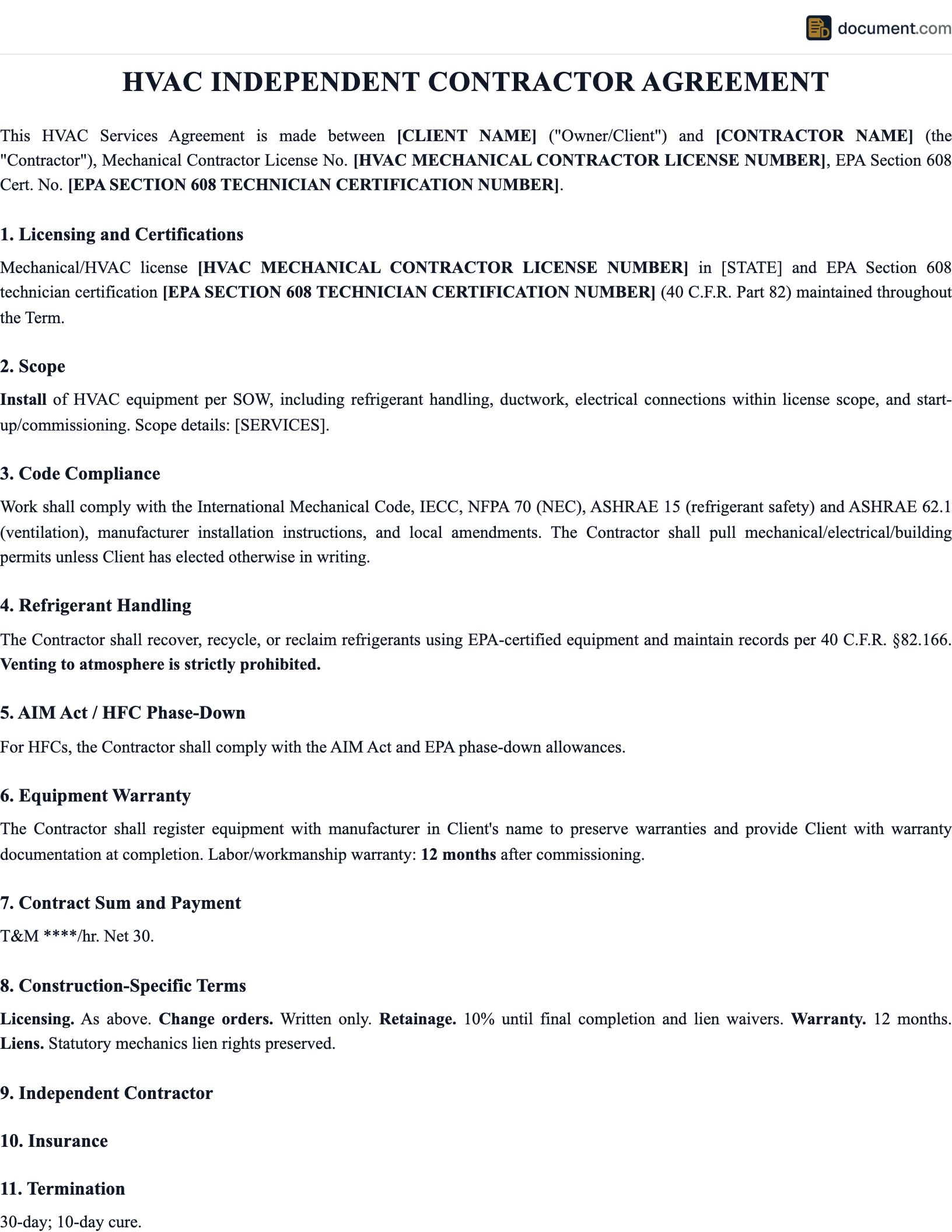



What Is an HVAC Service Contract?
An HVAC service contract is a written agreement that governs the relationship between a property owner and an independent HVAC contractor who installs, maintains, repairs, or replaces heating, ventilation, and air conditioning systems. HVAC systems are complex mechanical, electrical, and refrigerant-handling assemblies that require specialized knowledge, licensed technicians, and strict regulatory compliance. The contract establishes the terms of this specialized engagement and addresses considerations that do not arise in general service agreements — EPA refrigerant regulations, building code compliance, equipment sizing calculations, manufacturer warranty preservation, and energy efficiency standards.
The HVAC industry operates under a layered regulatory framework that the contract must address. At the federal level, the EPA regulates refrigerant handling under Section 608 of the Clean Air Act, the Department of Energy sets minimum equipment efficiency standards, and OSHA regulates workplace safety for HVAC technicians. At the state level, contractor licensing boards regulate who can perform HVAC work, and building departments enforce mechanical codes (typically based on the International Mechanical Code with local amendments). At the local level, building permits are required for most HVAC installations and major modifications, and inspections must be passed before the system can be energized. A comprehensive HVAC contract ensures that the contractor navigates all of these requirements and that the property owner receives compliant, warrantied, and properly permitted work.
HVAC contracts fall into three broad categories: installation contracts (for new system installations or complete system replacements), maintenance agreements (ongoing preventive maintenance to keep existing systems operating efficiently), and repair agreements (one-time or as-needed repairs to malfunctioning systems). Each type has distinct contractual considerations, pricing structures, and warranty provisions. Many HVAC contractors offer bundled maintenance agreements that include priority scheduling and discounted repair rates, creating a long-term relationship that benefits both parties — the contractor gets predictable revenue and the customer gets priority service and preventive care that extends the life of their equipment.
Maintenance Plans
Spring and fall tune-ups with comprehensive system inspections.
EPA Compliant
Addresses refrigerant handling, Section 608 certification, and leak reporting.
Clear Pricing
Flat-rate or T&M pricing with diagnostic fee credit and estimate thresholds.
HVAC Service Contract Form Preview
HVAC Service Agreement
Independent Contractor Engagement
1. EQUIPMENT COVERED
This Agreement covers the following HVAC equipment at the property located at : System Make/Model: , Serial No.: , Refrigerant Type: .
2. SCOPE OF SERVICES
Contractor shall provide: [ ] Preventive Maintenance (2 visits/year) [ ] Repair Services (as needed) [ ] New Installation [ ] System Replacement. All work shall comply with applicable building codes and EPA regulations.
3. COMPENSATION
Maintenance Agreement Annual Fee: $ . Repair Labor Rate: $ /hour. Diagnostic Fee: $ (credited toward repair).
PROPERTY OWNER
HVAC CONTRACTOR
Key Components
| Component | Purpose | Key Details |
|---|---|---|
| Equipment Identification | Specifies covered systems | Make, model, serial number, age, tonnage, refrigerant type, location |
| Maintenance Schedule | Defines preventive service visits | Spring AC tune-up, fall heating tune-up, included tasks, filter schedule |
| Repair Pricing | Establishes repair cost structure | Flat rate vs T&M, labor rate, parts markup, diagnostic fee, estimate threshold |
| Warranty | Covers workmanship and parts | Labor warranty period, parts warranty, manufacturer warranty coordination |
| EPA Compliance | Ensures refrigerant law compliance | Section 608 cert, refrigerant recovery, leak reporting, documentation |
| Emergency Service | Addresses urgent situations | After-hours availability, response time, surcharge rates, emergency definition |
| Licensing & Insurance | Verifies contractor qualifications | State HVAC license, EPA cert, GL insurance, workers' comp, permits |
| Termination & Renewal | Governs contract duration | Annual term, auto-renewal, cancellation notice, prorated refund |
How to Create an HVAC Service Contract
Inventory the HVAC Equipment
Document every HVAC component covered by the contract: make, model, serial number, tonnage/BTU rating, refrigerant type and charge amount, installation date, and current condition. For commercial properties, this includes rooftop units, split systems, boilers, chillers, air handlers, VAV boxes, exhaust fans, and building automation system (BAS) controllers.
Define the Service Scope
Specify whether the contract covers preventive maintenance only, repair services only, or both. For maintenance agreements, list every task included in each visit. For repair services, establish the pricing model, diagnostic procedures, and estimate approval process. For installation contracts, specify the equipment, installation standards, and code compliance requirements.
Establish Pricing and Payment Terms
For maintenance agreements: annual fee (typically $150-300/year residential, $500-5,000+/year commercial) paid annually or in monthly installments. For repairs: flat-rate pricing or T&M with documented labor rate ($75-150/hour residential, $100-200/hour commercial), parts markup percentage, and diagnostic fee. Specify payment terms, accepted methods, and late payment penalties.
Draft Warranty Provisions
Specify the labor warranty period (1-2 years standard), parts warranty (match manufacturer warranty or extend it), and the process for warranty claims. Address how the contractor will coordinate with equipment manufacturers on warranty repairs. Include exclusions for damage caused by power surges, flooding, acts of nature, or unauthorized modifications.
Address Regulatory Compliance
Require the contractor to hold all applicable licenses (state HVAC license, EPA Section 608), pull necessary permits for installations and major repairs, comply with building codes (International Mechanical Code, local amendments), and follow EPA refrigerant handling regulations. Specify who is responsible for permit fees and inspection coordination.
Include Emergency and Termination Terms
Define emergency service availability, response time commitments, and after-hours surcharges. For maintenance agreements, establish the contract term (typically annual with auto-renewal), the cancellation notice period (30-60 days), and the prorated refund policy for mid-term cancellations.
Maintenance vs Repair Agreements
Understanding the distinction between maintenance and repair agreements is critical for both the contractor and the customer:
| Feature | Maintenance Agreement | Repair Agreement |
|---|---|---|
| Purpose | Preventive care to extend equipment life | Fix specific malfunctions as they occur |
| Schedule | Planned visits (2x/year typical) | On-demand when problems arise |
| Pricing | Fixed annual or monthly fee | Per-repair (flat rate or T&M) |
| Repairs Included | Minor adjustments only; repairs billed separately | All repairs covered per the pricing terms |
| Priority | Agreement customers get priority scheduling | Standard scheduling queue |
| Discount | 10-20% discount on repair labor and parts | Standard pricing |
Licensing & EPA Compliance
HVAC work is regulated at multiple levels, and the contract must ensure compliance across all of them. EPA Section 608 of the Clean Air Act is the most important federal regulation: it requires any technician who maintains, services, repairs, or disposes of equipment containing refrigerants to be certified, prohibits the knowing venting of refrigerants (with limited exceptions for certain de minimis releases), requires the use of certified recovery equipment, and mandates proper refrigerant record-keeping for systems containing 50 or more pounds of charge. Violations can result in fines of up to $44,539 per day per violation, and the EPA actively enforces these regulations through inspections and whistleblower complaints.
State licensing is equally important. The specific requirements vary, but most states require HVAC contractors to hold a specialty license that demonstrates competency in mechanical systems, refrigerant handling, electrical work (as it relates to HVAC systems), and building code compliance. Many states require continuing education to maintain the license. The contract should require the contractor to maintain all applicable licenses and certifications throughout the term of the agreement and to provide copies of current licenses, EPA certifications, and insurance certificates before beginning any work.
R-22 Refrigerant Phase-Out
As of January 1, 2020, the production and import of R-22 (Freon) refrigerant was banned under the Montreal Protocol. Existing R-22 systems can only be serviced using recycled or reclaimed R-22, which has become increasingly scarce and expensive (often exceeding $100/pound). The HVAC contract should address: the current refrigerant type in the system; the cost implications if R-22 top-offs are needed; and the contractor's recommendation for system replacement if R-22 costs become prohibitive. New systems use R-410A or, increasingly, the newer R-454B (Opteon XL41) refrigerant.
Frequently Asked Questions
Official Resources
Authoritative resources on HVAC regulations, refrigerant management, and contractor licensing.
EPA - Section 608 Refrigerant Management
Federal regulations on refrigerant handling, recovery, and technician certification.
DOE - Home Heating Systems
Department of Energy guide to HVAC systems, efficiency standards, and energy savings.
ASHRAE - Standards & Guidelines
American Society of Heating, Refrigerating and Air-Conditioning Engineers standards.
NATE - Technician Certification
North American Technician Excellence certification for HVAC professionals.
ACCA - Air Conditioning Contractors
Industry association providing standards for HVAC system design and installation.
DOE - Tax Credits & Rebates
Federal tax credits and rebates for energy-efficient HVAC equipment under the IRA.
Create Your HVAC Service Contract
Protect your HVAC investment with a professional service agreement covering maintenance, repairs, and compliance.
Create DocumentNo account required. Free to create and preview.