
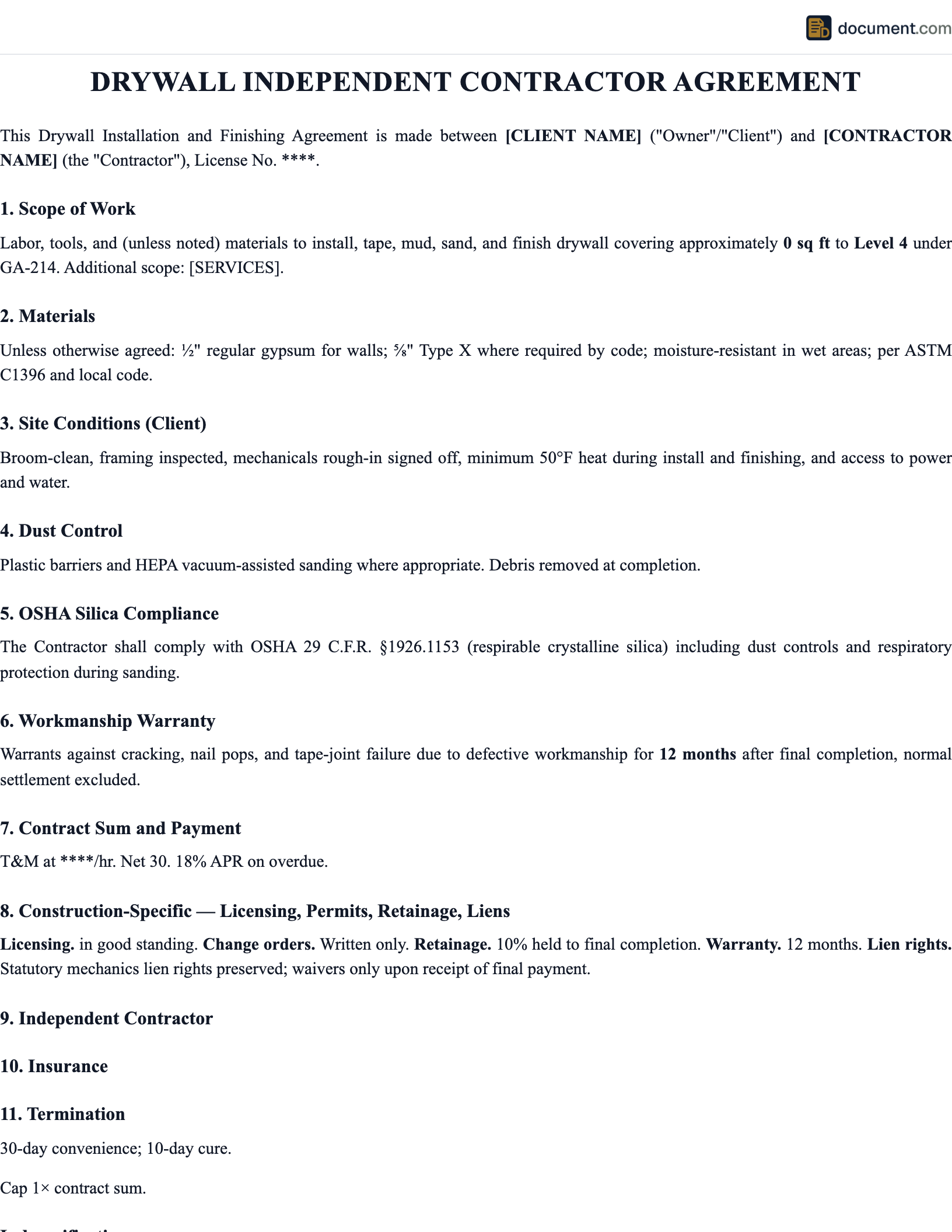



What Is a Drywall Contract?
A drywall contract governs the installation, finishing, and repair of gypsum wallboard — the ubiquitous interior wall and ceiling material found in virtually every modern residential and commercial building in the United States. Drywall work is a specialized construction trade that requires specific skills, tools, and knowledge of building codes, fire-rating requirements, and moisture management. The contract establishes the terms under which an independent drywall contractor (often called a drywall hanger, taper, or finisher) will perform this work for a property owner or general contractor.
The drywall phase is one of the most labor-intensive and schedule-critical stages of construction. It occurs after framing, rough-in electrical, plumbing, HVAC, and insulation are complete and inspected, and before painting, trim carpentry, and flooring can begin. Delays in drywall directly cascade to every subsequent trade, making schedule provisions in the contract particularly important. The work itself involves multiple distinct steps — measuring and cutting sheets, hanging them on studs and joists with screws, taping joints, applying multiple coats of joint compound with sanding between coats, and achieving the specified finish level — each requiring different skills and often performed by different crews within the same contractor's operation.
From a legal perspective, drywall contracts intersect with contractor licensing laws (which vary significantly by state), building code requirements (including fire-rated assembly specifications mandated by the International Building Code and local amendments), workers' compensation obligations (drywall work involves physical hazards including falls, repetitive motion injuries, and silica dust exposure), and mechanic's lien rights (the contractor's right to place a lien on the property if unpaid). A comprehensive drywall contract addresses all of these dimensions while defining the commercial terms of the engagement.
Finish Levels
Specifies Level 0-5 finish standards per ASTM C840 guidelines.
Code Compliant
Addresses fire ratings, moisture resistance, and building code requirements.
Milestone Payments
Progress payments tied to hanging, taping, finishing, and final inspection.
Drywall Contract Form Preview
Drywall Installation Agreement
Independent Contractor Services
1. PROJECT SCOPE
Contractor shall furnish all labor, tools, and equipment necessary to install, tape, mud, sand, and finish drywall in the areas identified in Exhibit A at the property located at . All work shall be completed to Level finish standard.
2. MATERIALS
Materials shall be provided by . Drywall type and thickness: . Fire-rated assemblies required in the following areas: .
3. PAYMENT SCHEDULE
Total contract price: $ , payable as follows: % at signing, % upon hanging completion, % upon finishing completion, and % upon final inspection.
PROPERTY OWNER
CONTRACTOR
Key Components
| Component | Purpose | Key Details |
|---|---|---|
| Project Scope | Defines areas and work type | Room-by-room breakdown, new install vs repair, square footage, ceiling heights |
| Materials | Specifies drywall type and supplies | Sheet thickness, fire rating, moisture resistance, joint compound type, corner bead |
| Finish Level | Sets quality standard | Level 0-5 per ASTM C840, different levels for different rooms if needed |
| Payment Schedule | Ties payments to milestones | Deposit, hanging complete, finishing complete, final inspection |
| Timeline | Establishes completion schedule | Start date, phase durations, drying times between coats, completion date |
| Warranty | Covers workmanship defects | 1-2 year warranty, nail pops, tape bubbles, joint cracks, exclusions |
| Dust Control | Protects occupied spaces | Plastic barriers, vacuum sanders, HVAC protection, daily cleanup |
| Insurance & Licensing | Ensures legal compliance | Contractor license, GL insurance, workers' comp, permit pulling |
How to Create a Drywall Contract
Survey the Project Site
Walk through the project with the drywall contractor to identify all areas requiring drywall work, measure square footage, note ceiling heights (standard 8' vs 9' or 10' ceilings affect sheet size and scaffolding needs), identify fire-rated wall assemblies, locate moisture-prone areas requiring specialty board, and verify that framing, rough-ins, and insulation have passed inspection.
Specify Materials and Finish Levels
Document the drywall type for each area: standard 1/2" for most walls, 5/8" for ceilings, 5/8" Type X fire-rated for garage walls and furnace rooms, moisture-resistant for bathrooms and kitchens. Specify the finish level for each room — Level 4 for most painted surfaces, Level 5 for areas with high-gloss paint or critical lighting. Include the joint compound type and corner bead style.
Establish the Payment Schedule
Tie payments to verifiable milestones: 20-25% deposit, 25% when all sheets are hung, 25% when taping and mudding are complete, and the final 25-30% upon satisfactory inspection. Never pay more than 50% before the contractor has completed hanging — this maintains the property owner's leverage to ensure quality finishing work.
Set the Timeline with Drying Allowances
Build in adequate drying time between mudding coats (each coat requires 24 hours minimum to dry before sanding and the next coat). A typical residential room requires 3-4 days for three coats of mud with sanding. Factor in weekend and weather delays — high humidity and low temperatures significantly extend drying times.
Include Change Order Procedures
Specify how changes to the scope will be handled: any work not described in the original contract must be documented in a written change order signed by both parties before the additional work begins. The change order should describe the additional work, the additional cost, and the impact on the timeline. This prevents disputes over 'extras' that the contractor claims were not included.
Verify Licensing and Insurance
Before signing, confirm the contractor holds the required state and local licenses, carries general liability and workers' compensation insurance, and can provide certificates of insurance. Verify the license through the state licensing board's online database and confirm insurance directly with the carrier.
Drywall Finish Levels Explained
The finish level is the most important quality specification in a drywall contract because it determines the final appearance of the walls and ceilings and directly affects cost. Misunderstandings about finish levels are the most common source of disputes between property owners and drywall contractors. The Gypsum Association and ASTM International define six finish levels:
| Level | Description | Typical Use | Cost Factor |
|---|---|---|---|
| Level 0 | No taping, mudding, or finishing | Temporary construction, smoke barriers | 1x (base) |
| Level 1 | Tape embedded in compound, no additional coats | Above ceilings, attics, garages | 1.5x |
| Level 2 | One coat over tape and fasteners | Tile substrate, warehouses, garages | 2x |
| Level 3 | Two coats over tape, one over fasteners | Medium/heavy texture applications | 2.5x |
| Level 4 | Three coats at joints, two at angles, three over fasteners | Standard residential/commercial (flat/eggshell paint) | 3x |
| Level 5 | Level 4 + skim coat over entire surface | High-gloss/semi-gloss paint, critical lighting areas | 4x |
Licensing & Code Compliance
Drywall contractors operate under a complex web of licensing and building code requirements that vary by state and municipality. The International Building Code (IBC), adopted with local amendments by most U.S. jurisdictions, mandates specific fire-rated wall and ceiling assemblies in residential and commercial construction. A 1-hour fire-rated wall assembly (common between a garage and living space, between dwelling units in multifamily buildings, and around furnace rooms) typically requires 5/8" Type X fire-rated drywall installed on both sides of the wall, with specific fastener patterns, joint treatment, and penetration sealing. The drywall contractor must understand and comply with these requirements, and the contract should reference the applicable building code and require compliance with all fire-rated assembly specifications.
OSHA regulations also apply to drywall work. Drywall installation involves hazards including falls from ladders and scaffolding, ergonomic injuries from overhead work, cuts from utility knives and drywall saws, and inhalation of silica dust from sanding joint compound. OSHA's silica standard (29 CFR 1926.1153) limits permissible exposure to respirable crystalline silica in construction and requires employers to use engineering controls (vacuum sanders, wet sanding) and provide respiratory protection when exposure exceeds the action level. The contract should require the drywall contractor to comply with all applicable OSHA regulations and maintain a written safety program for their crew.
Asbestos in Renovation Projects
When drywall work involves demolition or removal of existing walls in buildings constructed before 1980, there is a risk of disturbing asbestos-containing materials (joint compound, texture coatings, and certain drywall products manufactured before 1980 may contain asbestos). The contract should require asbestos testing before demolition begins and specify that the drywall contractor is not responsible for asbestos abatement — that work must be performed by a licensed asbestos abatement contractor in compliance with EPA and state regulations.
Frequently Asked Questions
Official Resources
Authoritative resources on drywall standards, building codes, and contractor licensing.
Gypsum Association
Industry standards, finish level guidelines, and technical resources for drywall installation.
ASTM International
ASTM C840 and other standards governing drywall application and finishing.
International Code Council
International Building Code (IBC) resources including fire-rated assembly requirements.
OSHA - Silica in Construction
OSHA silica standard, exposure limits, and required controls for drywall sanding.
National Association of Home Builders
Residential construction standards, contractor resources, and building practices.
EPA - Asbestos
EPA regulations for asbestos in renovation and demolition projects.
Create Your Drywall Contract
Define project scope, finish levels, and payment milestones in a professional drywall agreement.
Create DocumentNo account required. Free to create and preview.