



Key Takeaways
- •A digital replica agreement is enforceable in California and New York only if it clears three independent bars. The replica cannot replace work the performer would otherwise be hired to do, the contract has to include a reasonably specific description of intended uses, and the record has to show the performer was represented by counsel or a union CBA. Miss any one and the replica clause is void.
- •California Labor Code 927 (AB 2602) and New York GOL 5-302 (S7676B) both took effect January 1, 2025 and apply to contracts entered into or modified on or after that date, so a 2026 deal cannot rely on broad pre-2025 likeness language.
- •For deceased performers, California Probate Code 3344.1 (AB 1836) extends estate control over digital replicas to 70 years after death and sets statutory damages at the greater of $10,000 or actual damages. New York's right of action runs 40 years after death with damages of the greater of $2,000 or compensatory damages plus disgorged profits.
- •The 2023 SAG-AFTRA TV/Theatrical Agreement, ratified December 5, 2023 with 78% approval after a 118-day strike, created the first union digital replica framework. It requires clear and conspicuous consent, a reasonably specific use description, and pay at the performer's pro rata daily rate or the minimum, whichever is higher.
- •The 2025 SAG-AFTRA Commercials Contract, effective April 1, 2025, requires 48-hour advance notice and a standardized three-part Digital Replica Rider separating consent to create the replica from consent to each downstream use.
- •Consent to create a digital double does not carry consent to use it. Drafting the creation grant and the use license as one undifferentiated paragraph is the error most likely to void the clause and invite a publicity claim.
Reviewed for accuracy by the document.com legal team. Educational information, not legal advice.
What Is Digital Replica Agreement (Digital Double / AI Likeness Consent)?
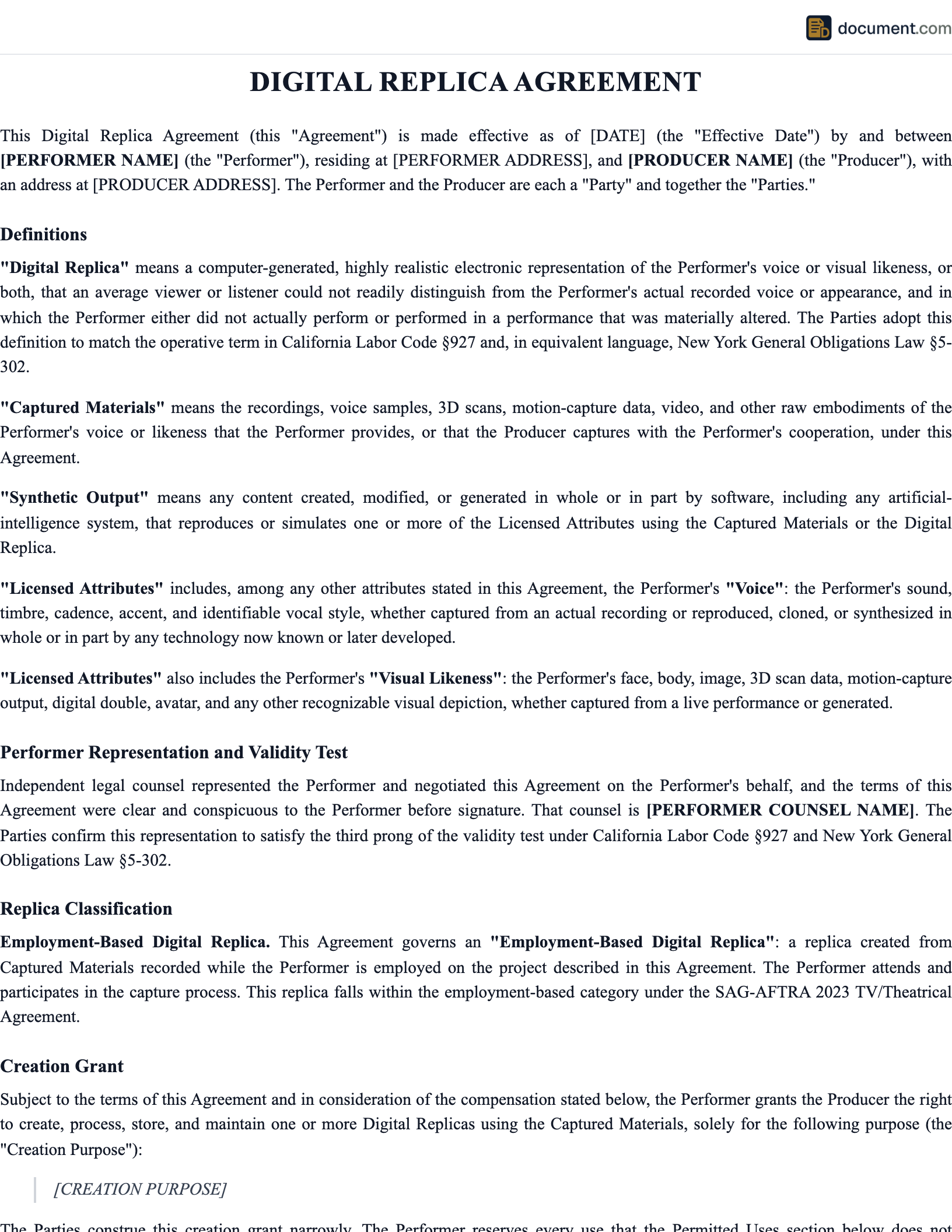
A digital replica agreement is the written consent and compensation contract that authorizes a producer, advertiser, studio, or game developer to create, store, and use a computer-generated double of a real performer's voice or visual likeness. In plain terms, it is the paperwork that turns a face scan, a body capture session, or a voice sample into something a company is legally allowed to reproduce on screen without the performer being physically present for that shot. The term covers two overlapping ideas that the industry uses loosely. A "digital double" usually means a production-grade CGI or scanned model of an actor used inside a single project, often for stunts, de-aging, or crowd fills. A "digital replica" is the broader statutory term, defined by California, New York, and the SAG-AFTRA contracts as a highly realistic synthetic version of a person's voice or likeness that an average viewer could not tell apart from the real thing.
What makes this document different from an ordinary appearance release is that it governs a performance the human never actually gave. A standard model release lets a company use footage you shot. A digital replica agreement lets a company generate new footage of you that you never performed, and possibly perform you in scenes, products, or campaigns you never agreed to individually. Because of that, the law now treats vague or perpetual replica grants with suspicion, and in two of the largest entertainment markets in the country a sloppy clause is simply unenforceable rather than merely unfavorable.
Why This Matters Now
The current rules came out of a fight, not a committee. SAG-AFTRA struck on July 14, 2023, and named the absence of AI and digital replica protections as a core reason alongside wages and pension funding. The strike ran 118 days, ending at 12:01 a.m. PST on November 9, 2023 after a tentative agreement the day before. Members ratified the deal on December 5, 2023 with 78% approval, and the package carried more than $1 billion in new wages and benefit-plan funding. For the first time, a major entertainment union required consent and minimum compensation before a studio could conjure a performer digitally.
Legislators moved fast on the same problem. On a single day, September 17, 2024, California Governor Newsom signed both AB 2602 (living performers, now Labor Code 927) and AB 1836 (deceased performers, now Probate Code 3344.1), with both effective January 1, 2025. New York followed: S7676B passed the Senate unanimously on June 6, 2024 and the Assembly the next day, Governor Hochul signed it on December 13, 2024, and it took effect January 1, 2025 as General Obligations Law 5-302. Tennessee had already gone further for music with the ELVIS Act, reaching beyond contracts to impose secondary liability on the AI tool developers themselves. By the time the 2025 SAG-AFTRA Commercials Contract took effect on April 1, 2025 with its standardized Digital Replica Rider, anyone scanning a performer in 2026 was operating inside a real, enforceable, multi-state framework rather than a gentleman's agreement.
The Legal Backbone
California Labor Code 927 (AB 2602): the three-part validity test for living performers
Labor Code 927 is the provision most digital replica deals now have to clear. It applies to contracts for personal or professional services entered into or modified on or after January 1, 2025, and it voids any provision allowing the creation or use of a digital replica of the performer's voice or likeness unless all three of these are true. First, the replica is not used in place of work the individual would otherwise have performed in person. Second, the contract includes a reasonably specific description of the intended uses of the replica. Third, the performer was either represented by legal counsel who negotiated on their behalf with the terms clear and conspicuous, or was covered by a collective bargaining agreement that expressly addresses digital replicas. The statute defines a digital replica as a computer-generated, highly realistic electronic representation that is readily identifiable as the voice or visual likeness of the individual, in which the actual performer either did not actually perform or performed but the performance was materially altered. It carves out ordinary sampling, remixing, mastering, and digital remastering authorized by the copyright holder, and it applies to new performances fixed after January 1, 2025. Read it as a drafting checklist: an open-ended grant signed without counsel or a union behind it is not a weak clause, it is no clause at all.
California Probate Code 3344.1 (AB 1836): deceased performers and a 70-year estate right
AB 1836 amended Probate Code 3344.1 to reach digital replicas of performers who have died. It gives the deceased's estate or successors control over the production and use of a digital replica in an expressive audiovisual work or sound recording for 70 years after death, and it makes use without consent actionable. Statutory damages are the greater of $10,000 or the actual damages the estate suffered, plus the user's profits attributable to the unauthorized use. The law preserves familiar First Amendment safety valves: it does not reach news, public affairs, sports broadcasts, documentary, biographical, or historical use, parody, satire, criticism, or comment, or fleeting and incidental appearances, provided the use is not so false that it would mislead. The effect is that a studio reviving a long-dead star cannot rely on an old, broad publicity license signed during the performer's life. It now has to get a present-day grant from whoever controls the post-mortem right.
New York General Obligations Law 5-302 (S7676B): the East Coast mirror
New York's Digital Replica Contracts Act, codified at GOL 5-302, tracks California's three-part test closely and applies to contracts entered into or modified on or after January 1, 2025. A provision authorizing creation or use of a digital replica is unenforceable unless the replica does not substitute for work the performer would otherwise have performed, the contract contains a reasonably specific description of the intended use, and the performer was represented by counsel or by a labor union whose CBA addresses digital replicas. New York defines a digital replica as a digital simulation of an individual's voice or likeness so closely resembling the real voice or likeness that the average person could not distinguish the two. It covers audiovisual works, sound recordings, and the live performance of musical works. On the publicity side, New York Civil Rights Law 50-f extends right-of-publicity protection to digital replicas of deceased performers, with the right of action expiring 40 years after death and damages set at the greater of $2,000 or compensatory damages plus the infringer's profits. The statute also includes a notice-based safe harbor for online service providers.
The SAG-AFTRA contract layer: union deals do double duty
For union work, the collective bargaining agreement is both the operating manual and one of the ways a contract satisfies the statutory representation prong. The 2023 TV/Theatrical Agreement splits replicas into an Employment-Based Digital Replica, made from material captured while the performer is employed on a project, and an Independently Created Digital Replica, generated without the performer's participation in that project. It requires clear and conspicuous consent, expressed in bold all-capitals language or in a separate document with specific initials, plus a reasonably specific description of intended use. Compensation runs to the performer's pro rata daily rate or the applicable minimum, whichever is higher, with a good-faith effort to estimate the number of days the performer would have worked had the replica not been used. Background actors scanned exclusively to build a replica are paid for a full day. The 2025 Commercials Contract layers on a standardized Digital Replica Rider developed with the Joint Policy Committee, 48-hour advance notice, and a three-part consent structure that separates creating the replica from each distinct downstream use. The 2024 Sound Recording Code applies the same logic to voice: clear consent plus minimum compensation, and consent is required to release any recording that uses a digital voice replica.
Why the two prongs of consent have to be separate
Every one of these regimes turns on a distinction that careless drafting blurs. Consent to make the replica and consent to use it are two different grants, and the second has to be specific. The statutes demand a reasonably specific description of intended use precisely so that a performer who agrees to be scanned for one film has not silently licensed their face for sequels, advertising, video games, or training data. A single sentence purporting to grant all rights in all media now and forever fails the specificity requirement on its face, and under both Labor Code 927 and GOL 5-302 a failed clause is void rather than narrowed. The defensible structure breaks the deal into a creation grant, a use license enumerated by project, medium, territory, and term, and a separate, conspicuous compensation schedule tied to each new use. That is also the architecture the SAG-AFTRA Commercials Rider adopts, which tells you a lot about what regulators and arbitrators will expect to see.
Right of Publicity by State: All 50 States and DC
A digital replica deal is only as strong as the law of the state whose rules apply, and right-of-publicity law varies sharply. The table below covers all fifty states and the District of Columbia: the governing statute or common-law basis, the post-mortem term the estate controls, and any AI or digital-replica-specific provision.
| State | Statute or basis | Post-mortem | AI / digital replica |
|---|---|---|---|
| Alabama | Ala. Code § 6-5-772 | 55 years | None |
| Alaska | Common law only | Common law | None |
| Arizona | A.R.S. §12-761 (soldiers/military only); Common law right of... | Soldiers only | No explicit AI-specific language in A.R.S |
| Arkansas | Ark. Code Ann. §§ 4-75-1101 et seq. (Frank Broyles Publicity Rights... | 50 years | AI digital replica provisions added via HB1071 (signed February 25, 2025, effective... |
| California | Cal. Civ. Code §§ 3344 (living persons) and 3344.1 (deceased... | 70 years | Digital replica provisions in §3344 (via SB 683, signed October 10, 2025, effective... |
| Colorado | Common law only | Common law | None |
| Connecticut | Common law only | Common law | None |
| Delaware | Common law only | Common law | HB 353 (Amelia Kramer Act) addresses synthetic media/deepfakes for minors and... |
| District of Columbia | Common law only | None | None |
| Florida | Fla. Stat. § 540.08 | 40 years | None |
| Georgia | Common law only | Common law | Georgia 'No Fakes' bill (HB 566) failed to advance in 2025 legislative session; no... |
| Hawaii | Hawaii Revised Statutes Title 26, Chapter 482P (HRS § 482P-1 et seq.) | 70 years | None |
| Idaho | Common law only | Common law | Idaho has enacted targeted deepfake legislation: House Bill 575 (explicit deepfakes),... |
| Illinois | 765 ILCS 1075 (Right of Publicity Act), as amended by HB 4875... | 50 years | HB 4875 (effective January 1, 2025) explicitly prohibits unauthorized digital replicas |
| Indiana | Indiana Code Title 32, Article 36, Chapter 1 (IC § 32-36-1 et seq.) | 100 years | None |
| Iowa | Common law only | Common law | Senate File 2243 and House File 2240 address synthetic media involving minors and... |
| Kansas | No recognized right | None | None |
| Kentucky | KY Rev. Stat. § 391.170 | 50 years | None |
| Louisiana | La. Rev. Stat. Ann. § 51:470.1 et seq. (Allen Toussaint Legacy Act) | 50 years | Digital replica defined in § 51:470.2 as computer-generated or electronic reproduction of... |
| Maine | Common law only | Common law | None |
| Maryland | Common law only | Common law | None |
| Massachusetts | Mass. Gen. Laws Ann. ch. 214, § 3A | None | Massachusetts HB 4744 (enacted 2024, Chapter 118 of Acts of 2024) addresses... |
| Michigan | Common law only | Common law | Michigan House Bills 4047 and 4048 (Protection from Intimate Deep Fakes Act, signed... |
| Minnesota | Common law only | Common law | Minnesota Statute 617.262 (enacted 2023, amended 2024) criminalizes nonconsensual... |
| Mississippi | Common law only | Undefined (no court... | No AI-specific provision; Mississippi has not enacted HB 768 or an ELVIS Act |
| Missouri | Common law only | Common law | None |
| Montana | Common law only | Common law | None |
| Nebraska | Neb. Rev. Stat. §20-202 (with post-mortem survival under §20-208) | Indefinite | None |
| Nevada | Nev. Rev. Stat. §597.770 et seq. (specifically §597.790) | 50 years | None |
| New Hampshire | Common law only | Common law | Deepfake law (H.B |
| New Jersey | Common law only | 50 years | Deepfake law (A3540/S2544 signed 2025) - separate from ROP, establishes civil/criminal... |
| New Mexico | Common law only | Common law | None |
| New York | N.Y. Civ. Rights Law §§50, 51, 50-f | 40 years | N.Y |
| North Carolina | Common law only | Common law | None |
| North Dakota | No recognized right | None | None |
| Ohio | Ohio Rev. Code §2741 (Chapters 2741.01-2741.09) | 60 years | None |
| Oklahoma | Okla. Stat. tit. 12 §1448 (deceased); Okla. Stat. tit. 12 §1449... | 100 years | Oklahoma HB 1364 (synthetic intimate content; 2024-2025) |
| Oregon | Common law only | Common law | Oregon HB 2299 addresses synthetic intimate imagery but not voice cloning specifically... |
| Pennsylvania | 42 Pa.C.S. §8316 (right of publicity); 18 Pa.C.S. §4101.1 (digital... | 30 years | 18 Pa.C.S |
| Rhode Island | R.I. Gen. Laws §9-1-28 (commercial use); R.I. Gen. Laws §9-1-28.1... | None | None |
| South Carolina | Common law only | Unclear (common law... | None |
| South Dakota | S.D. Codified Laws § 21-64 et seq. | 70 years | None |
| Tennessee | Tenn. Code Ann. § 47-25-1101 et seq. (ELVIS Act 2024) | 10 years | ELVIS Act - Tenn |
| Texas | Tex. Prop. Code § 26.001 et seq. | 50 years | None |
| Utah | Utah Code § 45-3 (Abuse of Personal Identity Act), as amended by SB... | 70 years | Yes |
| Vermont | Common law only | Common law | None |
| Virginia | Va. Code § 8.01-40 (civil); Va. Code § 18.2-216.1 (criminal) | 20 years | None |
| Washington | Wash. Rev. Code § 63.60.010 et seq. (amended by SB 5886, effective... | 10 years | RCW 63.60 amended 2026 to include 'forged digital likeness' - digital representations... |
| West Virginia | Common law only | Common law | None |
| Wisconsin | Common law only | Common law | None |
| Wyoming | Common law only | Common law | None |
Compiled from primary state statutes and verified against legislative sources in 2026. Post-mortem terms and AI-specific provisions change frequently; confirm current law for your state.
Digital double versus digital replica, and why your agreement has to name which one it is
The terms get used interchangeably in production meetings, but for drafting purposes the difference matters. A digital double, in the way visual-effects houses use the phrase, is a scanned or modeled version of an actor built to do something the actor cannot safely or practically do on set: a high fall, a de-aged flashback, a fully digital wide shot of a crowd. The performer is typically on the project, present for the capture session, and the double lives inside that one production. A digital replica, in the statutory sense, is wider. It is any synthetic version of the voice or likeness realistic enough that an average viewer cannot tell it from the real person, and it can be used to generate performances the human never gave, possibly long after the shoot and possibly in projects the human never saw. California and New York wrote their laws around the replica definition, not the visual-effects workflow, so a contract that only talks about a digital double for stunt work can still trigger the full consent-and-compensation regime the moment that asset is reused to make the performer say or do something new.
Most non-union and indie deals go wrong here. A producer copies an old appearance release, adds a line about capturing the actor's likeness for use in connection with the production and any derivatives, and assumes that covers AI. It does not. Under Labor Code 927 and GOL 5-302 that derivatives language is the opposite of a reasonably specific description of intended use, and because it was probably signed without counsel and outside any CBA, the replica portion is unenforceable. The performer can be scanned, the producer can build the asset, and then the producer discovers the right to use it for anything beyond the one production is hollow. Worse, reusing it anyway exposes the producer to a right-of-publicity claim, and for a deceased performer that means the estate's statutory damages under Probate Code 3344.1 or New York Civil Rights Law 50-f.
A clean digital replica agreement does the unglamorous work of separating the layers. It identifies whether the asset is an employment-based replica built from on-project capture or an independently created one, because the union framework and the compensation math differ. It enumerates uses one at a time, with each use carrying its own fee, rather than bundling them into a single perpetual grant. It states a term and a territory and says what happens to the underlying scan data when the term ends. And for anything touching California or New York performers, it documents the representation prong on the face of the document, naming the performer's counsel or the governing CBA, so that the validity test is satisfied in writing rather than argued about later. None of that is exotic. It is the same discipline a good license agreement has always required, applied to an asset that happens to be a synthetic human.
When You Need This
A studio or VFX vendor needs to scan an actor to build a digital double for de-aging, stunt work, or a fully digital shot inside a film or series.
An advertiser or agency wants to reuse a performer's likeness across additional spots, markets, or campaign cycles using an AI-generated version rather than reshooting.
A video game or interactive media developer is capturing an actor's voice and face to generate dialogue, animations, or in-game performances beyond what was recorded live.
A music label or producer plans to create or release a recording that uses a synthetic version of a performer's voice.
An estate or successor-in-interest is licensing the post-mortem right to digitally recreate a deceased performer for a new project under California Probate Code 3344.1 or New York Civil Rights Law 50-f.
A non-union production wants enforceable AI likeness rights and needs to satisfy California Labor Code 927 or New York GOL 5-302 without a CBA, which means routing the performer through independent counsel.
A performer or their representative is reviewing a likeness or appearance contract and needs the replica provisions narrowed, priced per use, and time-limited before signing.
How to Fill Out Digital Replica Agreement (Digital Double / AI Likeness Consent)
1. Identify the parties and the performer's representation status
Name the performer, the producer or licensee, and any agency or estate involved. Then record how the validity test will be met: state whether the performer is covered by a SAG-AFTRA or other CBA that addresses digital replicas, or whether they are represented by named independent legal counsel. For non-union deals in California or New York this field is load-bearing. Without it, Labor Code 927 and GOL 5-302 void the replica clause regardless of how good the rest of the contract is.
2. Classify the replica and define it precisely
State whether the asset is an employment-based digital replica created from capture during the performer's work on this project, or an independently created digital replica generated without the performer's participation. Then define the replica itself: voice, visual likeness, or both, and the capture method (3D scan, body capture, voice sampling). Use a definition that matches the statutory language so the document is unambiguous about what is being licensed.
3. Write a reasonably specific description of intended use
This is the field that satisfies the specificity requirement in both states and the SAG-AFTRA framework. Do not write 'all media now known or later devised.' Enumerate each intended use: the specific project or campaign, the medium (theatrical, streaming, broadcast, in-game, advertising), the territory, and the duration. If a future use is contemplated but not yet defined, say it requires a separate written consent and fee rather than trying to pre-grant it.
4. Separate the creation grant from each use license
Structure the consent in distinct parts: one granting the right to create and store the replica, and separate grants for each enumerated use. Mirror the 2025 SAG-AFTRA Commercials Rider's three-part approach. Make clear that authorizing the scan does not authorize any particular use, and that each new use outside the enumerated list requires fresh consent.
5. Set compensation per use and tie it to a rate
Build a compensation schedule rather than a single fee. For union work, peg pay to the performer's pro rata daily rate or the applicable minimum, whichever is higher, and document the good-faith estimate of days the performer would have worked. For background-actor scans done exclusively to build a replica, pay a full day. For non-union deals, set an upfront creation fee plus per-use fees for each enumerated use, and address residuals or renewal fees for term extensions.
6. State the term, territory, and post-term treatment of the asset
Give the license a defined term and territory rather than perpetuity. Specify what happens to the underlying scan and replica data when the term ends: deletion, return, or a renewal that requires renegotiated consent and compensation. For deceased-performer licenses, align the term with the 70-year window under California Probate Code 3344.1 or the 40-year right of action under New York Civil Rights Law 50-f, and identify who holds the post-mortem right.
7. Add notice, approvals, and conspicuous-consent formatting
Where a CBA applies, build in the required advance notice (48 hours under the 2025 Commercials Contract) before each new use. Decide whether the performer gets approval or consultation rights over how the replica is depicted. Format the consent so it is clear and conspicuous: bold all-capitals language or a separate signature page with specific initials, as the SAG-AFTRA framework requires, so the consent is not buried in boilerplate.
8. Add carve-outs, warranties, and a governing-law clause
Exclude uses the parties never intend, such as pornographic, defamatory, or political content, and any use that would falsely imply endorsement. Have the producer warrant it will not use the replica to replace work the performer would otherwise be hired to perform, which directly addresses the first prong of the validity test. Choose a governing law deliberately: if the performer is a California or New York resident, those statutes will likely apply regardless of the clause, so draft to comply rather than to contract around them, and have both parties confirm current law with counsel before signing.
Key Terms Defined
- Digital replica
- A computer-generated, highly realistic electronic representation of a real person's voice or visual likeness that is readily identifiable as that person, in which the individual either did not actually perform or whose performance was materially altered. This is the operative statutory term in California Labor Code 927 and, in slightly different words, New York GOL 5-302.
- Digital double
- Production and visual-effects shorthand for a scanned or modeled version of a performer used inside a single project for stunts, de-aging, or digital shots. A digital double is one kind of digital replica, but a contract that only describes a digital double can still trigger the broader statutory regime if the asset is reused.
- Employment-based digital replica
- Under the SAG-AFTRA framework, a replica created from material captured while the performer is employed on a project. It is distinguished from an independently created digital replica and carries its own consent and compensation rules.
- Independently created digital replica
- A replica generated without the performer's participation in the project at hand, for example built from publicly available material or older captures. The SAG-AFTRA agreements treat it differently from an employment-based replica because the performer was not on the job when it was made.
- Reasonably specific description of intended use
- The statutory requirement, in both California and New York, that a digital replica contract spell out how the replica will actually be used (project, medium, territory, term) rather than granting open-ended rights. A clause that fails this test is void as to the replica, not merely narrowed.
- Post-mortem right of publicity
- The right of a deceased person's estate or successors to control commercial use of their likeness after death. For digital replicas, California Probate Code 3344.1 sets a 70-year window with statutory damages of the greater of $10,000 or actual damages, while New York Civil Rights Law 50-f provides a right of action expiring 40 years after death.
Related Documents
Digital replica agreement vs. AI voice and likeness release
An AI voice and likeness release is the consent layer: it documents that a person agrees to have their voice or appearance used in AI systems. A digital replica agreement is the fuller transaction. It enumerates each use, sets per-use compensation, fixes a term and territory, and is built to satisfy the validity tests in California Labor Code 927 and New York GOL 5-302. Use a release when you only need documented consent; use the full agreement when you are paying for and licensing a synthetic performer over time.
Digital replica agreement vs. deepfake cease-and-desist letter
These sit at opposite ends of the same problem. The agreement is the proactive license that authorizes a replica before it is made. A deepfake likeness cease-and-desist letter is the reactive enforcement tool used after someone creates or distributes a synthetic likeness without permission, demanding it stop and invoking right-of-publicity or, where applicable, statutory damages. If consent was never obtained or the replica clause was void, the cease-and-desist is the remedy, not the agreement.
Digital replica agreement vs. photo licensing agreement
A photo licensing agreement grants rights in images the subject actually posed for, controlling reproduction of real footage. A digital replica agreement governs performances the person never gave, generated synthetically from captured data. The photo deal turns on rights in a fixed image; the replica deal turns on consent to manufacture new content and on the statutory specificity and representation requirements. A photo license alone almost never covers AI replica creation, and treating it as if it does is how producers end up with void clauses.
Legal Authorities & Sources
This page is grounded in primary law. The statutes and official resources below are the authorities behind the guidance above. Verify the current text of any statute before relying on it.
- California Labor Code 927 / AB 2602 bill text (CA Legislature)
- Governor Newsom signs bills to protect digital likeness of performers (gov.ca.gov)
- New York Senate Bill 2023-S7676B (nysenate.gov)
- New York Civil Rights Law 50-f (Justia)
- Digital Replicas 101 (SAG-AFTRA)
- 2025 Commercials Contract Digital Replica Rider (Joint Policy Committee)
- New York's Digital Replicas Law: An Evaluation (Cornell Journal of Law and Public Policy)
Frequently Asked Questions
Create your Digital Replica Agreement (Digital Double / AI Likeness Consent) in minutes.
Answer a few questions and download a clear, attorney-drafted document that cites the controlling law and is ready to sign.