
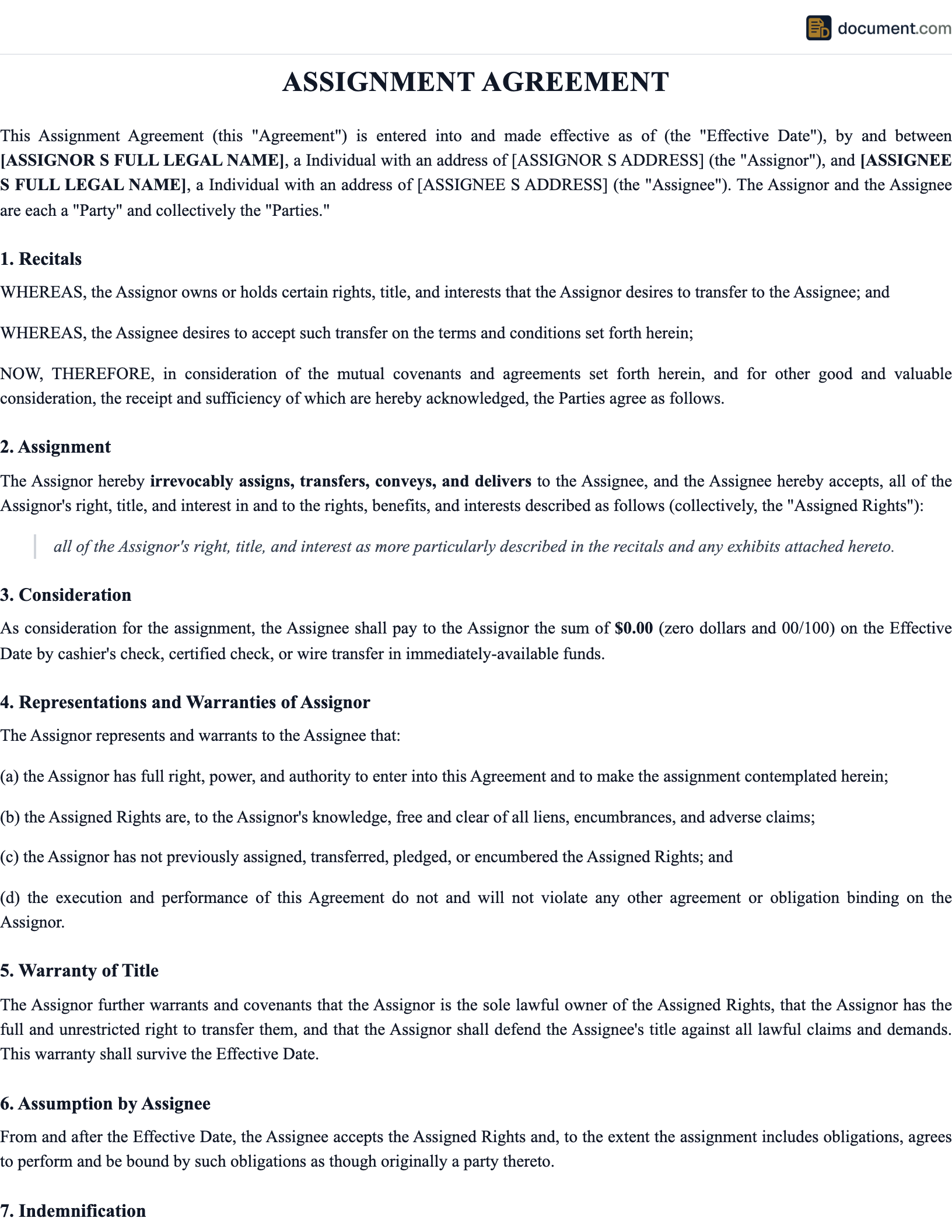



What Is an Assignment of Partnership Interest?
An assignment of partnership interest is a legal instrument by which an existing partner (the assignor) transfers all or a portion of their ownership stake in a partnership to another person or entity (the assignee). Unlike the sale of stock in a corporation, a partnership interest is a uniquely hybrid asset: it consists of both an economic interest (the right to receive distributions, profits, losses, and a share of liquidation proceeds) and a management interest (the right to vote, inspect books, bind the partnership, and participate in governance). These two components can be — and often are — transferred separately. An assignment of partnership interest, by default and unless the partnership agreement or the other partners say otherwise, conveys only the economic component.
This default rule is rooted in the common-law principle of delectus personae— "choice of the person" — which reflects the idea that partners have voluntarily chosen to do business with one another and should not be forced to accept a new co-owner without their consent. Both the Uniform Partnership Act (UPA) and its successor, the Revised Uniform Partnership Act (RUPA), codify this principle. Under RUPA Section 503, a partner's transferable interest can be assigned, but the transferee does not become a partner and has no right to participate in management or access partnership information beyond what is necessary to compute the transferee's share.
Partnership assignments arise in a wide range of circumstances: a retiring partner selling their stake to a colleague or to the firm itself, a family partner gifting fractional interests to children or trusts for estate planning, a partner pledging their interest as collateral for a personal loan, a divorce settlement requiring transfer of a business interest to a former spouse, or an investor partner exiting a venture and transferring their capital account to a replacement investor. Each context raises distinct legal, tax, and practical issues — and each demands a carefully drafted assignment document that addresses not only the transfer itself but also consent requirements, representations and warranties, release of liabilities, and the tax reporting that will follow.
The document typically identifies the partnership, the assignor, the assignee, the percentage or portion of the interest being transferred, the effective date, the consideration paid, and the rights being conveyed. Sophisticated assignments also include the assignor's representations about the absence of liens and encumbrances, the assignee's acknowledgment that they are taking only economic rights (unless admitted as a substitute partner), the partnership's written consent if required, and provisions addressing capital account transfer, Section 754 elections, and allocation of profits and losses for the short period in which the transfer occurs.
Whether you are a retiring partner cashing out, an heir receiving an interest through estate planning, or a business owner restructuring ownership among family members, our attorney-reviewed assignment of partnership interest template provides the legal framework you need. It addresses state-specific consent requirements, incorporates RUPA default rules where applicable, and includes the representations, warranties, and indemnification provisions that protect both parties from future disputes.
Economic Transfer
Assigns distributions, profit allocations, and capital account balance to the new holder
Consent Framework
Incorporates partnership consent and right-of-first-refusal provisions where required
Tax Ready
Structured to support Section 741 treatment and Section 754 inside-basis adjustments
Assignment of Partnership Interest Form Preview
Below is a visual preview of the sections included in our assignment of partnership interest template. Your completed document will be fully formatted and customized for the specific partnership, the type of interest being transferred, and your state's legal requirements.
Assignment of Partnership Interest
Transfer of Economic Interest in [Partnership Name]
Section 1: Partnership Identification
Section 2: Assignor (Transferring Partner)
Section 3: Assignee (Receiving Party)
Section 4: Scope of Rights Transferred
Types of Partnership Interest Assignments
Partnership interest assignments come in several forms depending on the scope of the transfer, the type of partnership, and whether the assignee will become a substitute partner. Understanding which type applies to your situation ensures the assignment is structured correctly and the tax and legal consequences are anticipated.
Full Assignment of Economic Interest
The assignor transfers 100% of their economic stake to the assignee. The assignor retains no right to future distributions or allocations but, without admission as a substitute partner, the assignee takes only economic rights.
Partial Assignment
Only a portion of the assignor's interest is transferred — for example, a partner assigning half of their 40% interest to a family trust, retaining the remaining 20%. Common in estate planning and gifting strategies.
Assignment with Substitute Partner Admission
The assignment is combined with written consent of the other partners admitting the assignee as a full substitute partner, transferring both economic and management rights in a single transaction.
Collateral Assignment
The partner grants a security interest in their partnership interest to a lender as collateral for a loan. Governed by UCC Article 9 and typically requires a UCC-1 filing to perfect.
General Partner Interest Transfer
Transfer of a general partner's interest in a limited partnership or LLP. Almost always requires unanimous consent and raises fiduciary duty and liability-release questions.
Limited Partner Interest Transfer
Transfer of a limited partner's interest, which is typically more freely transferable because limited partners have no management authority to begin with.
Assignment vs Admission as Substitute Partner
One of the most commonly misunderstood aspects of partnership law is the distinction between assigning an economic interest and admitting the assignee as a full substitute partner. These are two separate legal events, each with its own requirements and consequences.
Bare Assignment (Economic Only)
- - Transfers distributions, profits, losses, capital account
- - Does NOT transfer management or voting rights
- - Does NOT grant inspection of books and records
- - Typically does not require unanimous partner consent (depends on agreement)
- - Assignor may remain "partner of record" for some purposes
- - Assignee is a "mere assignee" or "transferee"
Admission as Substitute Partner
- - Assignee becomes full partner with all rights and duties
- - Participates in management and votes on partnership matters
- - Full access to books, records, and partnership information
- - Typically requires unanimous written consent of other partners
- - Assignor is released from future partnership obligations (past obligations may remain)
- - Assignee assumes all fiduciary duties to the partnership
Important: If your goal is to bring in a full replacement partner, the assignment document alone is not enough. You also need a separate written consent of the remaining partners and, in most cases, an amendment to the partnership agreement admitting the new partner.
How to Create an Assignment of Partnership Interest
Creating a valid, enforceable assignment of partnership interest requires careful attention to the partnership agreement, applicable state law, tax consequences, and the practical mechanics of transferring capital accounts and updating partnership records. Follow these steps to ensure your assignment is properly structured.
Review the Partnership Agreement
Before drafting any assignment, read the partnership agreement carefully. Look for transfer restrictions, rights of first refusal, required consents (majority, supermajority, or unanimous), notice periods, and any provisions governing admission of substitute partners. Many partnership agreements prohibit transfers to outside parties without consent, and violating these provisions can void the assignment or trigger penalties.
Determine the Scope of the Transfer
Decide whether you are transferring economic rights only, or whether the assignee will also be admitted as a substitute partner. This decision affects the level of consent required, the language of the assignment, and whether an amendment to the partnership agreement will be needed.
Value the Interest
Establish the fair market value of the interest being transferred. This is critical for tax purposes, for determining the consideration paid, and — in gift scenarios — for calculating any gift tax. A qualified business valuation may be required for large interests, family transfers, or transfers involving trusts and estates.
Obtain Required Consents
Secure written consent from the other partners or the partnership, as required by the partnership agreement. Consents should specifically reference the proposed assignment, identify the assignee, and state whether the assignee is being admitted as a substitute partner. Keep the consents with the assignment document.
Identify Hot Assets and Plan for Tax Treatment
Review the partnership's assets for Section 751 hot assets (unrealized receivables and substantially appreciated inventory). Consult a tax advisor about the potential ordinary income recharacterization, the need for a Section 754 election, and how the transfer will be reflected on Schedule K-1 and Form 8308.
Draft the Assignment Document
Prepare the written assignment using our template. Include all required elements: identification of partnership, assignor, assignee, interest percentage, consideration, scope of rights transferred, representations and warranties, effective date, governing law, and signature blocks. Address capital account transfer and any carve-outs from the assignment.
Execute the Document
Have both the assignor and assignee sign the assignment. Notarization is strongly recommended. If the partnership's written consent is required, secure partnership signatures as well. All signatures should be dated, and originals should be kept with partnership records.
Update Partnership Records
Update the partnership's books and records to reflect the assignment: adjust capital accounts, update the partner schedule, revise K-1 distributions, and file any required state notices (for limited partnerships, some states require an amended Certificate of Limited Partnership).
File Tax Reports
Ensure the partnership files Form 8308 (Report of a Sale or Exchange of Certain Partnership Interests) if required, and that the assignor and assignee each receive appropriate Schedule K-1s reflecting the allocated share of profits and losses for their respective periods of ownership.
Retain Documentation
Keep the signed assignment, partnership consents, valuation documentation, and tax filings in a permanent record. These documents may be needed years later for audit, succession, or dispute resolution purposes.
Key Components of a Partnership Interest Assignment
A complete assignment of partnership interest addresses every element needed to effect a clean transfer and protect both parties from future disputes.
| Component | Description |
|---|---|
| Partnership Identification | Legal name, state of formation, type (GP, LP, LLP), EIN, and principal place of business |
| Assignor Information | Full legal name, address, current ownership percentage, and capital account balance |
| Assignee Information | Full legal name or entity designation, address, taxpayer ID, and state of residence/formation |
| Interest Transferred | Exact percentage or portion of interest being assigned, expressed both as a percentage and as a capital account dollar amount |
| Consideration | Amount and form of consideration paid — cash, property, promissory note, or gift |
| Scope of Rights | Clear statement of whether the assignment transfers only economic rights or also admits the assignee as a substitute partner |
| Effective Date | Date the assignment takes effect for purposes of distributions, allocations, and record-keeping |
| Representations and Warranties | Assignor's representations that the interest is owned free and clear, not subject to undisclosed liens, and that the assignor has authority to transfer |
| Partnership Consent | Written consent of the partnership and/or other partners as required by the partnership agreement |
| Capital Account Transfer | Provision confirming the assignee inherits the assignor's capital account balance (or pro-rata portion) |
| Tax Allocations | Method for allocating profits and losses between assignor and assignee for the partnership year in which the transfer occurs |
| Section 754 Election | Reference to whether the partnership will make a Section 754 election to adjust inside basis for the assignee |
| Indemnification | Assignor indemnifies assignee against undisclosed liabilities; assignee indemnifies assignor for post-transfer obligations |
| Release | Release of claims between assignor, assignee, and the partnership, where applicable |
| Governing Law | State whose law governs interpretation and enforcement (typically the partnership's state of formation) |
| Signatures | Assignor, assignee, partnership (if required), and notary acknowledgment |
Tax Consequences of Assigning a Partnership Interest
Assigning a partnership interest is rarely tax-neutral. The IRC treats the sale or exchange of a partnership interest as the disposition of a capital asset under Section 741, but several overlapping rules can dramatically change that treatment — especially where the partnership holds "hot assets" or where the partnership has made certain elections.
Section 741 — Capital Gain Treatment
Under the general rule, the assignor recognizes capital gain or loss equal to the difference between the amount realized (cash plus fair market value of property plus relief of share of partnership liabilities) and the assignor's outside basis in the partnership interest.
Section 751 — Hot Assets
If the partnership holds unrealized receivables or substantially appreciated inventory, a portion of the assignor's gain is recharacterized as ordinary income rather than capital gain. This rule prevents partners from converting ordinary income into capital gain by selling their partnership interest rather than the underlying assets.
Section 754 Election
The partnership may elect under Section 754 to adjust the inside basis of partnership assets when a partnership interest is transferred. This prevents the assignee from being taxed on appreciation that was already taxed to the assignor. Once made, the election applies to all subsequent transfers until revoked with IRS consent.
Form 8308 Reporting
The partnership must file Form 8308 (Report of a Sale or Exchange of Certain Partnership Interests) when a Section 751(a) exchange occurs, notifying the IRS of the transfer and the parties involved.
Schedule K-1 Allocation
For the partnership tax year in which the transfer occurs, profits and losses must be allocated between the assignor and assignee, typically using either the interim closing-of-the-books method or a proration method as specified in the partnership agreement.
Consent Requirements and Transfer Restrictions
Nearly every partnership agreement contains some form of restriction on the transfer of partnership interests. These restrictions exist because partnerships are built on relationships of trust and shared commitment — the other partners have a legitimate interest in knowing who will be their co-owner.
- Right of First Refusal: The partnership or remaining partners have the right to purchase the interest on the same terms offered by a third-party buyer before the sale can proceed.
- Consent Requirements: Transfers may require majority, supermajority, or unanimous written consent of the other partners.
- Permitted Transferee Exceptions: Many agreements allow free transfers to spouses, children, trusts for estate planning, or wholly-owned entities without consent.
- Buy-Sell Triggers: Death, disability, divorce, bankruptcy, or retirement may trigger mandatory buyback provisions.
- Anti-Dilution Protection: Some agreements include tag-along or drag-along rights that affect how partial assignments are handled.
Sample Assignment of Partnership Interest
ASSIGNMENT OF PARTNERSHIP INTEREST
This Assignment of Partnership Interest (this "Assignment") is made and entered into as of [Effective Date] by and between [Assignor Name] ("Assignor") and [Assignee Name] ("Assignee").
1. ASSIGNMENT
For good and valuable consideration, the receipt and sufficiency of which are hereby acknowledged, Assignor hereby assigns, transfers, and conveys to Assignee all of Assignor's right, title, and interest in and to a [Percentage]% economic interest in [Partnership Name], a [State] [Type] partnership (the "Partnership"), including the corresponding right to receive distributions, allocations of profits and losses, and share of partnership capital account attributable to such interest.
2. SCOPE OF TRANSFER
This Assignment transfers only the economic rights described above. Unless and until Assignee is formally admitted as a substitute partner by written consent of the remaining partners in accordance with the Partnership Agreement, Assignee shall have no right to participate in the management of the Partnership, vote on Partnership matters, inspect the books and records of the Partnership (except as required to compute Assignee's distributive share), or otherwise act as a partner.
3. REPRESENTATIONS OF ASSIGNOR
Assignor represents and warrants that: (a) Assignor is the lawful owner of the interest being assigned; (b) the interest is free and clear of all liens, claims, and encumbrances; (c) Assignor has full power and authority to execute this Assignment; and (d) Assignor has complied with all notice, consent, and right-of-first-refusal provisions of the Partnership Agreement applicable to this transfer.
4. CAPITAL ACCOUNT
As of the Effective Date, Assignor's capital account in the Partnership is $[Amount]. Upon the effectiveness of this Assignment, a pro-rata portion of such capital account, equal to $[Amount], shall be transferred from Assignor to Assignee and shall thereafter be maintained by the Partnership in Assignee's name.
5. TAX ALLOCATIONS
Profits and losses of the Partnership for the taxable year in which this Assignment is effective shall be allocated between Assignor and Assignee using the interim closing-of-the-books method, unless the Partnership Agreement or the Partnership's tax matters partner elects otherwise.
6. GOVERNING LAW
This Assignment shall be governed by and construed in accordance with the laws of the State of [State], without regard to conflicts of law principles.
Frequently Asked Questions
Official Resources
IRS - Partnerships
Federal tax guidance on partnership taxation, Form 1065, and K-1 reporting
IRS Form 8308
Report of a Sale or Exchange of Certain Partnership Interests
Uniform Law Commission - RUPA
Revised Uniform Partnership Act text and commentary
SBA - Business Structures
U.S. Small Business Administration guide to partnerships
Create your Partnership Interest Assignment Agreement in under 10 minutes.
Answer a few questions and download a compliant, attorney-drafted document ready for your state.