



Key Takeaways
- •A synthetic voice license is the consent record that defeats a right-of-publicity claim. Use a cloned voice in a song without one and you face damages, an injunction, takedowns from Spotify and YouTube, and in Tennessee criminal exposure.
- •Tennessee's ELVIS Act, codified at Tenn. Code Ann. sections 47-25-1101 to 47-25-1108 and effective July 1, 2024, was the first U.S. law to protect a person's voice from AI cloning as a property right, and it lets record labels enforce on an artist's behalf.
- •The right covers two separate things that the license must price separately: training a model on an artist's recordings, and generating new songs from that model. A grant for one does not carry a grant for the other.
- •Master rights and publishing rights are different revenue streams. A synthetic-voice song touches both, plus a digital performance royalty collected by SoundExchange under the 1995 Digital Performance Right in Sound Recordings Act, 17 U.S.C. section 106(6).
- •Purely AI-generated music cannot be copyrighted. The U.S. Copyright Office confirmed in its January 29, 2025 guidance that registration requires meaningful human authorship in the selection, arrangement, or modification of the output.
- •The 'Heart on My Sleeve' Drake and Weeknd track (April 2023) was pulled and ruled Grammy-ineligible because the voices were never licensed. Randy Travis's 'Where That Came From' (2023) was lawful because consent was granted. The license is the difference.
Reviewed for accuracy by the document.com legal team. Educational information, not legal advice.
What Is AI Music & Synthetic Voice License?
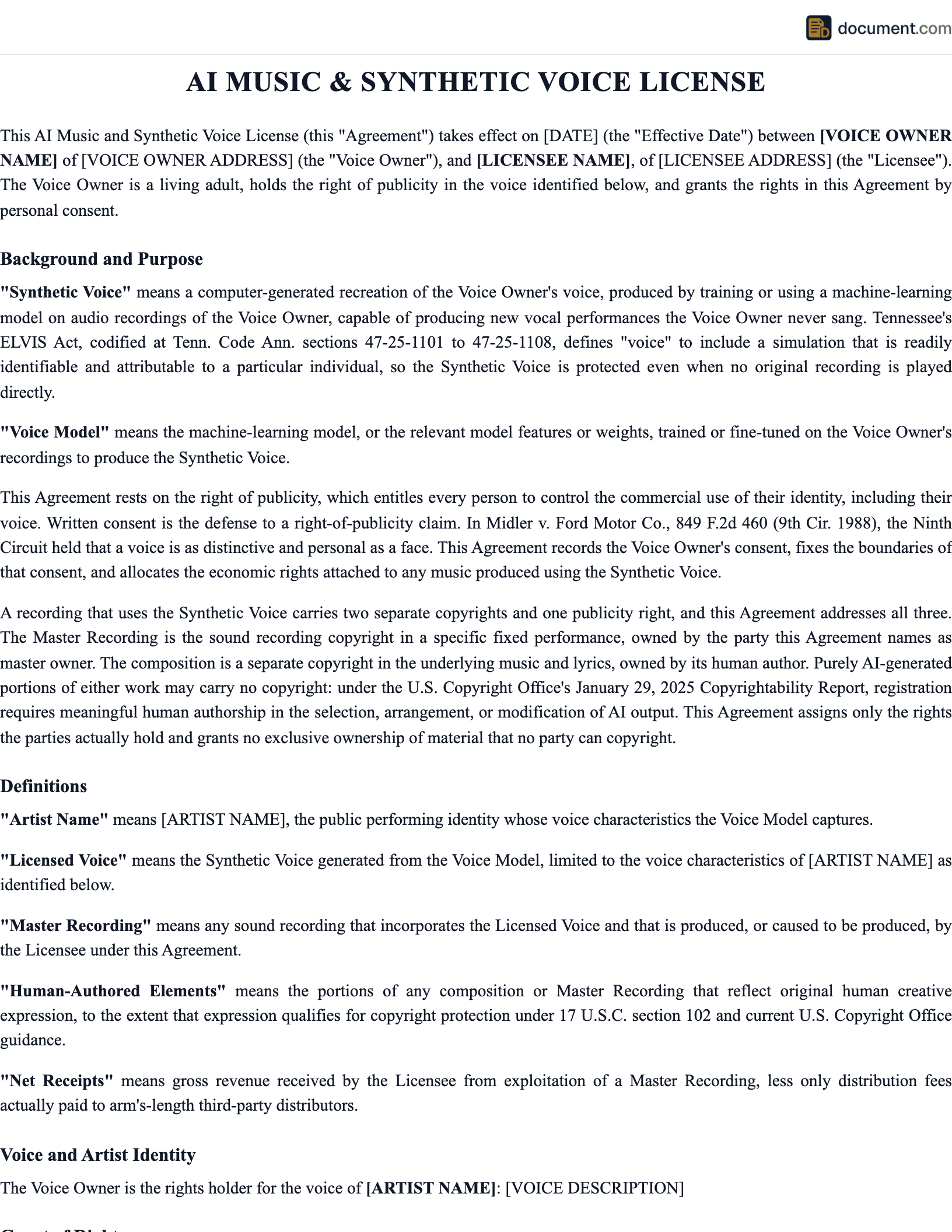
An AI music and synthetic voice license is a written agreement that gives one party the right to use another person's voice, through a cloned or AI-generated copy of it, to create and exploit recorded music. The license sits on top of the right of publicity, the legal right every person has to control the commercial use of their own identity. It records that the artist agreed, then draws the boundaries around that agreement: which uses are allowed, whether a model may be trained on the artist's recordings, who owns the resulting master, how the royalties split, how long it lasts, where it applies, and what happens if the artist later revokes.
Two questions decide whether a synthetic-voice song is lawful or a lawsuit. Did the voice owner consent, in writing? And did that consent actually cover the use, training a model versus generating one track being very different grants? Everything in this document exists to answer those two questions in a way that holds up in court, at a streaming platform's content review, and in front of a Grammy eligibility committee.
A one-clause form will not do the job. A label cloning a legacy artist's voice with the estate's blessing, a startup building a singing voice model from a session vocalist's stems, a producer licensing the GrimesAI voice for a release, and a publisher synthesizing narration of a catalog song all need the same skeleton of answers but very different terms inside it. The license is built from options you select rather than a single rigid template, because a flat fee for one ad and a perpetual training grant for a model that can sing forever are different deals and should never read the same way.
Why This Matters Now
Voice cloning collapsed from a research demo into a consumer app in about two years, and the music industry's first real reckoning arrived in April 2023. An anonymous TikTok user posting as Ghostwriter977 released 'Heart on My Sleeve,' a track using AI-cloned voices of Drake and The Weeknd. It pulled more than nine million views before Universal Music Group had it removed from TikTok, Spotify, and YouTube. The takedown leaned on a producer tag and on the artists' right of publicity, because the voices were never cleared. The song was then ruled ineligible for the Grammy Awards in September 2023 after the Recording Academy reversed an earlier position, on the ground that the vocals were unlicensed and the track was not commercially available.
Contrast that with Randy Travis. The country artist, who has lived with aphasia since a 2013 stroke, released 'Where That Came From' in 2023 using AI voice synthesis built with his explicit consent and direct involvement. The Copyright Office treated it as registrable because real human creative contribution went into it, and Travis went on to publicly back the federal NO FAKES Act. Same technology, opposite legal outcome. Consent is the whole difference.
Legislatures moved fast. Tennessee passed the ELVIS Act in March 2024, the first statute in the country to protect the human voice from AI cloning as a property right, and by 2026 more than a dozen states had AI or digital-replica provisions on the books. California's AB 1836 took effect January 1, 2025, extending its publicity statute to AI digital replicas of deceased performers. New York signed two AI bills on December 11, 2025, one requiring disclosure of synthetic performers in advertising and one stripping the deception requirement from unauthorized uses of deceased performers.
The money followed the law. The three major labels sued the AI music platforms Suno and Udio in June 2024 over training data. By late 2025 the dam had broken. Universal Music Group settled with Udio in October and announced a joint AI music service, and Warner Music Group settled with both Udio and Suno in November, with both deal structures building in opt-in compensation for artists whose voices and compositions feed the models. The American Federation of Musicians then sued UMG and Warner, arguing the settlements licensed member recordings without compensation or credit. As of June 2026 Sony Music remains the lone major holdout. The licensing framework is being written in real time, and the documents you sign now have to anticipate where it lands.
The Legal Backbone
The right of publicity is the foundation, and it is a 50-state patchwork
There is no single national right of publicity. Each state sets its own rule, and the AI-specific pieces are the newest law on the books. The foundational common-law case for voices is Midler v. Ford Motor Co., 849 F.2d 460 (9th Cir. 1988), where the Ninth Circuit held that 'a voice is as distinctive and personal as a face' and that deliberately imitating a professional singer's distinctive voice to sell a product is a tort under California common law. Bette Midler recovered $400,000, the market rate for the performance she had declined. That principle, that a recognizable voice belongs to the person it identifies, is the spine that every modern AI voice statute builds on. A synthetic voice license works because written consent is the defense to a publicity claim. No consent, no defense.
Tennessee ELVIS Act: the first true AI voice statute, Tenn. Code Ann. sections 47-25-1101 to 47-25-1108
The Ensuring Likeness, Voice, and Image Security Act, signed March 21, 2024 and effective July 1, 2024, was the first state law in the country to criminalize unauthorized AI voice cloning. It defines 'voice' broadly: 'a sound in a medium that is readily identifiable and attributable to a particular individual, regardless of whether the sound contains the actual voice or a simulation.' Read that twice. A simulation counts, which is the entire point for synthetic music. A violation is a Class A misdemeanor, carrying up to 11 months and 29 days and a $2,500 fine, and the civil side allows an injunction, destruction of the offending material, actual damages, the infringer's profits, and attorney's fees. Record labels can enforce on an artist's behalf. The statute carves out news, public affairs, sports broadcasts, comment, criticism, scholarship, satire, and parody, but not where the use creates a false impression of an authentic recording. For a synthetic song meant to sound like a real release, those exemptions will rarely save you.
California Civil Code section 3344, plus 3344.1 and AB 1836 for the deceased
California gives the publicity right unusual teeth. Under Civil Code section 3344, using a living person's name, voice, signature, photograph, or likeness for advertising or commercial purposes without consent lets them recover the greater of actual damages or a statutory floor of $750, plus the user's profits attributable to the use and attorney's fees. Section 3344.1 extends protection 70 years after death, which is why a deceased singer's estate still controls AI recreations of the voice. AB 1836, effective January 1, 2025, amended section 3344.1 to explicitly reach AI-generated 'digital replicas' of deceased performers, closing the question of whether a cloned voice counts. If your project touches California talent or a California audience, section 3344 sets the stakes.
New York: Civil Rights Law sections 50, 50-f, 51 and the 2025 amendments
New York modernized its law specifically for synthetic media. Civil Rights Law sections 50 and 51 are the original privacy and publicity provisions, and section 50-f governs digital replicas of deceased performers. Two bills signed December 11, 2025 sharpened the regime. SB 8391, effective January 1, 2025, removed the 'likelihood of deception' requirement for unauthorized use of a deceased performer's replica, so a plaintiff estate no longer has to prove the audience was fooled. SB 8420-A, effective June 9, 2026, requires advertisers to disclose AI-generated 'synthetic performers' in advertising, with penalties of $1,000 for a first violation and $5,000 for later ones. If your release will be advertised into New York after that date, write the synthetic-performer disclosure into the campaign plan, because the statute fines the omission.
Federal copyright and the digital performance right
Two federal pieces matter for synthetic music. First, copyrightability. The U.S. Copyright Office issued AI guidance in two parts, on digital replicas (July 31, 2024) and copyrightability (January 29, 2025), confirming that a purely AI-generated work cannot be registered, while a work with sufficient human authorship in the creative selection, arrangement, or modification of AI output can be. A song generated entirely by a prompt is not yours to copyright. A song where a human meaningfully shaped the composition and arrangement may be. Second, the performance royalty. The Digital Performance Right in Sound Recordings Act of 1995, Pub. L. No. 104-39, codified at 17 U.S.C. section 106(6), created the exclusive digital performance right for sound recording owners and is administered through compulsory licensing collected by SoundExchange. That royalty stream attaches to a synthetic-voice master the same way it attaches to a human one.
The NO FAKES Act: pending, not law, but already shaping deals
The NO FAKES Act, reintroduced in 2025 as H.R. 2794 in the 119th Congress with bipartisan backing from Senators Coons, Blackburn, Klobuchar, and Tillis, would create the first federal intellectual property right in a person's voice and likeness. As proposed, statutory damages run from $5,000 to $750,000 per work, scaled to how much good-faith compliance effort the defendant made. It is not enacted as of June 2026, so do not draft as if it were the law, but a license written to satisfy its consent and disclosure expectations now will not need a rewrite if it passes. Confirm current status before relying on any of this; it is moving.
International: the EU AI Act treats a voiceprint as biometric data
If you distribute into the European Union, the AI Act, fully in force in 2026, classifies voiceprints as biometric data and requires, under Article 50, transparency and labeling of synthetic audio. Training data must be licensed with documented consent. Serious violations carry penalties of up to 30 million euros or 7 percent of global annual turnover, whichever is higher. A US-only consent form will not clear an EU release. The license should carry a documented consent chain and a labeling obligation if the master will travel.
Right of Publicity by State: All 50 States and DC
The right being licensed varies sharply by state. The table below covers all fifty states and the District of Columbia: the governing statute or common-law basis, the post-mortem term the estate controls, and any AI or digital-replica-specific provision.
| State | Statute or basis | Post-mortem | AI / digital replica |
|---|---|---|---|
| Alabama | Ala. Code § 6-5-772 | 55 years | None |
| Alaska | Common law only | Common law | None |
| Arizona | A.R.S. §12-761 (soldiers/military only); Common law right of... | Soldiers only | No explicit AI-specific language in A.R.S |
| Arkansas | Ark. Code Ann. §§ 4-75-1101 et seq. (Frank Broyles Publicity Rights... | 50 years | AI digital replica provisions added via HB1071 (signed February 25, 2025, effective... |
| California | Cal. Civ. Code §§ 3344 (living persons) and 3344.1 (deceased... | 70 years | Digital replica provisions in §3344 (via SB 683, signed October 10, 2025, effective... |
| Colorado | Common law only | Common law | None |
| Connecticut | Common law only | Common law | None |
| Delaware | Common law only | Common law | HB 353 (Amelia Kramer Act) addresses synthetic media/deepfakes for minors and... |
| District of Columbia | Common law only | None | None |
| Florida | Fla. Stat. § 540.08 | 40 years | None |
| Georgia | Common law only | Common law | Georgia 'No Fakes' bill (HB 566) failed to advance in 2025 legislative session; no... |
| Hawaii | Hawaii Revised Statutes Title 26, Chapter 482P (HRS § 482P-1 et seq.) | 70 years | None |
| Idaho | Common law only | Common law | Idaho has enacted targeted deepfake legislation: House Bill 575 (explicit deepfakes),... |
| Illinois | 765 ILCS 1075 (Right of Publicity Act), as amended by HB 4875... | 50 years | HB 4875 (effective January 1, 2025) explicitly prohibits unauthorized digital replicas |
| Indiana | Indiana Code Title 32, Article 36, Chapter 1 (IC § 32-36-1 et seq.) | 100 years | None |
| Iowa | Common law only | Common law | Senate File 2243 and House File 2240 address synthetic media involving minors and... |
| Kansas | No recognized right | None | None |
| Kentucky | KY Rev. Stat. § 391.170 | 50 years | None |
| Louisiana | La. Rev. Stat. Ann. § 51:470.1 et seq. (Allen Toussaint Legacy Act) | 50 years | Digital replica defined in § 51:470.2 as computer-generated or electronic reproduction of... |
| Maine | Common law only | Common law | None |
| Maryland | Common law only | Common law | None |
| Massachusetts | Mass. Gen. Laws Ann. ch. 214, § 3A | None | Massachusetts HB 4744 (enacted 2024, Chapter 118 of Acts of 2024) addresses... |
| Michigan | Common law only | Common law | Michigan House Bills 4047 and 4048 (Protection from Intimate Deep Fakes Act, signed... |
| Minnesota | Common law only | Common law | Minnesota Statute 617.262 (enacted 2023, amended 2024) criminalizes nonconsensual... |
| Mississippi | Common law only | Undefined (no court... | No AI-specific provision; Mississippi has not enacted HB 768 or an ELVIS Act |
| Missouri | Common law only | Common law | None |
| Montana | Common law only | Common law | None |
| Nebraska | Neb. Rev. Stat. §20-202 (with post-mortem survival under §20-208) | Indefinite | None |
| Nevada | Nev. Rev. Stat. §597.770 et seq. (specifically §597.790) | 50 years | None |
| New Hampshire | Common law only | Common law | Deepfake law (H.B |
| New Jersey | Common law only | 50 years | Deepfake law (A3540/S2544 signed 2025) - separate from ROP, establishes civil/criminal... |
| New Mexico | Common law only | Common law | None |
| New York | N.Y. Civ. Rights Law §§50, 51, 50-f | 40 years | N.Y |
| North Carolina | Common law only | Common law | None |
| North Dakota | No recognized right | None | None |
| Ohio | Ohio Rev. Code §2741 (Chapters 2741.01-2741.09) | 60 years | None |
| Oklahoma | Okla. Stat. tit. 12 §1448 (deceased); Okla. Stat. tit. 12 §1449... | 100 years | Oklahoma HB 1364 (synthetic intimate content; 2024-2025) |
| Oregon | Common law only | Common law | Oregon HB 2299 addresses synthetic intimate imagery but not voice cloning specifically... |
| Pennsylvania | 42 Pa.C.S. §8316 (right of publicity); 18 Pa.C.S. §4101.1 (digital... | 30 years | 18 Pa.C.S |
| Rhode Island | R.I. Gen. Laws §9-1-28 (commercial use); R.I. Gen. Laws §9-1-28.1... | None | None |
| South Carolina | Common law only | Unclear (common law... | None |
| South Dakota | S.D. Codified Laws § 21-64 et seq. | 70 years | None |
| Tennessee | Tenn. Code Ann. § 47-25-1101 et seq. (ELVIS Act 2024) | 10 years | ELVIS Act - Tenn |
| Texas | Tex. Prop. Code § 26.001 et seq. | 50 years | None |
| Utah | Utah Code § 45-3 (Abuse of Personal Identity Act), as amended by SB... | 70 years | Yes |
| Vermont | Common law only | Common law | None |
| Virginia | Va. Code § 8.01-40 (civil); Va. Code § 18.2-216.1 (criminal) | 20 years | None |
| Washington | Wash. Rev. Code § 63.60.010 et seq. (amended by SB 5886, effective... | 10 years | RCW 63.60 amended 2026 to include 'forged digital likeness' - digital representations... |
| West Virginia | Common law only | Common law | None |
| Wisconsin | Common law only | Common law | None |
| Wyoming | Common law only | Common law | None |
Compiled from primary state statutes and verified against legislative sources in 2026. Confirm current law for your state.
Master rights, publishing rights, and the royalty split for a cloned-voice song
If any part of a synthetic-voice deal is going to trip you up, it is the rights stack, so slow down here. A song carries two copyrights, and a synthetic voice sits on top of both. The composition is the underlying music and lyrics, the thing a songwriter writes. The sound recording, the 'master,' is a particular fixed performance of that composition. When you stream a track, the songwriter's side gets paid through publishing royalties and the recording owner's side gets paid through master royalties. They are separate revenue streams with separate owners, and a license that only addresses one of them leaves the other unaccounted for.
Now add the cloned voice. The synthetic voice is the performance that creates the master, so the voice owner's rights live on the recording side and in the right of publicity, which is a third, distinct claim layered over the copyright. A clean synthetic-voice license has to settle who owns the master that the AI voice produces, whether the voice owner shares in the master royalty or takes a separate publicity fee, and how the publishing splits if the AI also generated or arranged the composition. TuneCore's GrimesAI arrangement is the cleanest public example: artists who release using the Grimes voice split master revenue 50/50 with GrimesAI. That 50/50 is a deal point, not a default. Yours can be anything the parties agree to, but it has to be stated.
Layered on top of the master is the digital performance royalty. Under 17 U.S.C. section 106(6) and the 1995 Digital Performance Right in Sound Recordings Act, non-interactive digital plays of a sound recording, internet radio, satellite radio, and similar services, generate a royalty that SoundExchange collects and distributes. By statute, that money splits among the sound recording copyright owner and the featured and non-featured performers on the track. For a synthetic-voice master, the agreement should name who stands in the performer's shoes for that distribution, because the AI did not register with SoundExchange and the voice owner may have a claim to that share.
Then there is the training question, which is its own grant and its own price. Licensing your voice for one finished song is narrow. Licensing your recordings to train a model that can then sing anything, in your voice, on any future track, indefinitely, is enormous. The UMG-Udio and Warner-Suno settlements in late 2025 both built in opt-in compensation specifically for training use, paid separately from generation, precisely because the two are different economic events. A serious license prices them apart: a training fee or training royalty for the model build, and a generation or per-release royalty for each song the model produces. Lump them into one number and the voice owner almost always gives away the larger right for the smaller price.
Copyright ownership of the output is the last piece, and it runs counter to intuition. The Copyright Office's January 29, 2025 guidance means the AI-generated portion of a track is generally not copyrightable on its own. What you can register is the human-authored contribution: the composition a person wrote, the arrangement a producer shaped, the selection and editing a human performed over the raw AI output. So a synthetic-voice song can be partly protected and partly in the public domain, and the license should be honest about that. Do not promise the licensee an exclusive copyright in material that no one can actually own. Promise them the master rights you do hold, the publicity consent, and the human-authored copyrightable layer, and say plainly what falls outside copyright.
Revocation is the clause that AI changes most. With a human performance, the recording is fixed and the deal is done. With a model trained on a voice, revocation has to mean something concrete: stop generating new outputs, delete the training copies of the voice owner's data, and retire the model features built from their recordings. Decide this before any recording happens. Adding a revocation right after a model is already trained is hard to enforce and sometimes impossible in practice, because the voice is now baked into the weights. The estates' post-mortem rights matter here too. California's 70-year window under section 3344.1 and New York's deceased-performer rules mean a license that outlives the artist still has to answer to whoever controls the estate.
When You Need This
A label, producer, or platform building a singing voice model from a real vocalist's stems or master recordings, where the model will generate new performances.
An artist, songwriter, or estate licensing a recognizable voice for AI-generated music, including the GrimesAI-style arrangement where the voice is offered to third-party creators for a revenue split.
A studio or distributor releasing a track that uses a cloned or synthesized voice and needs every voice owner on record before it hits Spotify, Apple Music, YouTube, or TuneCore, all of which now reject unlicensed AI vocals.
A developer collecting voice samples to train a music model and needing documented, opt-in consent to satisfy the SoundExchange AI registry, a 'Fairly Trained' style certification, or the EU AI Act's biometric and transparency rules.
An estate or rights holder licensing a deceased artist's voice, which California permits for 70 years under Civil Code section 3344.1 and New York governs through Civil Rights Law section 50-f, but only with the estate's authorization.
A company that already has a clear chain of consent but needs to formalize the master and publishing splits, the SoundExchange performer share, and a revocation-and-model-retirement path before scaling up generation.
How to Fill Out AI Music & Synthetic Voice License
1. Identify the parties and confirm authority to grant
Enter the full legal name and address of the voice owner (the licensor) and the company or individual receiving the rights (the licensee). For a living artist, the artist signs. For a deceased one, the grant must come from the estate's authorized representative, not a third party, because the post-mortem right belongs to the estate under statutes like California Civil Code section 3344.1. For a minor, a parent or guardian signs and the term should be narrower. Notarization is strongly recommended for estate grants and high-value perpetual licenses, because it closes off the most common later challenge, that the signature was not authorized.
2. Define the voice and the recordings being licensed
Describe the voice with enough specificity that there is no ambiguity, and identify the source recordings or stems the model will use. Remember Tennessee's definition: 'voice' includes a simulation that is readily identifiable to the individual. State whether the license covers only this defined voice or any derivative voice the model produces, and attach a schedule of the master recordings supplied for training if a model is involved.
3. Separate the training grant from the generation grant
Choose whether the license permits (a) using the recordings to train or fine-tune a model, (b) generating new music from a trained model, or both, and price each one on its own line. Get this field wrong and the whole deal is mispriced. A training grant is far broader than a one-song generation grant, and the late-2025 UMG and Warner settlements compensated training separately for exactly this reason. Do not collapse them into one fee.
4. Set the master and publishing rights and the royalty split
State who owns the master recording the synthetic voice produces, and whether the voice owner takes a share of master revenue (the GrimesAI model is 50/50), a separate flat publicity fee, or both. If the AI also generates or arranges the composition, set the publishing split and identify any human songwriter whose contribution is registrable. Name who receives the SoundExchange digital-performance performer share under 17 U.S.C. section 106(6), because that distribution will not sort itself out automatically.
5. Set commercial scope, term, and territory
Indicate whether the licensee can monetize the output, and choose how long the license lasts (fixed period to perpetual) and where it applies (one country to worldwide). Commercial use triggers the strongest publicity protections, including California's section 3344 statutory minimum, so this field should match what will actually happen. Make perpetual and worldwide grants a deliberate choice, never a default, and remember the EU AI Act adds biometric-consent and labeling obligations for any territory that includes the European Union.
6. Set the disclosure and labeling obligations
Decide how the synthetic voice will be disclosed. New York's SB 8420-A requires disclosure of synthetic performers in advertising as of June 9, 2026, the EU AI Act's Article 50 requires labeling of synthetic audio, and Spotify, YouTube, and TuneCore enforce their own AI-vocal disclosure rules. The license should obligate the licensee to apply the correct credit and metadata so a compliance failure does not boomerang back to the voice owner.
7. Set revocation, deletion, and model retirement
Decide whether the voice owner can withdraw consent, and define exactly what revocation requires for a trained model: stopping new generation, deleting the training copies of the voice owner's data, and retiring the model features built from their recordings. Settle this before recording begins. A revocation right bolted on after a model is trained is often unenforceable because the voice is already in the weights. For estate licenses, address what happens at the end of the post-mortem term.
8. Sign, register consent, and notarize where warranted
Both parties sign and date. Consider filing or updating an opt-in or opt-out declaration with the SoundExchange AI registry to memorialize the consent against third-party training claims. Notarize for estate grants, perpetual or worldwide licenses, and any minor's grant. Then download as PDF or Word, sign electronically, or route for signature through the built-in e-sign flow.
Key Terms Defined
- Synthetic voice
- An AI-generated copy of a person's voice, trained on their recordings, capable of producing new vocal performances the person never sang. Tennessee's ELVIS Act defines 'voice' to include a simulation that is readily identifiable to the individual, so a synthetic voice is protected even when no original recording is used.
- Master rights (sound recording copyright)
- The ownership of a specific recorded performance of a song, as opposed to the underlying composition. A synthetic-voice performance creates a new master, and the license must say who owns it and how the master royalty is shared.
- Publishing rights (composition copyright)
- The ownership of the underlying music and lyrics, separate from any particular recording. Songwriters earn through publishing royalties. If an AI generates or arranges the composition, the license must address the publishing split and identify any registrable human authorship.
- Digital performance royalty / SoundExchange
- A royalty for non-interactive digital plays of a sound recording (internet and satellite radio), created by the 1995 Digital Performance Right in Sound Recordings Act, 17 U.S.C. section 106(6), and collected by SoundExchange. It splits among the recording owner and the featured and non-featured performers, so a synthetic master needs a named recipient for the performer share.
- Training-data grant
- Permission to feed a person's recordings into a machine-learning model so it can generate unlimited new output in their voice. It is a far broader grant than licensing a single song, and the 2025 major-label settlements compensated it separately from generation for that reason.
- Right of publicity
- Every person's right to control the commercial use of their identity, including their voice. It is recognized through state statutes and common law, was applied to voices in Midler v. Ford Motor Co. (9th Cir. 1988), and is the legal foundation of a synthetic voice license. Written consent is the defense to a claim.
- Digital replica
- A computer-generated, AI-enabled recreation of a real person's voice or likeness realistic enough to be hard to distinguish from the real person. California's AB 1836 and New York's Civil Rights Law section 50-f govern digital replicas, including of deceased performers, and the pending federal NO FAKES Act would create a nationwide right against unauthorized replicas.
Related Documents
AI Voice & Likeness Release
The broader consent form for any AI use of a voice or image, not just music. If your project is a song, the synthetic voice license adds the master and publishing splits, the SoundExchange performer share, and the royalty structure that a general release does not cover. Many projects use the release for the underlying consent and this license for the music-specific economics. See the AI voice and likeness release.
Digital Replica Agreement
Governs creating and using a realistic AI recreation of a real person across media, the framework New York's section 50-f and California's AB 1836 address. For a deceased artist or a performer whose full digital double is being built, the digital replica agreement sets the consent and term, while this license handles the song-level rights and royalties on top.
AI Likeness Takedown Notice
The document you send after the fact, when a cloned voice or AI song has already been released without permission. A license grants rights going forward; the AI likeness takedown notice demands an unauthorized use come down and preserves the right to sue. If 'Heart on My Sleeve' were yours to enforce, this is the tool, not a license.
Biometric Voiceprint Consent
Focuses on the data side: capturing and storing a voiceprint, which the EU AI Act and state biometric laws treat as sensitive personal data. Where a model is trained on an artist's recordings, the biometric voiceprint consent documents the lawful capture of the underlying data, and this license documents the right to exploit the resulting music.
End User License Agreement
If you are the platform offering a synthetic voice to creators, your users need an EULA setting the terms on which they may generate and release music. The end-user license agreement governs the platform relationship; this synthetic voice license governs the upstream rights you secured from the voice owner that make the platform offering lawful in the first place.
Posthumous Digital Likeness Directive
For an artist planning how their voice may be used after death, the posthumous digital likeness directive records their wishes and names who controls the post-mortem right that California protects for 70 years under section 3344.1. The estate then uses this license to actually authorize and monetize a synthetic-voice release within those instructions.
Legal Authorities & Sources
This page is grounded in primary law. The statutes and official resources below are the authorities behind the guidance above. Verify the current text of any statute before relying on it.
- Tennessee ELVIS Act, Tenn. Code Ann. sections 47-25-1101 et seq. (Governor's announcement)
- U.S. Copyright Office, Copyright and Artificial Intelligence policy guidance
- NO FAKES Act, H.R. 2794, 119th Congress (full text, Congress.gov)
- Senators Coons, Blackburn, Klobuchar, Tillis introduce the NO FAKES Act (press release)
- Midler v. Ford Motor Co., 849 F.2d 460 (9th Cir. 1988) (Justia)
- California Right of Publicity Roadmap (sections 3344, 3344.1, AB 1836)
- SoundExchange developing a global AI sound recording registry
- Variety: AI Drake/Weeknd 'Heart on My Sleeve' ruled Grammy-ineligible
Frequently Asked Questions
Create your AI Music & Synthetic Voice License in minutes.
Answer a few questions and download a clear, attorney-drafted document that cites the controlling law and is ready to sign.