



Key Takeaways
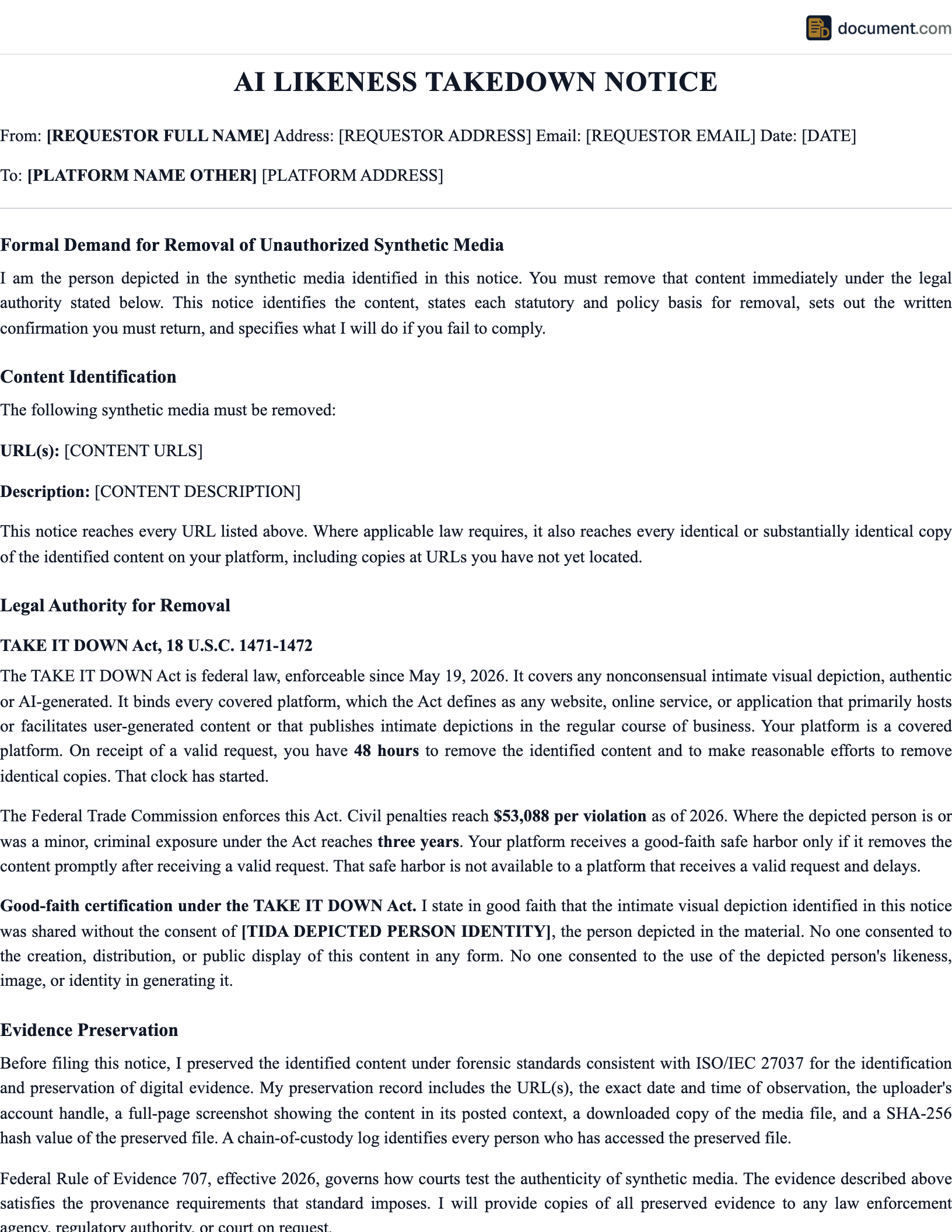
- •An AI likeness takedown notice is a written request sent to the platform hosting the synthetic media, not to the person who made it. The platform, not a court, does the removal.
- •Under the federal TAKE IT DOWN Act (18 U.S.C. 1471-1472), enforcement live since May 19, 2026, covered platforms must remove reported nonconsensual intimate imagery, real or AI-generated, within 48 hours of a valid request. The FTC can assess civil penalties of up to $53,088 per violation.
- •For deepfakes built on copyrighted footage you own, a DMCA notice under 17 U.S.C. 512(c)(3) requires expeditious removal, but the uploader can file a counter-notice and the content can return in 10 to 14 business days unless you sue.
- •Right-of-publicity laws cover voice and image even when no copyright exists. Tennessee's ELVIS Act protects simulated voice, California Civil Code 3344 (amended by AB 1836 and AB 2602) covers digital replicas, and Midler v. Ford established that sound-alikes can violate publicity rights.
- •Filing costs nothing and needs no lawyer. The risk is the perjury clause: a knowingly false DMCA statement exposes you to liability under 17 U.S.C. 512(f).
- •Preserve evidence before you file. Capture URLs, timestamps, full-page screenshots with metadata, and SHA-256 hashes of the file, because FRE 707 (2026) now governs how courts test deepfake authenticity.
Reviewed for accuracy by the document.com legal team. Educational information, not legal advice.
What Is AI Likeness Takedown Notice?
An AI likeness takedown notice is a written demand sent to the online platform hosting a synthetic depiction of you, asking it to remove that content under a specific legal authority. It is the fastest and cheapest tool for getting a deepfake, an AI voice clone, or a face-swapped video off the internet, because the platform handles removal directly rather than a court ordering it after months of litigation. You are not suing anyone when you send one. You are invoking a statutory or policy mechanism that the platform already has to honor to keep its own legal protections.
The notice draws its force from one of three sources, and which one you pick depends on the content. If the media is nonconsensual intimate imagery, the TAKE IT DOWN Act gives you a 48-hour federal removal right against covered platforms. If the deepfake reuses video, photos, or audio you hold the copyright to, the Digital Millennium Copyright Act's Section 512 notice-and-takedown system applies. If the content uses your name, face, or voice for commercial gain with no underlying copyright claim, a right-of-publicity demand under state law, sometimes paired with the platform's own synthetic-media policy, is the route. Many strong notices cite more than one of these at once.
Why This Matters Now
The legal ground shifted hard in the eighteen months before 2026. The TAKE IT DOWN Act was signed May 19, 2025 and its enforcement window opened exactly one year later, on May 19, 2026, so the 48-hour removal mandate is now live law and not a proposal. Tennessee's ELVIS Act took effect in 2024 as the first statute to expressly criminalize cloning a person's voice, and California's AB 1836 and AB 2602 brought digital-replica protections into Civil Code 3344 in January 2025. The federal NO FAKES Act, reintroduced in April 2025 with backing from SAG-AFTRA, Disney, Google, and OpenAI, would add a nationwide right of publicity with $5,000-per-violation statutory damages, though it has not passed.
Real disputes drove the urgency. When Scarlett Johansson said in May 2024 that OpenAI's Sky voice was eerily similar to hers after she had declined to license it, OpenAI pulled the voice without a lawsuit ever being filed. That outcome, a removal achieved through demand rather than judgment, is exactly what a takedown notice is built to produce. Meanwhile TikTok reported pulling 2.3 million videos under its synthetic-media rules in Q1 2026, a 180 percent jump over the prior year, and YouTube widened its likeness-detection tool to users over 18. The mechanisms exist. The hard part is filing a notice that platforms cannot lawfully ignore.
The Legal Backbone
TAKE IT DOWN Act, 18 U.S.C. 1471-1472 (federal, enforcement live May 19, 2026)
This is the strongest tool when the deepfake is sexual or intimate in nature. The Act covers nonconsensual intimate visual depictions whether they are authentic photos or AI-fabricated, and it reaches any covered platform, defined as a website, online service, or app that primarily hosts user-generated content or that publishes such depictions in the regular course of business. Once a covered platform receives a valid request, it has 48 hours to remove the content and to make reasonable efforts to remove identical copies. A valid request needs a physical or electronic signature, identification of the person depicted, the location of the media, a good-faith statement that the depiction is nonconsensual, and your contact information. The FTC enforces it, with civil penalties reaching $53,088 per violation as of 2026, and there is criminal exposure of up to two years for adult-victim cases and three years where a minor is involved. Platforms that remove in good faith get a safe harbor, which is precisely why they tend to act fast.
DMCA Section 512, 17 U.S.C. 512 (federal copyright safe harbor)
The Digital Millennium Copyright Act does not distinguish between human-made and AI-made content, so if a deepfake incorporates a copyrighted work you own, say it was trained on or stitched together from your original video, your notice triggers the same expeditious-removal duty as any infringement. Section 512(c)(3) requires that your notice identify the copyrighted work, point to the location of the infringing material, include a good-faith statement that the use is unauthorized, and carry a statement under penalty of perjury that you are authorized to act. The catch is the counter-notice. Under 512(g)(3) the uploader can swear the removal was a mistake, and the platform may restore the content in 10 to 14 business days unless you have filed a federal copyright suit. DMCA also breaks down where AI content is ephemeral or regenerated on the fly, because you cannot point to a fixed location. And section 512(f) penalizes knowingly false notices, so do not assert copyright over your mere face or voice, which copyright does not protect.
State right of publicity, including ELVIS Act and California Civil Code 3344
Right of publicity fills the gap copyright leaves: it protects your identity itself, the commercial value of your name, image, and increasingly your voice, without any copyrighted work needing to exist. Tennessee's ELVIS Act (Tenn. Code Ann. 47-25-801 et seq., 2024) was first to define voice as a protected sound that is readily identifiable and attributable to a person regardless of whether it contains the actual voice or a simulation, which squarely captures AI voice clones. California's Civil Code 3344, amended by AB 1836 and AB 2602 effective January 2025, lists voice among protected attributes, requires consent for commercial use, and now reaches unauthorized digital replicas of living and deceased performers. The Ninth Circuit's Midler v. Ford Motor Co., 849 F.2d 460 (9th Cir. 1988), established decades ago that imitating a performer's voice in an ad can violate publicity rights even when nothing is literally copied, the precedent that loomed over the Johansson dispute.
Platform synthetic-media policies (contractual, not statutory)
Even where no statute fits, the platform's own terms may. YouTube requires disclosure of realistic altered or synthetic content and runs a privacy-complaint and likeness-detection process that can force removal within 48 hours of a non-disclosed deceptive deepfake. TikTok operates a four-tier labeling and penalty system that flatly bans sexual deepfakes, deepfakes of minors, and election deepfakes inside the relevant window. X uses a harm-based standard, removing deceptively shared synthetic media likely to cause harm, though independent research shows its NCII removals can lag three weeks. Note the 2026 shift: starting July 2026, Meta will label rather than remove most manipulated media, removing only when other Community Standards are violated, so on Meta you often need a statute. The TAKE IT DOWN 48-hour duty still overrides its general policy for intimate imagery.
Evidence and authenticity rules (FRE 707 and forensic standards)
If the dispute escalates past the takedown, courts now apply Federal Rule of Evidence 707 (2026) to test the authenticity of challenged synthetic media, which makes provenance certificates and qualified forensic verification increasingly necessary. The forensic baseline tracks ISO/IEC 27037 for identifying and preserving digital evidence: keep bit-for-bit copies, record SHA-256 hash values at each handling stage, document a chain of custody for every person who touches the file, and preserve original metadata. NIST has directly evaluated deepfake-detection systems and flags their limits in robustness against laundering and generalization across new generation methods, so a qualified expert, not a consumer app, should authenticate media you intend to put before a court.
State Deepfake Laws by State
Where the content is a deepfake, state synthetic-media statutes add force to a takedown demand. The table below lists, for every state and DC, the primary intimate-deepfake and election-deepfake statutes a notice can cite alongside federal law.
| State | Intimate deepfake law | Election deepfake law |
|---|---|---|
| Alabama | Ala. Code § 13A-6-240 | Ala. Code § 17-5-16.1 |
| Alaska | None | None |
| Arizona | A.R.S. § 13-1425 | A.R.S. § 16-1024 |
| Arkansas | A.C.A. § 5-14-139 | None |
| California | Cal. Civ. Code § 1708.86 | Cal. Elec. Code § 20010 |
| Colorado | C.R.S. § 18-7-107, § 18-7-108 | C.R.S. § 1-46-103 |
| Connecticut | Conn. Gen. Stat. § 53a-189c | HB 5342 |
| Delaware | Del. Code Title 10 § 7802 et seq. | Del. Code Title 15 § 5145 |
| District of Columbia | D.C. Code § 22-3053 | None |
| Florida | Fla. Stat. § 836.13 | None |
| Georgia | O.C.G.A. § 16-11-90 | O.C.G.A. § 16-12-80 |
| Hawaii | HI SB1156 | None |
| Idaho | Idaho Code § 18-6606 | Idaho Code § 67-6628A |
| Illinois | 740 ILCS 190 | Election deepfake provisions integrated into omnibus... |
| Indiana | IC 35-45-4-8 | IC 3-9-8-5 |
| Iowa | Iowa Code 708.7 | No enacted law. Multiple bills proposed in 2026 |
| Kansas | KSA 21-5510 | None |
| Kentucky | KRS Chapter 411 | KRS 42.722, KRS 42.726 |
| Louisiana | La. R.S. 14:73.14 | None |
| Maine | Me. Rev. Stat. Ann. tit. 17-A, § 511-A | Me. Rev. Stat. Ann. tit. 21-A |
| Maryland | Md. Code, Crim. Law § 3-809 | Md. Code, Election Law |
| Massachusetts | Mass. Gen. Laws c. 265 § 43A | None |
| Michigan | MCL 752.383 | None |
| Minnesota | Minn. Stat. § 617.262 | Minn. Stat. § 609.771 |
| Mississippi | Miss. Code § 97-5-31 | Miss. Code § 97-13-47 |
| Missouri | None | None |
| Montana | MCA 45-8-331 | MCA Title 13 |
| Nebraska | Neb. Rev. Stat. § 28-311.08 | None |
| Nevada | NRS 200.780 | AB 73 (2025) - requires clear and conspicuous... |
| New Hampshire | RSA 644:9-a | None |
| New Jersey | N.J.S. 2C:21-17.8 | N.J.S. 2C:21-17.8 - covers false political advertising... |
| New Mexico | NOT ENACTED. Section 30-37A-1 NMSA 1978 covers only... | ENACTED: Section 1-19-26.4 NMSA 1978 |
| New York | Civil Rights Law §52-c | None |
| North Carolina | G.S. §14-190.5A | None |
| North Dakota | N.D.C.C. §12.1-27.1-01 | N.D.C.C. §16.1-10 |
| Ohio | Ohio Revised Code § 2917.211 | None |
| Oklahoma | 21 O.S. § 1040.13b | None |
| Oregon | ORS 163.472 | None |
| Pennsylvania | 18 Pa.C.S. § 3131 | HB 811 |
| Rhode Island | RI Gen. Laws § 11-64-3 | RI Gen. Laws § 17-30-1 |
| South Carolina | SC Code § 16-15-332 | SC Code § 7-25-230 |
| South Dakota | SB41 (signed March 18, 2026, effective July 1, 2026) -... | SDCL SB164 |
| Tennessee | Tenn. Code Ann. § 39-17-1901 | None |
| Texas | Tex. Penal Code § 21.165 | Tex. Elec. Code § 255.004 |
| Utah | Utah Code § 76-5b-205 | None |
| Vermont | 13 V.S.A. § 2606 | 17 V.S.A. Chapter 35, Subchapters 4 & 5 |
| Virginia | Va. Code § 18.2-386.2 | None |
| Washington | RCW 9A.60.045 | RCW 42.62 |
| West Virginia | West Virginia Code §61-8-28a | Not enacted. HB 4963 |
| Wisconsin | Wis. Stat. § 942.09 | Wis. Stat. § 11.1303 |
| Wyoming | Wyo. Stat. § 6-4-307 | None |
Compiled from primary state statutes and verified against legislative sources in 2026. "None" means no specific statute of that type was confirmed; right of publicity and federal law may still apply.
Which removal route fits your deepfake, and why the choice decides everything
Whether your notice works comes down to matching the content to the right legal hook, because each hook has different standing, different speed, and a different failure mode. Start with what the media actually is. If it is sexual or intimate, go straight to the TAKE IT DOWN Act: it gives you the cleanest standing as the depicted person, a hard 48-hour clock, and no requirement that you own any copyright. You do not need to prove the image is fake, only that it is intimate and nonconsensual. This is the rare situation where the law moves faster than the internet, and you should use it.
If the deepfake is not intimate but reuses footage or audio you created and own, the DMCA is your lever. It is powerful but conditional. A platform must act expeditiously to keep its safe harbor, yet the uploader holds a return ticket: a counter-notice under 512(g) can put the content back up in roughly two weeks unless you have actually filed suit. Many people are blindsided when a deepfake reappears, then learn the platform did everything the law required. So treat a DMCA notice as the opening move in a sequence, not a final fix, and decide before you file whether you are prepared to litigate if the uploader pushes back. Never stretch copyright over your face or voice alone, because that is the kind of knowingly false assertion 512(f) was written to punish.
When the content uses your identity but no copyrighted work of yours appears in it, a face-swap onto someone else's video or a synthetic ad reading in your cloned voice, copyright simply does not apply, and right of publicity is the answer. This is where state law and platform policy do the work together. A right-of-publicity demand has teeth because it can carry actual damages, statutory damages, and in some states criminal exposure, but platforms enforce it through their own complaint channels rather than a uniform federal procedure, so you lean on both the statute and the platform's synthetic-media terms in the same notice. The strongest packages cite every applicable basis at once, TAKE IT DOWN for the intimate element, DMCA for any copyrighted source, and right of publicity for the identity itself, then attach hashed, time-stamped evidence so the reviewer can act without guessing. Pair the platform notice with a cease-and-desist letter to the creator when you can identify them, since the takedown removes the content while the letter preserves the demand and pressures the source.
When You Need This
A sexually explicit deepfake or face-swap of you has been posted without consent: invoke the TAKE IT DOWN Act for 48-hour federal removal.
An AI voice clone of you is reading ads, narration, or statements you never recorded: assert right of publicity under your state's law, citing ELVIS Act or Civil Code 3344 logic.
A synthetic video stitched from footage you hold the copyright to is circulating: file a DMCA 512(c)(3) notice with the platform's designated agent.
Your face has been grafted onto someone else's body or video to misrepresent your endorsement or words: combine a right-of-publicity demand with the platform's synthetic-media policy.
You want the fastest, cheapest first move before deciding whether to sue: a takedown notice costs nothing and does not foreclose later litigation.
You need a paper trail showing you demanded removal before escalating: a filed notice plus a cease-and-desist letter documents your good-faith demand.
How to Fill Out AI Likeness Takedown Notice
1. Preserve evidence before you touch anything
Capture the full URL, the exact timestamp, the uploader's account handle, and a full-page screenshot showing the content in context. Download the media file itself, generate a SHA-256 hash of it, and save that hash with the date. Keep the original metadata intact. Do this first, because content can vanish the moment the uploader senses a complaint, and FRE 707 means a court will later test how the media was preserved.
2. Identify the platform and its correct intake channel
Determine exactly who hosts the content and which removal path applies. For DMCA, find the platform's designated agent, registered with the U.S. Copyright Office. For intimate imagery, locate the NCII or TAKE IT DOWN reporting link. For likeness misuse, use the privacy-complaint form (YouTube), the in-app report arrow (TikTok), or the synthetic-media report channel. Sending a notice to the wrong inbox is the most common reason removals stall.
3. Identify the depicted person and the exact content
State clearly that you are the person depicted, or that you act with authority for them, and pinpoint the content with its URL and a description specific enough that a reviewer finds it in seconds. If identical copies exist at other URLs, list every one, because the TAKE IT DOWN duty extends to identical copies and platforms remove what you specify.
4. State your legal basis explicitly
Name the authority you are invoking. Write that the depiction is nonconsensual intimate imagery under the TAKE IT DOWN Act, or that it infringes a copyrighted work you identify under 17 U.S.C. 512, or that it misappropriates your voice or likeness in violation of your state's right of publicity. Citing the specific ground tells the platform which obligation it is under and shortens its review.
5. Include the required good-faith statements
Add the certifications the law demands. For TAKE IT DOWN, a good-faith statement that the depiction is nonconsensual. For DMCA, a statement under penalty of perjury that the information is accurate and that you are authorized to act for the copyright owner. Get these exactly right: an inaccurate DMCA statement can expose you to liability under 512(f), so do not claim copyright over a mere face or voice.
6. Sign and provide contact information
Apply a physical or electronic signature and give a working email, name, and address. Unsigned or anonymous notices are routinely rejected as invalid. For DMCA specifically, your contact information is part of what makes the notice legally sufficient and also what the platform forwards to the uploader if a counter-notice follows.
7. Submit, log the confirmation, and calendar the deadline
File through the identified channel and save the confirmation number, the submission timestamp, and a copy of everything you sent. Calendar the 48-hour TAKE IT DOWN window or the expeditious DMCA window. If the deadline passes with no removal, that lapse is itself evidence, and the FTC can pursue penalties up to $53,088 per TAKE IT DOWN violation.
8. Plan for a counter-notice and escalation
If you filed under DMCA, expect a possible counter-notice that can restore the content in 10 to 14 business days unless you file a federal copyright suit. Decide in advance whether you will litigate. In parallel, consider a cease-and-desist letter to the identified creator and, where damages matter, a right-of-publicity claim, since the notice removes content but does not award you anything.
Key Terms Defined
- Deepfake
- AI-generated or AI-manipulated video, image, or audio that depicts a real person doing or saying something they did not, often by swapping a face or cloning a voice. Platforms increasingly require disclosure labels for realistic synthetic content.
- Digital replica
- Under the proposed NO FAKES Act, a newly created, computer-generated, highly realistic electronic representation readily identifiable as a specific person's voice or visual likeness, embodied in a recording, image, or audiovisual work. California's AB 1836 and AB 2602 use a similar concept in Civil Code 3344.
- Nonconsensual intimate imagery (NCII)
- Sexual or intimate visual depictions of a person shared without consent, authentic or AI-fabricated. The TAKE IT DOWN Act requires covered platforms to remove reported NCII within 48 hours and authorizes FTC enforcement.
- DMCA counter-notice
- A sworn response under 17 U.S.C. 512(g)(3) by which an uploader asserts that content was removed by mistake or misidentification. It can force the platform to restore the material in 10 to 14 business days unless the original complainant files a federal copyright lawsuit.
- Right of publicity
- A person's legal right to control commercial use of their name, image, and voice. It protects identity itself, so it reaches AI voice clones and likeness misuse even where no copyright exists. Midler v. Ford confirmed that imitations can violate it.
- Designated agent
- The contact a platform registers with the U.S. Copyright Office to receive DMCA notices. Sending a Section 512 notice to the designated agent rather than a general support inbox is what triggers the platform's takedown obligation.
Related Documents
AI Likeness Takedown Notice vs. Cease-and-Desist Letter
A takedown notice targets the platform and forces removal through a statutory or policy mechanism, often within 48 hours, free and without a court. A cease-and-desist letter targets the individual creator, is a common-law demand with no automatic enforcement, and needs a lawsuit to compel compliance, but it preserves evidence of your demand and strengthens later litigation. Use the takedown to get the content down fast; use the C&D to pressure the source and build a record. Sending both at once is often the right move.
AI Likeness Takedown Notice vs. DMCA Takedown Notice
A DMCA notice is one type of takedown notice, the copyright-based one, usable only when the deepfake reuses a work you own. A broader AI likeness takedown notice can instead invoke the TAKE IT DOWN Act (for intimate imagery, with no copyright needed) or state right of publicity (for voice and face misuse). DMCA's weakness is the counter-notice, which can restore content in 10 to 14 days; the TAKE IT DOWN route has no equivalent return ticket. Match the authority to the content rather than defaulting to DMCA.
AI Likeness Takedown Notice vs. Right of Publicity Lawsuit
A takedown notice removes content but awards you nothing, since no damages flow from the notice itself. A right-of-publicity lawsuit can win actual damages, statutory damages, and injunctions, and in some states criminal penalties apply, but it takes weeks to months and usually a lawyer. The takedown is the fast, free first move; the lawsuit is the remedy when you need compensation or when the content keeps reappearing. They work in sequence, not as substitutes.
Legal Authorities & Sources
This page is grounded in primary law. The statutes and official resources below are the authorities behind the guidance above. Verify the current text of any statute before relying on it.
- TAKE IT DOWN Act, Congress.gov CRS Legislative Summary (LSB11314)
- U.S. Copyright Office, DMCA Section 512 Resource
- Cornell Legal Information Institute, 17 U.S.C. 512 Full Text
- Congress.gov CRS, Federal Right of Publicity Proposals (LSB11052)
- ABA, OpenAI and Scarlett Johansson Right-of-Publicity Analysis
- Holon Law, 2026 Synthetic Media, Voice Cloning, and Right-of-Publicity Risk Map
- ProofSnap, FRE 707 (2026) Deepfake Evidence and Provenance Guide
Frequently Asked Questions
Create your AI Likeness Takedown Notice in minutes.
Answer a few questions and download a clear, attorney-drafted document that cites the controlling law and is ready to sign.