



Key Takeaways
- •A disclaimer is necessary but it will not shield you. In Mata v. Avianca, 678 F. Supp. 3d 443 (S.D.N.Y. 2023), the court sanctioned the lawyers $5,000 for filing six fabricated ChatGPT citations. No terms-of-service language saved them, because the duty to verify falls on the user and never on the tool.
- •Texas is one of the few states with a real statutory safe harbor. Texas Government Code Section 83.001 exempts legal software from unauthorized-practice rules only if it 'clearly and conspicuously' states the product is not a substitute for an attorney. Fine print does not count.
- •Public AI tools can blow up attorney-client privilege. In United States v. Heppner (S.D.N.Y. Feb. 17, 2026), a defendant's prompts to a consumer AI platform were ruled non-privileged and admissible because there was no lawyer in the loop and the terms allowed logging and disclosure.
- •Accuracy disclosures should be quantitative. The 2024 Stanford RegLab study found purpose-built legal research tools hallucinated on roughly 17 to 33 percent of queries, with GPT-4 at 43 percent. A disclaimer that warns of a real, measured error rate reads as candid, not boilerplate.
- •The FTC fined DoNotPay $193,000 in February 2025 for marketing a 'robot lawyer' it could not back up. The disclaimer and the marketing copy have to match. Overclaiming in ads while disclaiming in the footer is its own violation.
Reviewed for accuracy by the document.com legal team. Educational information, not legal advice.
What Is AI Legal Tool Disclaimer (UPL, Hallucination, and Privilege)?
An AI legal tool disclaimer is the notice that keeps software addressing UPL (unauthorized practice of law) on the right side of the line, telling users the product is not a lawyer, does not give legal advice, and does not create an attorney-client relationship. It is the legal-facing counterpart to the marketing copy: where the homepage sells speed and convenience, the disclaimer sets the boundaries that bar regulators, the FTC, and courts actually look for.
The document carries a lot of weight at once. It states that the provider is not a law firm and uses the disclaimer to satisfy state unauthorized-practice exemptions where they exist. It warns that AI output can be wrong in specific, measurable ways, and it pushes the duty to verify back onto the user. It also addresses confidentiality and privilege, because the moment a user types client facts into a tool whose terms permit logging and training, the protection most people assume they have may already be gone.
This disclaimer does a different job from the line at the bottom of a recipe blog. A general 'for informational purposes only' notice was written for a world where the risk was a reader following bad advice. The risk here is sharper. A user files an AI-drafted brief with fake cases and gets sanctioned, a provider gets investigated for practicing law without a license, or a client's privileged information ends up in a vendor's training set. The disclaimer has to speak to each of those failures by name.
A well-drafted version is also a product document, not just a legal one. It tells an honest user what the tool is good for and where it stops, which is exactly the line between LegalZoom (clear scope, survived) and DoNotPay (overclaimed, settled with the FTC).
Why This Matters Now
The case law caught up fast. Mata v. Avianca landed in June 2023 and turned 'AI hallucination' into a sanctions term of art almost overnight. By 2025 there were hundreds of documented cases of fabricated AI citations reaching courts, and judges in multiple districts had issued standing orders requiring lawyers to disclose and certify any AI use in filings.
Regulators moved from silence to detailed rules in under two years. The ABA issued Formal Opinion 512 on July 29, 2024, its first ethics guidance on generative AI, applying Model Rules 1.1, 1.4, 1.6, 3.3, 5.1, and 5.3 to the technology. California's COPRAC approved proposed enforceable rule amendments on March 13, 2026. Florida, Texas, North Carolina, Pennsylvania, and New York all issued opinions in the same window.
States are quietly opening doors that did not exist before. Colorado adopted a three-year non-prosecution policy for AI legal tools in September 2025, Minnesota approved the first state AI sandbox in July 2025, and Utah runs its tech-based legal services sandbox under Supreme Court Standing Order 15. Each of these comes with disclosure conditions a disclaimer has to satisfy to qualify.
Privilege law is now being tested directly. United States v. Heppner (February 2026) is the clearest signal yet that typing into a public AI tool can waive attorney-client privilege and work-product protection. The court even spelled out the path that would have preserved it, counsel-directed use under the Kovel doctrine, which means the disclaimer can and should tell users how to avoid the trap.
The FTC has shown it will treat overstated AI capability as a deceptive-practices problem regardless of any disclaimer. The DoNotPay settlement makes clear that the words in the footer do not cure the claims in the ad.
The Legal Backbone
ABA Model Rules and Formal Opinion 512
The ABA Model Rules are the template most state bars adopt, so they set the national baseline even though they are not law on their own. Four rules carry the weight here. Rule 1.1 (Competence) and its Comment 8 require a lawyer to keep abreast of 'the benefits and risks associated with relevant technology,' which the ABA reads to mean a lawyer using AI must independently review and verify its output. Rule 1.4 (Communication) requires telling clients about AI use when it presents a significant risk or materially affects the scope, cost, or manner of the work. Rule 1.6 (Confidentiality) extends the duty of confidentiality to anything fed into a third-party system. Rule 3.3 (Candor Toward the Tribunal) prohibits false statements to a court and is the rule lawyers violate when they file hallucinated cases. ABA Formal Opinion 512, issued July 29, 2024, ties these together and adds a point that belongs in every engagement letter discussion: boilerplate consent buried in an engagement letter is not enough to satisfy Rule 1.6 when confidential information goes to an AI vendor.
Texas Government Code Section 83.001 and Opinion 705
Texas gives legal software an actual statutory carve-out, which is rare. Section 83.001 defines unauthorized practice but excludes computer software and similar products from that definition, on one condition: the product must 'clearly and conspicuously' state that it is not a substitute for the advice of an attorney. Read that requirement literally. A grey six-point line at the bottom of a terms page is arguably neither clear nor conspicuous, and a Texas court applying the statute could find the exemption was never earned. The State Bar of Texas Professional Ethics Committee Opinion 705 (February 2025) reinforces the human-oversight side of the same coin, holding that a lawyer 'cannot blindly rely on AI outputs' and must check for fabricated citations. If you operate in Texas, the conspicuousness of the disclaimer is not a style choice. It is the element that makes the exemption apply.
Federal Rule of Civil Procedure 11 and Mata v. Avianca
Rule 11 lets a federal court sanction a lawyer who files papers without a reasonable inquiry into whether the claims and citations are warranted. Mata v. Avianca, Inc., 678 F. Supp. 3d 443 (S.D.N.Y. 2023), is the case that put teeth into Rule 11 for AI. Attorneys used ChatGPT to research a personal-injury matter, the tool invented six complete judicial opinions with fake judges, docket numbers, and reasoning, and the lawyers filed them. Judge P. Kevin Castel imposed a $5,000 sanction and found subjective bad faith, noting that the cover-up of the AI errors was worse than the original mistake. For disclaimer purposes, the opinion's doctrine is that the technology changed nothing: existing rules already governed this conduct, the AI did not create a new excuse, and the verification duty stayed entirely with the lawyer. That is why a credible disclaimer puts the verification obligation on the user in plain, specific terms rather than relying on a generic 'as is' clause.
Attorney-Client Privilege and United States v. Heppner
Privilege protects confidential communications between a client and a lawyer made for the purpose of obtaining legal advice. United States v. Heppner, No. 22-CR-6535 (S.D.N.Y. Feb. 17, 2026), held that prompts a criminal defendant fed into a public AI platform failed all three of the requirements. There was no attorney-client relationship, because the AI is not a lawyer. There was no reasonable expectation of confidentiality, because the platform's terms allowed logging, model training, and disclosure to third parties including regulators. And the documents were not prepared at counsel's direction for legal advice. The court added a roadmap to the opposite result: if counsel had directed the defendant to use the tool, it might have qualified as the lawyer's agent under the Kovel doctrine and stayed privileged. The disclaimer should disclose the data-retention reality and warn users not to enter privileged material unless they are doing so under counsel's direction with confidentiality terms in place.
FTC Authority and the DoNotPay Settlement
Section 5 of the FTC Act prohibits unfair or deceptive acts or practices, and the FTC applied it to legal AI in its Operation AI Comply sweep. In the DoNotPay matter (settled February 2025, roughly $193,000), the FTC alleged the company marketed a 'robot lawyer' that produced 'perfectly valid legal documents' without ever testing its output against the work of licensed attorneys and without employing lawyers to validate the legal features. The settlement requires DoNotPay to notify past subscribers of the service's limits and to stop unsubstantiated claims that the product works like a licensed attorney. The lesson for disclaimer drafting is that the disclaimer and the marketing cannot contradict each other. You cannot promise a 'robot lawyer' on the landing page and disclaim all legal capability in the footer. The FTC reads the whole net impression, and a buried disclaimer does not cure a headline claim.
What Belongs in the Disclaimer
Ten elements do the real work, and they map directly onto the failures regulators and courts have already punished. Skip one and you leave a specific, named gap that competitors have been called out for leaving open.
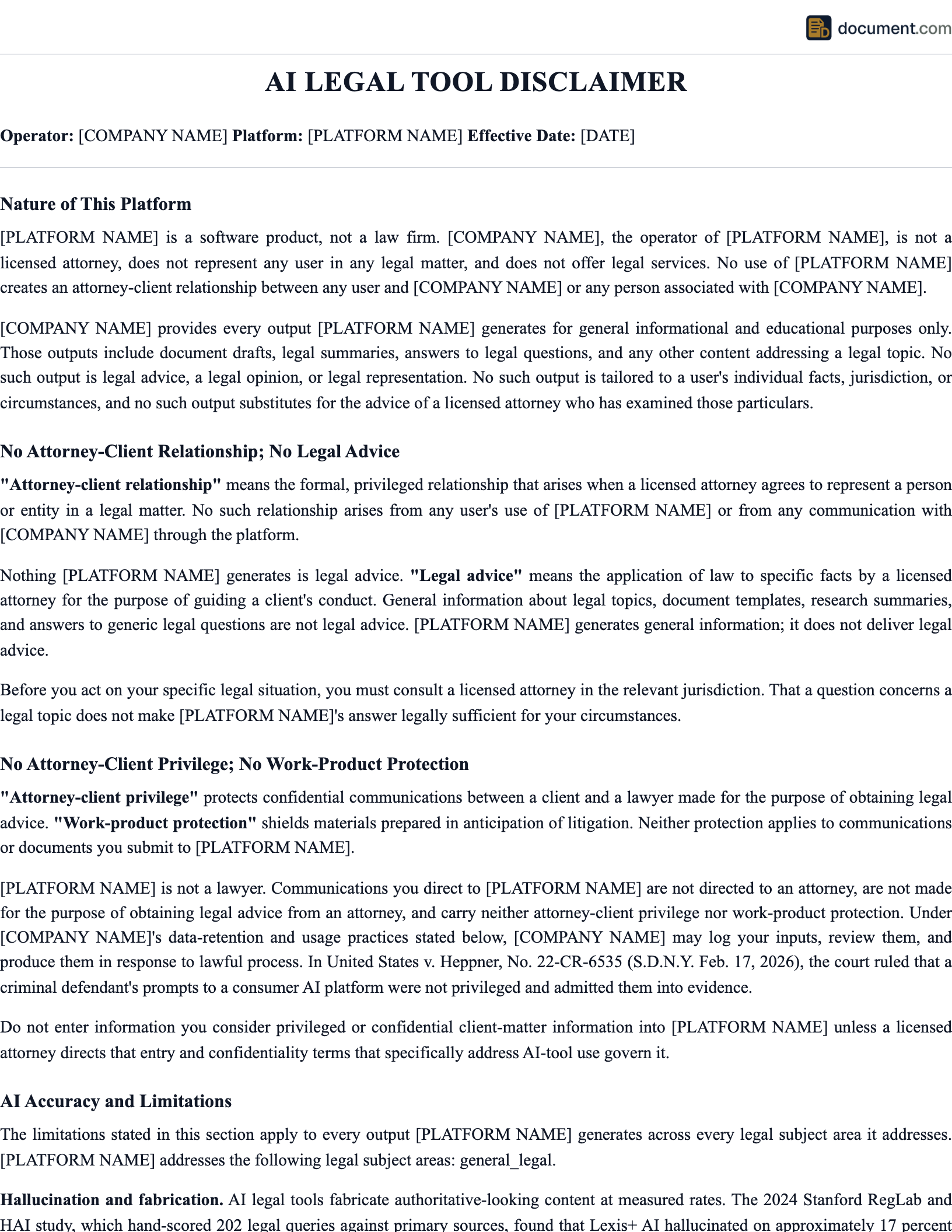
No attorney-client relationship and no privilege. State that the provider is not a law firm, is not operated by attorneys for the user's benefit, and that nothing the user types is protected by attorney-client privilege or the work-product doctrine. Heppner makes this element urgent. Paxton AI handles it well, telling users their communications are covered by the privacy policy but expressly not by privilege. Many tools omit it entirely, which leaves users with a false sense of security the disclaimer should be correcting.
No legal advice. Say the output is informational only and is not legal advice, a legal opinion, or legal strategy, and direct the user to a licensed attorney in their jurisdiction. Plain and unambiguous beats clever. LegalZoom's version goes further and lists what it does not do (it does not review answers for legal sufficiency, draw legal conclusions, or apply law to facts), and that specificity is part of why its language has held up.
A hallucination and accuracy disclosure with a real number. Do not write 'results may vary.' Tell users that AI models fabricate authoritative-looking but false content, and cite the measured rate: the 2024 Stanford study found 17 to 33 percent error rates on purpose-built legal tools and 43 percent on GPT-4. Then state plainly that the user is solely responsible for checking every citation, statute, and proposition against primary sources before relying on it.
A court-filing verification standard. If output might go to a court or agency, require the user to verify every authority, confirm each cited case and statute actually exists and says what the tool claims, disclose AI use to the tribunal where local rules require it, and accept full responsibility for the filing. Cite Mata v. Avianca by name. A user who reads this and ignores it has been warned in the exact terms a sanctions motion would use.
A privilege-waiver and data-retention disclosure. Tell users, in one place, what the provider does with their inputs: whether prompts are logged, used for training, or disclosed to third parties or regulators, and what the encryption and security posture is. Then warn that entering confidential or privileged client information may waive protection, and point users who need privilege toward counsel-directed use. This is where Heppner and Rule 1.6 meet.
A limitation of liability. Provide the output 'as is,' disclaim the implied warranties of merchantability and fitness, and cap or exclude indirect and consequential damages, with discontinuation of use as the exclusive remedy. Understand the ceiling: this clause does not survive gross negligence, fraud, or a regulatory violation, so it is a backstop, not a force field.
State-specific UPL language where it earns you something. In Texas, track Section 83.001 word for word and make the 'not a substitute for the advice of an attorney' statement genuinely conspicuous. In Colorado, name the lawyer or firm providing quality-assurance oversight to fit the non-prosecution policy's conditions. In a sandbox state like Minnesota or Utah, the disclaimer reflects whatever the program order requires. Generic national language leaves these exemptions on the table.
Disclosure of the AI model and its limits. Name the underlying model and training cutoff and warn that results are weaker for recent cases, niche jurisdictions, and emerging issues. Honesty here is cheap and it pairs with the accuracy disclosure to make the whole document read like it was written by someone who understands the technology.
A user acknowledgment. Close with an affirmative acknowledgment that the user has read the disclaimers, accepts the risks, will independently verify output, understands no attorney-client relationship exists, and will not treat the tool as a substitute for counsel. An acknowledgment the user actively accepts is worth far more than passive fine print, both legally and under the Texas conspicuousness standard.
When You Need This
You are building software that drafts, fills, reviews, or assembles legal documents, even from templates, and consumers will use it without a lawyer in the loop.
You run an AI legal research or case-summary tool and need to disclose hallucination risk and shift the verification duty to the user before they file anything.
You operate a chatbot or assistant that answers legal questions, where the line between general information and individualized legal advice is exactly the line UPL polices.
You are a law firm or solo practitioner deploying client-facing AI and you need the disclaimer plus the engagement-letter and confidentiality disclosures to line up with Rule 1.6 and Formal Opinion 512.
You want to qualify for a state safe harbor: the Texas Section 83.001 software exemption, the Colorado non-prosecution policy, or a Minnesota or Utah sandbox, each of which conditions protection on specific disclosure.
Your marketing makes capability claims about the product and you need the disclaimer to match the ads so you do not repeat the DoNotPay overclaiming problem under the FTC Act.
You handle anything a user might reasonably believe is confidential, and you need to disclose data retention and warn about privilege waiver before that belief turns into a Heppner-style surprise.
How to Fill Out AI Legal Tool Disclaimer (UPL, Hallucination, and Privilege)
1. Identify your states and pick your legal theory
List every state where users will access the tool and decide, per state, whether you are relying on a statutory exemption (Texas Section 83.001), a non-prosecution policy (Colorado), a sandbox (Minnesota, Utah), or simply the no-advice and no-relationship disclaimer alone. Your theory dictates the language. There is no single national disclaimer that earns every safe harbor, so this choice comes first.
2. Draft the no-relationship and no-advice core
Write the two foundational statements: the provider is not a law firm and forms no attorney-client relationship, and the output is not legal advice. Make them unconditional. Add the explicit privilege line from Heppner: communications are not protected by attorney-client privilege or the work-product doctrine. These sentences should sit near the top, not buried in clause fourteen.
3. Add the accuracy and hallucination disclosure with a number
State that AI fabricates plausible but false content and give the measured rate from the Stanford study (17 to 33 percent for legal tools, 43 percent for general models). Then write the verification obligation in the user's voice: 'You are solely responsible for verifying every citation, statute, and legal proposition against primary sources.' A real number signals candor and pairs with the verification duty to satisfy the spirit of Rule 3.3.
4. Write the court-filing verification standard
Add a dedicated paragraph for users who might file output with a court or agency. Require independent verification of each authority, confirmation that cited cases and statutes exist and say what is claimed, disclosure of AI use where local rules demand it, and acceptance of full responsibility. Cite Mata v. Avianca, Inc., 678 F. Supp. 3d 443 (S.D.N.Y. 2023) by name so the warning carries the weight of the actual sanctions case.
5. Disclose data retention and the privilege trap
In one consolidated paragraph, state exactly what happens to user inputs: logging, model training, third-party or regulator disclosure, and the encryption and security standard (for example AES-256 in transit and at rest, or SOC 2 compliance, if true). Warn that entering confidential or privileged material may waive protection, and tell users who need privilege to use the tool only under counsel's direction with confidentiality terms in place, the Kovel path Heppner identified.
6. Insert the limitation of liability and 'as is' language
Provide the service 'as is,' disclaim implied warranties of merchantability and fitness for a particular purpose, exclude indirect and consequential damages, and make discontinuation of use the exclusive remedy. Note internally that this clause will not survive a gross-negligence or fraud finding, so treat it as a backstop and do not let it tempt you into weaker disclosures elsewhere.
7. Layer in your state-specific and model-specific language
Drop in the exact statutory text for each state where you claim an exemption. For Texas, mirror Section 83.001 and make the 'not a substitute for the advice of an attorney' statement visually conspicuous: separate block, adequate size, near the point of use. For Colorado, name the supervising lawyer or firm. Add the model name, training cutoff, and a note that recent or obscure matters are less reliable.
8. Make acceptance affirmative and confirm current law
Convert the passive footer into an active acknowledgment the user must accept (a checkbox or click-through) confirming they have read and accept the disclaimers and the verification duty. Then have a licensed attorney in each operating state confirm the language against current rules before launch. The 2024 to 2026 window saw new opinions almost monthly, so verify that nothing has shifted since this page was written. None of this is legal advice for your specific product.
Key Terms Defined
- Unauthorized Practice of Law (UPL)
- Providing legal services, advice, or representation without a law license. State UPL statutes are what make a legal AI tool's no-advice and no-relationship language necessary, and what a few states (Texas) carve software out of by statute if the right disclaimer appears.
- Hallucination
- AI output that is fabricated yet presented as authoritative: invented cases, fake citations, misstated holdings. Mata v. Avianca involved six hallucinated opinions, and the 2024 Stanford study measured hallucination rates of 17 to 43 percent across leading legal tools.
- Attorney-Client Privilege
- The protection that keeps confidential lawyer-client communications made for legal advice out of evidence. Heppner held that prompts to a public AI tool fail the test, because the AI is not a lawyer, the terms permit disclosure, and there is no counsel direction.
- Work-Product Doctrine
- A protection for materials prepared in anticipation of litigation. Like privilege, it can be waived by feeding the material into a system whose terms allow logging, training, or third-party disclosure, which is why disclaimers address both together.
- Kovel Doctrine
- The rule that extends privilege to a third party (originally an accountant) acting as the lawyer's agent to help deliver legal advice. Heppner suggested an AI tool used under counsel's direction might qualify, which is the path a disclaimer can point users toward.
- Clear and Conspicuous
- A legal standard for notices that must actually be noticed: prominent, readable, and placed where the user will see it. Texas Government Code Section 83.001 conditions its software UPL exemption on a 'clearly and conspicuously' stated disclaimer, so fine print can forfeit the protection.
Related Documents
AI Legal Tool Disclaimer vs. a General Website Disclaimer
A general website disclaimer says 'for informational purposes only' and was built for low-stakes content. An AI legal tool disclaimer has to address named risks the general version never contemplates: UPL exemptions by state, the hallucination error rate, the user's duty to verify before filing, and privilege waiver. Using a general disclaimer for legal software leaves every one of those gaps open.
AI Legal Tool Disclaimer vs. an Engagement Letter
An engagement letter forms the attorney-client relationship and sets the terms of representation; the disclaimer does the opposite, stating that no such relationship exists. They serve different functions, and a law firm deploying client-facing AI usually needs both: the disclaimer for the tool itself, and engagement-letter language disclosing AI use and obtaining Rule 1.6 informed consent. Formal Opinion 512 warns that boilerplate consent in the engagement letter alone is insufficient.
AI Legal Tool Disclaimer vs. a Privacy Policy
The privacy policy explains how user data is collected, stored, and shared in general. The disclaimer references those practices for a narrower purpose: warning that data retention and third-party disclosure can waive privilege. The disclaimer should link to the privacy policy rather than duplicate it, and the two must not contradict each other on retention and training, because a court in a Heppner-style dispute will read both.
AI Legal Tool Disclaimer vs. Terms of Service
Terms of service govern the whole contractual relationship: payment, acceptable use, termination, dispute resolution. The disclaimer is the legal-capability and risk subset, and it usually appears both inside the terms and as a standalone, conspicuous notice at the point of use. In Texas, the conspicuous standalone placement is what earns the Section 83.001 exemption; burying the same words deep in the terms can forfeit it.
Legal Authorities & Sources
This page is grounded in primary law. The statutes and official resources below are the authorities behind the guidance above. Verify the current text of any statute before relying on it.
- ABA Formal Opinion 512: Generative Artificial Intelligence Tools (July 29, 2024)
- Mata v. Avianca, Inc., 678 F. Supp. 3d 443 (S.D.N.Y. 2023) (FindLaw)
- United States v. Heppner (Harvard Law Review case comment, 2026)
- State Bar of Texas Professional Ethics Committee, Opinion 705 (Feb. 2025)
- Colorado OARC AI Non-Prosecution Policy (Sept. 2025)
- Florida Bar Opinion 24-1 (Jan. 19, 2024)
- Stanford RegLab: Hallucination-Free? Assessing the Reliability of Leading AI Legal Research Tools (2024)
- National Center for State Courts: Modernizing UPL Regulations White Paper (Aug. 2025)
Frequently Asked Questions
Create your AI Legal Tool Disclaimer (UPL, Hallucination, and Privilege) in minutes.
Answer a few questions and download a clear, attorney-drafted document that cites the controlling law and is ready to sign.