



Key Takeaways
- •The FTC's revised Endorsement Guides (16 CFR Part 255), effective July 26, 2023, expanded the definition of "endorser" to cover parties that only appear to be people. That language reaches virtual influencers, AI-generated personas, and bots.
- •When the endorser is AI-generated, you generally need two disclosures: the material-connection disclosure (this is paid or sponsored) and a synthetic-identity disclosure (this persona is AI-generated). The synthetic-identity requirement does not appear verbatim in the CFR text; it follows from applying the existing clear-and-conspicuous standard to synthetic media.
- •Disclosures must be clear and conspicuous, meaning hard to miss and easy to understand. A buried #ad among fifteen hashtags, an end-credit caption, or text-only language on a video no longer satisfies the standard.
- •The Consumer Review Rule (16 CFR Part 465), effective October 21, 2024, flatly bans fake reviews and testimonials whether written by a human or generated by AI. Civil penalties run up to roughly $53,088 per violation for 2026.
- •State law is layering on fast. New York's synthetic-performer disclosure law takes effect June 9, 2026; Tennessee's ELVIS Act and California's SB 942 add voice-cloning and provenance rules. A page that complies federally can still violate state law.
- •Both the brand and the influencer can be held liable. The FTC has extracted settlements from Fashion Nova, Kim Kardashian, Google/iHeartMedia, and Teami for disclosure failures.
- •This page is general information, not legal advice. Confirm the current text of each rule and any new state law before you publish a campaign.
Reviewed for accuracy by the document.com legal team. Educational information, not legal advice.
What Is AI Influencer FTC Endorsement Disclosure?
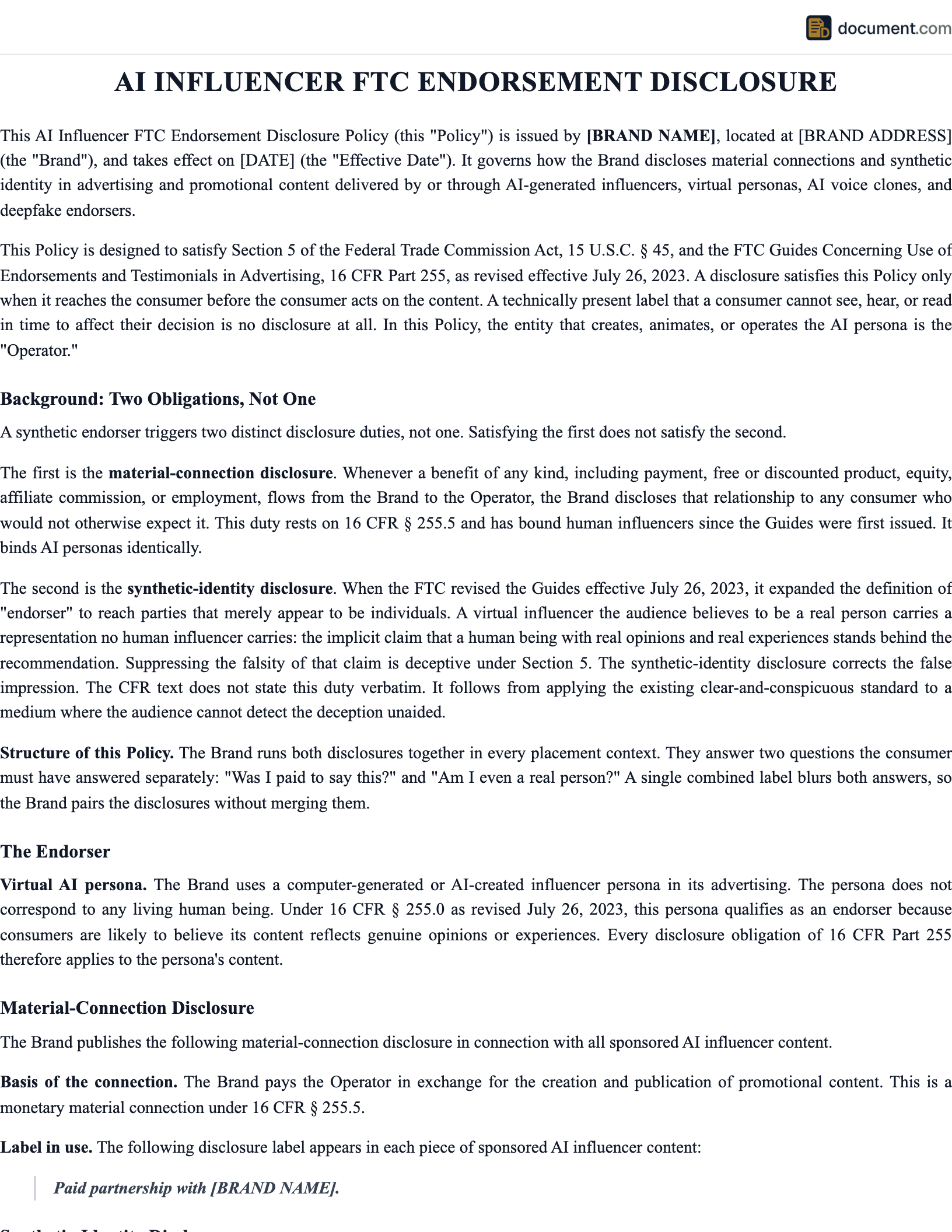
An AI influencer FTC endorsement disclosure is a clear, conspicuous statement that tells consumers two things about a synthetic endorser: that a paid or material relationship exists between the brand and the endorser, and that the endorser itself is AI-generated rather than a real human. It sits at the intersection of two federal rules and a growing stack of state statutes, and it exists because consumers weigh a recommendation differently once they know it was bought, and weigh it differently again once they learn the face or voice delivering it was never a person.
The federal anchor is the FTC's Guides Concerning Use of Endorsements and Testimonials in Advertising, codified at 16 CFR Part 255 and last comprehensively revised effective July 26, 2023. The Guides are not a statute passed by Congress. They are the Commission's interpretation of Section 5 of the FTC Act, which prohibits unfair or deceptive acts in commerce. Violating the spirit of the Guides is evidence that an ad is deceptive, and the FTC can pursue an enforcement action on that basis.
What changed in 2023 matters for anyone using synthetic media. The revised definition of "endorser" now reaches a party that "appears to be" an individual, group, or institution. In plain terms, the Commission closed the argument that a virtual influencer is not a real person so the rules do not apply. They apply. A computer-generated Instagram persona promoting a serum carries the same disclosure burden as a human creator, and arguably a heavier one, because the audience may not even realize a person is absent.
A disclosure of this kind typically lives inside the ad creative itself: on-screen text in the opening seconds of a video, a spoken line in audio, or the first line of a caption above the "more" fold. A consumer does not sign it the way they sign a contract. The paperwork that sits behind it, the influencer agreement and the likeness authorization, is where you allocate who writes the disclosure and who pays if it is missing.
Why This Matters Now
The rules are new and the enforcement is active. The Endorsement Guides revision took effect in mid-2023, the Consumer Review Rule in October 2024, and the FTC has not been quiet since. In December 2025 the Commission sent warning letters to ten companies over fake and AI-generated reviews, undisclosed incentives, unlabeled insider testimonials, and active suppression of negative feedback. That campaign cites 16 CFR Part 465 directly.
AI-generated endorsers moved from novelty to default. Brands now spin up virtual influencers and clone voices because it is cheap and controllable. The FTC's September 2024 Operation AI Comply brought five enforcement actions against operations that used AI hype or sold AI tools enabling deceptive conduct, a signal that the Commission is watching the supply side as well as the advertiser.
Penalties scale per violation, and a campaign is thousands of impressions. The Consumer Review Rule carries a civil penalty cap of roughly $53,088 per violation for 2026. Courts and the FTC have treated each deceptive review or post as a separate violation in some contexts, so the arithmetic on a viral undisclosed campaign gets ugly fast.
State law arrives on a clock. New York's synthetic-performer disclosure requirement, signed December 11, 2025, takes effect June 9, 2026. Tennessee's ELVIS Act has been live since July 1, 2024, with criminal exposure for unauthorized voice cloning. California's SB 942 provenance and disclosure obligations phase in through 2026. A federally clean disclosure can still draw a state penalty.
Brands cannot hide behind the creator anymore. The FTC has settled with Fashion Nova ($10,000 for failing to ensure influencers disclosed paid partnerships), Kim Kardashian ($1.26 million), Google and iHeartMedia ($9.4 million), and Teami ($930,000). Liability runs to the advertiser who hired the endorser, not just the endorser who posted.
The Legal Backbone
FTC Endorsement Guides, 16 CFR Part 255 (revised effective July 26, 2023)
These Guides are the core federal authority. Section 255.0 defines an "endorsement" as any advertising or promotional message consumers are likely to believe reflects the opinions, beliefs, findings, or experiences of a party other than the sponsoring advertiser, including social media tags, demonstrations, and depictions of a person's name, signature, or likeness. The 2023 revision expanded "endorser" to include parties that merely appear to be individuals, groups, or institutions, which is the hook that pulls virtual influencers and AI personas into scope. The Guides also tightened the clear-and-conspicuous standard: a disclosure must be difficult to miss and easily understood by ordinary consumers, and it must match the medium, visual for video and audible for audio. These are interpretive guides rather than a standalone statute, but the FTC enforces them through Section 5 of the FTC Act.
Section 5 of the FTC Act, 15 U.S.C. § 45
The statute that gives the Guides their teeth. Section 5 prohibits unfair or deceptive acts or practices in or affecting commerce. An undisclosed material connection, or a failure to reveal that an endorser is synthetic, can render an ad deceptive under Section 5. The FTC's enforcement posture treats a failure to disclose the synthetic nature of a persona as per se deceptive. This is the provision under which the Commission brings most influencer cases.
FTC Consumer Review Rule, 16 CFR Part 465 (effective October 21, 2024)
A separate trade regulation rule, and unlike the Guides it carries civil penalties on its own terms. Part 465 prohibits creating, buying, selling, or disseminating fake or false consumer reviews and testimonials, and it says expressly that this applies whether the content was generated by a human or by AI. It also bars buying positive or negative reviews, insider reviews without clear disclosure, and the suppression of honest negative reviews. Penalties reach roughly $53,088 per violation for 2026. If your AI influencer is posting reviews or testimonials rather than open promotion, this rule is in play alongside the Endorsement Guides.
New York synthetic-performer disclosure law, N.Y. Gen. Bus. Law § 396-b as amended (effective June 9, 2026)
Signed December 11, 2025, this amendment requires a conspicuous disclosure when a "synthetic performer" appears in a commercial advertisement and the advertiser has actual knowledge of its use. A synthetic performer is a digital asset created or modified by generative AI or software that gives the impression of a human performance when no actual identifiable person is recognizable. First violation is $1,000, subsequent violations $5,000 each. Audio-only ads, pure language translation, and expressive works such as film and video games are exempt.
Tennessee ELVIS Act, Tenn. Code Ann. § 47-25-2101 et seq. (effective July 1, 2024)
The Ensuring Likeness, Voice and Image Security Act targets unauthorized AI voice cloning and likeness replication. It defines "voice" broadly to include any sound readily identifiable to a particular individual, real or simulated. Beyond a civil right of action, it adds criminal exposure: a Class A misdemeanor carrying up to 11 months and 29 days in jail plus a $2,500 fine. Liability can extend to the developers of AI tools whose primary purpose is creating unauthorized voice or likeness replicas, not just the advertiser using them.
California AI Transparency Act, SB 942 (effective January 1, 2026, with compliance deadlines extended into 2026 by AB 853)
Requires covered generative AI providers to offer manifest disclosure in AI-generated image, video, and audio content, meaning a disclosure clear and conspicuous to an ordinary person, plus latent disclosure carrying provenance metadata. The framework reaches commercial advertising that uses AI-generated digital actors and contemplates contracts specifying AI use of a performer's voice or likeness. October 2025 amendments under AB 853 pushed certain compliance deadlines to August 2, 2026, so confirm the operative date before relying on it.
What a compliant AI influencer disclosure actually contains
A disclosure for a synthetic endorser must do honest work the moment a consumer sees the ad. It needs to tell them the recommendation is paid and that the recommender is not a real person. These are distinct truths, and the FTC's clear-and-conspicuous standard means neither can be hidden where a normal viewer would skip past it.
Start with the material-connection disclosure. A material connection is any relationship between the endorser and the advertiser that could affect how much weight an ordinary consumer gives the endorsement. Cash payment is the obvious one. So are free products, an equity stake, an affiliate commission, employment, a business partnership, or even a complimentary sample sent in the hope of a post. If money or value changed hands, or the endorser is an employee or owner, you disclose it. Simple labels work better than clever ones: "Paid partnership," "Sponsored," "Ad," or a plain sentence like "BrandX paid for this post." The Commission has been blunt that a lone #ad buried in a hashtag pile, an abbreviated tag, or a disclosure that only appears after a "more" click does not cut it.
Now the part unique to synthetic endorsers: the AI-identity disclosure. When the influencer is a virtual persona or an AI-generated voice or face, the audience cannot infer the obvious fact that no human stands behind the opinion. So you state it. Language such as "This influencer is AI-generated" or "Synthetic voice" or "AI-created persona" placed where the persona appears. This requirement is not written verbatim into 16 CFR Part 255. It is the logical output of applying the existing clear-and-conspicuous rule to a situation the consumer would otherwise misread. The FTC's position is that concealing the synthetic nature of an endorser is itself deceptive under Section 5. An ad that carries only the sponsorship label still deceives on identity, so run the two disclosures together, the pairing often called the double-disclosure expectation for AI content.
A disclosure in the wrong spot fails the clear-and-conspicuous standard the same way a missing one does, so get placement exactly right. The governing idea is that the disclosure lives in the same location and format as the endorsement. For video, that means on-screen text in roughly the first three to five seconds, persistent and readable, not tucked into end credits or the description box, and not relying on auto-captions that fast-scrollers never see. For audio, it must be spoken aloud; a written line on a podcast cover does nothing, and an AI voice clone needs an explicit spoken statement that the voice is synthetic. For a social post, the disclosure belongs in the opening line of the caption, above the fold, before any expansion element. The FTC has gone so far as to say that if a platform's format prevents adequate disclosure, that channel should be disqualified from the campaign rather than used with a deficient label.
Consider a concrete example. A skincare brand licenses a fully computer-generated influencer named in-house, pays a studio to animate her, and runs a fifteen-second TikTok where she praises a moisturizer. A compliant approach opens with on-screen text reading "Paid promotion · AI-generated influencer" held for the first five seconds, repeated or kept persistent, with the caption leading "Paid partnership with BrandX. This influencer is AI-generated." Two truths, both in the medium the consumer is consuming, neither buried. Contrast that with the common failure: a single #BrandXpartner as the ninth hashtag and no mention anywhere that the influencer is synthetic. The first version is defensible. The second is a deceptive ad and, after June 9, 2026, a New York statutory violation for any advertiser with actual knowledge.
Brands also trip over a separate body of law. If your synthetic endorser is voicing or showing a recognizable real person, you have left endorsement law and walked into right-of-publicity and likeness territory. Cloning a celebrity's voice for a supplement ad without consent is its own violation, and in Tennessee it is a crime under the ELVIS Act regardless of how clearly you disclose that the voice is AI. Disclosure cures the deception problem. It does nothing for the consent problem. Those are different claims, and you can lose on both at once.
When You Need This
A virtual or AI-generated influencer promotes your product or service on any platform, whether the persona is fully synthetic or a CGI character with a fictional backstory.
You use an AI voice clone or deepfake face to deliver a testimonial, demonstration, or recommendation, including synthetic versions of a spokesperson you do control.
You pay, gift, or otherwise give value to a creator, real or synthetic, in exchange for content that reads as their genuine opinion. The material-connection disclosure is required even with no AI involved.
An employee, founder, agency, or anyone with a financial stake posts a review or endorsement of your offering. Insider endorsements without clear labeling are flagged under both the Endorsement Guides and the Consumer Review Rule.
You generate, buy, or distribute reviews or testimonials that did not come from a genuine, qualified user. AI-written fake reviews are banned outright under 16 CFR Part 465, disclosure or not.
You run a campaign that reaches New York consumers on or after June 9, 2026 and know a synthetic performer appears in it, or you operate where Tennessee or California AI-media rules apply.
You are drafting an influencer agreement or likeness authorization and need to allocate, in writing, who is responsible for inserting the disclosure and who indemnifies whom if it is missing.
How to Fill Out AI Influencer FTC Endorsement Disclosure
1. Classify the endorser and the relationship
Start by identifying two things: whether the endorser is a real human, a virtual or AI-generated persona, or a synthetic clone of a real person; and what value flows from you to them (cash, product, equity, commission, employment). The first determines whether you need the AI-identity disclosure on top of the material-connection disclosure. The second establishes whether a material connection exists at all. If value flows and the endorsement reads as genuine opinion, you are disclosing.
2. Draft the material-connection line in plain words
Use a label an ordinary consumer instantly understands. "Paid partnership," "Sponsored," "Ad," or a full sentence such as "BrandX paid me to post this." Avoid abbreviations, invented hashtags, and anything that requires the reader to already know your brand codes. If the connection is an affiliate commission or free product rather than cash, say that plainly too.
3. Add the synthetic-identity line for AI endorsers
If the endorser is AI-generated, write a second, separate statement: "This influencer is AI-generated," "Synthetic voice," or equivalent. Keep it in language a casual viewer grasps without effort. Do not merge it into the sponsorship label in a way that blurs either point. The two disclosures are doing two different jobs and the consumer needs both.
4. Match the disclosure to the medium
For video, set the disclosure as on-screen text in the opening three to five seconds, persistent and large enough to read on a phone, not in end credits or the description. For audio, script it as a spoken line; an AI voice must spell out that it is synthetic. For a still image or text post, place it in the first line of the caption, above the fold. Never rely on auto-captions or a label that only appears after a tap.
5. Check placement against the platform, then drop the platform if it cannot carry the disclosure
Open the actual post on the actual device a consumer uses. Confirm the disclosure is visible before any "more" expansion, not obscured by the platform's own UI, and present in every format you publish (feed, story, short-form, ad unit). The FTC's stated view is that if a channel structurally prevents an adequate disclosure, you should not advertise on that channel. Treat that as a real constraint, not a suggestion.
6. Layer in state-law requirements for your audience
Identify where the campaign will be seen. For New York reach on or after June 9, 2026, confirm the synthetic-performer disclosure is conspicuous and that you have addressed the actual-knowledge trigger. For voice or likeness clones, run the Tennessee ELVIS Act and California SB 942 analysis, including whether you needed consent and provenance metadata. A federally adequate disclosure does not satisfy these independently.
7. Confirm any reviews or testimonials are genuine and lawful
If the synthetic endorser is posting reviews or testimonials rather than open promotion, verify under 16 CFR Part 465 that the content is not fabricated, AI-invented, bought, or an unlabeled insider review, and that you are not suppressing honest negative feedback. Fake reviews are prohibited outright; no disclosure rescues them.
8. Paper the responsibility in your contract and keep records
In the influencer agreement and any likeness authorization, specify who writes and places the disclosure, who approves the final creative, who indemnifies for a missing or deficient disclosure, and what consent exists for any real person's voice or likeness. Keep screenshots of the published creative showing the disclosure as it actually appeared. When the FTC or a state AG asks, contemporaneous records are your defense. Have counsel review the program before launch; this checklist is general information, not legal advice.
Key Terms Defined
- Endorsement
- Under 16 CFR § 255.0, any advertising, marketing, or promotional message that consumers are likely to believe reflects the opinions, beliefs, findings, or experiences of a party other than the sponsoring advertiser. It covers verbal statements, social media tags, demonstrations, and depictions of a person's name, signature, or likeness, which sweeps in nearly every influencer post.
- Material connection
- Any relationship between an endorser and an advertiser that could affect the credibility or weight an ordinary consumer gives the endorsement. Examples include payment, free products, equity stakes, affiliate commissions, employment, and complimentary samples. Its existence is what triggers the duty to disclose, and it applies to virtual and AI endorsers exactly as it does to humans.
- Clear and conspicuous
- The FTC standard for a valid disclosure: difficult to miss (easily noticeable) and easily understood by ordinary consumers, presented in a format that matches the medium. Visual for video, audible for audio. A disclosure that is technically present but buried, abbreviated, or hidden behind a click does not meet the standard.
- Virtual influencer
- A computer-generated persona, often with a fabricated name, face, and backstory, used to promote products as if it were a human creator. After the 2023 Endorsement Guides revision expanded "endorser" to parties that appear to be individuals, virtual influencers carry full disclosure obligations plus the added duty to reveal they are AI-generated.
- Synthetic performer
- Under New York's law effective June 9, 2026, a digital asset created, reproduced, or modified by computer using generative AI or software that gives the impression of a human performance when no actual identifiable natural person is recognizable. Commercial ads featuring one require a conspicuous disclosure where the advertiser has actual knowledge.
- Double disclosure
- The practical expectation, derived from applying the clear-and-conspicuous standard to AI media, that a synthetic endorser carries two separate disclosures: the material-connection disclosure (paid or sponsored) and the AI-identity disclosure (this persona is AI-generated). It is not verbatim CFR text; it follows from the FTC's deception analysis under Section 5.
Related Documents
Material-connection disclosure vs. AI-identity disclosure
The material-connection disclosure answers "who paid for this?" It is required whenever value flows to the endorser, human or synthetic, and rests squarely in 16 CFR Part 255. The AI-identity disclosure answers "is this a real person?" It is required only when the endorser is synthetic, and it derives from the deception analysis under Section 5 plus emerging state law. For an AI influencer you need both, placed together but stated separately, because a consumer who learns the post is sponsored may still wrongly assume a human is speaking.
FTC Endorsement Guides vs. Consumer Review Rule
The Endorsement Guides (16 CFR Part 255) are interpretive and govern endorsements, influencer posts, and testimonials, enforced through Section 5 of the FTC Act. The Consumer Review Rule (16 CFR Part 465) is a binding trade regulation rule that bans fake reviews outright and carries its own civil penalties, up to roughly $53,088 per violation for 2026. If your synthetic endorser is openly recommending a product, the Guides lead. If it is posting something framed as a customer review, Part 465 also applies, and fabricated AI reviews are prohibited no matter how they are labeled.
Federal disclosure vs. state synthetic-media law
Federal rules focus on deception: was the consumer misled about payment or about whether a human endorsed the product. State laws like New York's synthetic-performer statute, Tennessee's ELVIS Act, and California's SB 942 add their own triggers, including conspicuous synthetic-performer labels, criminal liability for unauthorized voice cloning, and provenance metadata. The state regimes can apply even where the federal disclosure is adequate, and some reach the AI tool developer, not just the advertiser. Comply with the federal floor, then layer each relevant state requirement on top.
Disclosure vs. consent for a cloned real person
A disclosure is about honesty toward the audience. Consent is about authority over the individual whose voice or likeness you replicated. If your AI endorser clones a real celebrity or employee, disclosing "this voice is synthetic" satisfies the FTC's deception concern but does nothing for the right-of-publicity or ELVIS Act consent requirement. You need a signed likeness or voice authorization in addition to the disclosure. They are independent, and a campaign can fail the consent test while passing the disclosure test.
Legal Authorities & Sources
This page is grounded in primary law. The statutes and official resources below are the authorities behind the guidance above. Verify the current text of any statute before relying on it.
- eCFR, 16 CFR Part 255 (FTC Endorsement Guides, full text)
- Cornell Law, 16 CFR § 255.0 (definitions, including endorser and clear and conspicuous)
- Federal Register, 2023 Endorsement Guides revision (effective July 26, 2023)
- Federal Register, 16 CFR Part 465 Consumer Review Rule (effective October 21, 2024)
- FTC press release, December 2025 warning letters on the Consumer Review Rule
- FTC, Endorsements, Influencers, and Reviews (business guidance)
- FTC, Disclosures 101 for Social Media Influencers
- Cooley, New York synthetic-performer disclosure law (effective June 9, 2026)
- California SB 942, AI Transparency Act (bill text)
Frequently Asked Questions
Create your AI Influencer FTC Endorsement Disclosure in minutes.
Answer a few questions and download a clear, attorney-drafted document that cites the controlling law and is ready to sign.