



Key Takeaways
- •A disclaimer manages user expectations and limits liability, but it cannot strip away fiduciary duty. Once your AI gives personalized investment advice for compensation, Section 206 of the Investment Advisers Act applies no matter what your terms of service say.
- •The SEC has already brought enforcement actions over AI claims. In March 2024 it fined Delphia $225,000 and Global Predictions $175,000 for overstating what their AI actually did. Do not claim a capability you cannot prove.
- •A strong disclaimer tells users the output is general information rather than tailored advice, and it warns that the AI can misstate or invent facts and may be working from stale data, so output needs independent verification.
- •Registered investment advisers and broker-dealers cannot use a disclaimer to opt out of their conduct standards. Their disclaimer should clarify the limits of the AI tool inside the regulated framework that already governs them.
- •Free educational tools and non-registered platforms have more room. A clear, prominent, plain-English disclaimer that the content is not investment advice is the core protection, paired with a prompt to consult a licensed professional.
Reviewed for accuracy by the document.com legal team. Educational information, not legal advice.
What Is AI Financial Advice Disclaimer?
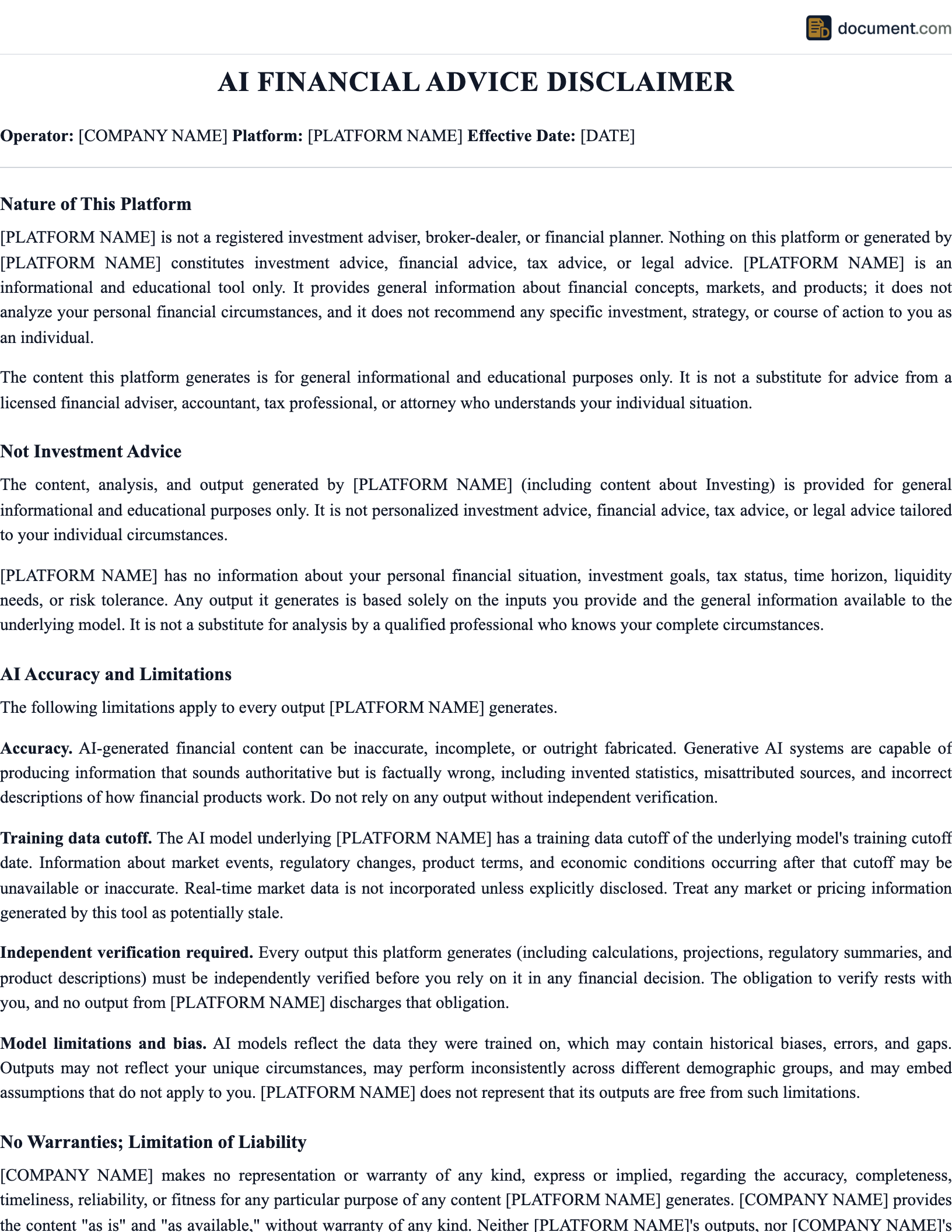
An AI financial advice disclaimer is a written notice that tells users your artificial intelligence tool provides general information and education, not personalized investment, tax, or financial advice tailored to their situation.
It usually sits at the bottom of a chatbot window, on a calculator results screen, inside an app's terms, or as a banner above AI-generated market commentary. Wherever the AI output lives, the disclaimer travels with it.
The disclaimer sets expectations, so users do not mistake a model's output for a binding recommendation, and it warns that the output can be wrong: these systems hallucinate, and their training data has a cutoff that can leave them blind to real-time market moves. It also marks the line between general information and the kind of personalized advice that triggers fiduciary regulation.
What it cannot do matters more than any of that. A disclaimer does not let you escape the law that already applies to you. If you are a registered investment adviser, or if your AI in practice recommends specific securities to specific people for a fee, you are inside the Investment Advisers Act regardless of the language you paste at the bottom of the page. A disclaimer can narrow your exposure, but your regulatory status stays where the law put it.
Why This Matters Now
AI financial tools went from novelty to default in about two years, and regulators noticed. The SEC has put AI representations on its examination priorities and is checking whether what firms say their AI does matches what it actually does.
The agency stopped theorizing and started fining. On March 18, 2024, the SEC announced its first settled charges against two advisers for 'AI washing': Delphia (USA) Inc. and Global Predictions Inc. Both claimed AI capabilities they could not substantiate, and both paid six-figure penalties. That is no longer a hypothetical risk for anyone marketing an AI financial product.
FINRA followed on the broker-dealer side. Regulatory Notice 25-07 in April 2025 extended the firm's supervision obligations under Rule 3110 to generative AI workflows, which means the AI tool itself, not just the people using it, now falls under the supervision regime.
Even the model providers are drawing lines. OpenAI updated its usage policies on October 29, 2025 to prohibit using ChatGPT for 'tailored advice that requires a license' and the automation of high-stakes financial decisions. When the platform you build on restricts personalized financial advice, your own disclaimers need to match that posture.
The regulatory picture is also moving in real time. The SEC withdrew its 2023 Predictive Data Analytics proposal in June 2025, so there is no new bespoke AI rulebook coming soon. The existing antifraud, marketing, and fiduciary rules are doing the work, and they apply today.
The Legal Backbone
Investment Advisers Act of 1940, Section 206 (fiduciary duty)
Section 206 makes every investment adviser a fiduciary. It prohibits fraud (subsection 2) and authorizes conduct rules (subsection 4), and it imposes a duty of care and a duty of loyalty that you owe your clients. If you give investment advice for compensation, you must act in the client's best interest, and you cannot contract your way out of that. A robo-adviser or AI-driven platform is an adviser like any other. The SEC said as much in its 2017 robo-adviser guidance. So a disclaimer cannot disclaim fiduciary status. What it can do, if you are a registered adviser, is describe the limits and risks of the AI tools you use inside that fiduciary relationship.
SEC Rule 206(4)-1, the Marketing Rule
The Marketing Rule has been fully enforceable since November 2, 2022. It bans untrue statements of material fact and the omission of facts needed to keep a statement from being misleading, and it requires you to have a reasonable basis for any material claim before you make it. Applied to AI, this is the rule that punishes overstatement. If your marketing says the AI 'predicts' returns or delivers 'expert forecasts,' you need documentation that it actually does that. A disclaimer does not cure a misleading headline. The 2024 enforcement actions against Delphia and Global Predictions were brought, in part, under this rule and its companion compliance rule, 206(4)-7.
FINRA Rule 2210, communications with the public
For broker-dealers, Rule 2210 requires that all communications be fair, balanced, and not misleading, and the standard applies whether a human or an AI generated the words. Retail communications that reach more than 25 retail investors within 30 days face stricter review and principal-approval requirements. So for AI content: you cannot omit a material qualification that would otherwise make the message misleading, and you cannot rely on the fact that 'the AI wrote it' as a defense, because the firm owns the output.
FINRA Rule 3110, supervision, and Regulatory Notice 25-07
Rule 3110 requires firms to supervise their associated persons and their business. Regulatory Notice 25-07, issued April 14, 2025, made clear that supervision now reaches generative AI workflows: firms must address technology governance, model risk management, data privacy and integrity, and the reliability and accuracy of AI output. If your firm deploys a generative AI tool, you are expected to supervise it the same way you would supervise a person who could make a misleading statement.
Regulation Best Interest (17 CFR 240.15l-1)
Reg BI applies to broker-dealers, not investment advisers, and it took effect June 30, 2020. It requires a recommendation to be in the retail customer's best interest at the time it is made. It is a fiduciary-like standard but narrower than the full Advisers Act duty, and it does not preempt state fiduciary rules. If your AI tool makes recommendations through a broker-dealer, your disclaimers and disclosures should reflect Reg BI rather than borrowing investment-adviser language that does not fit.
Form ADV Part 2A disclosure, for registered advisers
If you are registered and you use AI in your advisory process, your Form ADV Part 2A brochure has to say so accurately. Item 8 (methods of analysis) should describe the AI-based methods you actually use, not a hypothetical 'we may use AI.' Item 17 should address the specific risks and limits of AI-driven strategies, and Item 16 should disclose conflicts the AI use creates. SEC guidance through 2025 is blunt about this: avoid vague 'may' language, do not overstate how sophisticated or autonomous the system is, and update the brochure when your AI use changes materially. Your public disclaimer should not contradict what your ADV says.
What goes inside a strong AI financial advice disclaimer
A disclaimer that actually protects you is built from a few distinct blocks, and skipping any of them leaves a gap. Start with the general-information statement. This is the line that says the content is for general informational and educational purposes only and is not personalized investment advice tailored to the user's individual circumstances. It is the foundation, because it draws the boundary between education, which is broadly permitted, and personalized advice, which triggers regulation.
Next comes the no-fiduciary-recommendation language, written for your actual status. If you are not a registered adviser, you can say plainly that the tool does not constitute a fiduciary recommendation and that you have no information about the user's personal financial situation, tax status, goals, or risk tolerance. If you are a registered adviser, do not paste in 'this is not advice' boilerplate, because it conflicts with the duty you legally owe. Instead, describe the limits of the AI tool inside your advisory relationship.
Then there is the accuracy block, which is specific to AI and easy to overlook. Generative systems get facts wrong, sometimes by inventing them outright, and their picture of the market ages from the day training stops. Your disclaimer should say so directly: AI can generate wrong or made-up information, training data has a cutoff so real-time market data may be missing, and every output should be independently verified before anyone relies on it. After the AI-washing enforcement actions, admitting these limits is also good self-defense, because those cases punished firms for claiming too much.
Add a liability and no-warranty clause. State that you make no warranties about accuracy, completeness, or timeliness, and that you assume no liability for losses resulting from reliance on AI-generated content, to the extent the law allows. Note the qualifier. A consumer-protection statute or a fiduciary duty can override a liability waiver, so write the clause to limit risk where it legally can, not to promise an immunity you do not have.
Include a human-review and professional-consultation prompt. Tell users to consult a licensed financial adviser, accountant, or attorney before acting, and, if you are a firm, require that AI-generated recommendations get reviewed by a qualified human before they reach a client. This both protects users and matches the supervision expectations under FINRA Rule 3110.
Finally, think about placement and substantiation. If your disclaimer is ever tested, these two details will decide whether it holds. The text has to be prominent and readable, not buried in eight-point gray type at the bottom of a terms page. And it has to be consistent with your marketing. A clean disclaimer cannot rescue a homepage that calls your product the 'first regulated AI financial advisor' if you cannot prove the claim. Global Predictions used almost exactly that phrase and paid $175,000. Match your claims to your evidence, then let the disclaimer do its narrower job.
When You Need This
You operate a chatbot or AI assistant that answers user questions about investing, budgeting, retirement, taxes, or markets, even if you consider it purely educational.
You run a robo-advisory or digital-advice product and need disclaimers that sit correctly inside your fiduciary or best-interest obligations rather than pretending to escape them.
You publish AI-generated market commentary, stock summaries, or portfolio analysis on a website or app and want a banner that travels with that content.
You offer financial calculators or planning tools whose outputs could be mistaken for personalized recommendations.
You are a registered investment adviser or broker-dealer adding AI features and you need disclosure language that aligns with your Form ADV, Reg BI obligations, or FINRA communications rules.
You build on a third-party model such as ChatGPT whose own usage policies now restrict tailored, license-requiring financial advice, and you need your terms to match that restriction.
You market an AI capability and need to be sure your promotional claims are substantiated before the disclaimer goes anywhere near them.
How to Fill Out AI Financial Advice Disclaimer
1. Classify your tool and your legal status first
Before you write a word, decide what you are. Are you a registered investment adviser, a broker-dealer, or a non-registered educational platform? Does your AI give general information or does it, in practice, recommend specific securities to specific people for compensation? This answer drives everything that follows. A non-registered educational tool can say 'this is not investment advice.' A registered adviser cannot, because it owes fiduciary duties it is not allowed to disclaim. If you misclassify yourself at this step, every clause that follows inherits the error.
2. Write the general-information and scope statement
Open with the boundary line: the content is for general informational and educational purposes only, it is not personalized investment advice tailored to the user's circumstances, and the tool has no information about the user's financial situation, goals, tax status, or risk tolerance. Keep it in plain English. This block defines the limit of what the AI is offering, and it is the sentence you will lean on hardest in any user dispute.
3. Add the AI accuracy and limitation warnings
State clearly that AI can produce inaccurate, outdated, or fabricated information, that training data has a cutoff date so real-time market data may be unavailable, and that all output must be independently verified before anyone relies on it. Mention that AI models can carry hidden biases and may not reflect a user's unique circumstances. Older financial disclaimers never carried this language, and it is exactly what regulators now expect to see.
4. Insert the liability and no-warranty language, with the legal qualifier
Disclaim warranties of accuracy, completeness, and timeliness, and disclaim liability for losses from reliance on AI output, but add 'to the maximum extent permitted by law.' That qualifier matters because consumer-protection statutes and fiduciary duties can void an unqualified waiver. Do not promise an immunity you do not actually have; a court that sees an overreaching clause may discard the whole thing.
5. Add the consultation and human-review prompt
Direct users to consult a licensed financial adviser, tax professional, or attorney before making decisions, and state that the tool is supplemental and not a substitute for professional advice. If you are a firm, also commit internally to human review of AI-generated recommendations before they reach a client, which supports your supervision obligations under FINRA Rule 3110.
6. Reconcile the disclaimer with your marketing and your Form ADV
Read your homepage, ad copy, and, if you are registered, your Form ADV Part 2A. Make sure no claim about your AI exceeds what you can document. Replace 'predicts returns' or 'expert AI forecasts' with what the system actually does unless you have testing to back the stronger claim. A disclaimer that contradicts an overstated headline does not protect you; the SEC charged Delphia and Global Predictions on exactly that gap.
7. Place it where users will actually see it
Put the disclaimer in or beside the AI output, not only in a terms-of-service page nobody opens. For a chatbot, that means a persistent line in the interface. For a calculator, a note on the results screen. Published commentary should carry a banner above or below the text. Prominent and readable beats comprehensive and buried, and 'conspicuous' is a real legal standard for whether a disclaimer was effective.
8. Date it, version it, and schedule a review
Note the effective date, keep a record of which version was live when, and revisit the language whenever you change your AI use, your registration status, or the underlying model, or when a rule changes. The regulatory ground is moving: the SEC withdrew its predictive-analytics proposal in June 2025 and FINRA issued new AI supervision guidance the same spring. If you have not reviewed the language since the last of those changes, assume it is out of date, and confirm the current rules with counsel before you rely on it.
Key Terms Defined
- Investment adviser
- Under the Investment Advisers Act of 1940, a person or firm that, for compensation, is in the business of advising others about securities. Once you meet this definition, you are a fiduciary and you are bound by Section 206 whether you registered or not. Robo-advisers and AI-driven advisory platforms fall squarely within it.
- Fiduciary duty
- The legal obligation to act in another person's best interest, owed by investment advisers under Section 206. It breaks into a duty of care and a duty of loyalty. You cannot waive it through a disclaimer or terms of service. This is the central reason a disclaimer manages risk but does not erase regulatory status.
- AI washing
- Marketing that overstates a product's artificial-intelligence capabilities, claiming AI does things it cannot actually do or be shown to do. The SEC's March 2024 cases against Delphia and Global Predictions were the first enforcement actions targeting it, and 'reasonable basis to substantiate' is the standard you have to meet to avoid it.
- Marketing Rule (Rule 206(4)-1)
- The SEC rule, fully enforceable since November 2, 2022, that governs investment-adviser advertising. It prohibits untrue or misleading statements of material fact and requires a reasonable basis for any material claim. It is the rule most directly aimed at exaggerated AI marketing language.
- Regulation Best Interest (Reg BI)
- A broker-dealer standard, effective June 30, 2020, requiring that a recommendation be in the retail customer's best interest at the time it is made. It is fiduciary-like but narrower than the Advisers Act duty and applies to broker-dealers rather than registered investment advisers.
- Form ADV Part 2A
- The plain-English 'brochure' that a registered investment adviser files and delivers to clients, disclosing its methods of analysis, fees, conflicts, and risks. If you use AI in your advisory process, Items 8 and 17 in particular must describe that use and its risks accurately, without hypothetical 'may use' hedging.
Related Documents
AI financial advice disclaimer vs. general website disclaimer
A general website disclaimer covers broad 'use at your own risk' territory for any site. An AI financial advice disclaimer is narrower and sharper: it addresses the specific risks of AI-generated financial content, including hallucination, training cutoffs, and the line between education and personalized advice, and it has to track securities rules like the Investment Advisers Act and FINRA Rule 2210. A generic disclaimer will not do that work.
Disclaimer vs. Form ADV Part 2A
A disclaimer is the short, user-facing notice that sits with your AI output. Form ADV Part 2A is a formal regulatory brochure that registered advisers file with the SEC and deliver to clients, describing methods of analysis, fees, conflicts, and risks in detail. They must agree with each other. If your disclaimer says one thing about your AI and your ADV says another, that inconsistency is itself a problem.
Non-fiduciary disclaimer vs. fiduciary-limit disclosure
A non-fiduciary disclaimer states that a tool is not giving fiduciary advice, which is appropriate for a non-registered educational platform. A fiduciary-limit disclosure is what a registered adviser uses instead: it cannot disclaim fiduciary status, so it describes the limits and risks of the AI tools used inside the advisory relationship. Choosing the wrong one for your status creates exactly the ambiguity regulators flag.
Disclaimer vs. terms of service
A disclaimer is a focused notice about the nature and accuracy of the AI output. Terms of service form the broader contract between you and the user, covering liability limits, indemnification, dispute resolution, and acceptable use. The disclaimer often appears at the point of output; the terms govern the whole relationship. Most AI financial products need both, and the disclaimer should not contradict the terms.
Legal Authorities & Sources
This page is grounded in primary law. The statutes and official resources below are the authorities behind the guidance above. Verify the current text of any statute before relying on it.
- Investment Advisers Act of 1940, Section 206 (fiduciary duty) , Cornell LII
- SEC Charges Two Investment Advisers With Making False and Misleading Statements About AI (March 18, 2024)
- SEC Division of Investment Management Guidance Update 2017-02 (Robo-Advisers)
- FINRA Rule 2210, Communications with the Public
- FINRA 2026 Annual Regulatory Oversight Report: Gen AI
- SEC Regulation Best Interest (Reg BI) , Cornell LII
- Form ADV Part 2A AI Disclosure Best Practices , Debevoise Data Blog
Frequently Asked Questions
Create your AI Financial Advice Disclaimer in minutes.
Answer a few questions and download a clear, attorney-drafted document that cites the controlling law and is ready to sign.