



What Is a Stock Certificate?
A stock certificate is a formal written document — historically a printed paper instrument and today often an electronic record — that evidences ownership of a specific number of shares in a corporation. The certificate identifies the corporation, the registered holder, the class and number of shares, and any restrictions or special rights attached to those shares. For centuries, paper stock certificates were the standard method of recording share ownership, complete with elaborate engraving, watermarks, and serial numbers designed to prevent forgery. Today, most public-company shares are held in electronic book-entry form, but paper certificates remain common in private companies and closely held corporations.
The legal framework for stock certificates is set out in Article 8 of the Uniform Commercial Code (governing investment securities) and in each state's corporation statute, most of which are based on the Model Business Corporation Act. These laws establish what information must appear on the certificate, who must sign it, how transfers are effected, and how lost certificates can be replaced. They also recognize that shares may be issued in "uncertificated" form, in which case the corporation must provide the shareholder with a written statement of the same information that would otherwise appear on the certificate.
In private companies, the choice between paper certificates and book-entry shares often comes down to investor preference and administrative convenience. Founders and early investors frequently prefer paper certificates as a tangible symbol of ownership, while later-stage investors and venture funds increasingly request book-entry to streamline transfers and avoid the risk of lost certificates. Whichever method is used, the corporation's capitalization table — its master record of who owns what — must be kept current, and any transfer restrictions must be properly noted on the certificates or in the corporation's records to be enforceable.
Stock certificates also play a critical role in securities law compliance. Certificates representing restricted securities — shares purchased in private placements, employee equity grants, or other transactions exempt from registration under the Securities Act of 1933 — must bear restrictive legends putting any prospective transferee on notice of the resale restrictions. These legends are typically lifted only when the holder satisfies the holding period and other conditions of SEC Rule 144 or another applicable exemption.
Whether you are a new corporation issuing its first round of founders stock, a small business adding new shareholders, or an established company implementing an employee equity plan, our attorney-reviewed stock certificate templates provide a compliant, professional starting point. Each template includes the required information under state corporation law and the necessary restrictive legends for private company securities.
Evidence of Ownership
Formally document the holder's equity stake in the corporation
Transfer Restrictions
Display restrictive legends required to enforce resale limits
Statutory Compliance
Meet UCC Article 8 and state corporation law requirements
Stock Certificate Form Preview
A visual preview of our stock certificate template.
Incorporated under the laws of the State of
DELAWARE
Aurelis Robotics, Inc.
Authorized Shares: 10,000,000 Common, $0.0001 par value
This certifies that Marcus J. Okonkwo is the registered owner of one hundred twenty-five thousand (125,000) shares of fully paid and non-assessable Common Stock of the above-named corporation, transferable only on the books of the corporation upon surrender of this certificate properly endorsed.
THE SHARES REPRESENTED BY THIS CERTIFICATE HAVE NOT BEEN REGISTERED UNDER THE SECURITIES ACT OF 1933 AND MAY NOT BE OFFERED OR SOLD EXCEPT PURSUANT TO REGISTRATION OR AN AVAILABLE EXEMPTION. TRANSFER IS FURTHER SUBJECT TO THE COMPANY'S RIGHT OF FIRST REFUSAL AS SET FORTH IN THE STOCKHOLDERS AGREEMENT DATED FEBRUARY 1, 2026.
President
Secretary
Certificated vs Uncertificated Shares
Modern corporations may issue shares in either form, each with trade-offs.
| Feature | Paper Certificate | Book-Entry (Uncertificated) |
|---|---|---|
| Physical document | Yes, printed | No, ledger only |
| Loss/theft risk | High | Eliminated |
| Transfer process | Endorse and surrender | Electronic instruction |
| Restrictive legends | On certificate face | In ledger record |
| Best for | Founders, early investors | VC rounds, public companies |
How to Issue a Stock Certificate
Follow these steps to issue a compliant certificate.
- 1
Confirm board authorization
Verify that the board of directors has authorized the issuance, including the number of shares, the class, the consideration received, and the recipient.
- 2
Update the cap table
Record the issuance in the corporation's capitalization table before generating the certificate to ensure accuracy.
- 3
Assign a serial number
Use sequential certificate numbers for each class of stock (e.g., CS-0001, PS-0001) so the corporate records can be audited.
- 4
Insert restrictive legends
Add Securities Act and any contractual transfer restriction legends to the certificate face in conspicuous text.
- 5
Obtain officer signatures
Have the president and secretary (or other officers designated in the bylaws) sign the certificate.
- 6
Apply the corporate seal
If required by state law or the bylaws, affix the corporate seal.
- 7
Record the issuance
Enter the certificate in the stock transfer ledger with date, holder name, share count, and consideration.
- 8
Deliver to the holder
Send the original certificate to the shareholder by traceable means and retain a copy in the corporate minute book.
Key Components
Corporation name and state
Full legal name of the issuer and state of incorporation.
Certificate number
Sequential serial number assigned to the certificate.
Holder name
Full legal name of the registered shareholder.
Number of shares
Both numerical and written-out number of shares represented.
Class and par value
Class of stock (common, preferred, etc.) and par value if any.
Restrictive legends
Securities Act, ROFR, and other applicable legends.
Officer signatures
President and secretary (or designated officers) signatures.
Corporate seal
Where required by bylaws or state law.
Transfer endorsement section
Reverse-side area for the holder to endorse upon transfer.
Legal Requirements
Stock certificates are governed by a combination of state corporation law, the Uniform Commercial Code (Article 8), and federal securities law. Each state's corporation statute specifies what information must appear on a certificate, who is authorized to sign it, and the procedures for transfer and cancellation. Most states allow corporations to issue shares in uncertificated form by board resolution.
The Securities Act of 1933 requires that any offer or sale of securities be either registered with the SEC or qualify for an exemption. Private company stock issued under exemptions (Regulation D, Section 4(a)(2), Rule 701) is restricted, and certificates representing such shares must bear the standard Securities Act legend warning that the shares cannot be resold without registration or another exemption.
Corporate bylaws often add additional requirements, including the form of the certificate, the officers required to sign, the use of facsimile signatures for high-volume issuers, and the procedure for cancellation and replacement. The certificate format should be reviewed against the bylaws before issuance to ensure compliance.
Sample Stock Certificate
STATE OF [STATE OF INCORPORATION]
[CORPORATION NAME]
Certificate No. [NUMBER] Shares: [NUMBER]
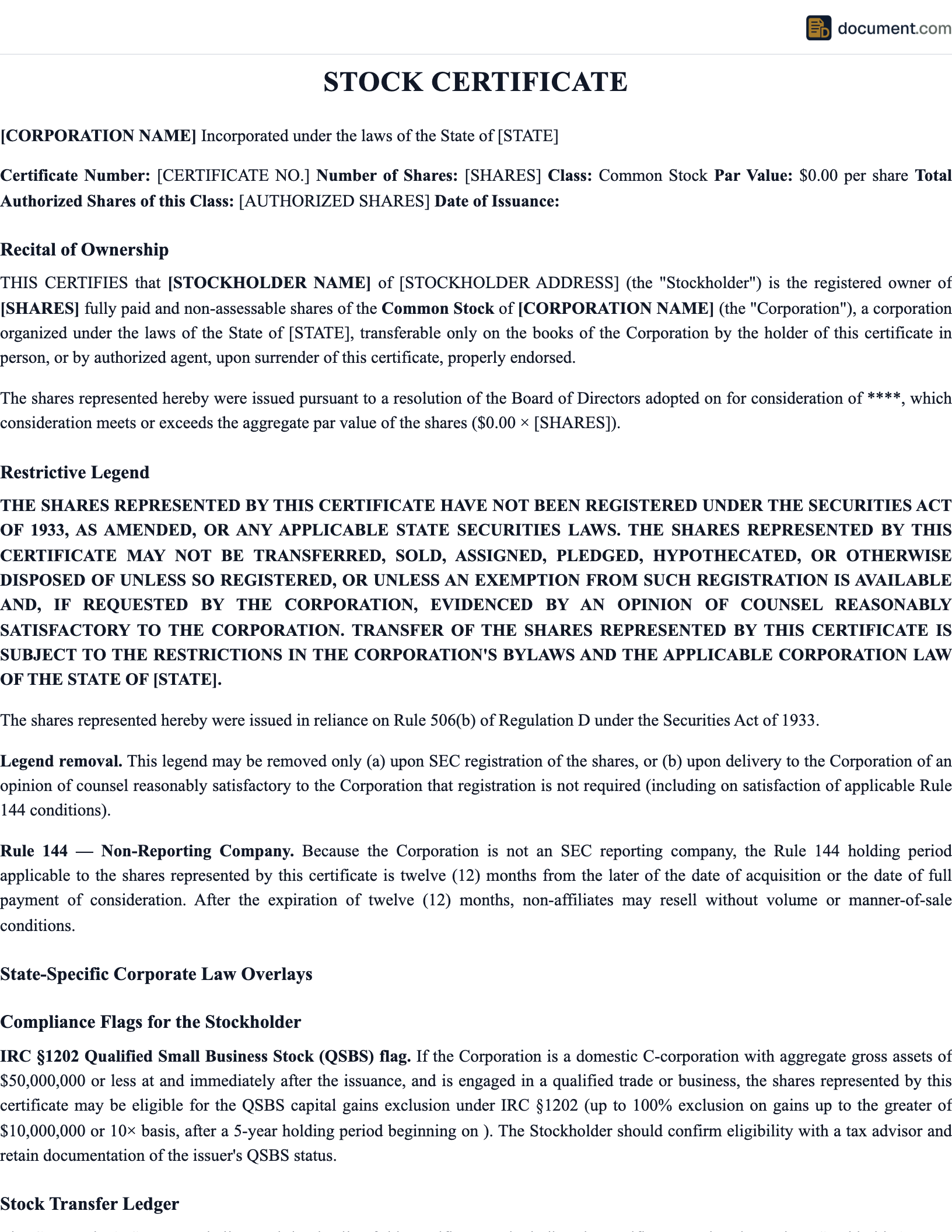
THIS CERTIFIES THAT [HOLDER NAME] is the registered holder of [NUMBER] shares of fully paid and non-assessable [CLASS] Stock of [CORPORATION NAME], a [STATE] corporation, transferable only on the books of the Corporation by the holder hereof in person or by duly authorized attorney upon surrender of this Certificate properly endorsed.
THE SHARES REPRESENTED BY THIS CERTIFICATE HAVE NOT BEEN REGISTERED UNDER THE SECURITIES ACT OF 1933, AS AMENDED, AND MAY NOT BE SOLD, PLEDGED, OR OTHERWISE TRANSFERRED WITHOUT AN EFFECTIVE REGISTRATION STATEMENT OR AN OPINION OF COUNSEL THAT REGISTRATION IS NOT REQUIRED.
IN WITNESS WHEREOF, the Corporation has caused this Certificate to be signed by its duly authorized officers this [DATE].
Frequently Asked Questions
Official Resources
Ready to Issue a Stock Certificate?
Generate an attorney-reviewed stock certificate in minutes.
Create Document