
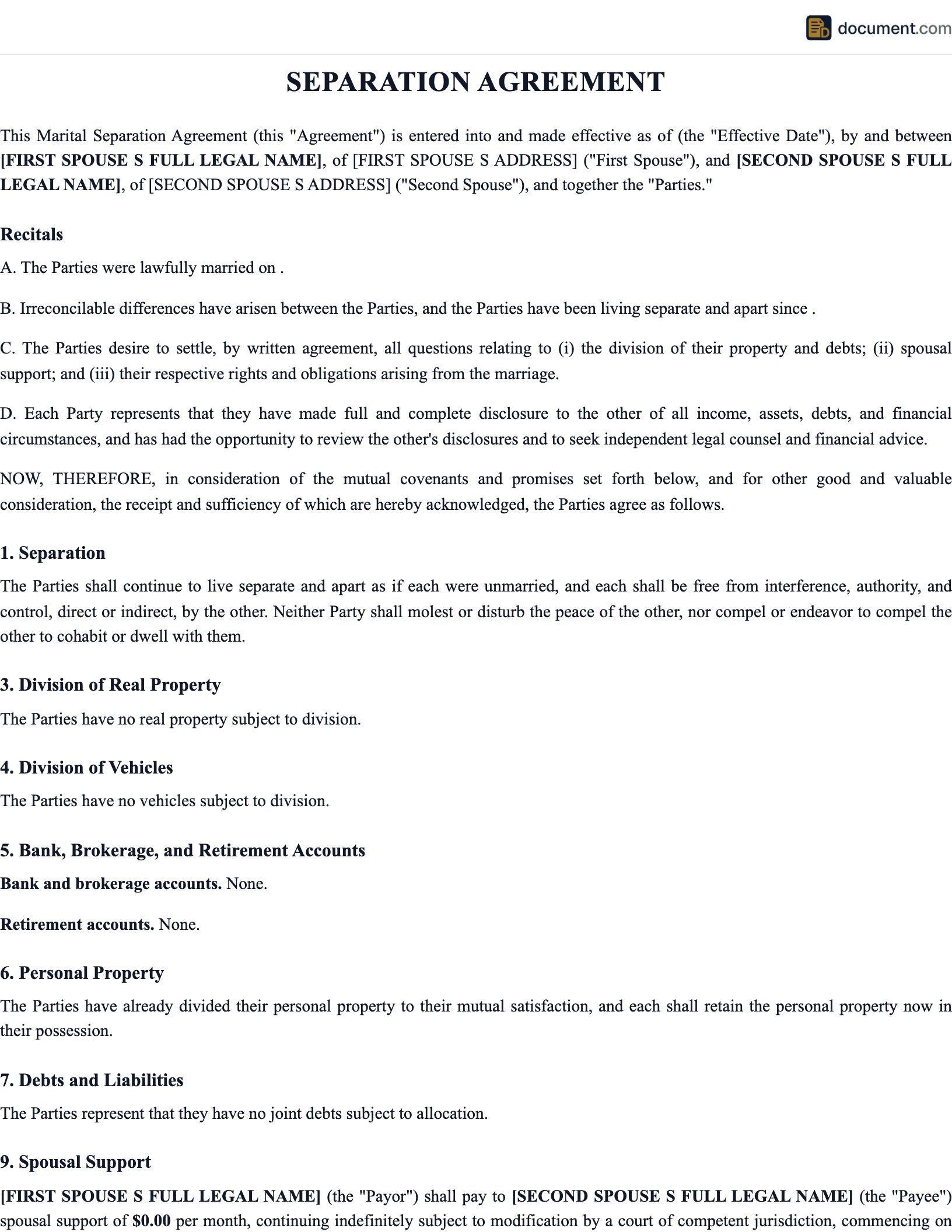



What Is a Separation Agreement?
A separation agreement is a legally binding contract between married spouses who have decided to live apart, establishing the terms and conditions that will govern their relationship during the period of separation. Unlike a divorce, a separation agreement does not dissolve the marriage — the couple remains legally married but lives under clearly defined rules regarding finances, property, children, and day-to-day responsibilities. This arrangement is sometimes chosen for religious reasons, to preserve certain marital benefits (health insurance, military dependent status, Social Security spousal benefits), or as a structured trial period before deciding whether to reconcile or proceed with divorce.
The agreement functions as a comprehensive roadmap for separated life. It addresses who lives where, how marital expenses and bills are divided, whether either spouse will pay support to the other, how jointly owned property and bank accounts will be managed, and — if there are children — the custody, visitation, and child support arrangements. Without a written agreement, separated spouses operate in a legal gray area where financial obligations are unclear, property rights are uncertain, and disputes can quickly escalate. A well-drafted separation agreement eliminates this ambiguity and provides a clear, enforceable framework for both parties.
From a strategic perspective, a separation agreement is one of the most important documents a couple can execute before or instead of a divorce. In states that require a mandatory separation period before granting a divorce (Virginia requires one year, North Carolina requires one year, Maryland requires six months for mutual consent), the separation agreement governs the parties' rights during that waiting period. If the couple later divorces, the separation agreement typically serves as the foundation for the divorce settlement — most of the difficult negotiations have already been completed. Courts generally uphold separation agreements that were entered into voluntarily with full financial disclosure, saving both parties significant time and legal fees.
The legal effect of a separation agreement depends on the jurisdiction and how it is executed. In states that recognize formal legal separation (approximately 38 states), the agreement can be filed with the court and enforced as a court order. In states that do not offer legal separation (such as Florida, Georgia, and Texas), the agreement is still valid as a private contract but is enforced through breach of contract actions rather than contempt proceedings. Regardless of the state, having a notarized, well-drafted separation agreement is far superior to an informal verbal understanding, which is nearly impossible to enforce and invites misunderstanding.
Our attorney-reviewed separation agreement templates are designed to address every major issue that arises when spouses begin living apart. Each template includes provisions tailored to your state's law regarding property rights during separation, the date-of-separation rule for new acquisitions and debts, custody standards, support guidelines, and enforcement mechanisms. Whether you are pursuing a trial separation, a long-term legal separation, or a separation as a precursor to divorce, our templates provide the legal structure you need.
Rights Protection
Preserve marital benefits while establishing clear boundaries and obligations
Structured Transition
Create a stable framework during an uncertain period without rushing into divorce
Divorce Foundation
Build the framework that converts directly into a divorce settlement if needed
Separation Agreement Form Preview
Below is a visual preview of the sections and fields in a comprehensive separation agreement. This mockup illustrates the structure and detail our templates provide. Your completed document will reflect your specific family situation, financial circumstances, and state requirements.
Separation Agreement
Between Married Spouses Living Apart
Section 1: Parties and Marriage Information
Section 2: Living Arrangements
Section 3: Financial Support During Separation
Section 4: Children's Arrangements
Section 5: Execution
Spouse 1 Signature / Date
Spouse 2 Signature / Date
Notary Public
Types of Separation
The type of separation you pursue depends on your goals, your state's laws, and whether you want court involvement. Understanding the differences helps you choose the right path and create an agreement suited to your situation.
Legal Separation Agreement
Court-recognized separation that establishes binding rights and obligations without dissolving the marriage
Trial Separation Agreement
Informal arrangement to live apart temporarily while deciding whether to reconcile or divorce
Permanent Separation Agreement
Long-term separation for couples who choose not to divorce for religious, financial, or personal reasons
Judicial Separation Decree
Court-ordered separation with formal division of property and support obligations
Collaborative Separation Agreement
Negotiated cooperatively with attorneys committed to reaching settlement without litigation
Separation Agreement vs Other Documents
A separation agreement occupies a unique position in family law — it addresses the same substantive issues as a divorce settlement but without dissolving the marriage. Understanding how it relates to other family law documents helps you choose the right approach.
Separation Agreement vs Divorce Settlement
Separation Agreement
- - Marriage remains legally intact
- - Neither party can remarry
- - May preserve health insurance and benefits
- - Can be reversed through reconciliation
- - Often converts to divorce settlement later
- - Available without court filing in some states
Divorce Settlement
- - Permanently dissolves the marriage
- - Both parties free to remarry
- - Employer health insurance for spouse ends
- - Cannot be reversed (must remarry)
- - Final resolution of all marital issues
- - Requires court filing and judicial approval
When to choose separation:Legal separation is often preferable when one spouse depends on the other's health insurance, when religious beliefs discourage divorce, when the couple wants time to attempt reconciliation with clear boundaries, or when preserving Social Security spousal benefits (which require 10+ years of marriage) is important.
Separation Agreement vs Postnuptial Agreement
Separation Agreement
- - Created when spouses are separating
- - Governs life during the separation period
- - Addresses living arrangements and daily logistics
- - Typically a precursor to divorce or reconciliation
Postnuptial Agreement
- - Created while spouses are still together
- - Predetermines terms if divorce occurs later
- - Does not address current living arrangements
- - Spouses continue living as a married couple
Key distinction: A postnuptial agreement is forward-looking and hypothetical — it plans for a future separation or divorce that may never happen. A separation agreement is immediate and operational — it governs the current reality of spouses who are already living apart.
How to Create a Separation Agreement: A 7-Step Guide
Creating a separation agreement requires thoughtful consideration of financial, custodial, and practical matters. Follow these seven steps to build an agreement that protects both spouses and provides a stable foundation during the separation period.
Establish the Date of Separation
The official date of separation is critically important for financial and legal purposes. In many states, this date determines the cutoff for marital property and community property — income earned and debts incurred after this date may be classified as separate. The date of separation is typically when one spouse moves out of the shared residence with the intent to live separately, though some states recognize in-home separation if the spouses maintain separate bedrooms and finances. Document this date clearly in the agreement and ensure both spouses acknowledge it.
Complete Financial Disclosure
Both spouses must provide full, honest disclosure of all income, assets, debts, and expenses. This includes pay stubs, tax returns, bank statements, investment account statements, retirement account balances, real estate valuations, vehicle values, business financial statements, and a complete list of debts. Concealing assets or understating income can invalidate the agreement if it later becomes part of a divorce proceeding. Many attorneys recommend attaching the financial disclosures as exhibits to the agreement as evidence of completeness.
Define Living Arrangements
Specify who will remain in the marital home, who will move out, and how the moving spouse's new housing costs will be handled. Address the mortgage or rent on the marital home — will the departing spouse continue to contribute? If the home is jointly owned, specify that neither spouse will encumber, refinance, or sell the property without the other's written consent. Establish rules for personal property retrieval, access to the marital home by the departing spouse, and disposition of jointly owned furnishings and household items.
Arrange Child Custody and Support
For couples with minor children, this is the most important section of the agreement. Establish a custody arrangement (joint legal, joint physical, or primary/visitation), a detailed parenting schedule, and child support based on state guidelines. Address decision-making authority for education, healthcare, and religion. Include provisions for communication protocols between parents, introduction of new partners to children, and relocation restrictions. The arrangement should prioritize the children's stability and minimize disruption to their routines.
Establish Financial Obligations
Determine whether either spouse will provide financial support to the other during the separation. Address how ongoing marital expenses will be shared — mortgage, car payments, insurance premiums, utility bills, and joint debt payments. Establish a financial cutoff date after which each spouse is solely responsible for their own new debts. Close or freeze joint credit accounts and establish individual accounts. Specify whether joint bank accounts will be split, maintained for shared expenses, or closed. Address how unexpected expenses (home repairs, medical emergencies) will be handled.
Address Insurance and Benefits
One of the key advantages of separation over divorce is the potential to maintain marital benefits. Specify whether the dependent spouse will remain on the other's employer health insurance plan (contact the employer to confirm this is permitted during legal separation). Address life insurance beneficiary designations, auto insurance policies, and any retirement or pension benefits. Determine who will pay premiums and what happens if coverage is terminated. For military families, address TRICARE and dependent ID card matters.
Execute and File (If Applicable)
Both spouses should have independent attorneys review the agreement before signing. Sign the agreement before a notary public — most states require or strongly recommend notarization. In states that offer formal legal separation, file the agreement with the family court for judicial approval and enforcement as a court order. In states without legal separation, retain the notarized agreement as a private contract. Keep the original in a safe location and provide copies to each spouse's attorney.
Tip: Even in states without formal legal separation, you can often file the separation agreement with the court as a stipulated order to gain contempt enforcement powers. Consult with a local family law attorney about this option.
Key Components of a Separation Agreement
A thorough separation agreement should address every area of married life that is affected when spouses begin living apart. Below are the essential components that protect both parties and minimize future disputes.
| Component | Description |
|---|---|
| Date of Separation | Official date establishing the legal and financial cutoff for marital obligations and property acquisition |
| Living Arrangements | Who occupies the marital home, moving arrangements, access rules, and restrictions on property disposition |
| Spousal Support | Amount, frequency, duration, and method of support payments from one spouse to the other |
| Expense Allocation | Division of ongoing shared expenses — mortgage, utilities, insurance premiums, and household costs |
| Child Custody | Legal and physical custody arrangements, decision-making authority, and parenting schedule |
| Child Support | Monthly amount calculated per state guidelines, payment method, and expense-sharing provisions |
| Property Use | Interim use of marital property (vehicles, furniture, equipment) without transferring ownership |
| Debt Responsibility | Allocation of existing debts and agreement that new debts are the sole responsibility of the incurring spouse |
| Insurance Continuation | Health, life, auto, and homeowner insurance maintenance during the separation period |
| Tax Filing | Filing status (joint vs. separate), dependency claims, and allocation of refunds or liabilities |
| Non-Disparagement | Agreement not to make negative statements about each other, especially in front of children |
| Reconciliation Clause | Terms for reconciliation, including whether the agreement survives temporary cohabitation attempts |
| Conversion to Divorce | Provisions for incorporating the agreement into a divorce decree if the couple later dissolves the marriage |
Financial Provisions in a Separation Agreement
Financial arrangements are the backbone of any separation agreement. Without clear, detailed financial provisions, separated spouses face uncertainty about who pays what, who earns what, and how shared obligations are managed. Below are the critical financial areas your agreement must address.
Income & Support
- - Spousal support amount and duration
- - Child support per state guidelines
- - Income from all sources disclosed
- - Bonus and commission sharing rules
- - Support modification triggers
- - Payment method and enforcement
Housing Costs
- - Mortgage or rent on marital home
- - Departing spouse's new housing costs
- - Property taxes and HOA fees
- - Home maintenance and repair responsibilities
- - Utilities and service accounts
- - Homeowner's insurance premiums
Accounts & Assets
- - Joint bank account management
- - Investment account access
- - Retirement contribution continuation
- - Stock option and RSU treatment
- - Business income allocation
- - Asset preservation obligations
Debts & Credit
- - Joint credit card account closure
- - Debt payment assignments
- - New debt responsibility rules
- - Credit monitoring provisions
- - Indemnification clauses
- - Student loan allocation
Legal Requirements for Separation Agreements
The legal framework for separation agreements varies significantly by state. Some states offer formal judicial separation with court oversight, while others only recognize separation agreements as private contracts. Understanding your state's approach is essential for creating an enforceable agreement.
States Offering Formal Legal Separation
Approximately 38 states and D.C. recognize legal separation as a formal legal status. In these states, you can file a petition for legal separation with the family court, and the court will issue a separation decree or order that has the same enforcement power as a divorce decree. Notable states with robust legal separation frameworks include California, Colorado, Kentucky, Maryland, New Jersey, New York, North Carolina, Ohio, Virginia, and Washington. Each state has different procedural requirements — some require a separation period before filing, others allow immediate filing, and some require specific grounds for legal separation.
Essential Legal Requirements
- Voluntary Execution: Both spouses must enter the agreement voluntarily without coercion, fraud, or undue influence. Courts will scrutinize agreements where there is a significant power imbalance between the parties.
- Full Financial Disclosure: Each spouse must provide complete, accurate disclosure of income, assets, and debts. Failure to disclose material financial information can render the agreement voidable.
- Written Form: Separation agreements must be in writing. Oral agreements regarding marital property, support, and custody are generally unenforceable under the statute of frauds and family law statutes.
- Notarization: Most states require or strongly recommend notarization. Notarization verifies the identity of the signers and confirms they signed voluntarily. Some states require notarization for the agreement to be filed with the court.
- Child-Related Provisions: Any provisions regarding child custody, visitation, and support are subject to the best interests of the child standard and must comply with state child support guidelines. Courts can modify child-related terms regardless of what the parents agreed to.
Important: Separation Does Not Equal Divorce
A common misconception is that being legally separated automatically leads to divorce after a certain period. This is not true in most states — legal separation and divorce are separate legal processes. You must affirmatively file for divorce to dissolve the marriage. However, in some states (like New York), a legal separation can be converted to a divorce after one year. In other states that require a separation period before divorce (Virginia, North Carolina, Maryland), the separation agreement documents that you have met the required separation period.
Sample Separation Agreement
Below is a condensed preview of our separation agreement template showing the structure, legal language, and key provisions. Your completed document will be fully customized for your specific situation and state requirements.
SEPARATION AGREEMENT
State of [State]
This Separation Agreement ("Agreement") is made and entered into on[Date] by and between [Spouse 1] and[Spouse 2], who were lawfully married on [Date] and have been living separate and apart since [Date].
RECITALS
WHEREAS, the Parties have voluntarily agreed to live separate and apart; and WHEREAS, both Parties desire to settle between themselves all questions regarding their respective property rights, financial obligations, custody of their minor child(ren), and all other matters arising from their marital relationship...
1. SEPARATION
The Parties acknowledge that they have been living separate and apart since[Date] and intend to continue living separately. Each Party shall be free from interference, authority, and control by the other, as fully as if unmarried...
2. LIVING ARRANGEMENTS
[Spouse] shall continue to reside in the marital home located at[Address]. Neither Party shall dispose of, encumber, or remove from the marital home any furnishings, equipment, or personal property belonging to the other Party without written consent...
3. FINANCIAL SUPPORT
[Payor Spouse] shall pay to [Payee Spouse]the sum of $[Amount] per month as spousal support, payable on the[1st/15th] of each month...
4. DEBTS AND OBLIGATIONS
From and after the date of separation, each Party shall be solely responsible for debts and obligations incurred in their own name. The Parties agree to divide existing marital debts as set forth in Schedule B attached hereto. Each Party shall indemnify and hold harmless the other from any claim arising from debts assigned to them...
5. CONVERSION TO DIVORCE
In the event either Party files for divorce, this Agreement shall be submitted to the Court for incorporation into the Final Decree of Dissolution. The terms of this Agreement shall survive as an independent contract and shall not merge with the decree unless specifically ordered by the Court...
Frequently Asked Questions
Find answers to common questions about separation agreements, legal separation versus divorce, financial obligations during separation, and protecting your rights.
Official Resources
For additional information on separation law, marital rights, and family law resources in your state, consult these official and reputable sources.
ABA Family Law Section
American Bar Association family law resources and attorney referrals
LawHelp.org
Free legal aid and family law resources by state
IRS - Separated Individuals
Tax filing guidance for separated and divorcing spouses
WomensLaw.org
State-by-state family law information and legal resources
Nolo - Separation Agreements
Free legal information on separation agreements and legal separation
Mediate.com - Family Mediation
Find family mediators and learn about collaborative separation
Create your Separation Agreement in under 10 minutes.
Answer a few questions and download a compliant, attorney-drafted document ready for your state.