



What Is a Two Weeks Notice Resignation Letter?
A two weeks notice resignation letter is a formal written communication to your employer announcing your intent to leave your position, with your last day of work set fourteen calendar days from the date of delivery. This standard notice period has been the prevailing professional convention in the United States for decades, even though no federal or state law mandates it for at-will employees. The letter serves a dual purpose: it formally documents your resignation with a clear end date, and it signals your commitment to facilitating an orderly transition of your responsibilities before you depart.
The two-week standard emerged from a balance of competing interests. For employers, fourteen days provides enough time to begin recruiting a replacement, redistribute workload among remaining team members, and arrange knowledge transfer sessions. For employees, it demonstrates professional courtesy without imposing an unreasonably long obligation to remain in a role they have decided to leave. The convention is so deeply embedded in American workplace culture that many employee handbooks, while unable to legally require notice from at-will employees, explicitly state that "adequate notice of at least two weeks is expected" and may tie benefits like PTO payout to compliance with this expectation.
Despite its ubiquity, the two weeks notice is not universally appropriate. Senior executives, employees in specialized technical roles, and professionals in client-facing positions may be expected to give 30, 60, or even 90 days of notice to allow for a thorough transition. Conversely, employees in industries with high turnover — retail, food service, temporary staffing — may find that even one week of notice exceeds the norm. The appropriate notice period is shaped by your seniority, the complexity of your role, the customs of your industry, and any contractual obligations you have agreed to. Regardless of the exact duration, the principles of a professional resignation letter remain the same: clarity about your departure date, a constructive tone, and a concrete plan for transition.
14-Day Standard
The widely accepted professional convention giving both parties adequate time to prepare for the transition.
Transition Planning
Structured handover period for documenting processes, transferring knowledge, and training successors.
Professional Courtesy
Preserves relationships, protects references, and demonstrates workplace integrity for future employers.
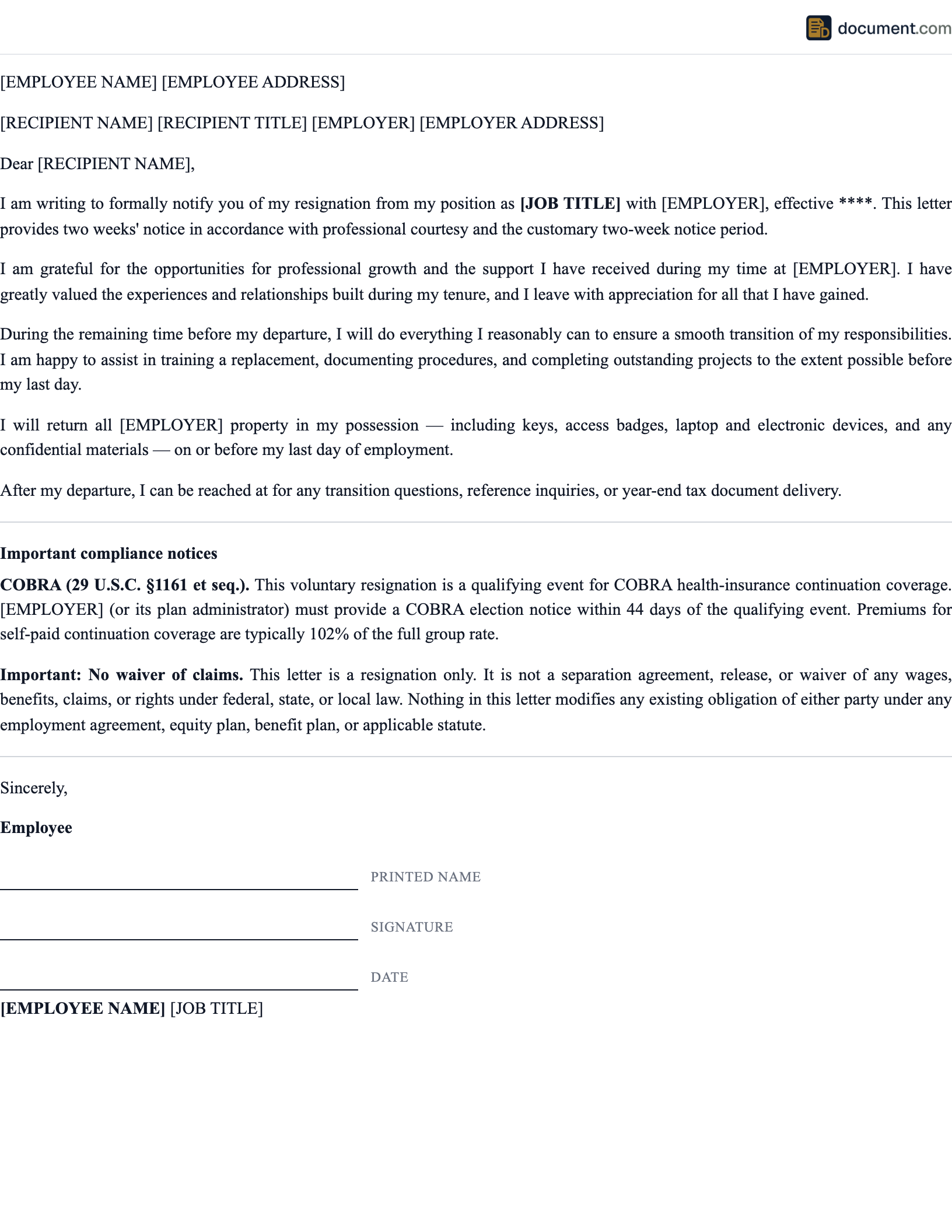
Two Weeks Notice Letter Preview
Two Weeks Notice Resignation Letter
Standard Notice Period
DATE AND RECIPIENT
Date:
To: ("Manager/HR Department")
RESIGNATION STATEMENT
Please accept this letter as formal notification that I am resigning from my position as effective (two weeks from today's date).
TRANSITION PLAN
During my remaining time, I will complete the following transition items: . I am prepared to train my replacement and document all ongoing projects and processes.
FINAL COMPENSATION
I request confirmation of my final paycheck date, accrued PTO balance of hours, and COBRA enrollment information.
EMPLOYEE SIGNATURE
DATE
Key Components
A well-structured two weeks notice letter includes these essential elements to protect your professional standing and ensure a smooth departure:
| Component | Purpose | Key Details |
|---|---|---|
| Last Day of Employment | Provides a clear, unambiguous end date | Specific calendar date exactly 14 days from letter delivery, not vague language like "in about two weeks" |
| Position and Department | Identifies the exact role being vacated | Full job title, department name, employee ID if applicable, especially important at large organizations |
| Transition Commitment | Demonstrates professional responsibility | Offer to train replacement, document workflows, complete critical deliverables, and transfer client relationships |
| Handover Documentation | Ensures institutional knowledge is preserved | Project status reports, SOPs for recurring tasks, vendor contacts, system access details, and file locations |
| PTO and Final Pay Request | Triggers compensation obligations | Accrued vacation payout, final paycheck timing, outstanding expense reimbursements, commission reconciliation |
| Benefits Continuation | Preserves health coverage and retirement rights | COBRA election timeline, 401(k) rollover options, life insurance conversion, FSA/HSA portability |
| Gratitude and Tone | Preserves relationships for future networking | Sincere acknowledgment of growth opportunities, mentorship, and positive experiences during tenure |
| Contact Information | Enables post-departure communication | Personal email and phone for transition questions, final paperwork, tax documents, and reference coordination |
How to Write a Two Weeks Notice Resignation Letter
Calculate Your Exact Last Day
Count fourteen calendar days from the date you plan to deliver the letter. If your two weeks spans a holiday or company shutdown, decide whether to extend your notice to account for non-working days or use the strict calendar calculation. Be precise: write 'my last day of employment will be Friday, [date]' rather than 'I am giving two weeks notice.' Precision prevents ambiguity about your end date and ensures payroll processes your separation correctly.
Draft the Resignation Statement
Open with a direct, unequivocal statement of resignation. State your full job title, the department you work in, and your calculated last day. Avoid hedging language like 'I am thinking about leaving' or 'I would like to discuss my future at the company.' The first sentence should leave no room for interpretation: this is a resignation, not a negotiation. If you have an employee ID, include it to prevent any confusion in organizations with multiple employees sharing similar names.
Outline Your Transition Plan
Dedicate a paragraph to how you intend to use your remaining fourteen days. Identify the critical projects you will complete, the tasks you will document, and the colleagues you will brief. Offer to train your replacement if one is identified during the notice period. This section transforms your resignation from a disruption into a managed transition and signals to your employer that you are departing responsibly. A concrete plan — 'I will complete the Q2 report by Day 5, document the vendor management process by Day 10, and conduct handover meetings during my final week' — is far more valuable than a vague promise to 'help however I can.'
Address Compensation and Benefits
Request written confirmation of your final paycheck date, accrued PTO balance and payout policy, any pending expense reimbursements, and COBRA enrollment information. Reference your state's specific final pay deadline if you know it — California requires final pay on the last day of work, while most states allow payment by the next regular payday. Putting these requests in writing creates a documented record that protects you if disputes arise later about what you were owed at separation.
Express Professional Gratitude
Include a brief, genuine expression of appreciation for specific opportunities, mentorship, or growth you experienced during your tenure. This is not empty politeness — it preserves the professional relationship and directly impacts the quality of future references. Avoid generic platitudes and instead cite concrete experiences: 'I am grateful for the opportunity to lead the product redesign last year, which significantly developed my project management skills.' Keep this section concise; two to three sentences strike the right balance between warmth and professionalism.
Deliver Strategically and Document Everything
Schedule a brief in-person meeting with your direct manager to deliver the news verbally first — this is a professional courtesy that prevents your manager from being blindsided by an email. Immediately after the meeting, send the formal letter via email to both your manager and HR, attaching a PDF copy. Keep the email subject line clear: 'Resignation - [Your Name] - Last Day [Date].' Save a copy of the sent email with its timestamp, any acknowledgment you receive, and the original letter. This documentation trail protects you in the event of any disputes about when notice was given or what was communicated.
Frequently Asked Questions
Official Resources
Authoritative resources on employment rights, notice periods, final pay requirements, and benefits continuation after resignation.
DOL - Final Paycheck Requirements
Department of Labor guidance on final pay rules and timelines after employee resignation.
DOL - COBRA Continuation Coverage
Official guide to health insurance continuation rights after leaving employment.
DOL - 401(k) Rollover Rights
Employee Benefits Security Administration guidance on retirement plan portability after job changes.
NLRB - Employee Rights
National Labor Relations Board guide to protected employee rights including concerted activity.
EEOC - Retaliation Protections
EEOC guidance on unlawful retaliation against employees who exercise their workplace rights.
IRS - Tax Withholding for Employees
IRS guidance on final paycheck tax withholding, W-2 timing, and tax obligations after resignation.
Create Your Two Weeks Notice Letter
Generate a professional two weeks notice resignation letter with a complete transition plan and proper documentation.
Create DocumentNo account required. Free to create and preview.