



What Is an Immediate Resignation Letter?
An immediate resignation letter is a written instrument that terminates the employment relationship the same day it is delivered. It dispenses with the customary two-week notice period and fixes the effective date as the date of delivery. The letter functions as both a notice of resignation and a contemporaneous record establishing voluntariness, the last day worked, and the circumstances of departure. Those three facts control downstream legal questions: final-pay timing under state wage statutes, COBRA election windows under 29 U.S.C. § 1161, unemployment eligibility under each state's good-cause framework, and stock-vesting cutoffs under the governing equity plan.
The legal basis is the at-will employment doctrine, the default rule in 49 states. Montana abandoned it in 1987 with the Wrongful Discharge from Employment Act (Mont. Code Ann. § 39-2-901), which requires good cause for termination after a probationary period. Everywhere else, either party may end the relationship at any time, for any lawful reason, with or without notice. The employee's right to walk out mirrors the employer's right to fire at-will. The right is bounded by three categories of contractual carve-out: a written employment agreement specifying a notice period, a collective bargaining agreement governed by the National Labor Relations Act (29 U.S.C. § 151), and licensure statutes for nurses, teachers, and other regulated professions whose Practice Acts treat sudden departure as professional misconduct.
Contract-breach exposure and liquidated damages
If you signed an employment agreement with a notice period, immediate departure is a breach. Without a liquidated-damages clause the employer must prove actual damages, which is rarely cost-justified. With one, courts enforce the clause if it is reasonable in light of anticipated harm at the time of contracting. California Civil Code § 1671(b) governs the reasonableness inquiry in non-consumer contracts; New York applies the parallel rule from Truck Rent-A-Center v. Puritan Farms, 41 N.Y.2d 420; Texas applies Phillips v. Phillips, 820 S.W.2d 785. Common amounts range from two weeks of base salary to one month, sometimes plus recruitment-fee reimbursement. Non-compete, non-solicit, and trade-secret obligations under the Defend Trade Secrets Act (18 U.S.C. § 1836) survive resignation regardless of how the employment ends.
Constructive discharge and unemployment eligibility
Hostile work environments under Title VII of the Civil Rights Act (42 U.S.C. § 2000e), unsafe conditions under OSHA's whistleblower protections (29 U.S.C. § 660(c)), and retaliation for protected activity can convert a voluntary quit into a constructive discharge. The standard, set by Pennsylvania State Police v. Suders, 542 U.S. 129 (2004), asks whether a reasonable person would have felt compelled to resign. A successful constructive-discharge finding preserves unemployment eligibility under good-cause exceptions in California Unemployment Insurance Code § 1256, New York Labor Law § 593, and Texas Labor Code § 207.045, and supports Title VII back-pay claims. Document the triggering conduct in writing before resigning: dated emails, HR complaints with delivery receipts, OSHA complaints, and EEOC charges.
Same-Day Effective
Fixed effective date triggers state final-pay statutes and starts the COBRA election clock.
At-Will Reciprocity
The employee's mirror right under at-will doctrine in every state but Montana.
Documentation Trail
Establishes voluntariness, last day worked, and separation circumstances for later disputes.
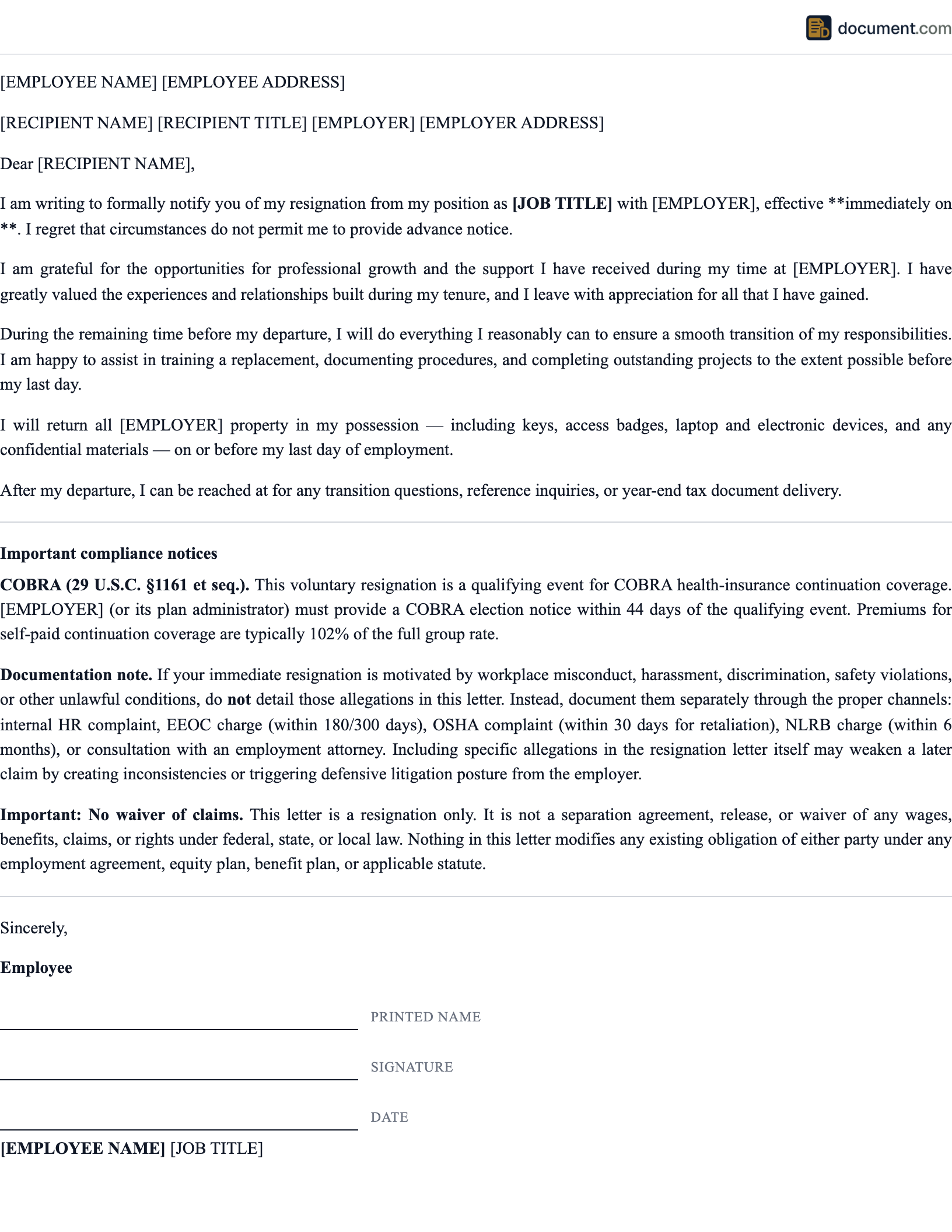
Immediate Resignation Letter Preview
Immediate Resignation Letter
Effective Immediately
DATE AND RECIPIENT
Date:
To: ("Manager/HR Department")
RESIGNATION STATEMENT
I hereby resign from my position as effective immediately. My last day of employment is today, .
TRANSITION ITEMS
I will return all company property including on or before .
EMPLOYEE SIGNATURE
DATE
Key Components
Eight components determine whether the letter performs the legal work required: fixing the separation date for state-statute purposes, preserving claims for unemployment and Title VII, triggering COBRA election notices, and protecting accrued PTO and final wages. Omit any component and you risk forfeiting a right that the document is designed to preserve.
State-by-state final-pay timing
The effective-date statement triggers a state-specific payment clock. California Labor Code § 202 requires payment within 72 hours of resignation without notice. Colorado C.R.S. § 8-4-109 requires payment by the next business day. Massachusetts G.L. c. 149 § 148 requires payment by the next regular payday or the day of discharge, whichever is earlier. New York Labor Law § 191 requires payment by the next regular payday. Texas Labor Code § 61.014 allows payment by the next regular payday after voluntary quit. California's Labor Code § 203 imposes one full day of waiting-time penalties for each day the check is late, up to 30 days.
PTO payout rules vary by state
Accrued vacation is treated as wages in California (Labor Code § 227.3, Suastez v. Plastic Dress-Up, 31 Cal.3d 774), Colorado (C.R.S. § 8-4-101), Illinois (820 ILCS 115/5), Massachusetts, Nebraska, North Dakota, and several others; it must be paid at separation. Florida, Alabama, Georgia, North Carolina, South Carolina, and roughly twenty other states defer to the employer's written policy, allowing use-it-or-lose-it forfeiture. Request the payout in writing within the resignation letter; silence operates as waiver in some plan documents.
| Component | Purpose | Key Details |
|---|---|---|
| Effective Date | Establishes your last day unambiguously | "Effective immediately" or today's date, no ambiguity about when employment ends |
| Position Identification | Clarifies which role you are vacating | Job title, department, employee ID if applicable |
| Brief Reason (Optional) | Provides context without oversharing | One to two sentences; keep it professional and factual, not emotional |
| Property Return Plan | Demonstrates good faith and prevents disputes | List of company items to return, timeline for return, request for personal item retrieval |
| Final Pay Request | Triggers state-specific payment timelines | Request for final wages, accrued PTO payout, expense reimbursements |
| Benefits Inquiry | Preserves COBRA and benefit rights | Request for COBRA information, 401(k) rollover instructions, life insurance conversion |
| Professional Tone | Preserves relationships and references | Brief gratitude, no blame or negativity, forward-looking language |
| Contact Information | Enables post-departure communication | Personal email or phone for final paperwork, tax documents, and reference requests |
How to Write an Immediate Resignation Letter
Six steps. Work them in order. The sequence matters because each step preserves a right that disappears if waived in the wrong order: contract review before drafting prevents inadvertent breach admissions; clear effective-date language before transition language fixes the wage-statute clock; request for COBRA notice on the date of separation starts the 14-day notification clock under 29 U.S.C. § 1166.
Verify Your Employment Status
Pull the offer letter, employment agreement, equity grant, and employee handbook. Identify any contractual notice period, liquidated-damages clause under Cal. Civ. Code § 1671 or its state analog, garden-leave provision, post-termination exercise window for vested options, and any notice obligations under a CBA. If a contract requires notice and contains a liquidated-damages clause, run the math: two weeks of base salary may be cheaper than litigating breach. Consult employment counsel before signing if the new role implicates non-compete or trade-secret obligations.
State the Resignation in Operative Terms
Open with operative language: 'I hereby resign from my position as [title], effective [date].' Avoid hedging verbs (considering, may, plan to). The effective-date phrase is the legal trigger for state final-pay statutes (Cal. Lab. Code § 202: 72 hours; Colo. R.S. § 8-4-109: next business day) and starts the COBRA notification clock. Use 'effective immediately' or a specific date; do not use ranges.
Limit the Stated Reason
No explanation is legally required. A brief, neutral phrase ('due to personal circumstances') prevents negative inference without supplying ammunition. Avoid grievance language, accusations, or admissions; the letter is admissible in any subsequent EEOC charge, unemployment hearing, or wrongful-termination action and will be construed against the drafter under standard contract canons. If the departure is constructive discharge under Pennsylvania State Police v. Suders, document the underlying conduct in a separate, contemporaneous memorandum, not in the resignation letter.
Address Property Return and Transition
Inventory company property to be returned: laptops, phones, badges, fobs, credit cards, hard copies. Specify the return date and method. Offer email-based transition support during a defined window if willing. Do not retain copies of customer data, technical specs, or confidential files; downloading proprietary information in the days surrounding resignation is the fact pattern in most Defend Trade Secrets Act preliminary-injunction cases.
Demand Final Pay, PTO Payout, and COBRA Notice
Request payment of all earned wages, accrued and unused PTO (mandatory in California, Colorado, Illinois, Massachusetts, Nebraska, North Dakota), and pending expense reimbursements by the state-statutory deadline. Cite the statute by section number. Request the COBRA election notice within the 14-day period under 29 U.S.C. § 1166 and confirmation of the special-enrollment-period notice under 45 C.F.R. § 155.420 for ACA marketplace coverage.
Deliver, Acknowledge, and Preserve
Email the letter as a PDF attachment to direct supervisor and HR simultaneously; retain the sent-timestamp. Request written acknowledgment of receipt and the effective date. Where feasible, hand-deliver a hard copy and have it date-stamped. Preserve copies in personal storage, not on company devices that may be wiped at termination. The contemporaneous record is the evidence base for any future unemployment, COBRA, or wage-claim proceeding.
Frequently Asked Questions
Official Resources
Authoritative resources on at-will employment, final pay rights, and resignation best practices.
DOL - Final Paycheck Requirements
Department of Labor guidance on final pay rules after resignation or termination.
DOL - COBRA Continuation Coverage
Official guide to COBRA health insurance continuation after leaving employment.
EEOC - Workplace Harassment
Equal Employment Opportunity Commission resources on harassment that may prompt resignation.
NLRB - Employee Rights
National Labor Relations Board guide to protected employee rights under federal law.
OSHA - Filing a Complaint
How to report unsafe working conditions that may necessitate immediate resignation.
IRS - Tax Withholding for Employees
IRS guidance on final paycheck tax withholding and W-2 requirements after resignation.
Create Your Immediate Resignation Letter
Generate a professional immediate resignation letter that protects your rights and maintains your reputation.
Create DocumentNo account required. Free to create and preview.