



What Is a Health & Stress Resignation Letter?
A health and stress resignation letter is a formal notification to your employer that you are leaving your position due to a medical condition, chronic health issue, mental health crisis, workplace-induced stress, or disability that makes continued employment in your current role impossible or medically inadvisable. Unlike other resignation types that focus primarily on transition logistics, a health-related resignation must carefully balance two competing interests: providing enough context for your employer to understand the seriousness and legitimacy of your departure, while protecting your medical privacy and preserving legal rights that could be jeopardized by over-disclosure.
The legal landscape surrounding health-related resignations is more complex than standard resignations because multiple federal and state laws intersect. The Americans with Disabilities Act (ADA) protects employees with qualifying disabilities and requires employers to provide reasonable accommodations. The Family and Medical Leave Act (FMLA) provides up to 12 weeks of job-protected leave for serious health conditions. State disability and workers' compensation laws may provide benefits if the health condition is work-related. And unemployment insurance laws in most states recognize health-related resignations as "good cause" that preserves benefit eligibility. Each of these legal frameworks requires different documentation and has different procedural requirements — and a poorly worded resignation letter can inadvertently waive rights under one or more of them.
Before drafting this letter, it is critical to evaluate whether resignation is truly your only option. Have you requested ADA accommodations? Have you explored FMLA leave? Has your physician documented that your condition prevents continued employment in any capacity at this employer, or only in your current role (which might be addressed through reassignment)? Resigning permanently ends the employment relationship and the employer's obligations under these statutes. If your employer has failed to accommodate a documented disability, your departure may constitute a "constructive discharge" that both preserves your unemployment eligibility and creates potential ADA discrimination liability for the employer — but only if you can demonstrate that you requested accommodation and it was denied or inadequate.
Privacy Protection
Carefully crafted language that avoids unnecessary medical disclosure.
Legal Rights Preserved
Protects ADA, FMLA, disability insurance, and unemployment eligibility.
Compassionate Tone
Professional language that communicates seriousness without blame or grievance.
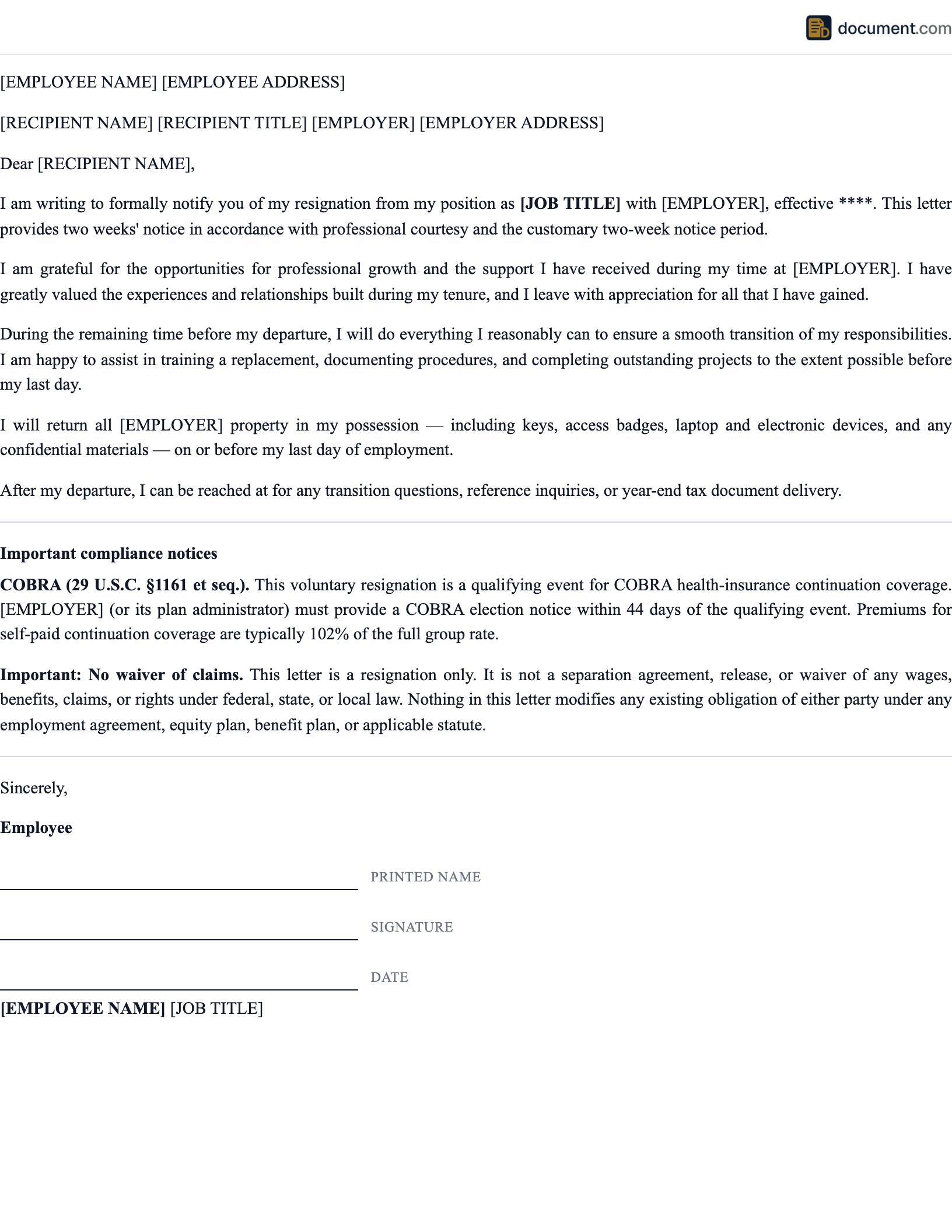
Health & Stress Resignation Letter Preview
Resignation Letter — Health Reasons
Confidential
1. RESIGNATION STATEMENT
I am writing to inform you that I must resign from my position as effective due to health reasons that prevent me from continuing in this role.
2. TRANSITION COMMITMENT
During my remaining time, I will ensure all current responsibilities are properly documented and transitioned to .
3. BENEFITS CONTINUATION REQUEST
I request information regarding COBRA continuation coverage, disability insurance conversion options, and the timeline for final pay and accrued benefits.
EMPLOYEE SIGNATURE
DATE
Key Components
A health-related resignation letter must strike a delicate balance between transparency and privacy:
| Component | Purpose | Key Details |
|---|---|---|
| Health Reason Citation | Establishes legitimate basis for departure | "For health reasons" or "on the advice of my medical team" — no diagnosis or symptoms |
| Notice Period | Accommodates health limitations | May be shorter than standard if health prevents continued work; physician's note may support this |
| Accommodation History | Documents that alternatives were explored | Brief reference to prior accommodation requests, if applicable, without detailed grievance |
| Benefits Inquiry | Preserves critical coverage | COBRA, disability insurance conversion, EAP access, HSA/FSA deadlines, life insurance conversion |
| Transition Plan | Shows professionalism despite circumstances | Realistic plan given health limitations; may offer limited post-departure availability |
| No Waiver Language | Protects legal rights | Avoid language that could be construed as waiving ADA, FMLA, or workers' comp rights |
| Professional Tone | Preserves relationships | Gratitude for understanding, no blame or detailed workplace complaints |
| Confidentiality Request | Controls information sharing | Request that health reason be kept confidential within HR, not shared broadly |
How to Write a Health & Stress Resignation Letter
Evaluate Alternatives Before Resigning
Before committing to resignation, exhaust other options: have you formally requested ADA accommodations in writing? Have you applied for FMLA leave? Have you discussed modified duties, reduced hours, or reassignment with HR? Have you filed a workers' compensation claim if the condition is work-related? Document each request and the employer's response. If the employer refused reasonable accommodations, your resignation may qualify as constructive discharge — but only if you have documentation showing the request and refusal.
Consult Your Medical Provider
Ask your physician, therapist, or psychiatrist to provide a letter stating that continued employment in your current role is medically inadvisable. You do not need to share this letter with your employer in your resignation, but you will need it for unemployment insurance claims, disability insurance applications, and potential legal proceedings. The medical professional's documentation should reference functional limitations without unnecessary diagnostic detail — 'Patient is unable to perform sustained full-time work due to a medical condition' is sufficient.
Keep the Medical Disclosure Minimal
Your resignation letter should state 'for health reasons' or 'on the advice of my physician' — nothing more. Do not name your condition, describe symptoms, list medications, reference therapy sessions, or provide a medical timeline. This information is protected under the ADA and HIPAA, and including it in your resignation letter puts it in your permanent personnel file where it could be accessed by anyone with file access. If your employer asks for details, you can decline or provide only what is legally required.
Address Benefits Continuation Explicitly
Health-related resignations make benefits continuation especially critical because you are leaving employment while dealing with an active medical issue. Request specific information about COBRA enrollment deadlines and costs, disability insurance conversion or portability options, EAP (Employee Assistance Program) access during transition, HSA and FSA fund usage deadlines, life insurance conversion options, and 401(k) rollover procedures. These requests should be listed clearly so HR can respond to each one.
Avoid Waiver Language and Emotional Detail
Do not include language that could be interpreted as waiving legal claims: avoid phrases like 'I bear no ill will,' 'I hold the company harmless,' or 'this is entirely my personal decision unrelated to workplace conditions.' Similarly, avoid emotional venting about workplace stress, management failures, or hostile colleagues — if these conditions contributed to your health issue, they are better documented in a separate memo to your attorney than in a resignation letter that your employer will read and file.
Plan for a Realistic Transition
Your transition plan should reflect your actual health capacity. If you can work a full two-week notice, offer to do so. If your health prevents continued work, explain that your physician has advised you to stop working effective a specific date, and offer alternative support — detailed written transition documentation, availability for phone questions during a limited window, or email-based knowledge transfer. Employers are generally understanding when health issues require a shortened notice, especially when the employee makes a genuine effort to minimize disruption within their limitations.
Frequently Asked Questions
Official Resources
Authoritative resources on health-related employment rights, disability protections, and medical leave.
ADA.gov - Introduction to the ADA
Federal guide to Americans with Disabilities Act rights and employer obligations.
DOL - Family and Medical Leave Act
Department of Labor FMLA guidance on medical leave eligibility and protections.
EEOC - Disability Discrimination
EEOC guidance on disability accommodation, discrimination, and workplace rights.
DOL - COBRA Continuation Coverage
Guide to continuing health insurance coverage after employment ends.
SSA - Disability Benefits
Social Security Administration guide to SSDI and SSI disability benefit programs.
DOL - Workers' Compensation
Federal workers' compensation program information for work-related health conditions.
Create Your Health & Stress Resignation Letter
Generate a resignation letter that protects your medical privacy and preserves your legal rights.
Create DocumentNo account required. Free to create and preview.