



What Is a Personal Reasons Resignation Letter?
A personal reasons resignation letter is a written notice of voluntary separation that identifies private circumstances as the cause without disclosing what those circumstances are. It is the default format when the drafter wants to preserve privacy, maintain references, and avoid creating documentary admissions that could surface in an unemployment proceeding, EEOC charge, or reference check. The letter discharges the social expectation of explanation without supplying any factual predicate that an adverse party could later use.
The legal value of the format is its silence. A health-related resignation puts medical information on the record and may waive ADA confidentiality protections under 42 U.S.C. § 12112(d)(3)(B). A grievance-driven letter becomes Exhibit A in any subsequent retaliation defense. A vague personal-reasons letter discloses nothing cognizable. That silence does not waive the right to pursue Title VII (42 U.S.C. § 2000e), constructive discharge under Pennsylvania State Police v. Suders, 542 U.S. 129 (2004), or unemployment good-cause claims under state UI statutes. The employee retains the option to develop those claims through separate documentation: contemporaneous emails, HR complaints with delivery receipts, EEOC charges within the 180- or 300-day window.
Privacy as a default: no disclosure obligation
No federal or state statute requires an employee to disclose the reason for resignation. The ADA's reverse- inquiry rule (42 U.S.C. § 12112(d)(2)) bars employers from compelling medical information and creates asymmetric protection: the employer cannot ask, and the employee need not tell. State analog statutes including the California Fair Employment and Housing Act (Cal. Gov't Code § 12940), the New York State Human Rights Law (N.Y. Exec. Law § 296), and the Illinois Human Rights Act (775 ILCS 5/2-102) reinforce this asymmetry. Refusal to elaborate is not insubordination, is not waiver of any claim, and is not grounds for adverse action. A polite declination ('the details are private') is a complete response.
References, anti-defamation safe harbor, and qualified privilege
Most states recognize a qualified privilege for truthful workplace communications about former employees. The leading case is Lewis v. Equitable Life Assurance, 389 N.W.2d 876 (Minn. 1986), which protects truthful employer statements made in good faith to prospective employers. Twenty-six states have codified job-reference immunity statutes (Florida Stat. § 768.095, California Civil Code § 47(c), Texas Labor Code § 103.001-104) that shield employers from defamation liability when responding to reference inquiries with truthful, good-faith information. The personal-reasons letter preserves these protections by avoiding documentary statements that could later be characterized as defamatory or pretextual.
Privacy Preserved
Professional language that sets clear boundaries without being evasive.
Relationships Protected
Gratitude and transition planning that preserve goodwill and references.
Legally Neutral
Keeps all legal options open without creating problematic documentation.
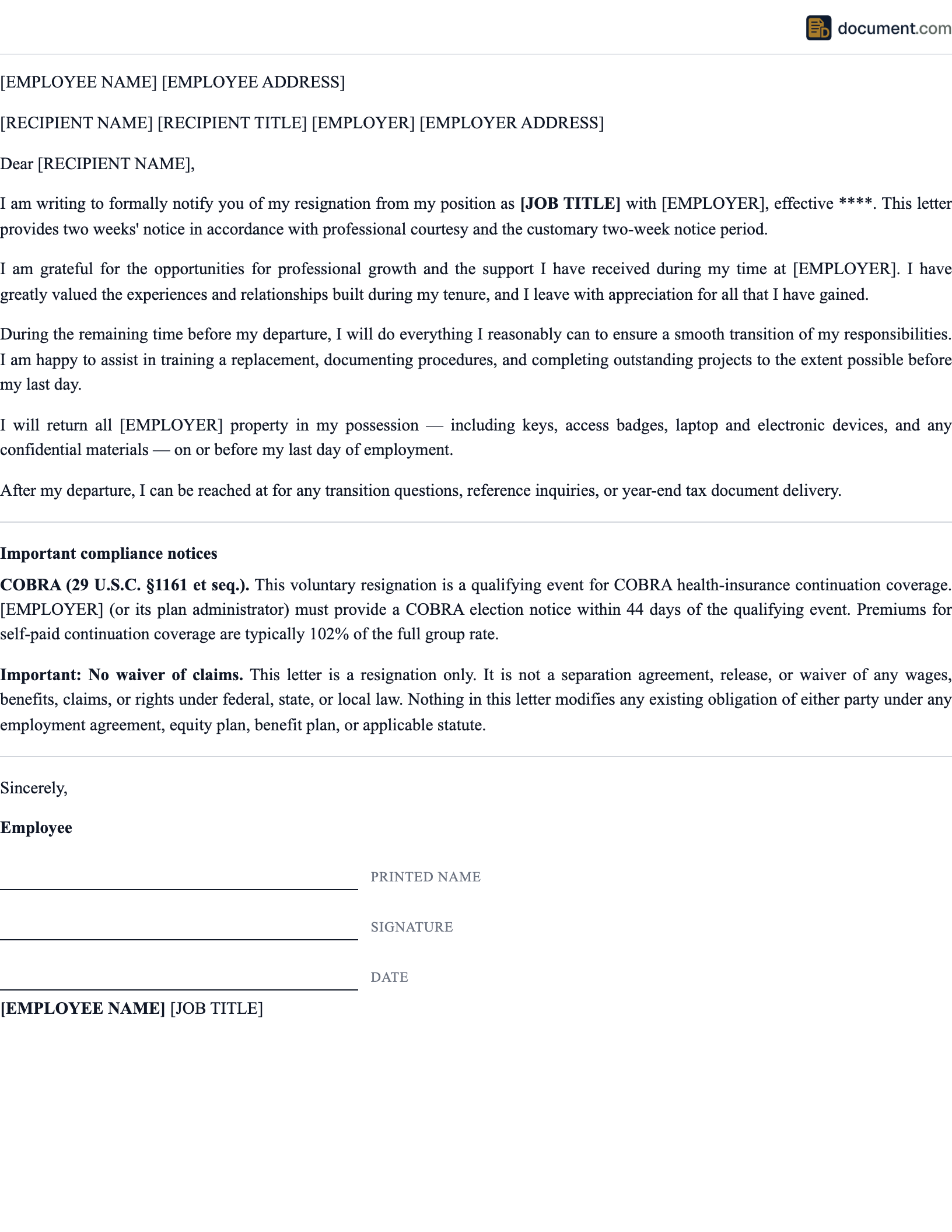
Personal Reasons Resignation Letter Preview
Resignation Letter
Personal Reasons
DATE AND RECIPIENT
Date:
To:
RESIGNATION NOTICE
I am writing to formally resign from my position as effective . This decision is due to personal reasons that require my full attention at this time.
TRANSITION COMMITMENT
I am committed to ensuring a smooth transition during my notice period and will prepare thorough documentation for my successor.
EMPLOYEE SIGNATURE
DATE
Key Components
Eight components compensate for the absent explanation. The letter must demonstrate professionalism through detail in other respects so the privacy invocation reads as boundary-setting rather than evasion.
ADA implications when departure relates to disability
When the underlying personal reason is a disability, the ADA's reasonable-accommodation framework (42 U.S.C. § 12112(b)(5)) and the parallel state statutes create an alternate path: request accommodation in writing before resigning. A documented accommodation request triggers the interactive process under 29 C.F.R. § 1630.2(o)(3). Employer failure to engage in the interactive process is independently actionable under the ADA Amendments Act. Resignation without first requesting accommodation may forfeit ADA claims because the employee did not give the employer notice and opportunity. If the disability is the driver, the personal-reasons letter is appropriate only after a documented accommodation request and either a denial or a constructive-discharge condition.
Reference protections and qualified privilege
The letter establishes the official narrative the employer is likely to repeat to reference inquiries. State reference-immunity statutes (Florida Stat. § 768.095, California Civil Code § 47(c), Texas Labor Code § 103) and the Lewis v. Equitable common-law privilege protect truthful employer statements. A clean letter with neutral reasons and detailed transition language pre-loads the employer's reference pool with favorable, non-controversial facts.
| Component | Purpose | Key Details |
|---|---|---|
| Vague but Professional Reason | Explains departure without disclosing details | "Personal reasons," "personal circumstances," or "family matters requiring my attention" |
| Firm Last Day | Removes ambiguity about timeline | Specific date, standard notice period unless circumstances require otherwise |
| Detailed Transition Offer | Compensates for lack of explanation with helpfulness | Specific transition steps, documentation plan, knowledge transfer sessions |
| Specific Gratitude | Makes the letter feel personal despite privacy | Reference to specific projects, mentorship, skills gained, or team experiences |
| Post-Departure Availability | Extends goodwill and eases transition anxiety | Offer to answer questions by email for a defined period after departure |
| Administrative Closeout | Demonstrates organizational responsibility | Property return plan, final pay inquiry, benefits continuation questions |
| Warm Closing | Leaves the door open for future connection | Well wishes for the team, invitation to stay in touch, personal contact info |
| No Grievance Language | Keeps the letter clean and non-confrontational | Zero references to workplace issues, management problems, or dissatisfaction |
How to Write a Personal Reasons Resignation Letter
Five steps. Each step calibrates the disclosure level against downstream legal exposure: unemployment good-cause (Cal. UI Code § 1256, NY Labor Law § 593), ADA confidentiality (42 U.S.C. § 12112(d)), and reference- privilege protections (Lewis v. Equitable, state codified immunity statutes).
Calibrate the Disclosure Level
Three escalating phrasings: 'personal reasons' (maximum privacy), 'family obligations requiring my attention' (slight context), 'a personal matter requiring relocation' (geographic anchoring). Pick one and use it identically in the letter, in the supervisor conversation, and in any team announcement. Inconsistency is the single most common source of workplace speculation and the strongest evidence in unemployment hearings that the stated reason was pretextual.
Lead with the Resignation, Not the Reason
Operative language first: 'I hereby resign from my position as [title], effective [date].' The reason follows in a separate sentence: 'The decision is due to personal circumstances requiring my attention.' Sequencing matters; the operative resignation must precede any explanation so the letter cannot be read as conditional or negotiable. Avoid 'I am considering,' 'I plan to,' or any tentative formulation.
Invest in the Transition Plan
The transition section compensates for the absent explanation. Itemize active projects, scheduled deliverables, client handoff procedures, file organization status, and access-credential transfer. Propose a written transition memo and a knowledge-transfer schedule. A detailed transition plan makes the privacy invocation read as professional boundary-setting rather than evasion, and it is the strongest predictor of a positive reference under state reference-immunity statutes.
Express Specific Gratitude
Generic gratitude reads as boilerplate. Specific gratitude reads as authentic. Identify two or three concrete experiences: a project that developed a skill, a mentorship that influenced your trajectory, a team initiative you contributed to. Specificity signals sincerity and is the content the supervisor is most likely to repeat in reference calls protected by Lewis v. Equitable's qualified privilege.
Prepare the Verbal Script
The supervisor will press for more detail. Prepare three sentences in advance: acknowledgment ('I appreciate you asking'), reaffirmation ('This is a settled decision after careful consideration'), redirection ('I want to use the notice period as productively as possible'). Treat verbal disclosures as if written; manager notes and HR file annotations capture them. The ADA's confidentiality protections (42 U.S.C. § 12112(d)(3)(B)) constrain employer dissemination of medical information but do not retroactively unmake voluntary disclosures.
Frequently Asked Questions
Official Resources
Authoritative resources on employment rights, workplace privacy, and professional transitions.
DOL - Final Paycheck Requirements
Federal and state guidance on final wage payment after voluntary resignation.
DOL - COBRA Health Coverage
Guide to continuing employer health insurance after separation.
EEOC - Employee Rights
Equal Employment Opportunity Commission guide to workplace rights and protections.
CareerOneStop - Unemployment Benefits
State-by-state guide to unemployment insurance eligibility and filing procedures.
SHRM - Workplace Resources
Society for Human Resource Management professional guidance on resignations.
FTC - Non-Compete Clause Rule
Federal Trade Commission information on non-compete agreement regulations.
Create Your Personal Reasons Resignation Letter
Generate a polished resignation letter that protects your privacy while preserving professional relationships.
Create DocumentNo account required. Free to create and preview.