



What Is a One Week Notice Resignation Letter?
A one week notice resignation letter is the written instrument by which an employee gives seven calendar days of advance notice (approximately five business days) rather than the conventional two weeks. The format occupies a defined position between the legal floor of zero notice under at-will doctrine and the professional- conduct standards of two weeks for non-licensed roles or 30 to 90 days for licensed professionals. The compressed timeline triggers narrower transition planning, accelerated benefits closeout under 29 U.S.C. § 1166 (COBRA notice within 14 days), and a documentary record establishing the abbreviated notice for purposes of any later contract or unemployment dispute.
The two-week convention is professional norm, not statute. No federal or state law imposes a notice period on at-will employees in 49 states (Montana excepted under Mont. Code Ann. § 39-2-901 after probationary period). The convention evolved as a balance between the employee's right to depart and the employer's need for coverage. The one-week format is a defined deviation: less than convention, more than immediate. Common triggers include a new employer's fixed start date (typically 7 to 14 days from offer acceptance in technology and consulting), a family obligation requiring travel, or contractual conflicts under non-compete or garden-leave clauses.
Insufficiency under most professional-conduct codes
One-week notice falls below the professional-conduct floor in several regulated fields. State Nurse Practice Acts (Texas Occupations Code § 301.413, California 16 CCR § 1442) treat insufficient notice resulting in patient- care disruption as grounds for Board discipline. Model Rule of Professional Conduct 1.16 requires attorneys to give reasonable notice on withdrawal sufficient to allow client representation transfer. Education-code teacher contracts require school-board approval to terminate mid- year (Cal. Educ. Code § 44930, Texas Educ. Code § 21.105), with one-week notice typically deemed insufficient absent emergency circumstances. CFA Institute Code of Ethics and Standards of Professional Conduct treat sudden departure affecting client portfolios as a fiduciary breach.
Contract-breach exposure and PTO payout state rules
Employment contracts with notice periods of 30 to 90 days treat one-week departure as breach. Liquidated-damages clauses are enforceable under Cal. Civ. Code § 1671(b) and parallel state statutes if reasonable in light of anticipated harm at contracting. PTO-payout exposure varies by state: California (Cal. Lab. Code § 227.3, Suastez), Colorado (C.R.S. § 8-4-101), Illinois (820 ILCS 115/5), Massachusetts, Nebraska, and North Dakota treat accrued PTO as wages requiring full payout regardless of notice; Florida, Alabama, North Carolina, South Carolina, and roughly twenty other states defer to written employer policy permitting forfeiture for insufficient notice. Confirm the state rule and the employer policy before drafting.
Compressed Timeline
Five business days to transition responsibilities while maintaining professionalism.
Focused Transition
A structured day-by-day plan to maximize your transition impact.
Reference Preservation
Professional language that maintains goodwill despite the shorter notice.
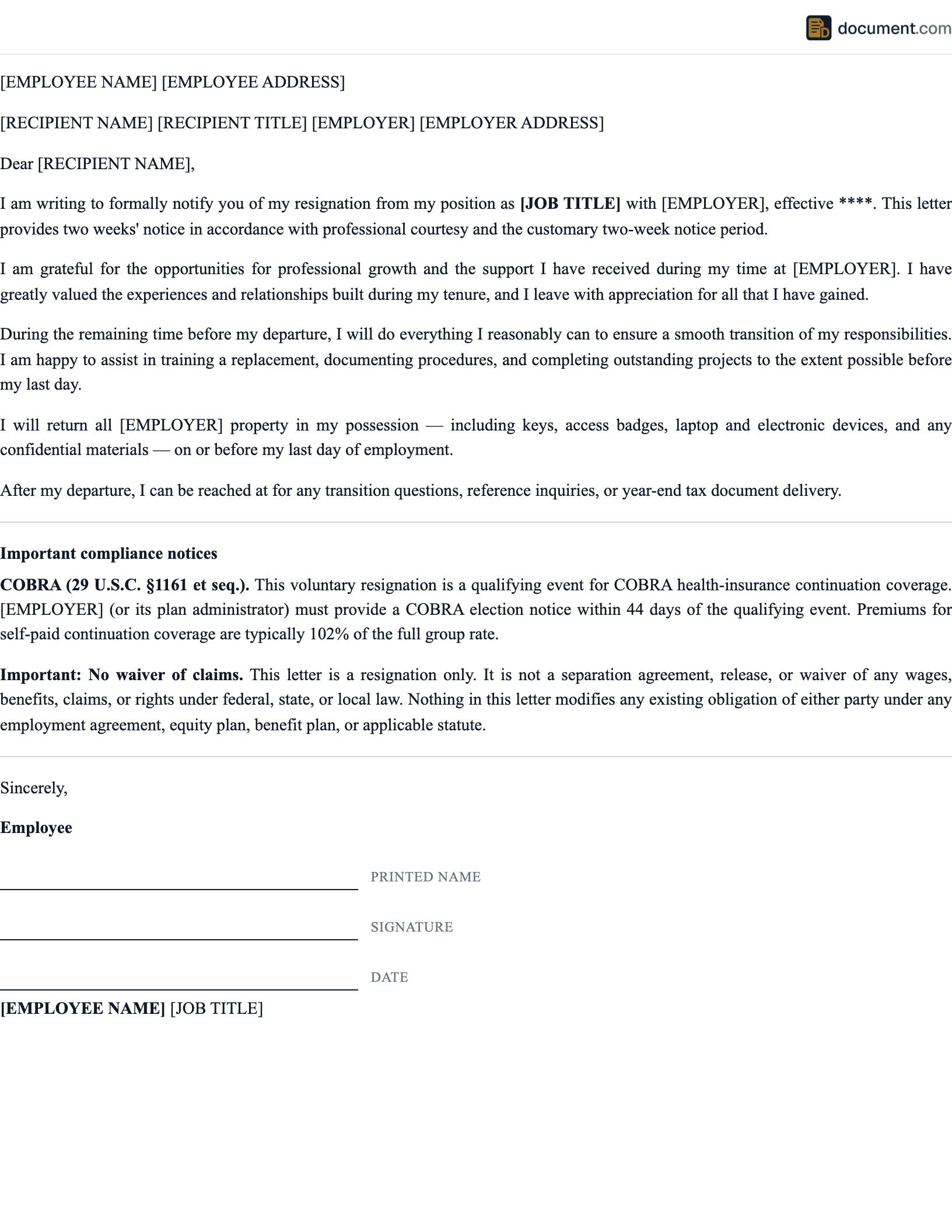
One Week Notice Letter Preview
One Week Notice Resignation Letter
Seven-Day Notice Period
DATE AND RECIPIENT
Date:
To: ("Manager/HR Department")
RESIGNATION WITH ONE WEEK NOTICE
I am writing to inform you of my resignation from my position as . My last day of employment will be , one week from today.
TRANSITION PLAN
During my remaining week, I will prioritize and prepare transition documentation for .
EMPLOYEE SIGNATURE
DATE
Key Components
Eight components compressed into a one-week window. Each component preserves a downstream right or pre-empts a downstream dispute. The compressed timeline does not reduce the legal work required; it concentrates it.
PTO payout exposure varies sharply by state
Accrued PTO is wages in California (Cal. Lab. Code § 227.3, Suastez v. Plastic Dress-Up, 31 Cal.3d 774), Colorado (C.R.S. § 8-4-101), Illinois (820 ILCS 115/5), Massachusetts (G.L. c. 149 § 148), Nebraska (Rev. Stat. § 48-1230), and North Dakota (N.D.C.C. § 34-14-09); forfeiture clauses are unenforceable. Florida, Alabama, North Carolina, South Carolina, and roughly twenty other states defer to written employer policy permitting forfeiture for insufficient notice. Where state law requires payout, demand it expressly in the resignation letter and cite the statute by section number.
Day-by-day transition allocation
Five business days requires explicit per-day allocation: Day 1 written transition memo; Days 2 to 3 live knowledge- transfer sessions with successor; Day 4 property return, IT access surrender, expense closeout; Day 5 farewell communications with supervisor approval and signed acknowledgment of last day worked. The allocation in the letter is the contemporaneous record of good-faith transition that supports later positive references and rehire eligibility.
| Component | Purpose | Key Details |
|---|---|---|
| Clear Last Day | Removes ambiguity about timeline | Specific date exactly one week out, not "approximately one week" |
| Acknowledgment of Short Notice | Shows awareness of professional norms | Brief expression of regret that circumstances prevent a longer notice period |
| Transition Priority List | Demonstrates commitment to smooth handoff | Top 3-5 priorities for the remaining week, ordered by business impact |
| Knowledge Transfer Offer | Minimizes operational disruption | Offer to brief replacement or team members, document processes, share files |
| Post-Departure Availability | Extends goodwill beyond the notice period | Willingness to answer questions by email for a defined period after leaving |
| Final Pay and Benefits | Ensures financial matters are addressed | Request for final paycheck timing, PTO payout, COBRA information |
| Gratitude Statement | Preserves the relationship | Genuine appreciation for specific experiences, mentorship, or growth opportunities |
| Contact Information | Enables post-departure communication | Personal email and phone for transition questions and tax document delivery |
How to Write a One Week Notice Resignation Letter
Six steps. Contract review precedes drafting because the notice period is the binding variable: a 60-day contract notice clause exposes one-week departure to liquidated damages under Cal. Civ. Code § 1671 and parallel state statutes regardless of how the letter is drafted.
Pull the Employment Contract and Handbook
Identify the contractual notice period (commonly 30 to 90 days for executives, two weeks for general employees), liquidated-damages clauses under Cal. Civ. Code § 1671 or parallel state statutes, PTO-payout conditions tied to notice (enforceable in policy-deferring states; preempted in California, Colorado, Illinois, Massachusetts, Nebraska, North Dakota), bonus accrual cliffs, equity-vesting cutoffs in the post-termination exercise window of any equity plan, and licensing-rule notice requirements for regulated professions.
State the Resignation and Specific Last Day
Operative language with specific date: 'I hereby resign from my position as [title] effective [date], one week from today.' Specificity matters because the last day is the trigger for state final-pay statutes (Cal. Lab. Code § 202: 72 hours; Colo. R.S. § 8-4-109: next business day) and starts the COBRA notification clock under 29 U.S.C. § 1166. Avoid 'approximately one week' or 'around [date].' Include a one-sentence acknowledgment of the abbreviated notice without elaborating reasons.
Present a Day-By-Day Transition Plan
Allocate five business days explicitly. Day 1: written transition memo with active project status, contact list, file locations, credential transfer plan. Days 2 to 3: live knowledge-transfer sessions with successor or designated colleague. Day 4: company property return with signed receipt, IT access surrender, expense closeout. Day 5: farewell communications with supervisor approval, final check-in, signed acknowledgment of last day worked. Realistic commitments that you can actually deliver.
Define Post-Departure Availability
Limited offer: email and phone availability for one to two weeks post-departure for transition questions only. Specify the duration and the scope. Open-ended offers create ambiguity about ongoing obligations; defined offers preserve goodwill without exposing you to indefinite uncompensated work. Provide personal email and phone contact rather than continued access to company systems.
Demand Final Pay, PTO Payout, and COBRA Notice
Cite the state final-pay statute by section number (Cal. Lab. Code § 202; Colo. R.S. § 8-4-109; Mass. G.L. c. 149 § 148). Demand PTO payout where state law treats PTO as wages (California, Colorado, Illinois, Massachusetts, Nebraska, North Dakota) or where written employer policy provides for payout. Request COBRA election notice within the 14-day window under 29 U.S.C. § 1166. Confirm forwarding address for W-2 delivery before January 31 deadline under IRC § 6051.
Close with Specific Gratitude
Two or three sentences referencing specific career experiences: a defined project, a mentorship, a skill developed. Generic gratitude reads as performative; specific gratitude reads as authentic and is the content the supervisor is most likely to repeat in references protected by Lewis v. Equitable's qualified privilege. Avoid sentimentality; declarative authenticity is stronger.
Frequently Asked Questions
Official Resources
Authoritative resources on employment rights, notice periods, and workplace transitions.
DOL - Final Paycheck Requirements
Federal guidance on final wage payment timing after voluntary resignation.
DOL - COBRA Health Coverage
Guide to continuing health insurance after leaving employment.
EEOC - Retaliation Protections
Federal protections against employer retaliation during the resignation process.
DOL - State Wage Payment Laws
State-by-state guide to final paycheck requirements and PTO payout rules.
SHRM - HR Resources
Society for Human Resource Management guidance on resignation best practices.
BLS - Job Openings and Labor Turnover
Bureau of Labor Statistics data on quits, separations, and labor market conditions.
Create Your One Week Notice Letter
Generate a professional one week notice resignation letter with a structured transition plan.
Create DocumentNo account required. Free to create and preview.