
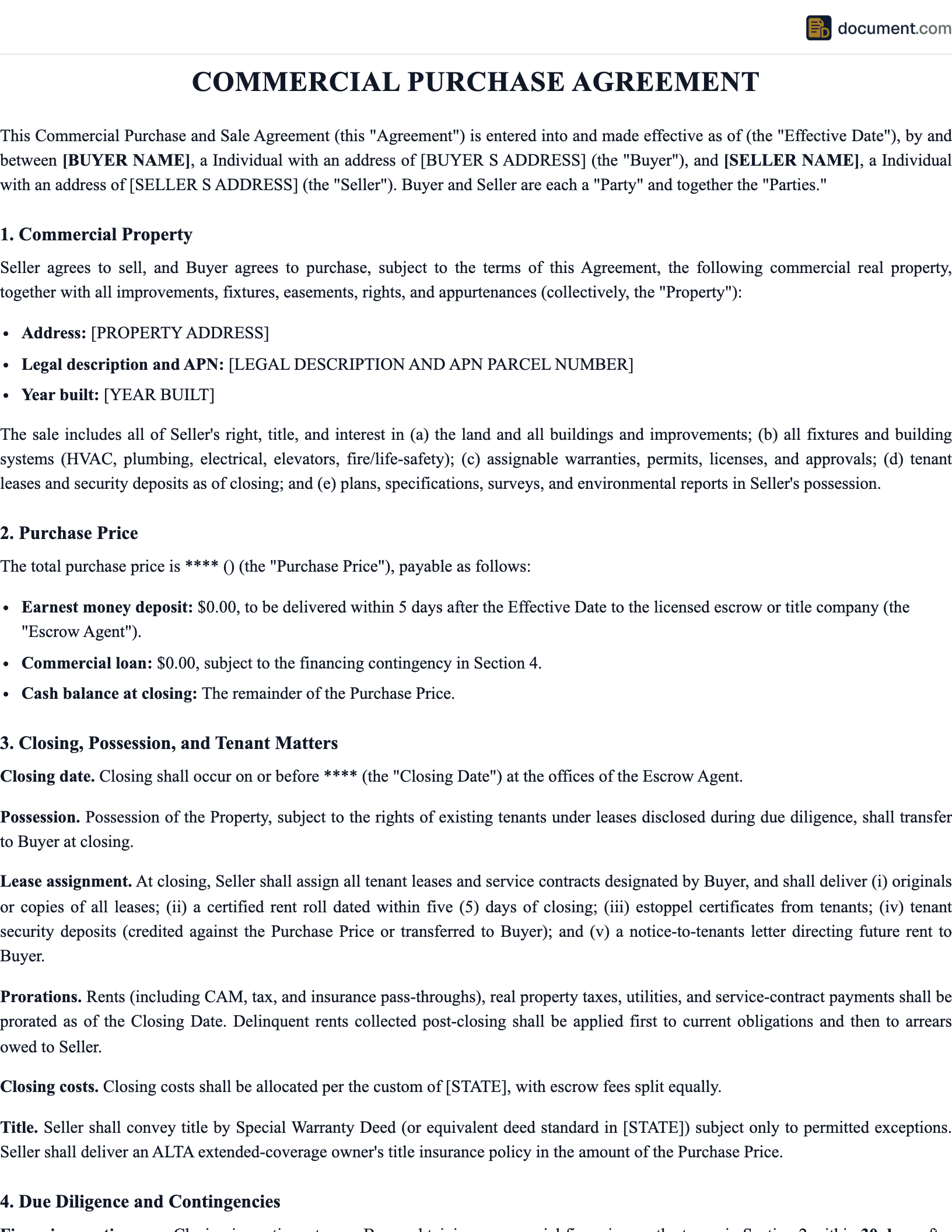



Rhode Island Commercial Purchase Agreement Overview
A commercial purchase agreement in Rhode Island is a legally binding contract that governs the acquisition of commercial real property — including office buildings, retail centers, industrial warehouses, multifamily apartment complexes, hotels, and mixed-use developments. Rhode Island commercial transactions are subject to Rhode Island General Laws Title 5, Chapter 20.5 as well as federal environmental laws including CERCLA and state-specific environmental regulations overseen by the RI DEM oversight.
Commercial real estate transactions in Rhode Island are more complex than residential deals, involving extended due diligence periods (typically 30-90 days), environmental site assessments, zoning compliance verification, tenant lease analysis, and sophisticated financing structures. As an attorney state, Rhode Island requires or customarily involves attorney oversight in the closing process, adding an important layer of legal protection for both parties.
Whether you are acquiring your first commercial property, expanding a real estate portfolio, or conducting a 1031 exchange in Rhode Island, a comprehensive purchase agreement protects your investment by clearly defining all terms, contingencies, representations, and warranties. Our Rhode Island-specific template addresses the unique requirements of commercial transactions in this state.
Rhode Island Commercial Real Estate Quick Facts
$2.30 per $500
Commercial transfer tax
RI
Environmental authority
Municipal
Zoning authority
Follows federal rules
1031 exchange
Rhode Island Commercial Real Estate Laws
Commercial real estate transactions in Rhode Island are governed by a combination of state statutes, federal environmental laws, and local zoning ordinances. The primary statutory framework is found in Rhode Island General Laws Title 5, Chapter 20.5. Key legal considerations for commercial property acquisitions include:
- Environmental Liability: Under federal CERCLA and Rhode Island state environmental laws, property owners can be held strictly liable for environmental contamination regardless of fault. A Phase I Environmental Site Assessment is essential to establish the innocent landowner defense.
- Zoning & Land Use: Rhode Island zoning authority is primarily held by Municipal governments. Verify that your intended use is permitted under the current zoning classification before finalizing the purchase.
- Transfer Taxes: Rhode Island imposes a commercial real estate transfer tax of $2.30 per $500. This can represent a significant closing cost on large transactions and should be accounted for in your financial analysis.
- Tenant Rights: Rhode Island landlord-tenant law governs existing leases that transfer with the property. Review all tenant leases carefully and obtain estoppel certificates to verify lease terms before closing.
- ADA Compliance: Commercial properties in Rhode Island must comply with the Americans with Disabilities Act (ADA). Non-compliant properties may face lawsuits and required modifications that can be costly.
Environmental Requirements in Rhode Island
Environmental due diligence is a critical component of any commercial real estate transaction in Rhode Island. The RI DEM oversight works in conjunction with the federal EPA to regulate environmental contamination and remediation. A Phase I Environmental Site Assessment (ESA) conducted in accordance with ASTM E1527-21 standards is the industry standard for evaluating environmental risk.
Rhode Island Environmental Liability
Under both federal CERCLA and Rhode Island state environmental laws, the current property owner can be held strictly, jointly, and severally liable for environmental contamination — even if the contamination occurred decades before your ownership. Cleanup costs can range from $100,000 to tens of millions of dollars. A properly conducted Phase I ESA provides the "innocent landowner" defense and is essentially mandatory for any commercial acquisition.
Phase I ESA
Historical records review, regulatory database search, site reconnaissance, and interviews — no physical sampling. Identifies Recognized Environmental Conditions (RECs). Cost: $2,000-$6,000. Timeline: 3-6 weeks.
Phase II ESA
Physical sampling and testing of soil, groundwater, and building materials to confirm or deny the presence of contamination identified in Phase I. Cost: $10,000-$50,000+. Timeline: 4-8 weeks.
Zoning & Land Use in Rhode Island
In Rhode Island, zoning authority is primarily held by Municipal governments. Before purchasing commercial property, it is essential to verify that your intended use is permitted under the current zoning classification. Key zoning considerations include:
- Permitted Uses: Verify your intended use is allowed as of right under the current zoning designation
- Conditional Use Permits: Some uses require special approval through a public hearing process
- Nonconforming Uses: Pre-existing uses that no longer comply with current zoning may have restrictions on expansion or resumption after abandonment
- Development Standards: Setbacks, height limits, floor area ratio (FAR), parking requirements, and sign regulations
- Overlay Districts: Historic preservation, floodplain, environmental, or other overlay zones may impose additional restrictions
Commercial Financing in Rhode Island
Commercial property buyers in Rhode Island have access to a variety of financing options. Unlike residential mortgages, commercial loans are primarily underwritten based on the property's income potential (NOI), debt service coverage ratio (DSCR), and the borrower's overall financial strength. Your purchase agreement should include a financing contingency with sufficient time to secure commercial financing, which typically takes 45-90 days.
| Loan Type | Typical LTV | Best For |
|---|---|---|
| Conventional Bank Loan | 65-75% | Stabilized properties with strong borrowers |
| SBA 504 Loan | Up to 90% | Owner-occupied commercial properties |
| CMBS (Conduit) Loan | 65-75% | Larger stabilized properties ($2M+) |
| Bridge Loan | 65-80% | Value-add or transitional properties |
Rhode Island Commercial Closing Process
Commercial real estate closings in Rhode Island typically take 60-120 days from contract execution — significantly longer than residential transactions. The extended timeline accommodates the more comprehensive due diligence, environmental assessment, financing, and legal review required for commercial properties.
Contract Execution & Earnest Money
Sign the purchase agreement and deposit earnest money (typically 1-5% of purchase price) into escrow
Due Diligence Period (30-90 days)
Physical inspection, Phase I ESA, financial analysis, lease review, zoning verification, title examination
Financing & Tenant Estoppels
Secure loan commitment, obtain tenant estoppel certificates, complete survey and appraisal
Pre-Closing & Document Preparation
Resolve title objections, finalize prorations and adjustments, prepare closing documents
Closing Day
Sign closing documents, transfer funds, record deed, deliver keys and property management files
Rhode Island Commercial Purchase Agreement FAQ
Answers to common questions about commercial purchase agreements, due diligence, environmental assessments, and commercial real estate transactions in Rhode Island.
Official Rhode Island Resources
Use these official resources for Rhode Island commercial real estate regulations, environmental requirements, and zoning information.
Rhode Island Department of Business Regulation
Licensing, regulations, and commercial resources
EPA — Brownfields Program
Environmental assessment grants and cleanup resources
SBA 504 Loan Program
Federal financing for owner-occupied commercial property
IRS — 1031 Exchange Guidance
Like-kind exchange rules for commercial property
Create your Rhode Island Commercial Purchase Agreement in under 5 minutes.
Answer a few questions and download a Rhode Island-compliant document, ready for the state agency.