



What Is a Revocation of Power of Attorney?
A revocation of power of attorney is the written instrument a competent principal uses to terminate a previously executed POA. Until execution and proper delivery, the agent retains every authority the original document conferred, regardless of whether the principal still trusts the agent or has named a successor. The Uniform Power of Attorney Act, adopted in some form by 30 jurisdictions including New Mexico, Idaho, Maine, Wisconsin, and Pennsylvania, codifies the rule in § 110, which lists revocation among the events that automatically end agent authority alongside the principal's death, the principal's incapacity (for non-durable POAs), and the agent's death or resignation.
The legal foundation is older than UPOAA. The right of a competent principal to revoke an agency at will runs back to common-law agency principles articulated in Restatement (Second) of Agency § 118 and Restatement (Third) of Agency § 3.10. UPOAA codified the rule in modern form and added two protective layers absent from common law: § 119 protects third parties who act in good faith without notice of the revocation, and § 116 imposes ongoing fiduciary duties on the former agent for any pre-revocation acts that have not yet been accounted for.
People revoke POAs for predictable reasons. Divorce is the most common; UPOAA § 110(b) and the parallel state statutes (Florida Stat. § 709.2109(2), California Probate Code § 4154(c)) automatically revoke any agent designation in favor of a former spouse upon entry of the dissolution decree, but only for that single agent. A separate written revocation is still advisable to clean up the record. The death of an agent is the second most common; the third is a falling-out, the fourth is the discovery of self-dealing, and the fifth is simply that the underlying transaction has finished. Whatever the reason, the mechanics are identical: write it down, sign it formally, and deliver it to everyone who relied on the original.
Written revocation requirements
UPOAA § 110(c) requires the revocation to be in writing or in a record. Twenty states require execution formalities at least as formal as the original POA, which in practice means notarization. Two-witness execution is required in Florida (Fla. Stat. § 709.2105), Connecticut (Conn. Gen. Stat. § 1-352), Pennsylvania (20 Pa. C.S. § 5601), and a handful of other states. California Probate Code § 4154 permits revocation by any writing that gives sufficient notice and is signed by the principal. New York General Obligations Law § 5-1511 requires the revocation to be acknowledged before a notary public. Always match the original POA's execution method, not a less-formal alternative; mismatched formalities are a frequent ground for agent challenge.
Recording obligations for real-estate POAs and third-party notice under UPOAA § 110
A POA recorded in county land records (typical for any POA used to convey, encumber, or manage real property) requires a recorded revocation in the same office to clear the chain of title. State recording acts are the controlling authority: California Civil Code § 1217 requires the revocation to be recorded in every county where the original was recorded; Florida Stat. § 695.18 imposes the same; Texas Property Code § 12.014 imposes the same. Recording fees run $20 to $100 per page. Until the revocation is recorded, a title insurer evaluating a transaction by the former agent has no constructive notice and may underwrite the transaction as valid, leaving the principal to litigate against the title company and the agent for the wrongful conveyance. The third-party notice obligations of UPOAA § 110 dovetail with the recording acts: notice to actually-known reliance parties is required in addition to recording, not as a substitute.
A clean revocation protects the principal in two directions. It cuts off the agent's ability to bind the principal going forward, and it puts third parties on notice so they can refuse to honor the now-void document. Without delivery, neither protection exists, which is why this page emphasizes distribution as much as drafting. The wrongful-acts claim period under UPOAA § 116 runs three to six years from discovery in most states, but recovery against an absent or insolvent agent is rarely meaningful; prevention through prompt, comprehensive notice is the better strategy.
Methods of Revocation
| Method | When to Use | Effective When |
|---|---|---|
| Written Revocation | Standard cancellation | On notice to agent and third parties |
| Replacement POA | When a new POA is being executed | When new POA is delivered |
| Destruction of Original | Informal but risky | Only if no copies exist |
| Recorded Revocation | Original POA was recorded | On recording in county office |
| Court Order | Principal lacks capacity | On entry of order |
How to Revoke a Power of Attorney
The six-step sequence below mirrors the formalities required by UPOAA and the state-recording acts. Skipping the recording step for a real-estate POA is the single most common procedural error and the one most likely to authorize an unwanted post-revocation transaction.
Locate the Original POA
Find the original power of attorney and note its date and any recording information.
Draft the Revocation
Write a clear revocation referencing the original document and the agent's name.
Sign Before a Notary
Execute the revocation with the same formalities as the original POA.
Notify the Agent
Deliver a signed copy by certified mail with return receipt.
Notify Third Parties
Send copies to banks, title companies, healthcare providers, and any institution holding the original.
Record if Needed
If the original POA was recorded with the county, record the revocation in the same office.
Required Components
Principal Identification
Full legal name and address of the person revoking the POA.
Original POA Reference
Date of execution and recording information of the POA being revoked.
Agent Identification
Name of the agent whose authority is being terminated.
Revocation Statement
Clear declaration that the POA is revoked effective immediately.
Signature & Notarization
Principal's signature, date, and notary acknowledgment.
Distribution List
Record of who received notice including the agent, banks, county recorder.
Form Preview
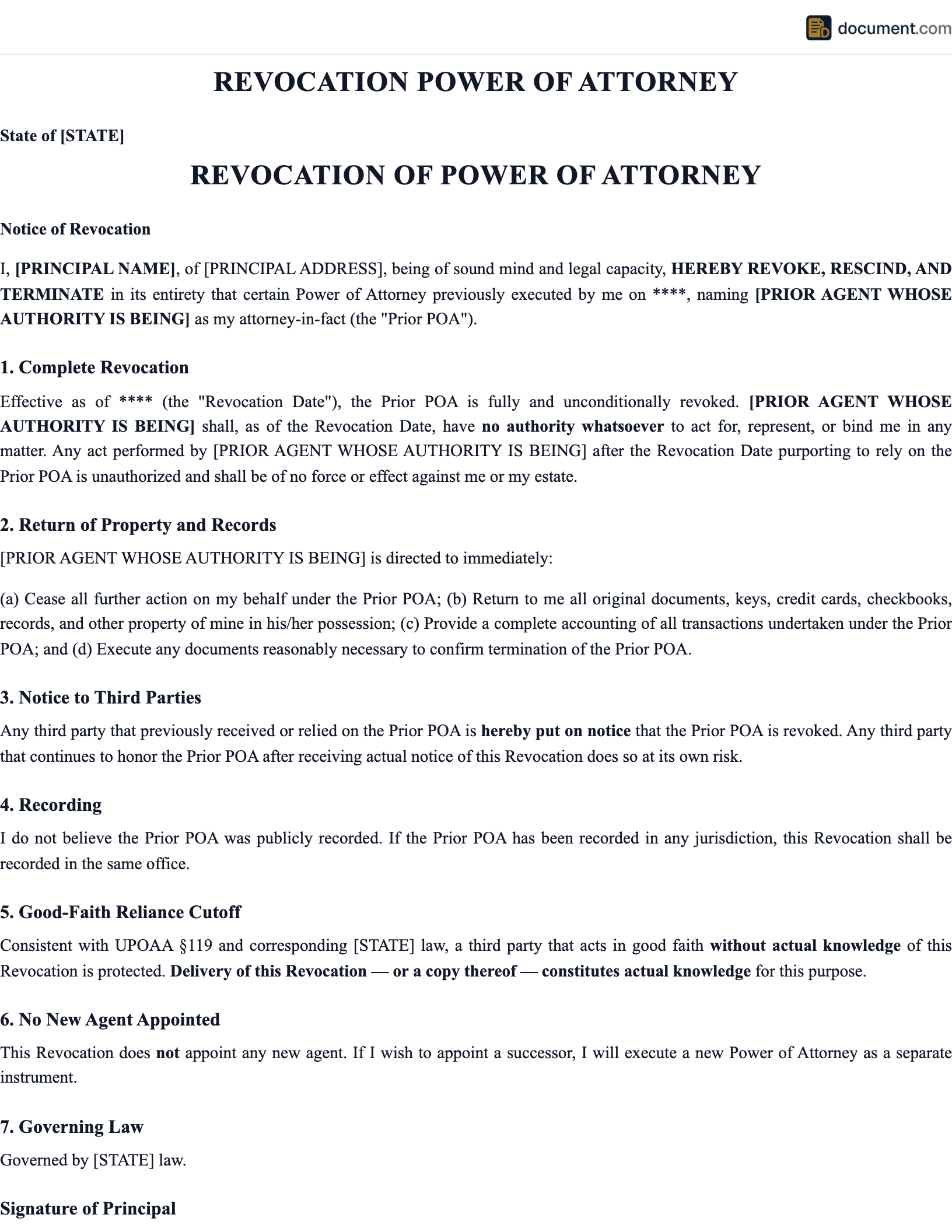
REVOCATION OF POWER OF ATTORNEY
I, [Principal Name], of [Address], being of sound mind, hereby revoke in full that certain Power of Attorney executed by me on [Date], appointing [Agent Name] as my attorney-in-fact.
All authority granted under that document is terminated effective immediately. I direct that no person rely upon the revoked instrument for any purpose.
Dated: [Date]
_____________________________ (Principal Signature)
State of [State] County of [County]
Subscribed and sworn before me this [Day] day of [Month], 20__.
Frequently Asked Questions
Common questions about revoking a POA, the notice requirements, and the duties of the former agent.
Official Resources
Authoritative sources for POA revocation, agency termination, and elder financial protection.
Revoke a Power of Attorney in under 10 minutes.
Answer a few questions and download a notarization-ready revocation with the distribution list built in.