



Understanding Oklahoma's UPOAA Framework for Powers of Attorney
Oklahoma's adoption of the Uniform Power of Attorney Act under Title 58, §§1071-1077 of the Oklahoma Statutes gave the state a modern, well-organized framework for delegating legal authority. But anyone who has practiced law in Oklahoma City, Tulsa, or the smaller county seats across the state knows that a generic UPOAA template rarely captures everything an Oklahoma principal actually needs. The state's economy runs on oil and gas production, ranching, and wheat farming — and the legal instruments that govern those activities need to reflect that reality.
Under Oklahoma law, a power of attorney must be signed by the principal and acknowledged before a notary public. No witnesses are required beyond the notary, which makes execution relatively straightforward compared to states like Pennsylvania or South Carolina. However, the simplicity of execution belies the complexity of what many Oklahoma POAs need to accomplish: managing mineral leases across half a dozen counties, participating in pooling orders before the Oklahoma Corporation Commission, or authorizing healthcare decisions for an elderly rancher in a county without a hospital.
Oklahoma also sits at a jurisdictional crossroads unlike any other state. With 39 federally recognized tribal nations and more tribal land than any state outside of Alaska, questions about whether a state-law POA will be honored for transactions touching tribal trust land or allotted property come up constantly. The answer depends on the specific tribe, the type of land, and whether federal agencies like the Bureau of Indian Affairs are involved. These layers of jurisdiction make Oklahoma one of the most legally interesting — and demanding — states for POA planning.
Required
Notarization
Not Required
Witnesses
Adopted
UPOAA
77 Counties
County Clerks
Mineral Rights & Tribal Jurisdiction in Oklahoma POA Planning
Oklahoma ranks among the top five oil-producing states and the top three natural gas-producing states in the country. For thousands of Oklahoma families, mineral rights represent a significant — sometimes the most significant — portion of their wealth. When a mineral owner becomes incapacitated, or simply needs someone to handle the day-to-day decisions while they travel or manage other obligations, a properly drafted POA is essential. But generic language will not cut it.
An Oklahoma mineral rights POA should specifically enumerate authority to execute oil and gas leases, approve pooling and unitization orders filed before the Oklahoma Corporation Commission (OCC), sign division orders with operators, negotiate bonus payments, and collect delay rentals and shut-in royalties. Without this granular language, operators and title companies operating under Oklahoma Title Examination Standards will reject the agent's authority. The OCC, which regulates all drilling and production in the state, maintains its own filing requirements that the agent must be authorized to fulfill.
The tribal jurisdiction dimension adds another layer entirely. Oklahoma is unique in that the McGirt v. Oklahoma (2020) and subsequent Supreme Court rulings clarified that much of eastern Oklahoma remains Indian Country for purposes of federal law. While these decisions primarily addressed criminal jurisdiction, they have rippled through civil matters. If your mineral interests sit on land within the boundaries of the Cherokee, Chickasaw, Choctaw, Muscogee (Creek), or Seminole nations, you may need supplementary authorizations recognized by the tribe or the BIA, particularly for trust or restricted land. An Oklahoma attorney familiar with both state energy law and federal Indian law should review any POA that touches these areas.
For agricultural operations — and Oklahoma's farm and ranch economy is massive, covering wheat, cattle, cotton, and pecans — the POA should address USDA program participation, Farm Service Agency filings, Conservation Reserve Program contracts, crop insurance claims, and livestock sale authority. Many Oklahoma ranchers operate across county lines, making it important that the POA be recorded with the county clerk in every county where land is situated.
Nine Types of Oklahoma Power of Attorney
Oklahoma law under the UPOAA supports a range of POA forms. Each type below links to a dedicated Oklahoma-specific page with detailed guidance, execution instructions, and downloadable templates.
General POA
Wide-ranging authority over financial, legal, and business matters — frequently used by Oklahoma landowners with oil and gas interests across multiple counties
Durable POA
Survives the principal's incapacity under 58 O.S. §1073 — essential for long-term mineral royalty management and agricultural operations
Limited / Special POA
Restricted to a defined transaction or timeframe — commonly used for signing a single oil lease or handling a specific cattle auction
Medical / Healthcare POA
Designates a healthcare proxy under Oklahoma's Advance Directive Act — critical in rural counties with limited hospital access
Financial POA
Covers banking, investments, tax filings, and royalty payments — tailored for Oklahoma's unique oil and gas revenue streams
Springing POA
Activates only upon a triggering event such as incapacity — allows Oklahoma principals to maintain control until it's truly needed
Minor Child POA
Grants temporary parental authority to a caregiver — used by Oklahoma military families and parents working seasonal agricultural jobs
Real Estate POA
Authority for property transactions including mineral deed transfers — must be recorded with the county clerk where Oklahoma land is situated
Vehicle POA
Handles vehicle title transfers and registrations through the Oklahoma Tax Commission — common for farm truck and equipment transactions
Execution Requirements Under Oklahoma's UPOAA
Creating a legally enforceable power of attorney in Oklahoma is procedurally simple but substantively demanding. Here is what the statute requires and what local practice adds.
Principal Must Be a Competent Adult
The principal must be at least 18 years old and possess the mental capacity to understand what authority they are delegating. Oklahoma courts apply the same competency standard used in contract law — the principal must comprehend the nature and consequences of the instrument at the time of signing.
Notarization Is Mandatory
Every Oklahoma POA must be acknowledged before a notary public. The notary verifies the principal's identity and confirms that the signing is voluntary. Mobile notary services are widely available across Oklahoma, including in rural areas where traveling to a county seat might be impractical.
Witnesses Are Not Statutorily Required
Oklahoma does not require witnesses for a standard POA. That said, many Oklahoma estate planning attorneys recommend adding one or two disinterested witnesses as a practical safeguard, particularly for durable POAs that may need to survive a competency challenge.
Durability Language per §1073
To make the POA durable, include a statement that the powers granted are not terminated by the principal's subsequent disability or incapacity. Under 58 O.S. §1073, a POA is durable if it contains the words "this power of attorney is not affected by subsequent disability or incapacity of the principal" or substantially similar language.
Recording with the County Clerk
If the POA grants any authority over real property or mineral interests, it must be recorded with the county clerk in the county where the property is located. Oklahoma has 77 counties, and each county clerk maintains its own land records. Multi-county mineral owners should plan to record in every relevant county.
Agent Fiduciary Obligations
Under the UPOAA, the agent owes the principal a fiduciary duty — meaning they must act loyally, avoid conflicts of interest, keep records, and not commingle funds. Oklahoma courts take these duties seriously, and breach can result in personal liability, removal, and disgorgement of profits.
How to Set Up an Oklahoma Power of Attorney
From choosing the right POA type to getting it recorded at the county clerk's office, here is the process for Oklahoma residents.
Identify Your Needs and Pick the Right Type
Start by thinking about what you actually need the agent to do. Oklahoma landowners with mineral interests will usually need a durable or general POA with explicit oil and gas authority. Someone facing surgery might only need a limited healthcare POA. Parents deploying from Tinker Air Force Base may need a minor child POA. Our templates let you pick from nine types and customize the powers granted to match your exact situation.
Execute Before an Oklahoma Notary
Sign the completed POA in front of a notary public. In Oklahoma, notaries are commissioned by the Secretary of State and can be found at banks, UPS stores, law offices, and through mobile notary services that travel to rural properties. Bring a valid photo ID. If you want to add voluntary witnesses for extra protection, have them present at the signing as well.
Record, Distribute, and Activate
Record the POA with every county clerk where you own real property or mineral interests. Then provide certified copies to your agent, successor agents, banks, brokerage firms, and healthcare providers. If you use Oklahoma's OKC or Tulsa county court systems, be aware that each may have slightly different recording fees and requirements. Keep the original in a secure, accessible location.
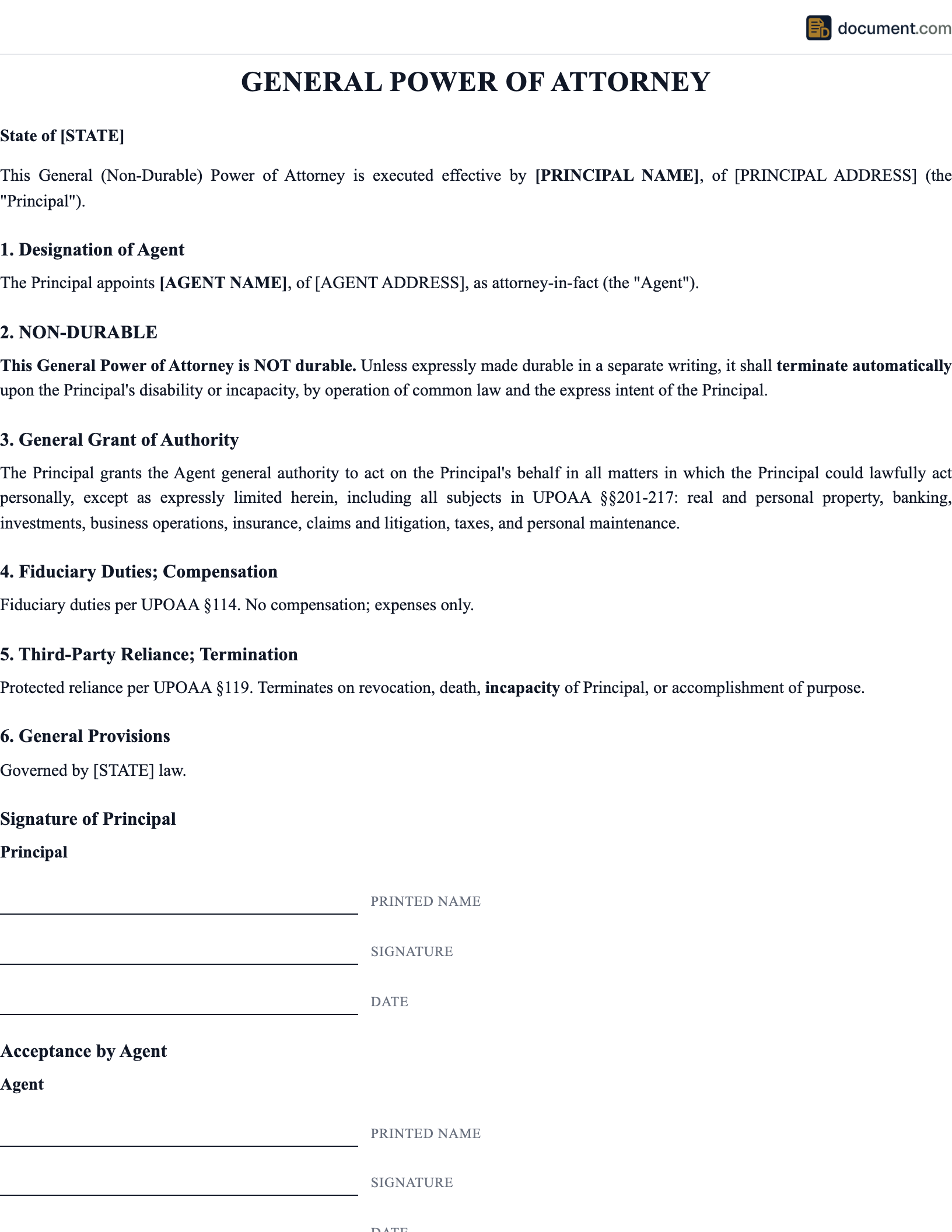
Sample Oklahoma Power of Attorney Document
Below is a preview of our Oklahoma-specific POA template. Your final document will include all provisions required under Oklahoma's UPOAA, with dedicated sections for mineral interests and agricultural operations if applicable.
POWER OF ATTORNEY
STATE OF OKLAHOMA
Pursuant to 58 O.S. §§1071-1077 (Uniform Power of Attorney Act)
PRINCIPAL:
Name: [Full Legal Name]
Address: [Oklahoma Address]
County of Residence: [County]
AGENT (ATTORNEY-IN-FACT):
Name: [Agent's Full Legal Name]
Address: [Agent's Address]
Relationship: [Relationship to Principal]
POWERS GRANTED
Type: [General / Durable / Limited / Other]
Mineral Rights Authority: [Yes / No — If Yes, Specify]
Effective Date: [Date or Triggering Event]
Expiration: [Date or Upon Revocation]
Governing Law: State of Oklahoma, 58 O.S. §§1071-1077
Oklahoma Power of Attorney — Common Questions
Answers to the questions Oklahoma residents ask most often about POA documents, from mineral lease management to tribal jurisdiction and county clerk recording.
Official Oklahoma Legal Resources
Verify Oklahoma's POA statutes, find your county clerk, and access state agency guidance through these official sources.
58 O.S. §1071 — UPOAA Text
Full statutory language of Oklahoma's Uniform Power of Attorney Act
OSCN — Oklahoma Statutes Title 58
Oklahoma State Courts Network — probate and POA provisions
Oklahoma Corporation Commission
Regulates oil, gas, and public utilities — pooling and unitization orders
Oklahoma Attorney General
Consumer protection, elder abuse prevention, and legal resources
Other Oklahoma Legal Documents
Oklahoma estate and business planning often involves several documents working in tandem with a power of attorney.
Oklahoma Living Will
Advance directive under Oklahoma's Advance Directive Act (63 O.S. §3101)
Oklahoma Last Will and Testament
Distribute your estate including mineral interests and agricultural land
Oklahoma Promissory Note
Document a loan with legally binding terms under Oklahoma law
Oklahoma Bill of Sale
Transfer ownership of vehicles, livestock, or equipment
Create your Oklahoma Power of Attorney in under 5 minutes.
Answer a few questions and download a Oklahoma-compliant document, ready for the state agency.